 Add to Chrome
 Add to Firefox
 Add to Edge
Efficient Neural Audio Synthesis
Jun 25, 2018
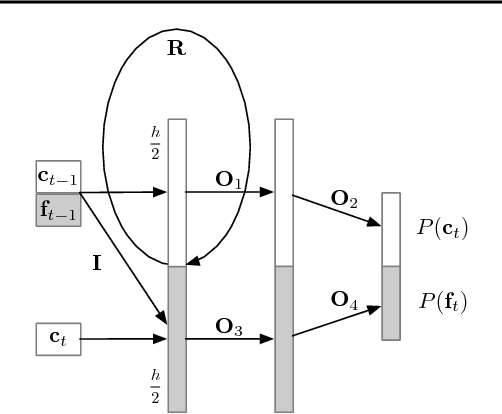

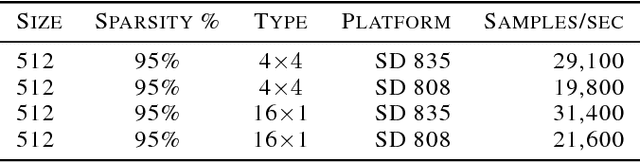
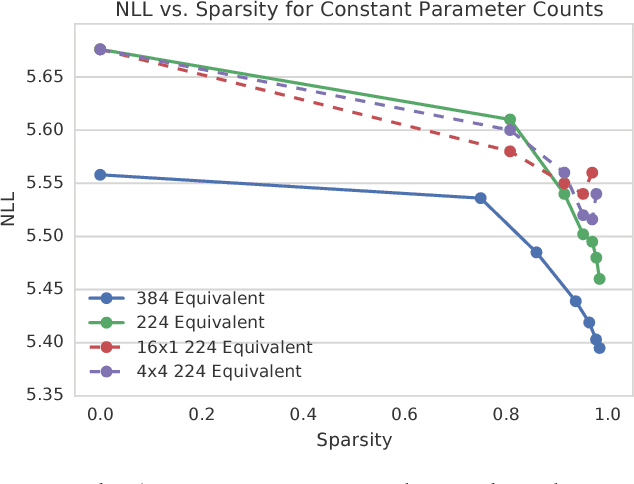
Sequential models achieve state-of-the-art results in audio, visual and textual domains with respect to both estimating the data distribution and generating high-quality samples. Efficient sampling for this class of models has however remained an elusive problem. With a focus on text-to-speech synthesis, we describe a set of general techniques for reducing sampling time while maintaining high output quality. We first describe a single-layer recurrent neural network, the WaveRNN, with a dual softmax layer that matches the quality of the state-of-the-art WaveNet model. The compact form of the network makes it possible to generate 24kHz 16-bit audio 4x faster than real time on a GPU. Second, we apply a weight pruning technique to reduce the number of weights in the WaveRNN. We find that, for a constant number of parameters, large sparse networks perform better than small dense networks and this relationship holds for sparsity levels beyond 96%. The small number of weights in a Sparse WaveRNN makes it possible to sample high-fidelity audio on a mobile CPU in real time. Finally, we propose a new generation scheme based on subscaling that folds a long sequence into a batch of shorter sequences and allows one to generate multiple samples at once. The Subscale WaveRNN produces 16 samples per step without loss of quality and offers an orthogonal method for increasing sampling efficiency.

DARTS: Differentiable Architecture Search
Jun 24, 2018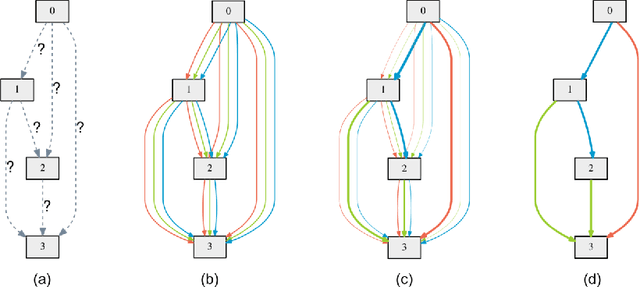
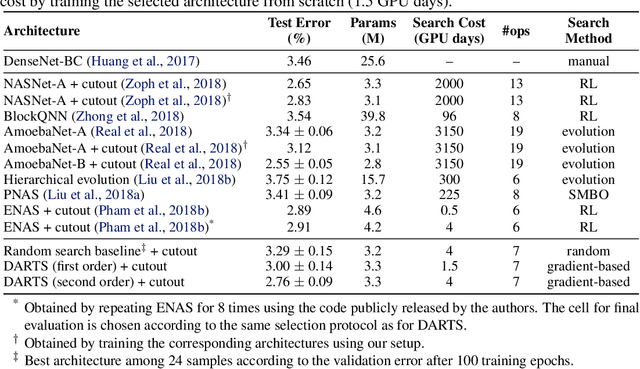
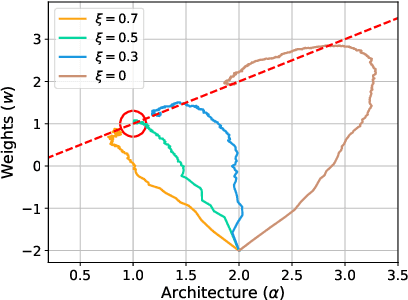
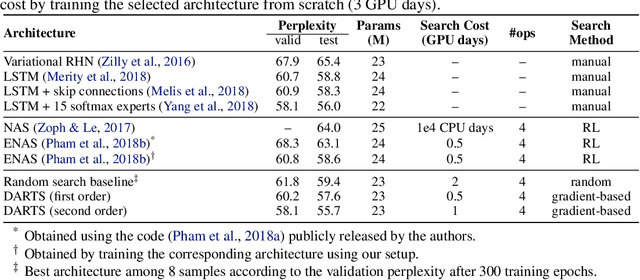
This paper addresses the scalability challenge of architecture search by formulating the task in a differentiable manner. Unlike conventional approaches of applying evolution or reinforcement learning over a discrete and non-differentiable search space, our method is based on the continuous relaxation of the architecture representation, allowing efficient search of the architecture using gradient descent. Extensive experiments on CIFAR-10, ImageNet, Penn Treebank and WikiText-2 show that our algorithm excels in discovering high-performance convolutional architectures for image classification and recurrent architectures for language modeling, while being orders of magnitude faster than state-of-the-art non-differentiable techniques.
Learning to Navigate in Cities Without a Map
Apr 17, 2018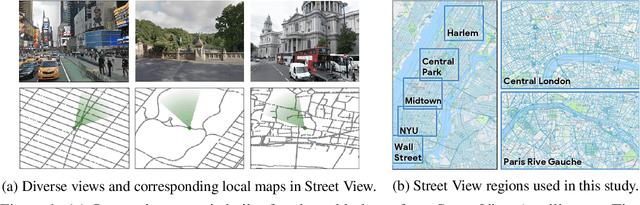
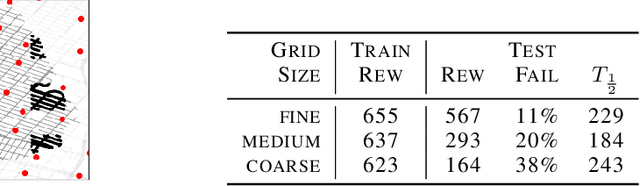
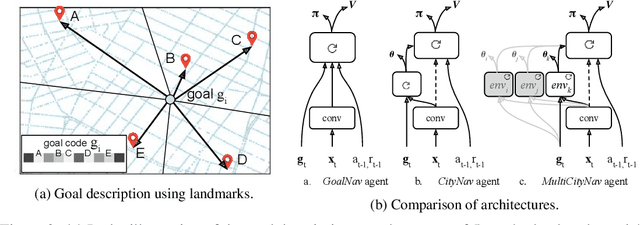
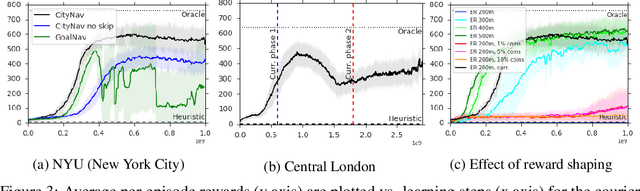
Navigating through unstructured environments is a basic capability of intelligent creatures, and thus is of fundamental interest in the study and development of artificial intelligence. Long-range navigation is a complex cognitive task that relies on developing an internal representation of space, grounded by recognisable landmarks and robust visual processing, that can simultaneously support continuous self-localisation ("I am here") and a representation of the goal ("I am going there"). Building upon recent research that applies deep reinforcement learning to maze navigation problems, we present an end-to-end deep reinforcement learning approach that can be applied on a city scale. Recognising that successful navigation relies on integration of general policies with locale-specific knowledge, we propose a dual pathway architecture that allows locale-specific features to be encapsulated, while still enabling transfer to multiple cities. We present an interactive navigation environment that uses Google StreetView for its photographic content and worldwide coverage, and demonstrate that our learning method allows agents to learn to navigate multiple cities and to traverse to target destinations that may be kilometres away. A video summarizing our research and showing the trained agent in diverse city environments as well as on the transfer task is available at: https://sites.google.com/view/streetlearn.
Kickstarting Deep Reinforcement Learning
Mar 10, 2018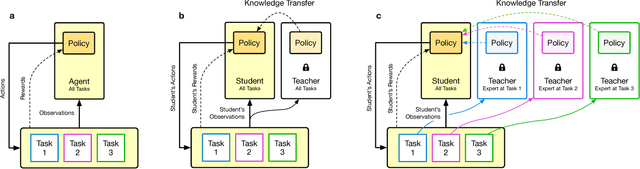
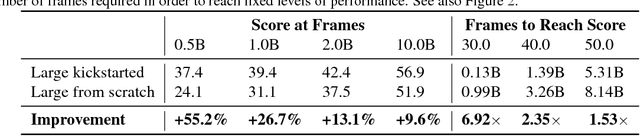
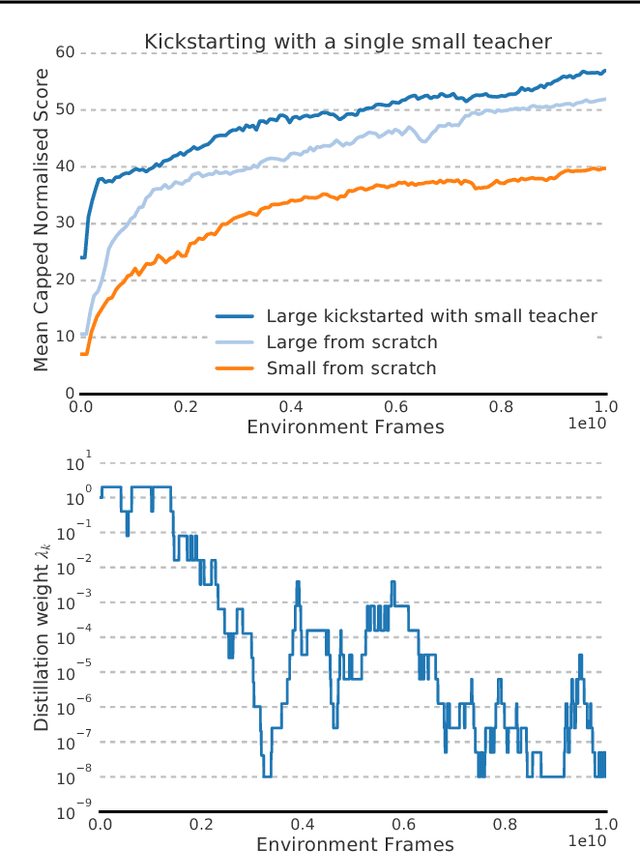
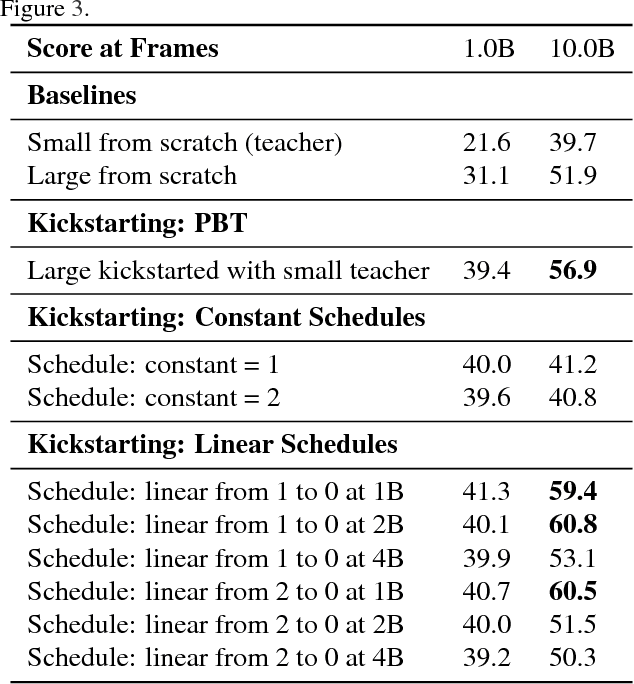
We present a method for using previously-trained 'teacher' agents to kickstart the training of a new 'student' agent. To this end, we leverage ideas from policy distillation and population based training. Our method places no constraints on the architecture of the teacher or student agents, and it regulates itself to allow the students to surpass their teachers in performance. We show that, on a challenging and computationally-intensive multi-task benchmark (DMLab-30), kickstarted training improves the data efficiency of new agents, making it significantly easier to iterate on their design. We also show that the same kickstarting pipeline can allow a single student agent to leverage multiple 'expert' teachers which specialize on individual tasks. In this setting kickstarting yields surprisingly large gains, with the kickstarted agent matching the performance of an agent trained from scratch in almost 10x fewer steps, and surpassing its final performance by 42 percent. Kickstarting is conceptually simple and can easily be incorporated into reinforcement learning experiments.
Hierarchical Representations for Efficient Architecture Search
Feb 22, 2018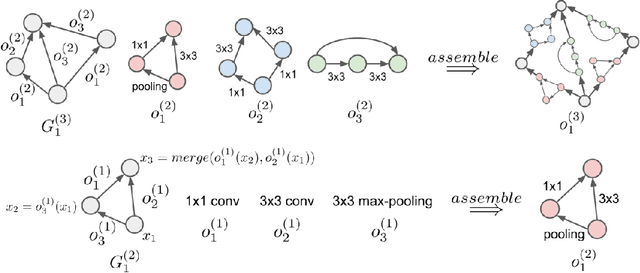
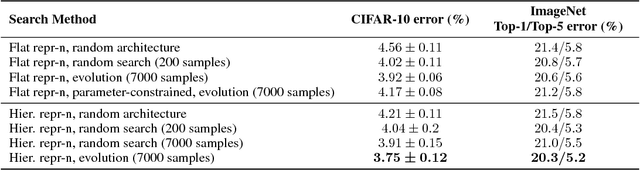
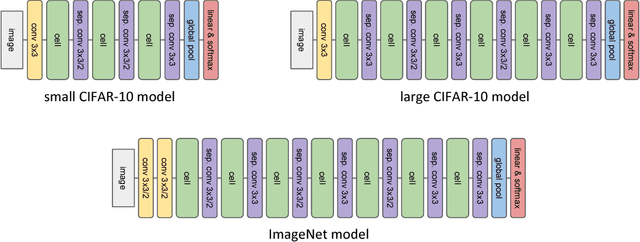
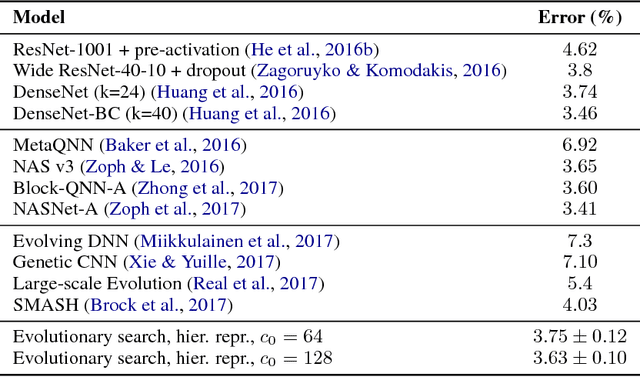
We explore efficient neural architecture search methods and show that a simple yet powerful evolutionary algorithm can discover new architectures with excellent performance. Our approach combines a novel hierarchical genetic representation scheme that imitates the modularized design pattern commonly adopted by human experts, and an expressive search space that supports complex topologies. Our algorithm efficiently discovers architectures that outperform a large number of manually designed models for image classification, obtaining top-1 error of 3.6% on CIFAR-10 and 20.3% when transferred to ImageNet, which is competitive with the best existing neural architecture search approaches. We also present results using random search, achieving 0.3% less top-1 accuracy on CIFAR-10 and 0.1% less on ImageNet whilst reducing the search time from 36 hours down to 1 hour.
Mastering Chess and Shogi by Self-Play with a General Reinforcement Learning Algorithm
Dec 05, 2017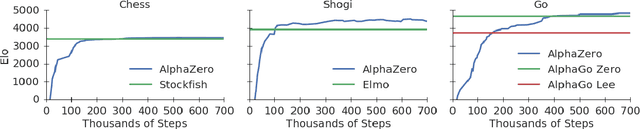
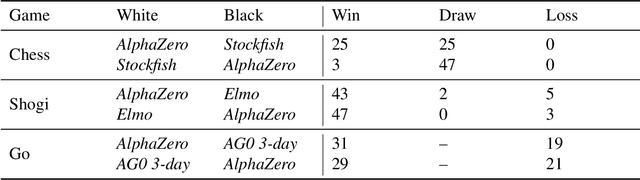
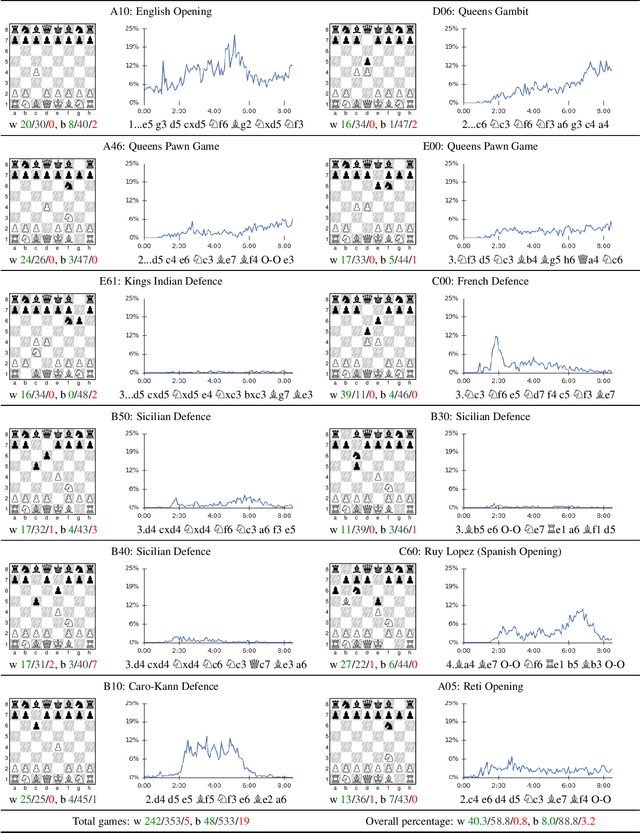
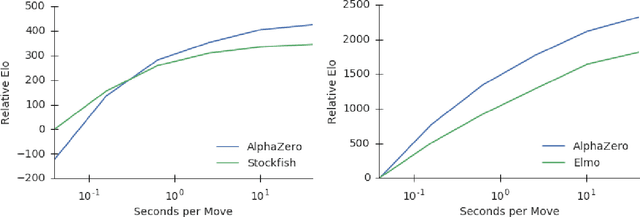
The game of chess is the most widely-studied domain in the history of artificial intelligence. The strongest programs are based on a combination of sophisticated search techniques, domain-specific adaptations, and handcrafted evaluation functions that have been refined by human experts over several decades. In contrast, the AlphaGo Zero program recently achieved superhuman performance in the game of Go, by tabula rasa reinforcement learning from games of self-play. In this paper, we generalise this approach into a single AlphaZero algorithm that can achieve, tabula rasa, superhuman performance in many challenging domains. Starting from random play, and given no domain knowledge except the game rules, AlphaZero achieved within 24 hours a superhuman level of play in the games of chess and shogi (Japanese chess) as well as Go, and convincingly defeated a world-champion program in each case.
Parallel WaveNet: Fast High-Fidelity Speech Synthesis
Nov 28, 2017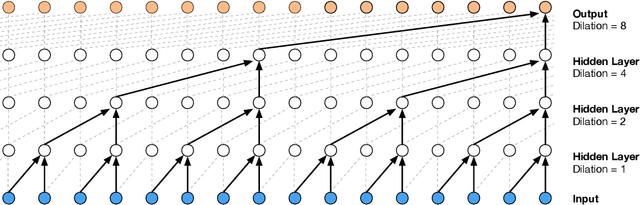
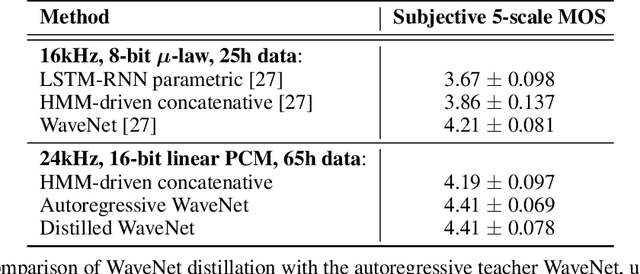
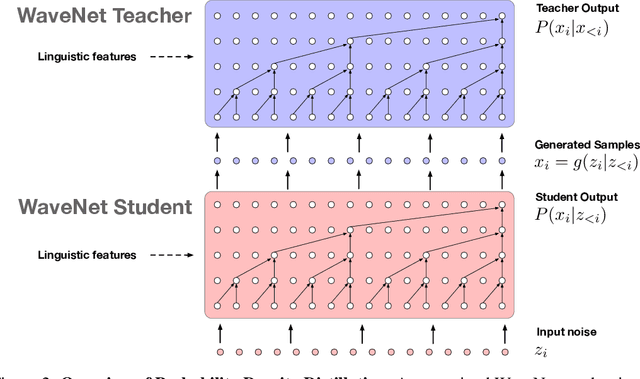
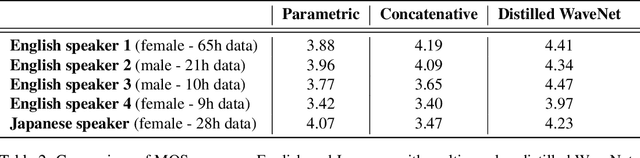
The recently-developed WaveNet architecture is the current state of the art in realistic speech synthesis, consistently rated as more natural sounding for many different languages than any previous system. However, because WaveNet relies on sequential generation of one audio sample at a time, it is poorly suited to today's massively parallel computers, and therefore hard to deploy in a real-time production setting. This paper introduces Probability Density Distillation, a new method for training a parallel feed-forward network from a trained WaveNet with no significant difference in quality. The resulting system is capable of generating high-fidelity speech samples at more than 20 times faster than real-time, and is deployed online by Google Assistant, including serving multiple English and Japanese voices.
Population Based Training of Neural Networks
Nov 28, 2017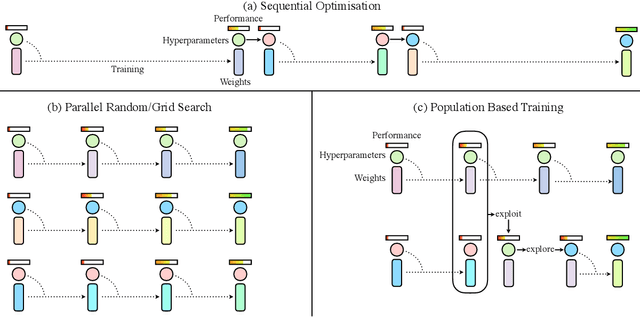

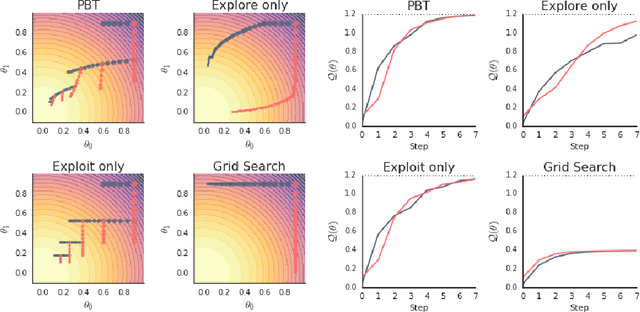
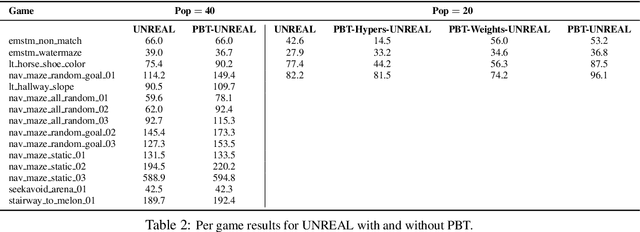
Neural networks dominate the modern machine learning landscape, but their training and success still suffer from sensitivity to empirical choices of hyperparameters such as model architecture, loss function, and optimisation algorithm. In this work we present \emph{Population Based Training (PBT)}, a simple asynchronous optimisation algorithm which effectively utilises a fixed computational budget to jointly optimise a population of models and their hyperparameters to maximise performance. Importantly, PBT discovers a schedule of hyperparameter settings rather than following the generally sub-optimal strategy of trying to find a single fixed set to use for the whole course of training. With just a small modification to a typical distributed hyperparameter training framework, our method allows robust and reliable training of models. We demonstrate the effectiveness of PBT on deep reinforcement learning problems, showing faster wall-clock convergence and higher final performance of agents by optimising over a suite of hyperparameters. In addition, we show the same method can be applied to supervised learning for machine translation, where PBT is used to maximise the BLEU score directly, and also to training of Generative Adversarial Networks to maximise the Inception score of generated images. In all cases PBT results in the automatic discovery of hyperparameter schedules and model selection which results in stable training and better final performance.
StarCraft II: A New Challenge for Reinforcement Learning
Aug 16, 2017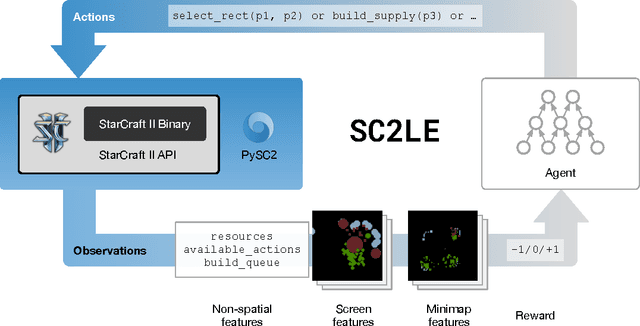
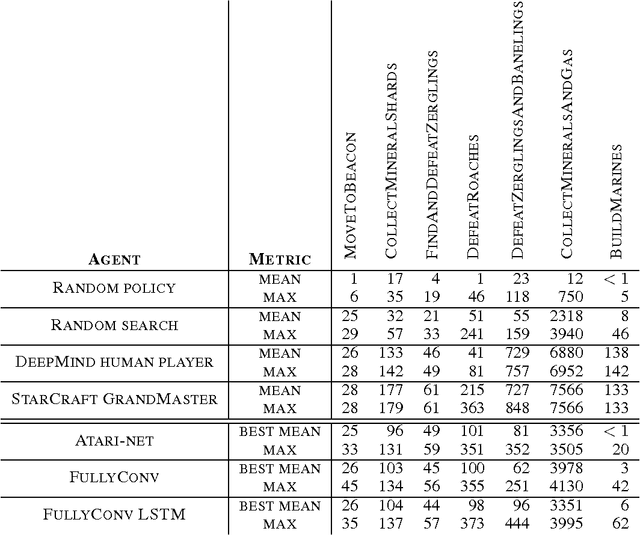
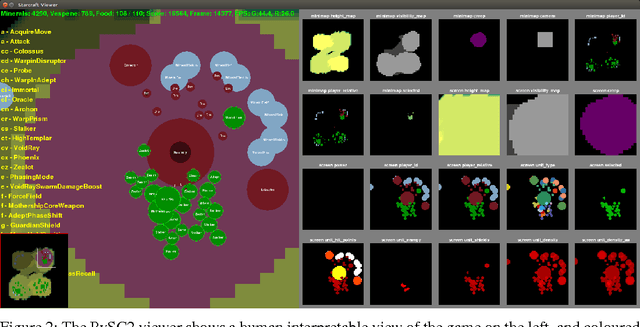
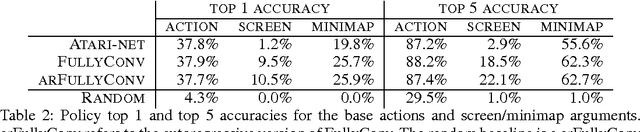
This paper introduces SC2LE (StarCraft II Learning Environment), a reinforcement learning environment based on the StarCraft II game. This domain poses a new grand challenge for reinforcement learning, representing a more difficult class of problems than considered in most prior work. It is a multi-agent problem with multiple players interacting; there is imperfect information due to a partially observed map; it has a large action space involving the selection and control of hundreds of units; it has a large state space that must be observed solely from raw input feature planes; and it has delayed credit assignment requiring long-term strategies over thousands of steps. We describe the observation, action, and reward specification for the StarCraft II domain and provide an open source Python-based interface for communicating with the game engine. In addition to the main game maps, we provide a suite of mini-games focusing on different elements of StarCraft II gameplay. For the main game maps, we also provide an accompanying dataset of game replay data from human expert players. We give initial baseline results for neural networks trained from this data to predict game outcomes and player actions. Finally, we present initial baseline results for canonical deep reinforcement learning agents applied to the StarCraft II domain. On the mini-games, these agents learn to achieve a level of play that is comparable to a novice player. However, when trained on the main game, these agents are unable to make significant progress. Thus, SC2LE offers a new and challenging environment for exploring deep reinforcement learning algorithms and architectures.
The Kinetics Human Action Video Dataset
May 19, 2017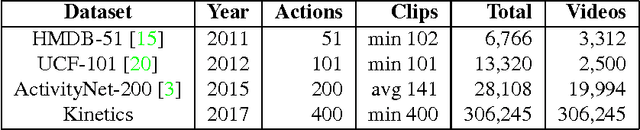
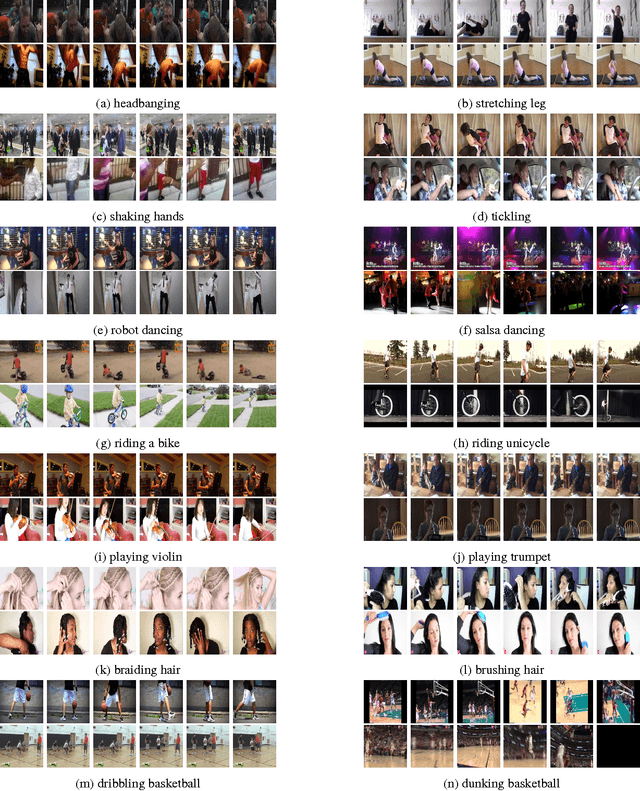

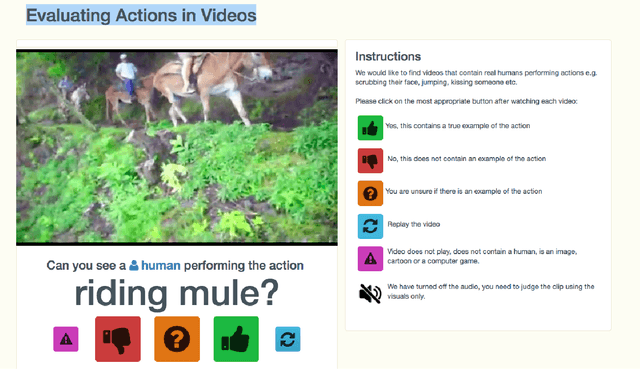
We describe the DeepMind Kinetics human action video dataset. The dataset contains 400 human action classes, with at least 400 video clips for each action. Each clip lasts around 10s and is taken from a different YouTube video. The actions are human focussed and cover a broad range of classes including human-object interactions such as playing instruments, as well as human-human interactions such as shaking hands. We describe the statistics of the dataset, how it was collected, and give some baseline performance figures for neural network architectures trained and tested for human action classification on this dataset. We also carry out a preliminary analysis of whether imbalance in the dataset leads to bias in the classifiers.