 Add to Chrome
 Add to Firefox
 Add to Edge
The Computational Basis of Confidence in Large Language Models
Jul 14, 2026
Reliable confidence -- the probability that a model's own answer is correct -- is essential for the trustworthy deployment of language models. Existing work has largely evaluated confidence by how well it predicts correctness and whether it is calibrated, leaving open a more fundamental question: what does the confidence signal itself represent? Answer logits may reflect a latent decision variable sufficient to compute normative confidence, or instead a heuristic preference signal that combines the available evidence in a non-Bayesian manner. We address this using statistical decision confidence (SDC), a normative framework from computational neuroscience. Treating the answer-logit difference (LD) as a candidate readout of the latent decision variable, we test the qualitative signatures predicted by SDC. Across three perceptual discrimination tasks and a memory-based decision task, spanning three multimodal non-reasoning models and one reasoning model, LD satisfied these signatures -- including the diagnostic correct/error folded-X pattern -- showing that, in these settings, answer logits behave as monotonic readouts of a latent decision variable rather than heuristic preference scores. In complex visual reasoning, LD continued to predict correctness beyond objective task difficulty, but the full geometric signatures of SDC were absent, illustrating the current boundary of the framework when explicit normative process models are unavailable. These results provide a computational account of confidence in multimodal language models, delineate when answer logits behave as readouts of a latent decision variable, and establish SDC as a unifying framework for studying confidence across biological and artificial intelligence.

Reported Confidence in LLMs Tracks Commitment More Than Correctness
Jun 28, 2026Confidence is an estimate of the probability that a chosen answer is correct. Verbal confidence reports are widely used as uncertainty measures in large language models, but whether they are best understood as estimates of correctness is unclear. We test this with a two-stage abstention paradigm from the neuroscience of perceptual decision making: a model first answers and reports its confidence, then decides whether to commit it to a user or abstain. Across four non-reasoning models, prompt framings, and confidence formats, verbal confidence predicted the commit/abstain decision substantially better than whether the answer was correct. Calibrated token log-probabilities showed the opposite profile, with abstention-prediction coupled to correctness discrimination, the signature of an answer-evidence signal. After removing the variance verbal confidence shared with log-probabilities, the residual stayed aligned with commitment while its link to correctness fell to near chance. The dissociation generalised to four reasoning models across four benchmarks of varying difficulty, from hard multiple-choice to frontier-level freeform questions. Mechanistic analyses in Gemma 3 and 4 were convergent: a post-answer state known to causally support verbal-confidence generation already encoded the future abstention decision before the abstention prompt, organised mainly by that decision rather than by correctness, the two lying in approximately orthogonal directions in activation space. Steering along a verbal-confidence-specific direction causally shifted abstention. Verbal and log-probability confidence are thus not interchangeable: log-probabilities track answer evidence and correctness, whereas verbal confidence is better understood as a behaviour-facing readout of an internal commit-readiness state, challenging the practice of treating verbal reports as proxies for reliability.
How LLMs Detect and Correct Their Own Errors: The Role of Internal Confidence Signals
Apr 24, 2026Large language models can detect their own errors and sometimes correct them without external feedback, but the underlying mechanisms remain unknown. We investigate this through the lens of second-order models of confidence from decision neuroscience. In a first-order system, confidence derives from the generation signal itself and is therefore maximal for the chosen response, precluding error detection. Second-order models posit a partially independent evaluative signal that can disagree with the committed response, providing the basis for error detection. Kumaran et al. (2026) showed that LLMs cache a confidence representation at a token immediately following the answer (i.e. post-answer newline: PANL) -- that causally drives verbal confidence and dissociates from log-probabilities. Here we test whether this PANL signal extends beyond confidence to support error detection and self-correction. Here we test whether this signal supports error detection and self-correction, deriving predictions from the second-order framework. Using a verify-then-correct paradigm, we show that: (i) verbal confidence predicts error detection far beyond token log-probabilities, ruling out a first-order account; (ii) PANL activations predict error detection beyond verbal confidence itself; and (iii) PANL predicts which errors the model can correct -- where all behavioural signals fail. Causal interventions confirm that PANL signals rescue error detection behavior when answer information is corrupted. All findings replicate across models (Gemma 3 27B and Qwen 2.5 7B) and tasks (TriviaQA and MNLI). These results reveal that LLMs naturally implement a second-order confidence architecture whose internal evaluative signal encodes not only whether an answer is likely wrong but whether the model has the knowledge to fix it.
Causal Evidence that Language Models use Confidence to Drive Behavior
Mar 23, 2026Metacognition -- the ability to assess one's own cognitive performance -- is documented across species, with internal confidence estimates serving as a key signal for adaptive behavior. While confidence can be extracted from Large Language Model (LLM) outputs, whether models actively use these signals to regulate behavior remains a fundamental question. We investigate this through a four-phase abstention paradigm.Phase 1 established internal confidence estimates in the absence of an abstention option. Phase 2 revealed that LLMs apply implicit thresholds to these estimates when deciding to answer or abstain. Confidence emerged as the dominant predictor of behavior, with effect sizes an order of magnitude larger than knowledge retrieval accessibility (RAG scores) or surface-level semantic features. Phase 3 provided causal evidence through activation steering: manipulating internal confidence signals correspondingly shifted abstention rates. Finally, Phase 4 demonstrated that models can systematically vary abstention policies based on instructed thresholds.Our findings indicate that abstention arises from the joint operation of internal confidence representations and threshold-based policies, mirroring the two-stage metacognitive control found in biological systems. This capacity is essential as LLMs transition into autonomous agents that must recognize their own uncertainty to decide when to act or seek help.
How do LLMs Compute Verbal Confidence
Mar 18, 2026Verbal confidence -- prompting LLMs to state their confidence as a number or category -- is widely used to extract uncertainty estimates from black-box models. However, how LLMs internally generate such scores remains unknown. We address two questions: first, when confidence is computed - just-in-time when requested, or automatically during answer generation and cached for later retrieval; and second, what verbal confidence represents - token log-probabilities, or a richer evaluation of answer quality? Focusing on Gemma 3 27B and Qwen 2.5 7B, we provide convergent evidence for cached retrieval. Activation steering, patching, noising, and swap experiments reveal that confidence representations emerge at answer-adjacent positions before appearing at the verbalization site. Attention blocking pinpoints the information flow: confidence is gathered from answer tokens, cached at the first post-answer position, then retrieved for output. Critically, linear probing and variance partitioning reveal that these cached representations explain substantial variance in verbal confidence beyond token log-probabilities, suggesting a richer answer-quality evaluation rather than a simple fluency readout. These findings demonstrate that verbal confidence reflects automatic, sophisticated self-evaluation -- not post-hoc reconstruction -- with implications for understanding metacognition in LLMs and improving calibration.
Transformers need glasses! Information over-squashing in language tasks
Jun 06, 2024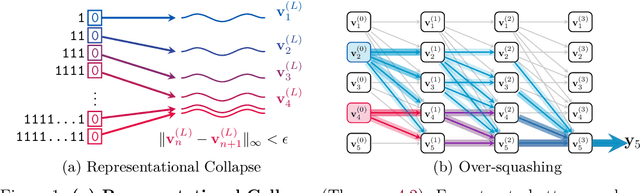
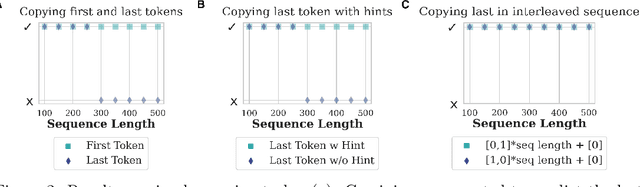
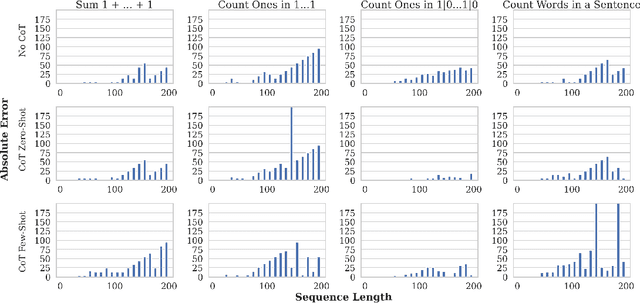

We study how information propagates in decoder-only Transformers, which are the architectural backbone of most existing frontier large language models (LLMs). We rely on a theoretical signal propagation analysis -- specifically, we analyse the representations of the last token in the final layer of the Transformer, as this is the representation used for next-token prediction. Our analysis reveals a representational collapse phenomenon: we prove that certain distinct sequences of inputs to the Transformer can yield arbitrarily close representations in the final token. This effect is exacerbated by the low-precision floating-point formats frequently used in modern LLMs. As a result, the model is provably unable to respond to these sequences in different ways -- leading to errors in, e.g., tasks involving counting or copying. Further, we show that decoder-only Transformer language models can lose sensitivity to specific tokens in the input, which relates to the well-known phenomenon of over-squashing in graph neural networks. We provide empirical evidence supporting our claims on contemporary LLMs. Our theory also points to simple solutions towards ameliorating these issues.
Synth$^2$: Boosting Visual-Language Models with Synthetic Captions and Image Embeddings
Mar 12, 2024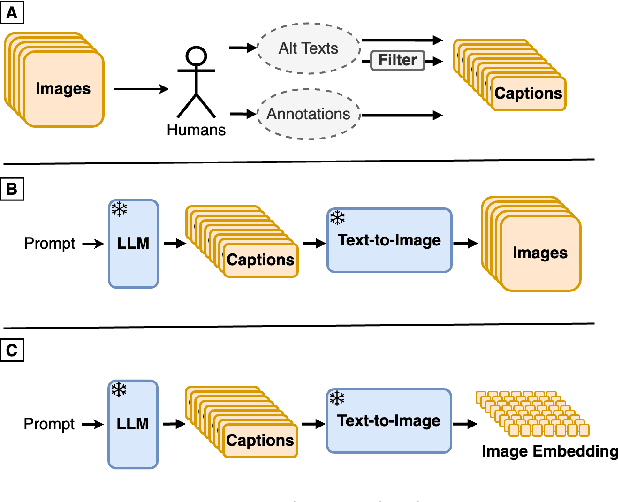

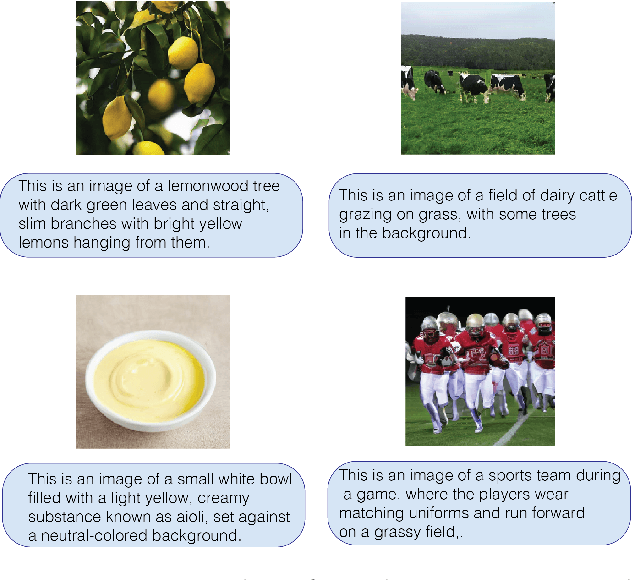

The creation of high-quality human-labeled image-caption datasets presents a significant bottleneck in the development of Visual-Language Models (VLMs). We propose a novel approach that leverages the strengths of Large Language Models (LLMs) and image generation models to create synthetic image-text pairs for efficient and effective VLM training. Our method employs pretraining a text-to-image model to synthesize image embeddings starting from captions generated by an LLM. These synthetic pairs are then used to train a VLM. Extensive experiments demonstrate that the VLM trained with synthetic data exhibits comparable performance on image captioning, while requiring a fraction of the data used by models trained solely on human-annotated data. In particular, we outperform the baseline by 17% through augmentation with a synthetic dataset. Furthermore, we show that synthesizing in the image embedding space is 25% faster than in the pixel space. This research introduces a promising technique for generating large-scale, customizable image datasets, leading to enhanced VLM performance and wider applicability across various domains, all with improved data efficiency and resource utilization.
Transformers generalize differently from information stored in context vs in weights
Oct 11, 2022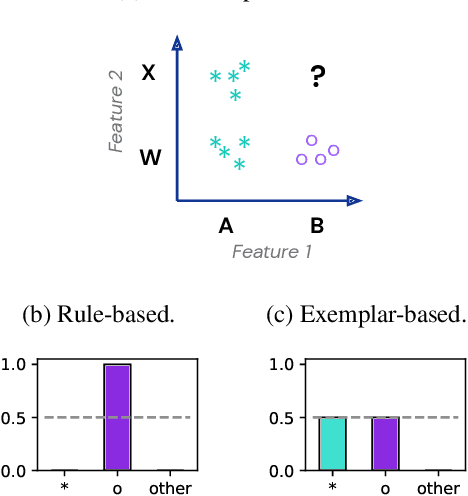
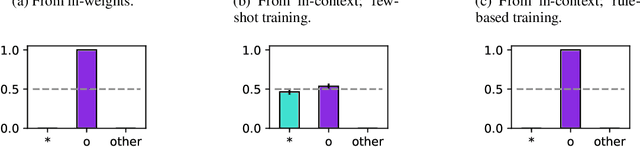
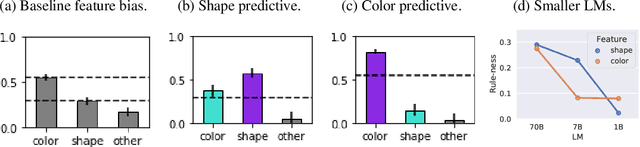
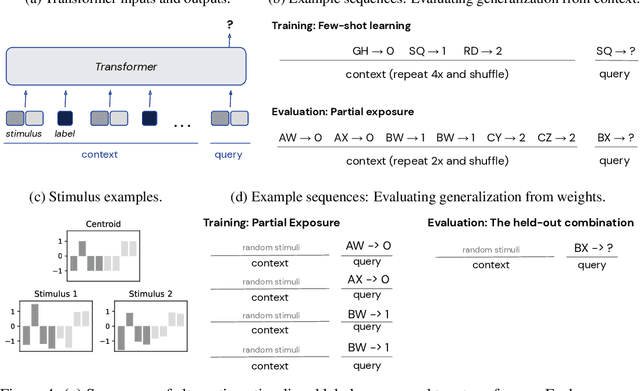
Transformer models can use two fundamentally different kinds of information: information stored in weights during training, and information provided ``in-context'' at inference time. In this work, we show that transformers exhibit different inductive biases in how they represent and generalize from the information in these two sources. In particular, we characterize whether they generalize via parsimonious rules (rule-based generalization) or via direct comparison with observed examples (exemplar-based generalization). This is of important practical consequence, as it informs whether to encode information in weights or in context, depending on how we want models to use that information. In transformers trained on controlled stimuli, we find that generalization from weights is more rule-based whereas generalization from context is largely exemplar-based. In contrast, we find that in transformers pre-trained on natural language, in-context learning is significantly rule-based, with larger models showing more rule-basedness. We hypothesise that rule-based generalization from in-context information might be an emergent consequence of large-scale training on language, which has sparse rule-like structure. Using controlled stimuli, we verify that transformers pretrained on data containing sparse rule-like structure exhibit more rule-based generalization.
Language models show human-like content effects on reasoning
Jul 14, 2022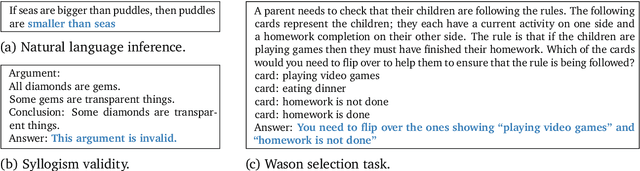
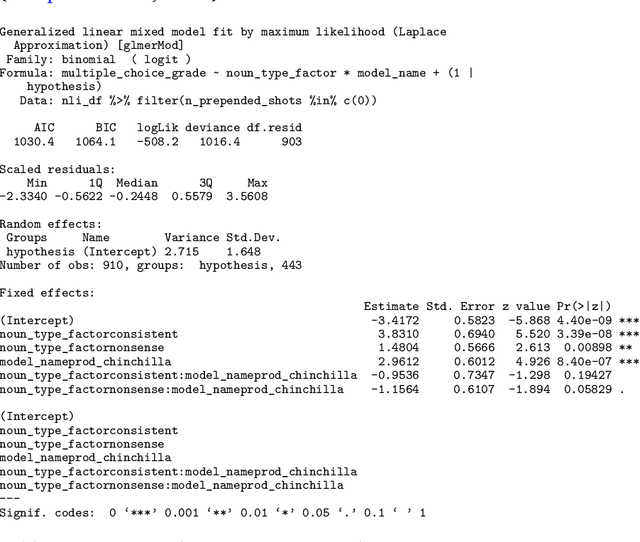
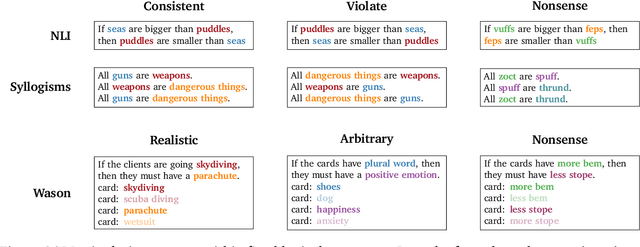
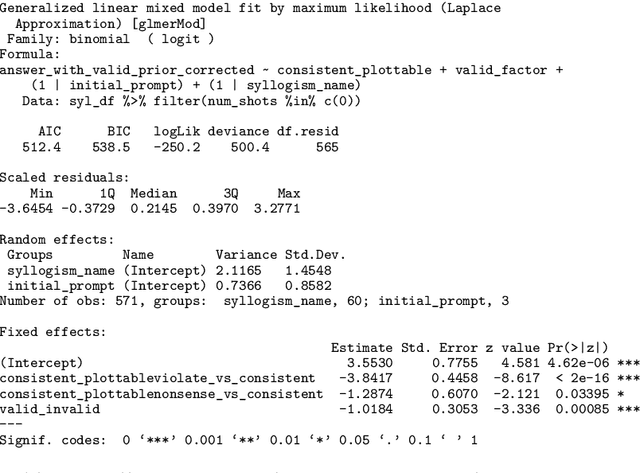
Abstract reasoning is a key ability for an intelligent system. Large language models achieve above-chance performance on abstract reasoning tasks, but exhibit many imperfections. However, human abstract reasoning is also imperfect, and depends on our knowledge and beliefs about the content of the reasoning problem. For example, humans reason much more reliably about logical rules that are grounded in everyday situations than arbitrary rules about abstract attributes. The training experiences of language models similarly endow them with prior expectations that reflect human knowledge and beliefs. We therefore hypothesized that language models would show human-like content effects on abstract reasoning problems. We explored this hypothesis across three logical reasoning tasks: natural language inference, judging the logical validity of syllogisms, and the Wason selection task (Wason, 1968). We find that state of the art large language models (with 7 or 70 billion parameters; Hoffman et al., 2022) reflect many of the same patterns observed in humans across these tasks -- like humans, models reason more effectively about believable situations than unrealistic or abstract ones. Our findings have implications for understanding both these cognitive effects, and the factors that contribute to language model performance.
MEMO: A Deep Network for Flexible Combination of Episodic Memories
Jan 29, 2020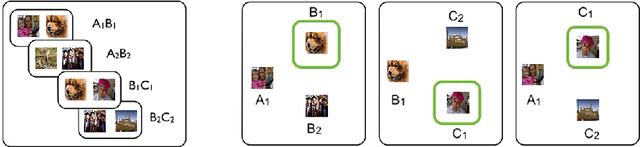
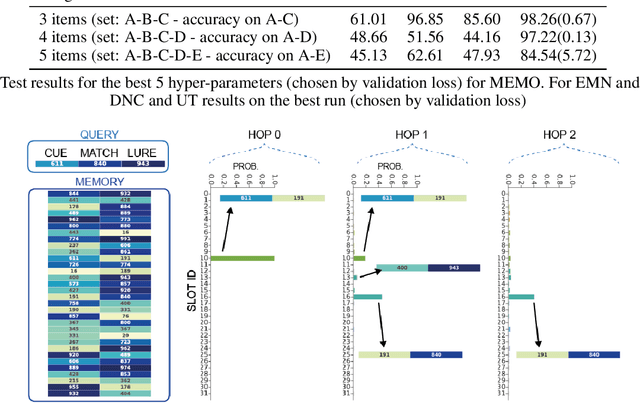
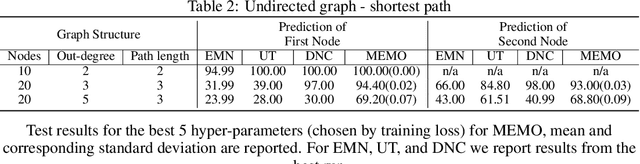

Recent research developing neural network architectures with external memory have often used the benchmark bAbI question and answering dataset which provides a challenging number of tasks requiring reasoning. Here we employed a classic associative inference task from the memory-based reasoning neuroscience literature in order to more carefully probe the reasoning capacity of existing memory-augmented architectures. This task is thought to capture the essence of reasoning -- the appreciation of distant relationships among elements distributed across multiple facts or memories. Surprisingly, we found that current architectures struggle to reason over long distance associations. Similar results were obtained on a more complex task involving finding the shortest path between nodes in a path. We therefore developed MEMO, an architecture endowed with the capacity to reason over longer distances. This was accomplished with the addition of two novel components. First, it introduces a separation between memories (facts) stored in external memory and the items that comprise these facts in external memory. Second, it makes use of an adaptive retrieval mechanism, allowing a variable number of "memory hops" before the answer is produced. MEMO is capable of solving our novel reasoning tasks, as well as match state of the art results in bAbI.