 Add to Chrome
 Add to Firefox
 Add to Edge
MARIO: Motion-Augmented Real-Time Multi-Sensor Inertial Odometry
Jun 02, 2026
Inertial odometry (IO) using only Inertial Measurement Units (IMUs) provides a lightweight solution for human motion tracking in augmented reality (AR) and wearable devices. Recent learning-based IO methods have improved the generalizability of inertial localization through large-scale pretraining on human motion datasets. However, these approaches remain prone to drift and noise because they do not explicitly capture human motion dynamics, especially on daily activity datasets such as Nymeria. In this work, we propose to ground inertial odometry in human kinematics through a learned IMU-inferred pose prior, which promotes physically consistent motion constraints. We integrate this pose prior into existing IO architectures and reduce positional drift by up to 36% on the challenging Nymeria dataset, which is 5x larger than datasets used in prior work. We further improve long-term performance with a sensor-fusion framework that incorporates auxiliary signals from lightweight sensors already available on commercial AR glasses, including magnetometers, barometers, and secondary IMUs. With this fusion strategy, positional drift is reduced by up to 42%, improving robustness and generalization across diverse motion conditions. Together, our results introduce a new paradigm for inertial and lightweight odometry by unifying human motion kinematics with multimodal sensing, setting a new benchmark for accurate and robust camera-less human tracking. Our website is available at https://spice-lab.org/projects/MARIO/.

Towards a General Intelligence and Interface for Wearable Health Data
May 21, 2026While ubiquitous wearable sensors capture a wealth of behavioral and physiological information, effectively transforming these signals into personalized health insights is challenging. Specifically, converting low-level sensor data into representations capable of characterizing higher-level states is difficult due to high phenotypic diversity and variation in individual baseline health, physiology, and lifestyle factors. Moreover, collecting wearable data paired with health outcome annotations is laborious and expensive, and retrospective annotation remains practically unfeasible, contributing to a scarcity of data with high-quality labels. To overcome these limitations, we propose a foundation model for wearable health that is pretrained on more than one trillion minutes of unlabeled sensor signals drawn from a large cohort of five million participants. We demonstrate that the joint scaling of model capacity and pretraining data volume leads to systematic improvements in performance, as evaluated on a diverse set of 35 health prediction tasks, spanning cardiovascular, metabolic, sleep, and mental health, as well as lifestyle choices and demographic factors. We find that this population scale representation unlocks label-efficient few-shot learning and generative capabilities for robust daily metric estimation. To further leverage this learned representation, we deploy a classroom of LLM agents to autonomously search the space of downstream predictive heads built on the model embeddings, showing broad performance improvements that increase with LLM model capacity. Finally, we show how integrating these downstream predictors into a Personal Health Agent can support model responses that are more relevant, contextually aware, and safe, and we validate this via 1,860 ratings from a cohort of clinicians.
VGGRPO: Towards World-Consistent Video Generation with 4D Latent Reward
Mar 27, 2026Large-scale video diffusion models achieve impressive visual quality, yet often fail to preserve geometric consistency. Prior approaches improve consistency either by augmenting the generator with additional modules or applying geometry-aware alignment. However, architectural modifications can compromise the generalization of internet-scale pretrained models, while existing alignment methods are limited to static scenes and rely on RGB-space rewards that require repeated VAE decoding, incurring substantial compute overhead and failing to generalize to highly dynamic real-world scenes. To preserve the pretrained capacity while improving geometric consistency, we propose VGGRPO (Visual Geometry GRPO), a latent geometry-guided framework for geometry-aware video post-training. VGGRPO introduces a Latent Geometry Model (LGM) that stitches video diffusion latents to geometry foundation models, enabling direct decoding of scene geometry from the latent space. By constructing LGM from a geometry model with 4D reconstruction capability, VGGRPO naturally extends to dynamic scenes, overcoming the static-scene limitations of prior methods. Building on this, we perform latent-space Group Relative Policy Optimization with two complementary rewards: a camera motion smoothness reward that penalizes jittery trajectories, and a geometry reprojection consistency reward that enforces cross-view geometric coherence. Experiments on both static and dynamic benchmarks show that VGGRPO improves camera stability, geometry consistency, and overall quality while eliminating costly VAE decoding, making latent-space geometry-guided reinforcement an efficient and flexible approach to world-consistent video generation.
SurfaceXR: Fusing Smartwatch IMUs and Egocentric Hand Pose for Seamless Surface Interactions
Mar 19, 2026Mid-air gestures in Extended Reality (XR) often cause fatigue and imprecision. Surface-based interactions offer improved accuracy and comfort, but current egocentric vision methods struggle due to hand tracking challenges and unreliable surface plane estimation. We introduce SurfaceXR, a sensor fusion approach combining headset-based hand tracking with smartwatch IMU data to enable robust inputs on everyday surfaces. Our insight is that these modalities are complementary: hand tracking provides 3D positional data while IMUs capture high-frequency motion. A 21-participant study validates SurfaceXR's effectiveness for touch tracking and 8-class gesture recognition, demonstrating significant improvements over single-modality approaches.
WatchHAR: Real-time On-device Human Activity Recognition System for Smartwatches
Sep 05, 2025
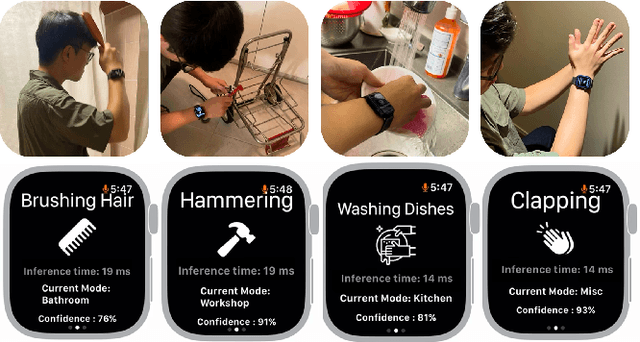
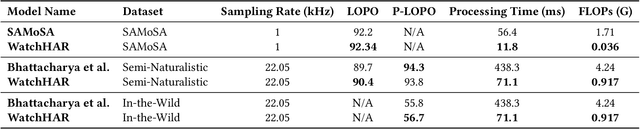
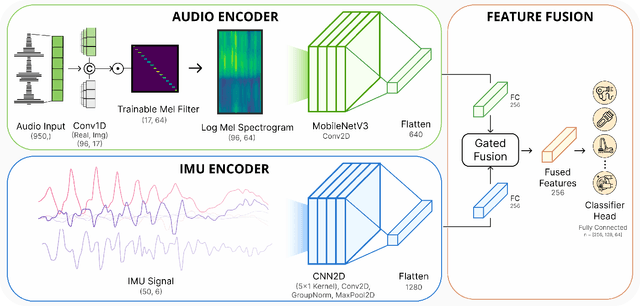
Despite advances in practical and multimodal fine-grained Human Activity Recognition (HAR), a system that runs entirely on smartwatches in unconstrained environments remains elusive. We present WatchHAR, an audio and inertial-based HAR system that operates fully on smartwatches, addressing privacy and latency issues associated with external data processing. By optimizing each component of the pipeline, WatchHAR achieves compounding performance gains. We introduce a novel architecture that unifies sensor data preprocessing and inference into an end-to-end trainable module, achieving 5x faster processing while maintaining over 90% accuracy across more than 25 activity classes. WatchHAR outperforms state-of-the-art models for event detection and activity classification while running directly on the smartwatch, achieving 9.3 ms processing time for activity event detection and 11.8 ms for multimodal activity classification. This research advances on-device activity recognition, realizing smartwatches' potential as standalone, privacy-aware, and minimally-invasive continuous activity tracking devices.
MobilePoser: Real-Time Full-Body Pose Estimation and 3D Human Translation from IMUs in Mobile Consumer Devices
Apr 16, 2025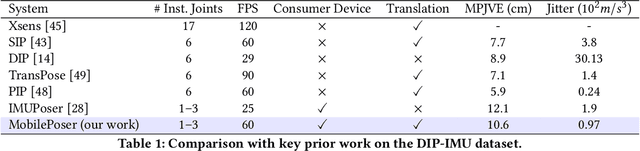
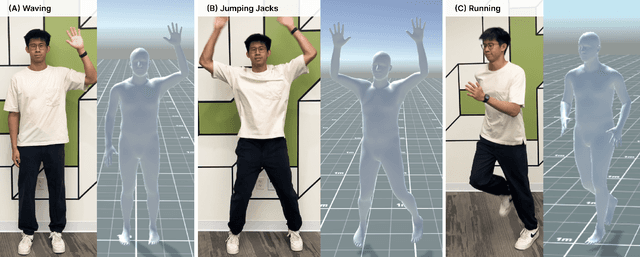
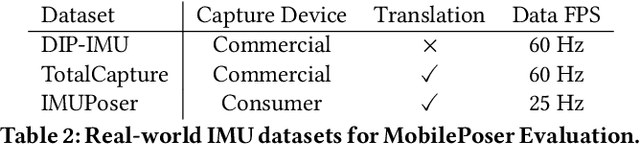
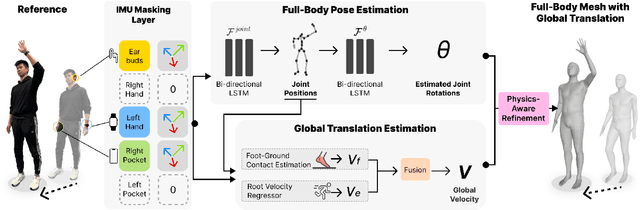
There has been a continued trend towards minimizing instrumentation for full-body motion capture, going from specialized rooms and equipment, to arrays of worn sensors and recently sparse inertial pose capture methods. However, as these techniques migrate towards lower-fidelity IMUs on ubiquitous commodity devices, like phones, watches, and earbuds, challenges arise including compromised online performance, temporal consistency, and loss of global translation due to sensor noise and drift. Addressing these challenges, we introduce MobilePoser, a real-time system for full-body pose and global translation estimation using any available subset of IMUs already present in these consumer devices. MobilePoser employs a multi-stage deep neural network for kinematic pose estimation followed by a physics-based motion optimizer, achieving state-of-the-art accuracy while remaining lightweight. We conclude with a series of demonstrative applications to illustrate the unique potential of MobilePoser across a variety of fields, such as health and wellness, gaming, and indoor navigation to name a few.
Geometry Fidelity for Spherical Images
Jul 25, 2024


Spherical or omni-directional images offer an immersive visual format appealing to a wide range of computer vision applications. However, geometric properties of spherical images pose a major challenge for models and metrics designed for ordinary 2D images. Here, we show that direct application of Fr\'echet Inception Distance (FID) is insufficient for quantifying geometric fidelity in spherical images. We introduce two quantitative metrics accounting for geometric constraints, namely Omnidirectional FID (OmniFID) and Discontinuity Score (DS). OmniFID is an extension of FID tailored to additionally capture field-of-view requirements of the spherical format by leveraging cubemap projections. DS is a kernel-based seam alignment score of continuity across borders of 2D representations of spherical images. In experiments, OmniFID and DS quantify geometry fidelity issues that are undetected by FID.
Augmented Object Intelligence: Making the Analog World Interactable with XR-Objects
Apr 23, 2024

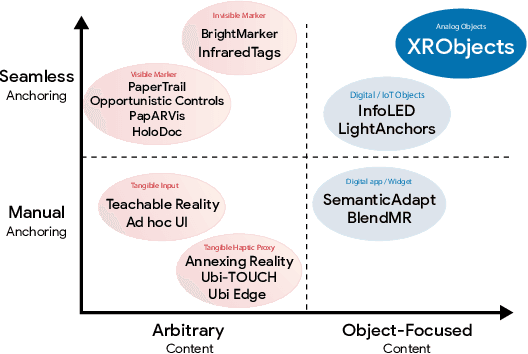
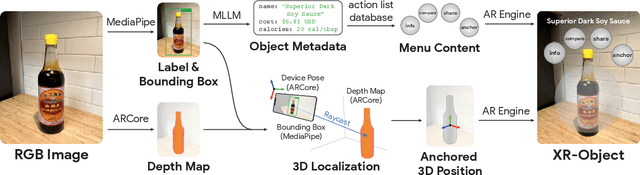
Seamless integration of physical objects as interactive digital entities remains a challenge for spatial computing. This paper introduces Augmented Object Intelligence (AOI), a novel XR interaction paradigm designed to blur the lines between digital and physical by equipping real-world objects with the ability to interact as if they were digital, where every object has the potential to serve as a portal to vast digital functionalities. Our approach utilizes object segmentation and classification, combined with the power of Multimodal Large Language Models (MLLMs), to facilitate these interactions. We implement the AOI concept in the form of XR-Objects, an open-source prototype system that provides a platform for users to engage with their physical environment in rich and contextually relevant ways. This system enables analog objects to not only convey information but also to initiate digital actions, such as querying for details or executing tasks. Our contributions are threefold: (1) we define the AOI concept and detail its advantages over traditional AI assistants, (2) detail the XR-Objects system's open-source design and implementation, and (3) show its versatility through a variety of use cases and a user study.
Practical and Rich User Digitization
Feb 29, 2024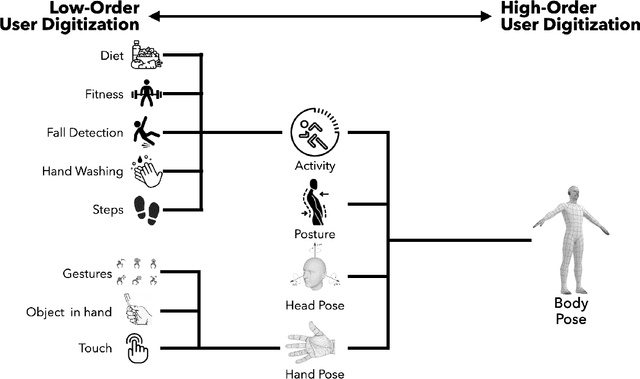
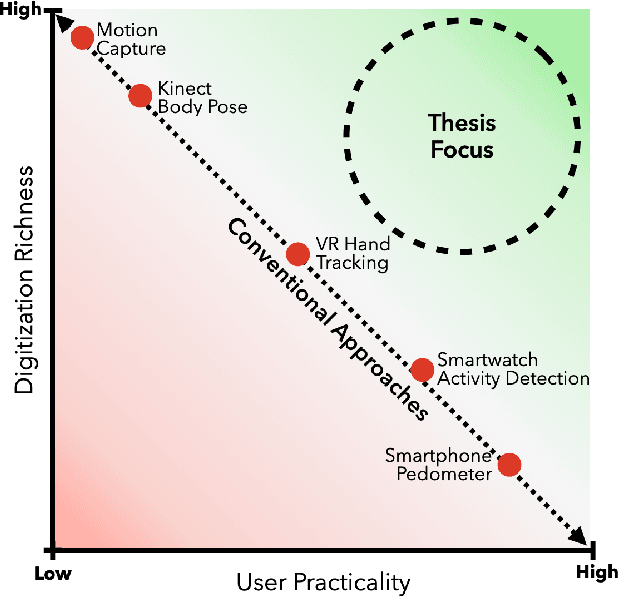

A long-standing vision in computer science has been to evolve computing devices into proactive assistants that enhance our productivity, health and wellness, and many other facets of our lives. User digitization is crucial in achieving this vision as it allows computers to intimately understand their users, capturing activity, pose, routine, and behavior. Today's consumer devices - like smartphones and smartwatches provide a glimpse of this potential, offering coarse digital representations of users with metrics such as step count, heart rate, and a handful of human activities like running and biking. Even these very low-dimensional representations are already bringing value to millions of people's lives, but there is significant potential for improvement. On the other end, professional, high-fidelity comprehensive user digitization systems exist. For example, motion capture suits and multi-camera rigs that digitize our full body and appearance, and scanning machines such as MRI capture our detailed anatomy. However, these carry significant user practicality burdens, such as financial, privacy, ergonomic, aesthetic, and instrumentation considerations, that preclude consumer use. In general, the higher the fidelity of capture, the lower the user's practicality. Most conventional approaches strike a balance between user practicality and digitization fidelity. My research aims to break this trend, developing sensing systems that increase user digitization fidelity to create new and powerful computing experiences while retaining or even improving user practicality and accessibility, allowing such technologies to have a societal impact. Armed with such knowledge, our future devices could offer longitudinal health tracking, more productive work environments, full body avatars in extended reality, and embodied telepresence experiences, to name just a few domains.
IMUPoser: Full-Body Pose Estimation using IMUs in Phones, Watches, and Earbuds
Apr 25, 2023


Tracking body pose on-the-go could have powerful uses in fitness, mobile gaming, context-aware virtual assistants, and rehabilitation. However, users are unlikely to buy and wear special suits or sensor arrays to achieve this end. Instead, in this work, we explore the feasibility of estimating body pose using IMUs already in devices that many users own -- namely smartphones, smartwatches, and earbuds. This approach has several challenges, including noisy data from low-cost commodity IMUs, and the fact that the number of instrumentation points on a users body is both sparse and in flux. Our pipeline receives whatever subset of IMU data is available, potentially from just a single device, and produces a best-guess pose. To evaluate our model, we created the IMUPoser Dataset, collected from 10 participants wearing or holding off-the-shelf consumer devices and across a variety of activity contexts. We provide a comprehensive evaluation of our system, benchmarking it on both our own and existing IMU datasets.