 Add to Chrome
 Add to Firefox
 Add to Edge
MARIO: Motion-Augmented Real-Time Multi-Sensor Inertial Odometry
Jun 02, 2026
Inertial odometry (IO) using only Inertial Measurement Units (IMUs) provides a lightweight solution for human motion tracking in augmented reality (AR) and wearable devices. Recent learning-based IO methods have improved the generalizability of inertial localization through large-scale pretraining on human motion datasets. However, these approaches remain prone to drift and noise because they do not explicitly capture human motion dynamics, especially on daily activity datasets such as Nymeria. In this work, we propose to ground inertial odometry in human kinematics through a learned IMU-inferred pose prior, which promotes physically consistent motion constraints. We integrate this pose prior into existing IO architectures and reduce positional drift by up to 36% on the challenging Nymeria dataset, which is 5x larger than datasets used in prior work. We further improve long-term performance with a sensor-fusion framework that incorporates auxiliary signals from lightweight sensors already available on commercial AR glasses, including magnetometers, barometers, and secondary IMUs. With this fusion strategy, positional drift is reduced by up to 42%, improving robustness and generalization across diverse motion conditions. Together, our results introduce a new paradigm for inertial and lightweight odometry by unifying human motion kinematics with multimodal sensing, setting a new benchmark for accurate and robust camera-less human tracking. Our website is available at https://spice-lab.org/projects/MARIO/.

SurfaceXR: Fusing Smartwatch IMUs and Egocentric Hand Pose for Seamless Surface Interactions
Mar 19, 2026Mid-air gestures in Extended Reality (XR) often cause fatigue and imprecision. Surface-based interactions offer improved accuracy and comfort, but current egocentric vision methods struggle due to hand tracking challenges and unreliable surface plane estimation. We introduce SurfaceXR, a sensor fusion approach combining headset-based hand tracking with smartwatch IMU data to enable robust inputs on everyday surfaces. Our insight is that these modalities are complementary: hand tracking provides 3D positional data while IMUs capture high-frequency motion. A 21-participant study validates SurfaceXR's effectiveness for touch tracking and 8-class gesture recognition, demonstrating significant improvements over single-modality approaches.
WatchHAR: Real-time On-device Human Activity Recognition System for Smartwatches
Sep 05, 2025
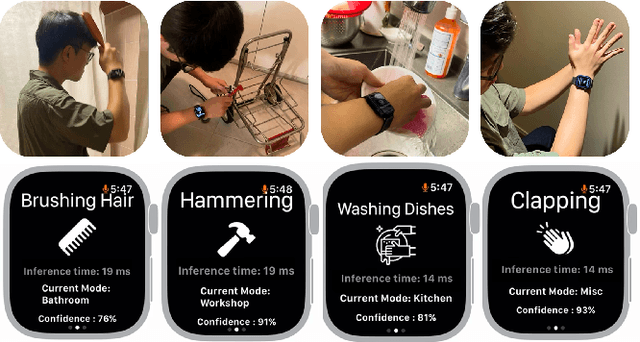
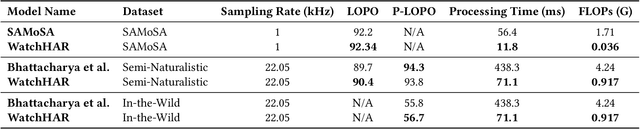
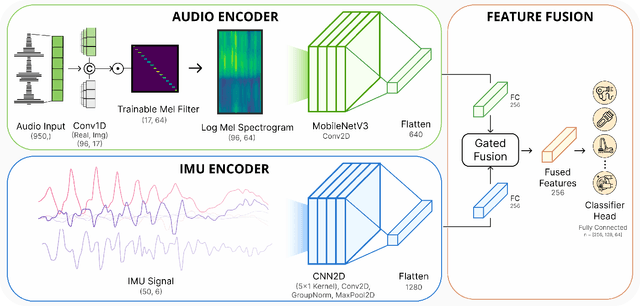
Despite advances in practical and multimodal fine-grained Human Activity Recognition (HAR), a system that runs entirely on smartwatches in unconstrained environments remains elusive. We present WatchHAR, an audio and inertial-based HAR system that operates fully on smartwatches, addressing privacy and latency issues associated with external data processing. By optimizing each component of the pipeline, WatchHAR achieves compounding performance gains. We introduce a novel architecture that unifies sensor data preprocessing and inference into an end-to-end trainable module, achieving 5x faster processing while maintaining over 90% accuracy across more than 25 activity classes. WatchHAR outperforms state-of-the-art models for event detection and activity classification while running directly on the smartwatch, achieving 9.3 ms processing time for activity event detection and 11.8 ms for multimodal activity classification. This research advances on-device activity recognition, realizing smartwatches' potential as standalone, privacy-aware, and minimally-invasive continuous activity tracking devices.
MobilePoser: Real-Time Full-Body Pose Estimation and 3D Human Translation from IMUs in Mobile Consumer Devices
Apr 16, 2025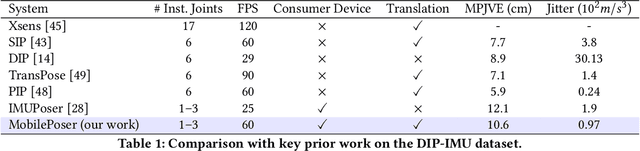
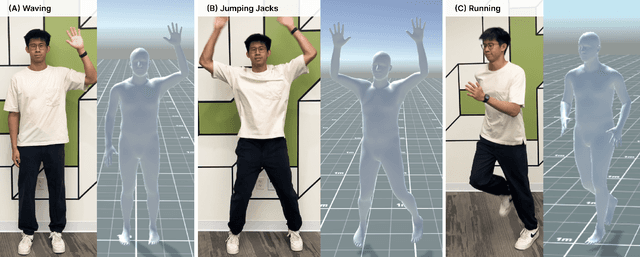
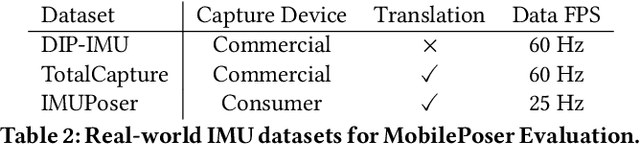
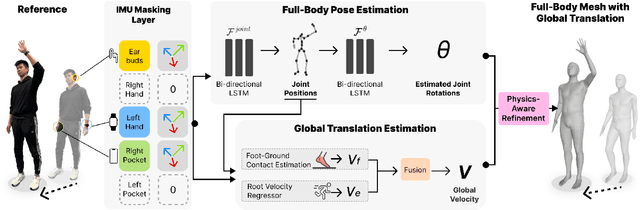
There has been a continued trend towards minimizing instrumentation for full-body motion capture, going from specialized rooms and equipment, to arrays of worn sensors and recently sparse inertial pose capture methods. However, as these techniques migrate towards lower-fidelity IMUs on ubiquitous commodity devices, like phones, watches, and earbuds, challenges arise including compromised online performance, temporal consistency, and loss of global translation due to sensor noise and drift. Addressing these challenges, we introduce MobilePoser, a real-time system for full-body pose and global translation estimation using any available subset of IMUs already present in these consumer devices. MobilePoser employs a multi-stage deep neural network for kinematic pose estimation followed by a physics-based motion optimizer, achieving state-of-the-art accuracy while remaining lightweight. We conclude with a series of demonstrative applications to illustrate the unique potential of MobilePoser across a variety of fields, such as health and wellness, gaming, and indoor navigation to name a few.