 Add to Chrome
 Add to Firefox
 Add to Edge
Multilingual Multi-Speaker Unit Vocoders: A Systematic Analysis of Discrete Speech Representations
Jun 04, 2026
Discrete speech units obtained via k-means clustering of self supervised embeddings entangle phonetic, speaker, and language information, causing speaker mixing and cross-lingual interference in multilingual multi-speaker speech generation. Despite growing use in Audio LLMs and speech to speech systems, unit vocoders remain underexplored. We analyze a BigVGAN based unit vocoder, across four Indian languages. We study the interaction between cluster size and conditioning strategies using WER, speaker similarity, and unit level metrics. Results show that cluster size governs intelligibility by improving phonetic discriminability, while explicit speaker conditioning is indispensable for preventing identity collapse. Language supervision yields further gains mainly at lower cluster sizes where units remain ambiguous. Our analysis shows similar phonemes across languages collapse to the same cluster IDs at smaller inventories, with larger clusters progressively separating them.

HybridCodec: Fast Dual-Stream, Semantically Enhanced Neural Audio Codec
Jun 04, 2026The popularity of neural audio codecs as speech tokenizers has surged with the advent of Multimodal Large Language Models. New codec architectures with semantic and acoustic disentanglement have emerged. There are two main approaches to introduce semantic information into codec models: one distills semantic information from SSL representations into the first RVQ layer, while the other maintains separate streams for semantic and acoustic features. We propose HybridCodec, a unified architecture that combines both paradigms. It employs separate semantic and acoustic branches while distilling SSL representations into the semantic stream. This design ensures strong disentanglement without requiring an SSL model during inference. HybridCodec shows superior semantic specialization (RVQ-1) on in-domain test set and competitive reconstruction (RVQ-all). We demonstrate its robustness in out-of-domain and zero-shot cross-lingual settings, achieving a 3x speedup over existing dual-stream models.
Building Robust and Scalable Multilingual ASR for Indian Languages
Nov 19, 2025This paper describes the systems developed by SPRING Lab, Indian Institute of Technology Madras, for the ASRU MADASR 2.0 challenge. The systems developed focuses on adapting ASR systems to improve in predicting the language and dialect of the utterance among 8 languages across 33 dialects. We participated in Track 1 and Track 2, which restricts the use of additional data and develop from-the-scratch multilingual systems. We presented a novel training approach using Multi-Decoder architecture with phonemic Common Label Set (CLS) as intermediate representation. It improved the performance over the baseline (in the CLS space). We also discuss various methods used to retain the gain obtained in the phonemic space while converting them back to the corresponding grapheme representations. Our systems beat the baseline in 3 languages (Track 2) in terms of WER/CER and achieved the highest language ID and dialect ID accuracy among all participating teams (Track 2).
SPRING-INX: A Multilingual Indian Language Speech Corpus by SPRING Lab, IIT Madras
Oct 24, 2023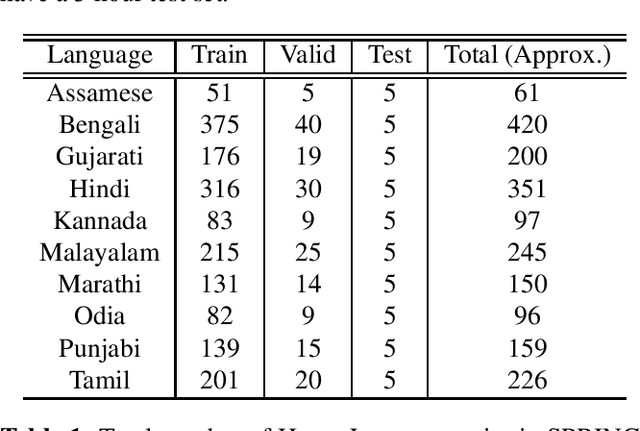
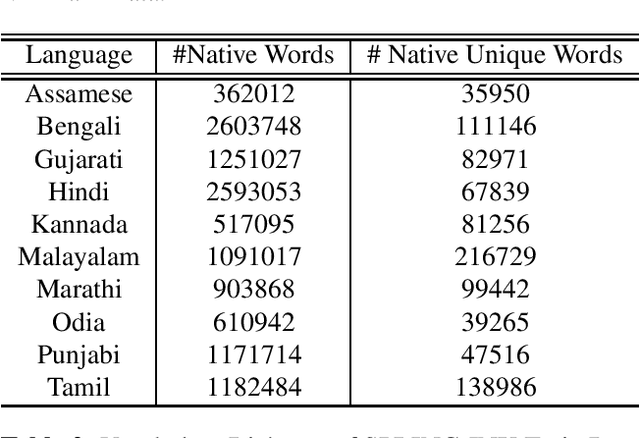
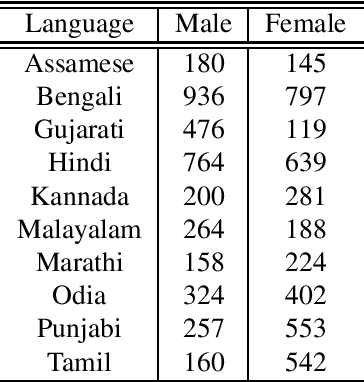
India is home to a multitude of languages of which 22 languages are recognised by the Indian Constitution as official. Building speech based applications for the Indian population is a difficult problem owing to limited data and the number of languages and accents to accommodate. To encourage the language technology community to build speech based applications in Indian languages, we are open sourcing SPRING-INX data which has about 2000 hours of legally sourced and manually transcribed speech data for ASR system building in Assamese, Bengali, Gujarati, Hindi, Kannada, Malayalam, Marathi, Odia, Punjabi and Tamil. This endeavor is by SPRING Lab , Indian Institute of Technology Madras and is a part of National Language Translation Mission (NLTM), funded by the Indian Ministry of Electronics and Information Technology (MeitY), Government of India. We describe the data collection and data cleaning process along with the data statistics in this paper.