 Add to Chrome
 Add to Firefox
 Add to Edge
Rethinking Spectral Graph Neural Networks with Spatially Adaptive Filtering
Jan 30, 2024
Whilst spectral Graph Neural Networks (GNNs) are theoretically well-founded in the spectral domain, their practical reliance on polynomial approximation implies a profound linkage to the spatial domain. As previous studies rarely examine spectral GNNs from the spatial perspective, their spatial-domain interpretability remains elusive, e.g., what information is essentially encoded by spectral GNNs in the spatial domain? In this paper, to answer this question, we establish a theoretical connection between spectral filtering and spatial aggregation, unveiling an intrinsic interaction that spectral filtering implicitly leads the original graph to an adapted new graph, explicitly computed for spatial aggregation. Both theoretical and empirical investigations reveal that the adapted new graph not only exhibits non-locality but also accommodates signed edge weights to reflect label consistency among nodes. These findings thus highlight the interpretable role of spectral GNNs in the spatial domain and inspire us to rethink graph spectral filters beyond the fixed-order polynomials, which neglect global information. Built upon the theoretical findings, we revisit the state-of-the-art spectral GNNs and propose a novel Spatially Adaptive Filtering (SAF) framework, which leverages the adapted new graph by spectral filtering for an auxiliary non-local aggregation. Notably, our proposed SAF comprehensively models both node similarity and dissimilarity from a global perspective, therefore alleviating persistent deficiencies of GNNs related to long-range dependencies and graph heterophily. Extensive experiments over 13 node classification benchmarks demonstrate the superiority of our proposed framework to the state-of-the-art models.

Diff-Oracle: Diffusion Model for Oracle Character Generation with Controllable Styles and Contents
Dec 21, 2023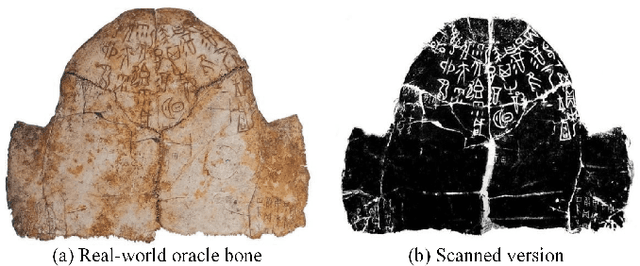
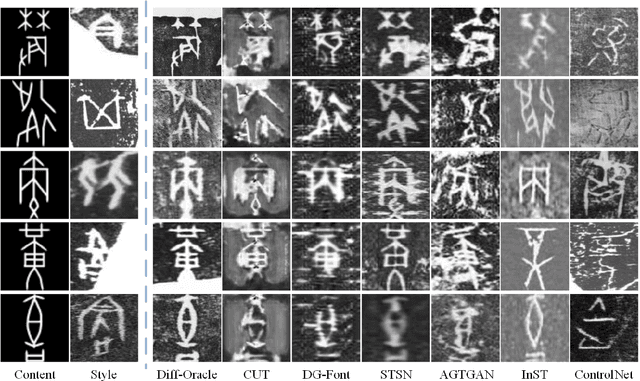
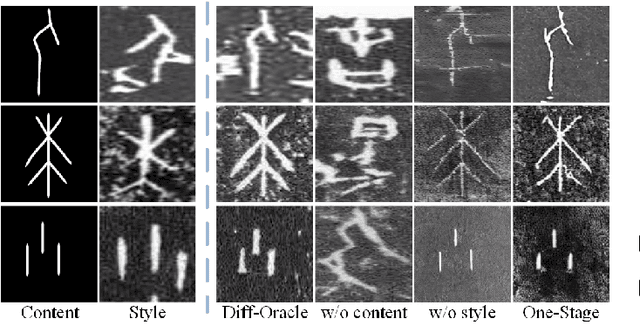

Deciphering the oracle bone script plays a significant role in Chinese archaeology and philology. However, it is significantly challenging due to the scarcity of oracle character images. To overcome this issue, we propose Diff-Oracle, based on diffusion models (DMs), to generate sufficient controllable oracle characters. In contrast to most DMs that rely on text prompts, we incorporate a style encoder to control style information during the generation process. This encoder extracts style prompts from existing oracle character images, where style details are converted from a CLIP model into a text embedding format. Inspired by ControlNet, we introduce a content encoder to capture desired content information from content images, ensuring the fidelity of character glyphs. To train Diff-Oracle effectively, we propose to obtain pixel-level paired oracle character images (i.e., style and content images) by a pre-trained image-to-image translation model. Extensive qualitative and quantitative experiments conducted on two benchmark datasets, Oracle-241 and OBC306, demonstrate that our Diff-Oracle outperforms existing generative methods in terms of image generation, further enhancing recognition accuracy. Source codes will be available.
Unraveling Batch Normalization for Realistic Test-Time Adaptation
Dec 15, 2023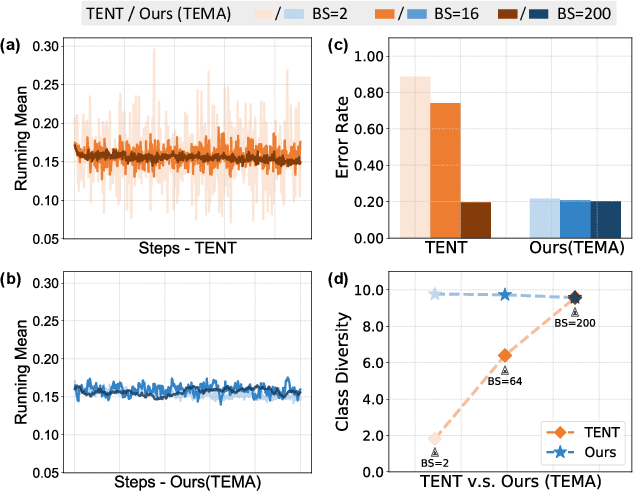
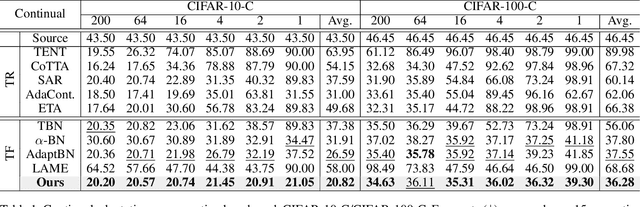
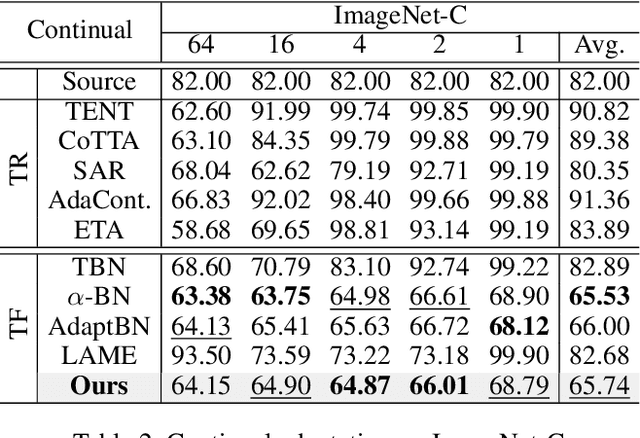
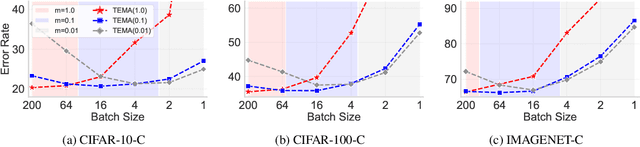
While recent test-time adaptations exhibit efficacy by adjusting batch normalization to narrow domain disparities, their effectiveness diminishes with realistic mini-batches due to inaccurate target estimation. As previous attempts merely introduce source statistics to mitigate this issue, the fundamental problem of inaccurate target estimation still persists, leaving the intrinsic test-time domain shifts unresolved. This paper delves into the problem of mini-batch degradation. By unraveling batch normalization, we discover that the inexact target statistics largely stem from the substantially reduced class diversity in batch. Drawing upon this insight, we introduce a straightforward tool, Test-time Exponential Moving Average (TEMA), to bridge the class diversity gap between training and testing batches. Importantly, our TEMA adaptively extends the scope of typical methods beyond the current batch to incorporate a diverse set of class information, which in turn boosts an accurate target estimation. Built upon this foundation, we further design a novel layer-wise rectification strategy to consistently promote test-time performance. Our proposed method enjoys a unique advantage as it requires neither training nor tuning parameters, offering a truly hassle-free solution. It significantly enhances model robustness against shifted domains and maintains resilience in diverse real-world scenarios with various batch sizes, achieving state-of-the-art performance on several major benchmarks. Code is available at \url{https://github.com/kiwi12138/RealisticTTA}.
Graph Neural Networks with Diverse Spectral Filtering
Dec 14, 2023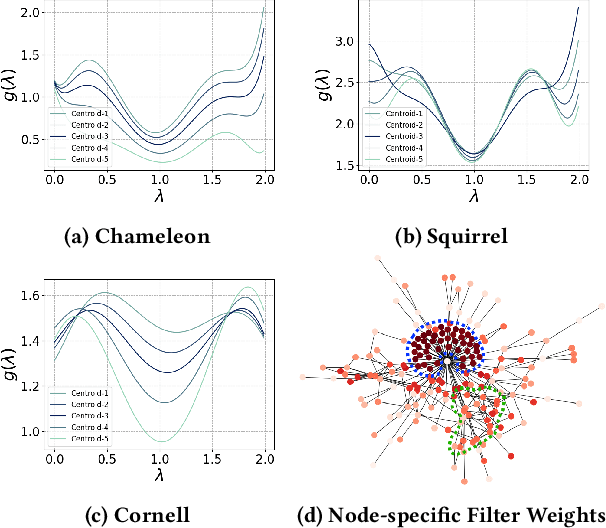
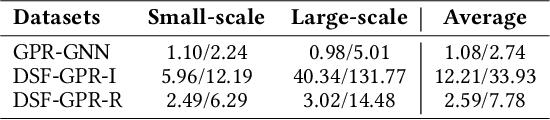
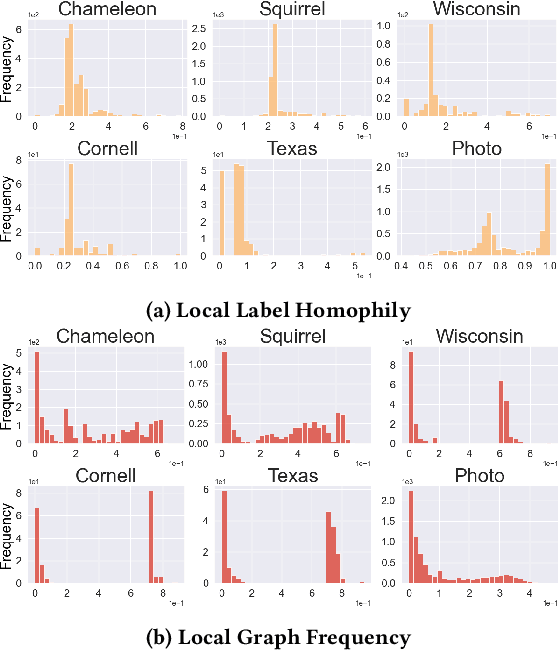
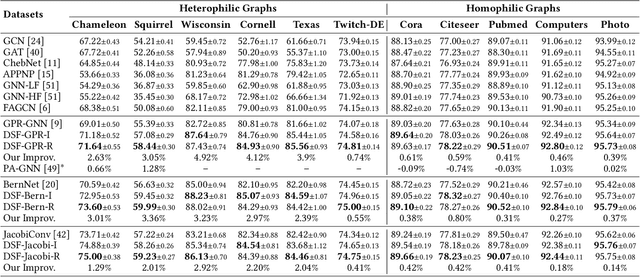
Spectral Graph Neural Networks (GNNs) have achieved tremendous success in graph machine learning, with polynomial filters applied for graph convolutions, where all nodes share the identical filter weights to mine their local contexts. Despite the success, existing spectral GNNs usually fail to deal with complex networks (e.g., WWW) due to such homogeneous spectral filtering setting that ignores the regional heterogeneity as typically seen in real-world networks. To tackle this issue, we propose a novel diverse spectral filtering (DSF) framework, which automatically learns node-specific filter weights to exploit the varying local structure properly. Particularly, the diverse filter weights consist of two components -- A global one shared among all nodes, and a local one that varies along network edges to reflect node difference arising from distinct graph parts -- to balance between local and global information. As such, not only can the global graph characteristics be captured, but also the diverse local patterns can be mined with awareness of different node positions. Interestingly, we formulate a novel optimization problem to assist in learning diverse filters, which also enables us to enhance any spectral GNNs with our DSF framework. We showcase the proposed framework on three state-of-the-arts including GPR-GNN, BernNet, and JacobiConv. Extensive experiments over 10 benchmark datasets demonstrate that our framework can consistently boost model performance by up to 4.92% in node classification tasks, producing diverse filters with enhanced interpretability. Code is available at \url{https://github.com/jingweio/DSF}.
* Accepted by Proceedings of the ACM Web Conference 2023 (WWW '23)
Polar-Doc: One-Stage Document Dewarping with Multi-Scope Constraints under Polar Representation
Dec 13, 2023Document dewarping, aiming to eliminate geometric deformation in photographed documents to benefit text recognition, has made great progress in recent years but is still far from being solved. While Cartesian coordinates are typically leveraged by state-of-the-art approaches to learn a group of deformation control points, such representation is not efficient for dewarping model to learn the deformation information. In this work, we explore Polar coordinates representation for each point in document dewarping, namely Polar-Doc. In contrast to most current works adopting a two-stage pipeline typically, Polar representation enables a unified point regression framework for both segmentation and dewarping network in one single stage. Such unification makes the whole model more efficient to learn under an end-to-end optimization pipeline, and also obtains a compact representation. Furthermore, we propose a novel multi-scope Polar-Doc-IOU loss to constrain the relationship among control points as a grid-based regularization under the Polar representation. Visual comparisons and quantitative experiments on two benchmarks show that, with much fewer parameters than the other mainstream counterparts, our one-stage model with multi-scope constraints achieves new state-of-the-art performance on both pixel alignment metrics and OCR metrics. Source codes will be available at \url{*****}.
Semantic-aware Data Augmentation for Text-to-image Synthesis
Dec 13, 2023Data augmentation has been recently leveraged as an effective regularizer in various vision-language deep neural networks. However, in text-to-image synthesis (T2Isyn), current augmentation wisdom still suffers from the semantic mismatch between augmented paired data. Even worse, semantic collapse may occur when generated images are less semantically constrained. In this paper, we develop a novel Semantic-aware Data Augmentation (SADA) framework dedicated to T2Isyn. In particular, we propose to augment texts in the semantic space via an Implicit Textual Semantic Preserving Augmentation ($ITA$), in conjunction with a specifically designed Image Semantic Regularization Loss ($L_r$) as Generated Image Semantic Conservation, to cope well with semantic mismatch and collapse. As one major contribution, we theoretically show that $ITA$ can certify better text-image consistency while $L_r$ regularizing the semantics of generated images would avoid semantic collapse and enhance image quality. Extensive experiments validate that SADA enhances text-image consistency and improves image quality significantly in T2Isyn models across various backbones. Especially, incorporating SADA during the tuning process of Stable Diffusion models also yields performance improvements.
Diff-OP3D: Bridging 2D Diffusion for Open Pose 3D Zero-Shot Classification
Dec 12, 2023With the explosive 3D data growth, the urgency of utilizing zero-shot learning to facilitate data labeling becomes evident. Recently, the methods via transferring Contrastive Language-Image Pre-training (CLIP) to 3D vision have made great progress in the 3D zero-shot classification task. However, these methods primarily focus on aligned pose 3D objects (ap-3os), overlooking the recognition of 3D objects with open poses (op-3os) typically encountered in real-world scenarios, such as an overturned chair or a lying teddy bear. To this end, we propose a more challenging benchmark for 3D open-pose zero-shot classification. Echoing our benchmark, we design a concise angle-refinement mechanism that automatically optimizes one ideal pose as well as classifies these op-3os. Furthermore, we make a first attempt to bridge 2D pre-trained diffusion model as a classifer to 3D zero-shot classification without any additional training. Such 2D diffusion to 3D objects proves vital in improving zero-shot classification for both ap-3os and op-3os. Our model notably improves by 3.5% and 15.8% on ModelNet10$^{\ddag}$ and McGill$^{\ddag}$ open pose benchmarks, respectively, and surpasses the current state-of-the-art by 6.8% on the aligned pose ModelNet10, affirming diffusion's efficacy in 3D zero-shot tasks.
Zero-Shot Medical Information Retrieval via Knowledge Graph Embedding
Oct 31, 2023In the era of the Internet of Things (IoT), the retrieval of relevant medical information has become essential for efficient clinical decision-making. This paper introduces MedFusionRank, a novel approach to zero-shot medical information retrieval (MIR) that combines the strengths of pre-trained language models and statistical methods while addressing their limitations. The proposed approach leverages a pre-trained BERT-style model to extract compact yet informative keywords. These keywords are then enriched with domain knowledge by linking them to conceptual entities within a medical knowledge graph. Experimental evaluations on medical datasets demonstrate MedFusion Rank's superior performance over existing methods, with promising results with a variety of evaluation metrics. MedFusionRank demonstrates efficacy in retrieving relevant information, even from short or single-term queries.
Context Does Matter: End-to-end Panoptic Narrative Grounding with Deformable Attention Refined Matching Network
Oct 25, 2023Panoramic Narrative Grounding (PNG) is an emerging visual grounding task that aims to segment visual objects in images based on dense narrative captions. The current state-of-the-art methods first refine the representation of phrase by aggregating the most similar $k$ image pixels, and then match the refined text representations with the pixels of the image feature map to generate segmentation results. However, simply aggregating sampled image features ignores the contextual information, which can lead to phrase-to-pixel mis-match. In this paper, we propose a novel learning framework called Deformable Attention Refined Matching Network (DRMN), whose main idea is to bring deformable attention in the iterative process of feature learning to incorporate essential context information of different scales of pixels. DRMN iteratively re-encodes pixels with the deformable attention network after updating the feature representation of the top-$k$ most similar pixels. As such, DRMN can lead to accurate yet discriminative pixel representations, purify the top-$k$ most similar pixels, and consequently alleviate the phrase-to-pixel mis-match substantially.Experimental results show that our novel design significantly improves the matching results between text phrases and image pixels. Concretely, DRMN achieves new state-of-the-art performance on the PNG benchmark with an average recall improvement 3.5%. The codes are available in: https://github.com/JaMesLiMers/DRMN.
MathAttack: Attacking Large Language Models Towards Math Solving Ability
Sep 04, 2023With the boom of Large Language Models (LLMs), the research of solving Math Word Problem (MWP) has recently made great progress. However, there are few studies to examine the security of LLMs in math solving ability. Instead of attacking prompts in the use of LLMs, we propose a MathAttack model to attack MWP samples which are closer to the essence of security in solving math problems. Compared to traditional text adversarial attack, it is essential to preserve the mathematical logic of original MWPs during the attacking. To this end, we propose logical entity recognition to identify logical entries which are then frozen. Subsequently, the remaining text are attacked by adopting a word-level attacker. Furthermore, we propose a new dataset RobustMath to evaluate the robustness of LLMs in math solving ability. Extensive experiments on our RobustMath and two another math benchmark datasets GSM8K and MultiAirth show that MathAttack could effectively attack the math solving ability of LLMs. In the experiments, we observe that (1) Our adversarial samples from higher-accuracy LLMs are also effective for attacking LLMs with lower accuracy (e.g., transfer from larger to smaller-size LLMs, or from few-shot to zero-shot prompts); (2) Complex MWPs (such as more solving steps, longer text, more numbers) are more vulnerable to attack; (3) We can improve the robustness of LLMs by using our adversarial samples in few-shot prompts. Finally, we hope our practice and observation can serve as an important attempt towards enhancing the robustness of LLMs in math solving ability. We will release our code and dataset.