 Add to Chrome
 Add to Firefox
 Add to Edge
RAPID: A Reproducible Multi-Agent Pipeline for Interpretable Disaster Damage Assessment from Satellite and Street-View Imagery
Jun 20, 2026
Due to the increasing frequency and intensity of extreme climate events, there is a clear demand for intelligent, scalable, and autonomous approaches to disaster damage assessment. Existing methods, largely based on supervised learning and task-specific fine-tuning, struggle to generalize under domain shifts, long-tailed data distributions, and heterogeneous geospatial data sources, especially in disaster scenarios. They also often lack the ability to integrate and reason across multimodal geospatial information, such as satellite images and street-view images. In this paper, we introduce RAPID, a reproducible multi-agent pipeline for interpretable disaster damage assessment, including damage-level assessment, damage-type interpretation, and actionable suggestions for response, remediation, and recovery. RAPID coordinates specialized agents to perform cross-view understanding, image restoration, structured damage recognition, and geographical reasoning across heterogeneous data modalities. Without task-specific fine-tuning, RAPID supports zero-shot damage assessment by jointly using complementary information from remote sensing and ground-level perspectives. The system produces fine-grained, interpretable assessments and automatically generates location-specific, decision-relevant disaster reports to support early-stage emergency response. We evaluate RAPID across hurricanes, floods, wildfires, and earthquakes using multiple cross-view imagery inputs, including pre- and post-disaster street-view images, post-disaster remote sensing imagery, and street-view image pairs. Experiments show that RAPID achieves 0.92 overall accuracy for multi-disaster type classification and up to 0.627 for cross-view damage severity prediction, highlighting its potential as a foundational framework for autonomous disaster intelligence.

GIScholarBench: Benchmarking LLM Overconfidence in GIS Research
Jun 06, 2026Large language models (LLMs) are increasingly used in academic research workflows, but scholarly tasks require high factual precision and therefore expose a key weakness: overconfidence. Here, overconfidence is defined behaviorally as the tendency to produce confident, assertive, and well-formatted outputs even when the underlying knowledge is incomplete or unverifiable, rather than as a calibration gap between stated confidence and accuracy. To examine this issue, we introduce GIScholarBench, a benchmark built from 10,865 papers published in 25 core GIScience journals between 2020 and 2025. The benchmark covers three tasks with increasing cognitive complexity: metadata retrieval, literature linking, and research direction generation. We evaluate Claude Sonnet 4.5, Gemini 3, and ChatGPT 5.3 through their native web interfaces under real-world user-facing conditions. Results show consistent overconfidence across all tasks. In metadata retrieval, ChatGPT 5.3 achieves the highest accuracy, but all models still generate definitive titles and DOIs when predictions are wrong. In literature linking, Claude Sonnet 4.5 recovers the most references, but all models show a clear gap between top-ranked retrieval and longer citation lists, suggesting that references are extended beyond reliable retrieval capacity. In research direction generation, AI-generated directions show lower topic coverage, higher novel miss rates, and lower semantic diversity than real future-citing papers. These findings suggest that LLM overconfidence is task-invariant but takes different forms: factual overgeneration in retrieval, unreliable citation expansion in literature linking, and overconfidence in output completeness during research ideation.
Information Sieve: Content Leakage Reduction in End-to-End Prosody For Expressive Speech Synthesis
Aug 04, 2021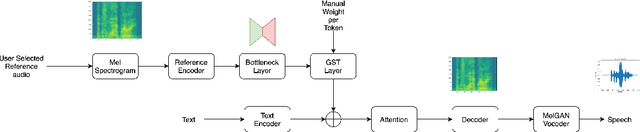
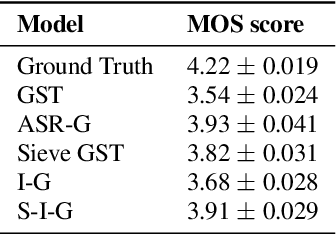
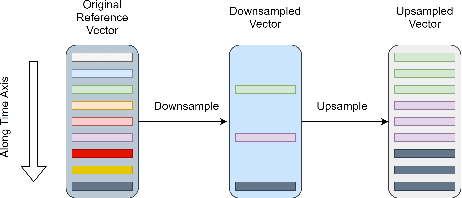
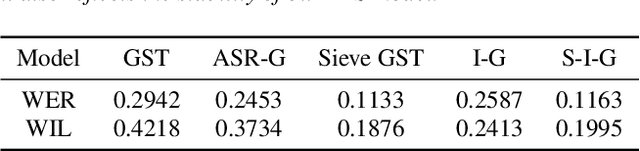
Expressive neural text-to-speech (TTS) systems incorporate a style encoder to learn a latent embedding as the style information. However, this embedding process may encode redundant textual information. This phenomenon is called content leakage. Researchers have attempted to resolve this problem by adding an ASR or other auxiliary supervision loss functions. In this study, we propose an unsupervised method called the "information sieve" to reduce the effect of content leakage in prosody transfer. The rationale of this approach is that the style encoder can be forced to focus on style information rather than on textual information contained in the reference speech by a well-designed downsample-upsample filter, i.e., the extracted style embeddings can be downsampled at a certain interval and then upsampled by duplication. Furthermore, we used instance normalization in convolution layers to help the system learn a better latent style space. Objective metrics such as the significantly lower word error rate (WER) demonstrate the effectiveness of this model in mitigating content leakage. Listening tests indicate that the model retains its prosody transferability compared with the baseline models such as the original GST-Tacotron and ASR-guided Tacotron.