 Add to Chrome
 Add to Firefox
 Add to Edge
RAPID: A Reproducible Multi-Agent Pipeline for Interpretable Disaster Damage Assessment from Satellite and Street-View Imagery
Jun 20, 2026
Due to the increasing frequency and intensity of extreme climate events, there is a clear demand for intelligent, scalable, and autonomous approaches to disaster damage assessment. Existing methods, largely based on supervised learning and task-specific fine-tuning, struggle to generalize under domain shifts, long-tailed data distributions, and heterogeneous geospatial data sources, especially in disaster scenarios. They also often lack the ability to integrate and reason across multimodal geospatial information, such as satellite images and street-view images. In this paper, we introduce RAPID, a reproducible multi-agent pipeline for interpretable disaster damage assessment, including damage-level assessment, damage-type interpretation, and actionable suggestions for response, remediation, and recovery. RAPID coordinates specialized agents to perform cross-view understanding, image restoration, structured damage recognition, and geographical reasoning across heterogeneous data modalities. Without task-specific fine-tuning, RAPID supports zero-shot damage assessment by jointly using complementary information from remote sensing and ground-level perspectives. The system produces fine-grained, interpretable assessments and automatically generates location-specific, decision-relevant disaster reports to support early-stage emergency response. We evaluate RAPID across hurricanes, floods, wildfires, and earthquakes using multiple cross-view imagery inputs, including pre- and post-disaster street-view images, post-disaster remote sensing imagery, and street-view image pairs. Experiments show that RAPID achieves 0.92 overall accuracy for multi-disaster type classification and up to 0.627 for cross-view damage severity prediction, highlighting its potential as a foundational framework for autonomous disaster intelligence.

DamageArbiter: A CLIP-Enhanced Multimodal Arbitration Framework for Hurricane Damage Assessment from Street-View Imagery
Mar 16, 2026Analyzing street-view imagery with computer vision models for rapid, hyperlocal damage assessment is becoming popular and valuable in emergency response and recovery, but traditional models often act like black boxes, lacking interpretability and reliability. This study proposes a multimodal disagreement-driven Arbitration framework powered by Contrastive Language-Image Pre-training (CLIP) models, DamageArbiter, to improve the accuracy, interpretability, and robustness of damage estimation from street-view imagery. DamageArbiter leverages the complementary strengths of unimodal and multimodal models, employing a lightweight logistic regression meta-classifier to arbitrate cases of disagreement. Using 2,556 post-disaster street-view images, paired with both manually generated and large language model (LLM)-generated text descriptions, we systematically compared the performance of unimodal models (including image-only and text-only models), multimodal CLIP-based models, and DamageArbiter. Notably, DamageArbiter improved the accuracy from 74.33% (ViT-B/32, image-only) to 82.79%, surpassing the 80% accuracy threshold and achieving an absolute improvement of 8.46% compared to the strongest baseline model. Beyond improvements in overall accuracy, compared to visual models relying solely on images, DamageArbiter, through arbitration of discrepancies between unimodal and multimodal predictions, mitigates common overconfidence errors in visual models, especially in situations where disaster visual cues are ambiguous or subject to interference, reducing overconfidence but incorrect predictions. We further mapped and analyzed geo-referenced predictions and misclassifications to compare model performance across locations. Overall, this work advances street-view-based disaster assessment from coarse severity classification toward a more reliable and interpretable framework.
StreetviewLLM: Extracting Geographic Information Using a Chain-of-Thought Multimodal Large Language Model
Nov 19, 2024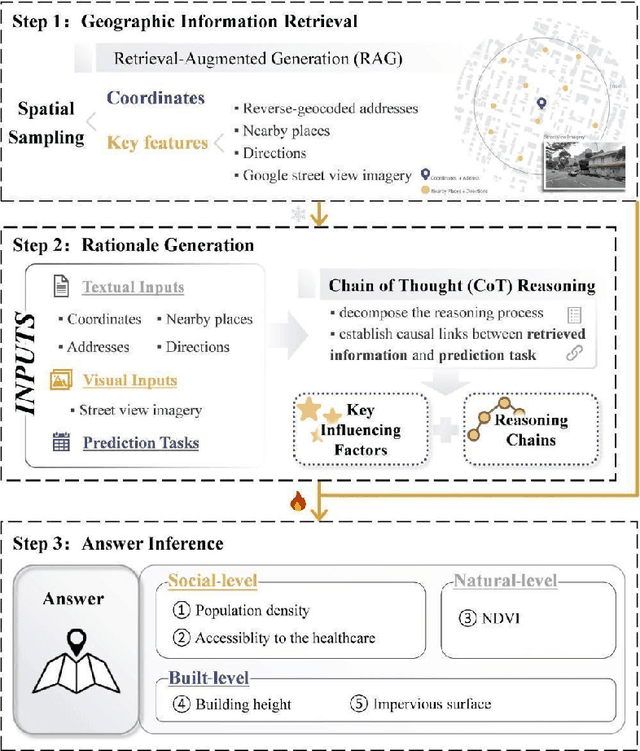
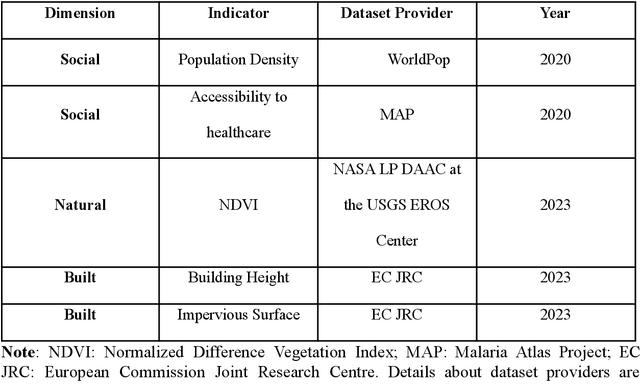

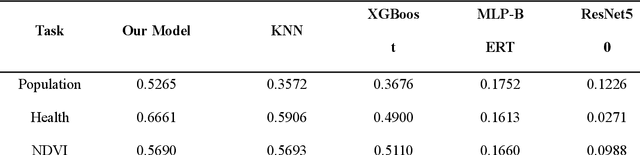
Geospatial predictions are crucial for diverse fields such as disaster management, urban planning, and public health. Traditional machine learning methods often face limitations when handling unstructured or multi-modal data like street view imagery. To address these challenges, we propose StreetViewLLM, a novel framework that integrates a large language model with the chain-of-thought reasoning and multimodal data sources. By combining street view imagery with geographic coordinates and textual data, StreetViewLLM improves the precision and granularity of geospatial predictions. Using retrieval-augmented generation techniques, our approach enhances geographic information extraction, enabling a detailed analysis of urban environments. The model has been applied to seven global cities, including Hong Kong, Tokyo, Singapore, Los Angeles, New York, London, and Paris, demonstrating superior performance in predicting urban indicators, including population density, accessibility to healthcare, normalized difference vegetation index, building height, and impervious surface. The results show that StreetViewLLM consistently outperforms baseline models, offering improved predictive accuracy and deeper insights into the built environment. This research opens new opportunities for integrating the large language model into urban analytics, decision-making in urban planning, infrastructure management, and environmental monitoring.
BuildingView: Constructing Urban Building Exteriors Databases with Street View Imagery and Multimodal Large Language Mode
Sep 29, 2024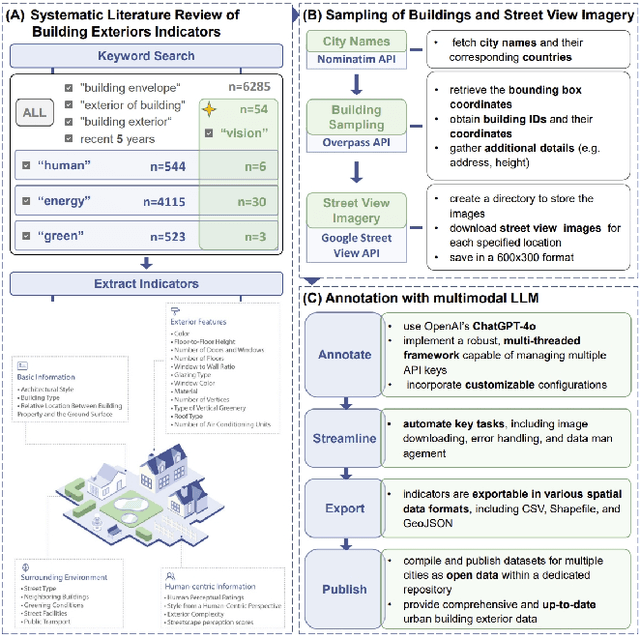
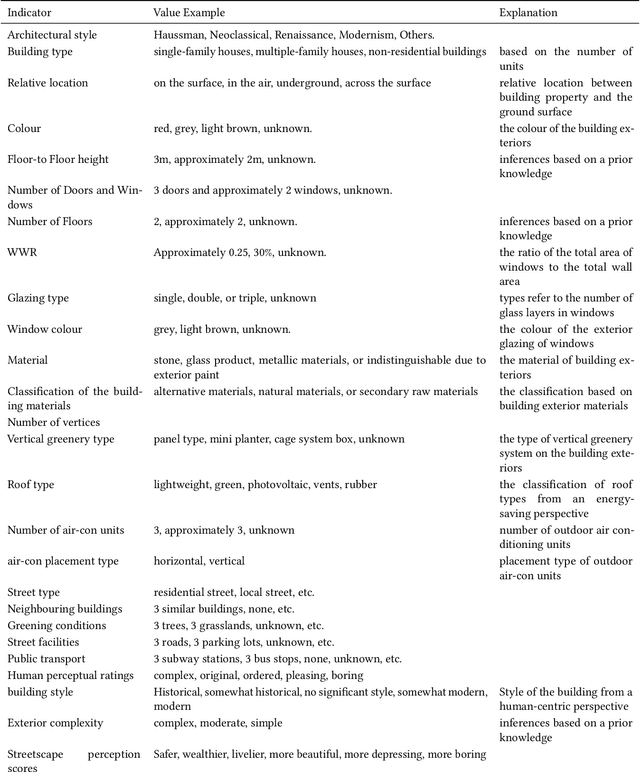
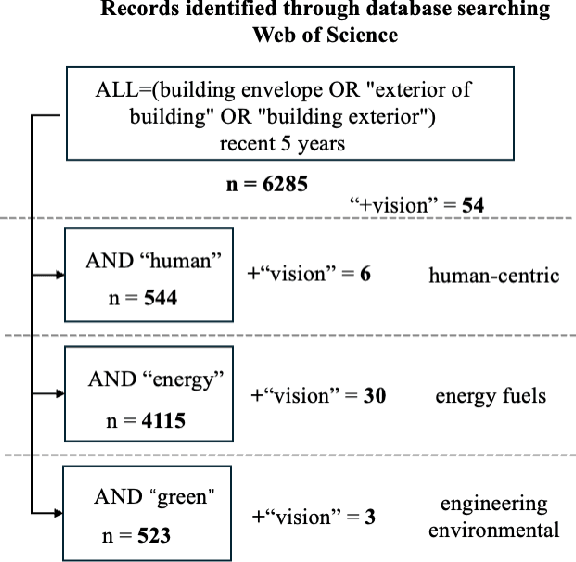
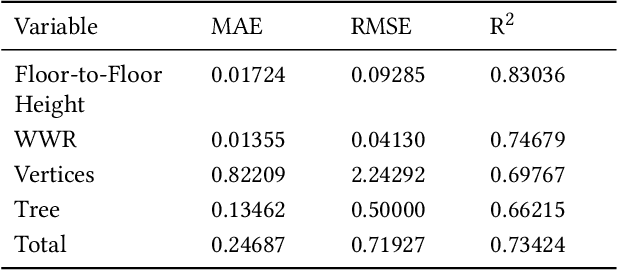
Urban Building Exteriors are increasingly important in urban analytics, driven by advancements in Street View Imagery and its integration with urban research. Multimodal Large Language Models (LLMs) offer powerful tools for urban annotation, enabling deeper insights into urban environments. However, challenges remain in creating accurate and detailed urban building exterior databases, identifying critical indicators for energy efficiency, environmental sustainability, and human-centric design, and systematically organizing these indicators. To address these challenges, we propose BuildingView, a novel approach that integrates high-resolution visual data from Google Street View with spatial information from OpenStreetMap via the Overpass API. This research improves the accuracy of urban building exterior data, identifies key sustainability and design indicators, and develops a framework for their extraction and categorization. Our methodology includes a systematic literature review, building and Street View sampling, and annotation using the ChatGPT-4O API. The resulting database, validated with data from New York City, Amsterdam, and Singapore, provides a comprehensive tool for urban studies, supporting informed decision-making in urban planning, architectural design, and environmental policy. The code for BuildingView is available at https://github.com/Jasper0122/BuildingView.