 Add to Chrome
 Add to Firefox
 Add to Edge
Do MLLMs Really See It: Reinforcing Visual Attention in Multimodal LLMs
Feb 09, 2026
While chain-of-thought (CoT) reasoning has substantially improved multimodal large language models (MLLMs) on complex reasoning tasks, existing approaches largely rely on long textual reasoning trajectories and provide limited mechanisms for learning stable visual attention policies. Our analysis shows that current MLLMs exhibit weak visual focus: early-stage visual misalignment is rarely corrected during subsequent reasoning, leading to error propagation and failed inferences. We argue that this limitation stems from inadequate credit assignment for visual attention during training. To address this issue, we propose SAYO, a visual reasoning model trained with a reinforcement learning (RL) framework that introduces a region-level visual attention-based reward. This reward explicitly aligns optimization signals with visually grounded reasoning steps, enabling the model to learn more reliable attention behaviors. Extensive experiments across multiple multimodal benchmarks demonstrate that SAYO consistently improves performance on diverse reasoning and perception tasks.

One-Shot Crowd Counting With Density Guidance For Scene Adaptaion
Feb 08, 2026Crowd scenes captured by cameras at different locations vary greatly, and existing crowd models have limited generalization for unseen surveillance scenes. To improve the generalization of the model, we regard different surveillance scenes as different category scenes, and introduce few-shot learning to make the model adapt to the unseen surveillance scene that belongs to the given exemplar category scene. To this end, we propose to leverage local and global density characteristics to guide the model of crowd counting for unseen surveillance scenes. Specifically, to enable the model to adapt to the varying density variations in the target scene, we propose the multiple local density learner to learn multi prototypes which represent different density distributions in the support scene. Subsequently, these multiple local density similarity matrixes are encoded. And they are utilized to guide the model in a local way. To further adapt to the global density in the target scene, the global density features are extracted from the support image, then it is used to guide the model in a global way. Experiments on three surveillance datasets shows that proposed method can adapt to the unseen surveillance scene and outperform recent state-of-the-art methods in the few-shot crowd counting.
FusAD: Time-Frequency Fusion with Adaptive Denoising for General Time Series Analysis
Dec 16, 2025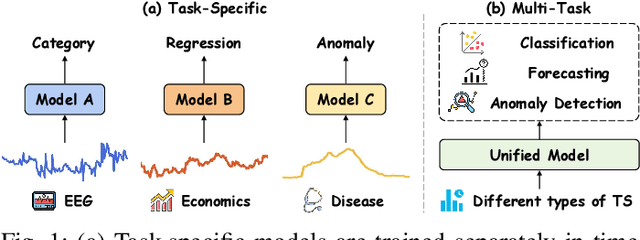
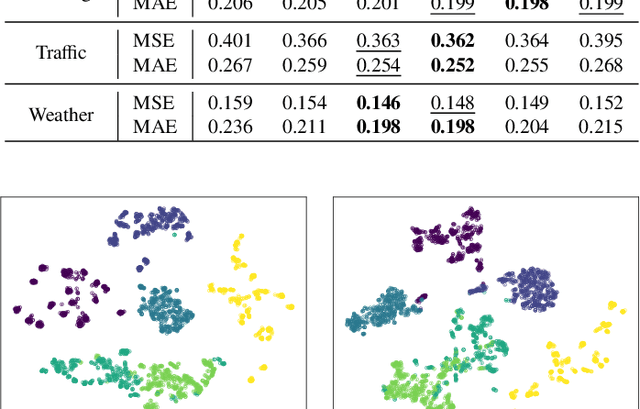
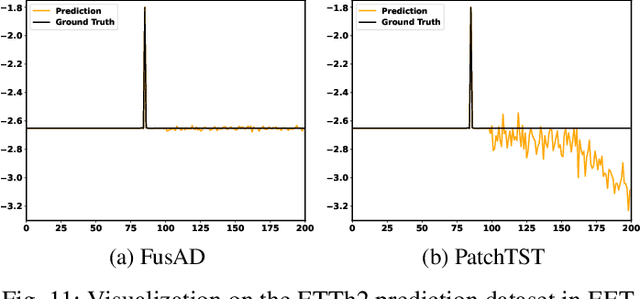
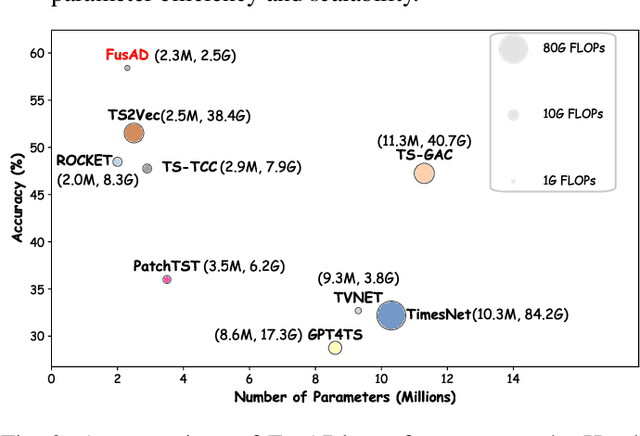
Time series analysis plays a vital role in fields such as finance, healthcare, industry, and meteorology, underpinning key tasks including classification, forecasting, and anomaly detection. Although deep learning models have achieved remarkable progress in these areas in recent years, constructing an efficient, multi-task compatible, and generalizable unified framework for time series analysis remains a significant challenge. Existing approaches are often tailored to single tasks or specific data types, making it difficult to simultaneously handle multi-task modeling and effectively integrate information across diverse time series types. Moreover, real-world data are often affected by noise, complex frequency components, and multi-scale dynamic patterns, which further complicate robust feature extraction and analysis. To ameliorate these challenges, we propose FusAD, a unified analysis framework designed for diverse time series tasks. FusAD features an adaptive time-frequency fusion mechanism, integrating both Fourier and Wavelet transforms to efficiently capture global-local and multi-scale dynamic features. With an adaptive denoising mechanism, FusAD automatically senses and filters various types of noise, highlighting crucial sequence variations and enabling robust feature extraction in complex environments. In addition, the framework integrates a general information fusion and decoding structure, combined with masked pre-training, to promote efficient learning and transfer of multi-granularity representations. Extensive experiments demonstrate that FusAD consistently outperforms state-of-the-art models on mainstream time series benchmarks for classification, forecasting, and anomaly detection tasks, while maintaining high efficiency and scalability. Code is available at https://github.com/zhangda1018/FusAD.
Exploring the Underwater World Segmentation without Extra Training
Nov 11, 2025Accurate segmentation of marine organisms is vital for biodiversity monitoring and ecological assessment, yet existing datasets and models remain largely limited to terrestrial scenes. To bridge this gap, we introduce \textbf{AquaOV255}, the first large-scale and fine-grained underwater segmentation dataset containing 255 categories and over 20K images, covering diverse categories for open-vocabulary (OV) evaluation. Furthermore, we establish the first underwater OV segmentation benchmark, \textbf{UOVSBench}, by integrating AquaOV255 with five additional underwater datasets to enable comprehensive evaluation. Alongside, we present \textbf{Earth2Ocean}, a training-free OV segmentation framework that transfers terrestrial vision--language models (VLMs) to underwater domains without any additional underwater training. Earth2Ocean consists of two core components: a Geometric-guided Visual Mask Generator (\textbf{GMG}) that refines visual features via self-similarity geometric priors for local structure perception, and a Category-visual Semantic Alignment (\textbf{CSA}) module that enhances text embeddings through multimodal large language model reasoning and scene-aware template construction. Extensive experiments on the UOVSBench benchmark demonstrate that Earth2Ocean achieves significant performance improvement on average while maintaining efficient inference.
Secure Tug-of-War (SecTOW): Iterative Defense-Attack Training with Reinforcement Learning for Multimodal Model Security
Jul 29, 2025The rapid advancement of multimodal large language models (MLLMs) has led to breakthroughs in various applications, yet their security remains a critical challenge. One pressing issue involves unsafe image-query pairs--jailbreak inputs specifically designed to bypass security constraints and elicit unintended responses from MLLMs. Compared to general multimodal data, such unsafe inputs are relatively sparse, which limits the diversity and richness of training samples available for developing robust defense models. Meanwhile, existing guardrail-type methods rely on external modules to enforce security constraints but fail to address intrinsic vulnerabilities within MLLMs. Traditional supervised fine-tuning (SFT), on the other hand, often over-refuses harmless inputs, compromising general performance. Given these challenges, we propose Secure Tug-of-War (SecTOW), an innovative iterative defense-attack training method to enhance the security of MLLMs. SecTOW consists of two modules: a defender and an auxiliary attacker, both trained iteratively using reinforcement learning (GRPO). During the iterative process, the attacker identifies security vulnerabilities in the defense model and expands jailbreak data. The expanded data are then used to train the defender, enabling it to address identified security vulnerabilities. We also design reward mechanisms used for GRPO to simplify the use of response labels, reducing dependence on complex generative labels and enabling the efficient use of synthetic data. Additionally, a quality monitoring mechanism is used to mitigate the defender's over-refusal of harmless inputs and ensure the diversity of the jailbreak data generated by the attacker. Experimental results on safety-specific and general benchmarks demonstrate that SecTOW significantly improves security while preserving general performance.
WebUIBench: A Comprehensive Benchmark for Evaluating Multimodal Large Language Models in WebUI-to-Code
Jun 09, 2025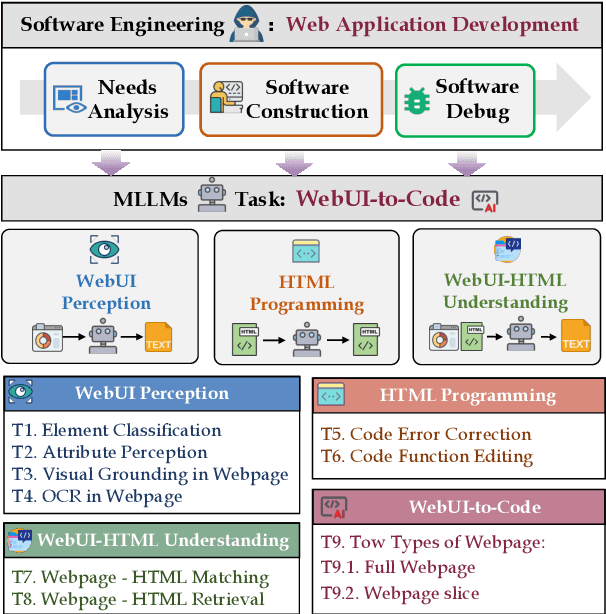
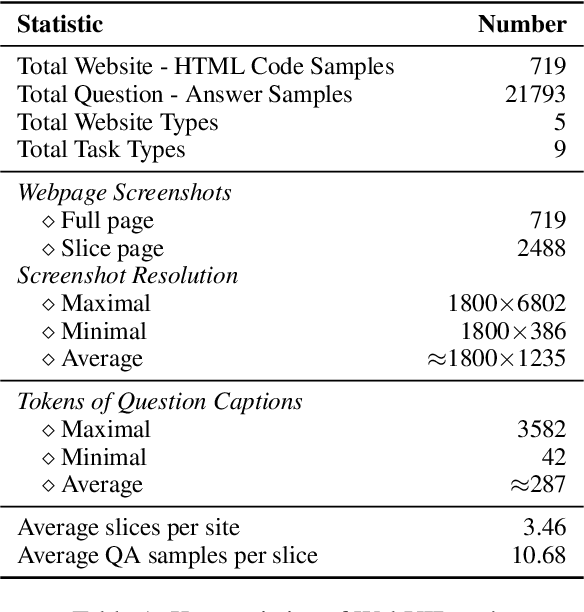
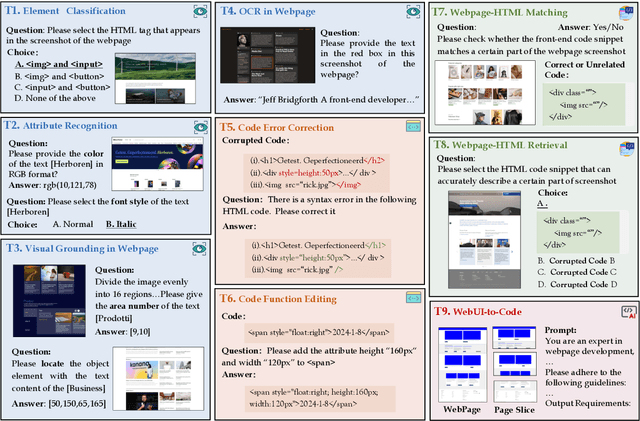
With the rapid advancement of Generative AI technology, Multimodal Large Language Models(MLLMs) have the potential to act as AI software engineers capable of executing complex web application development. Considering that the model requires a confluence of multidimensional sub-capabilities to address the challenges of various development phases, constructing a multi-view evaluation framework is crucial for accurately guiding the enhancement of development efficiency. However, existing benchmarks usually fail to provide an assessment of sub-capabilities and focus solely on webpage generation outcomes. In this work, we draw inspiration from the principles of software engineering and further propose WebUIBench, a benchmark systematically designed to evaluate MLLMs in four key areas: WebUI Perception, HTML Programming,WebUI-HTML Understanding, and WebUI-to-Code. WebUIBench comprises 21K high-quality question-answer pairs derived from over 0.7K real-world websites. The extensive evaluation of 29 mainstream MLLMs uncovers the skill characteristics and various weakness that models encountered during the development process.
LLMs Caught in the Crossfire: Malware Requests and Jailbreak Challenges
Jun 09, 2025The widespread adoption of Large Language Models (LLMs) has heightened concerns about their security, particularly their vulnerability to jailbreak attacks that leverage crafted prompts to generate malicious outputs. While prior research has been conducted on general security capabilities of LLMs, their specific susceptibility to jailbreak attacks in code generation remains largely unexplored. To fill this gap, we propose MalwareBench, a benchmark dataset containing 3,520 jailbreaking prompts for malicious code-generation, designed to evaluate LLM robustness against such threats. MalwareBench is based on 320 manually crafted malicious code generation requirements, covering 11 jailbreak methods and 29 code functionality categories. Experiments show that mainstream LLMs exhibit limited ability to reject malicious code-generation requirements, and the combination of multiple jailbreak methods further reduces the model's security capabilities: specifically, the average rejection rate for malicious content is 60.93%, dropping to 39.92% when combined with jailbreak attack algorithms. Our work highlights that the code security capabilities of LLMs still pose significant challenges.
Scale Efficient Training for Large Datasets
Mar 17, 2025


The rapid growth of dataset scales has been a key driver in advancing deep learning research. However, as dataset scale increases, the training process becomes increasingly inefficient due to the presence of low-value samples, including excessive redundant samples, overly challenging samples, and inefficient easy samples that contribute little to model improvement.To address this challenge, we propose Scale Efficient Training (SeTa) for large datasets, a dynamic sample pruning approach that losslessly reduces training time. To remove low-value samples, SeTa first performs random pruning to eliminate redundant samples, then clusters the remaining samples according to their learning difficulty measured by loss. Building upon this clustering, a sliding window strategy is employed to progressively remove both overly challenging and inefficient easy clusters following an easy-to-hard curriculum.We conduct extensive experiments on large-scale synthetic datasets, including ToCa, SS1M, and ST+MJ, each containing over 3 million samples.SeTa reduces training costs by up to 50\% while maintaining or improving performance, with minimal degradation even at 70\% cost reduction. Furthermore, experiments on various scale real datasets across various backbones (CNNs, Transformers, and Mambas) and diverse tasks (instruction tuning, multi-view stereo, geo-localization, composed image retrieval, referring image segmentation) demonstrate the powerful effectiveness and universality of our approach. Code is available at https://github.com/mrazhou/SeTa.
From Captions to Rewards (CAREVL): Leveraging Large Language Model Experts for Enhanced Reward Modeling in Large Vision-Language Models
Mar 08, 2025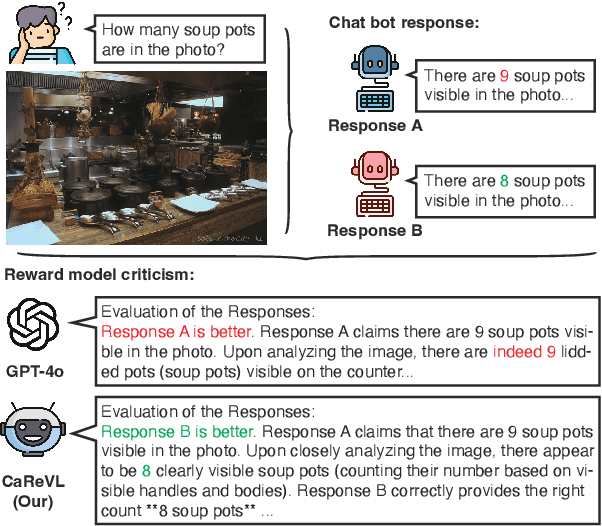
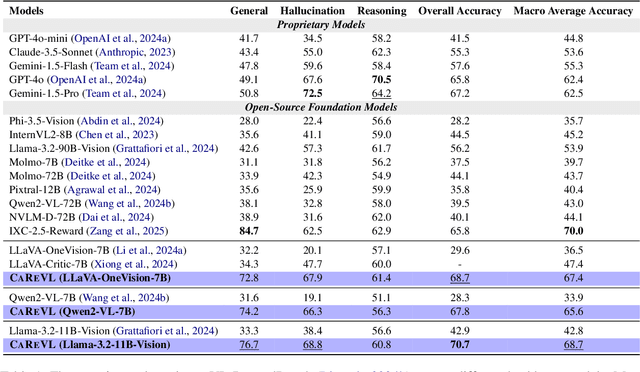
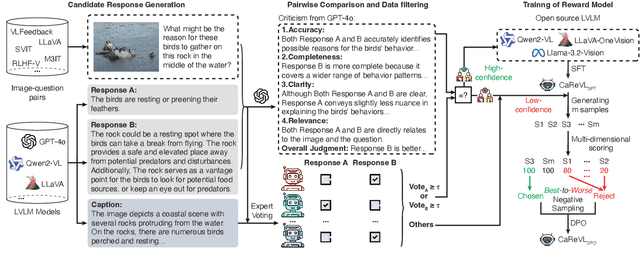
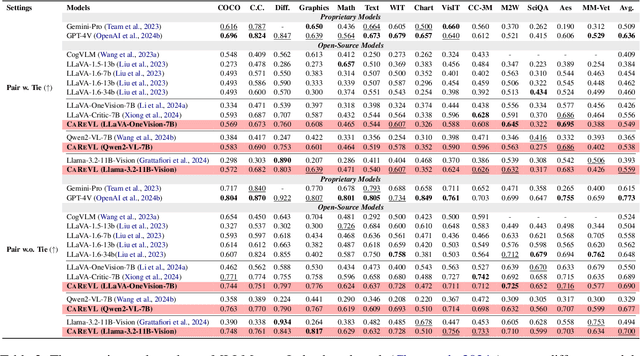
Aligning large vision-language models (LVLMs) with human preferences is challenging due to the scarcity of fine-grained, high-quality, and multimodal preference data without human annotations. Existing methods relying on direct distillation often struggle with low-confidence data, leading to suboptimal performance. To address this, we propose CAREVL, a novel method for preference reward modeling by reliably using both high- and low-confidence data. First, a cluster of auxiliary expert models (textual reward models) innovatively leverages image captions as weak supervision signals to filter high-confidence data. The high-confidence data are then used to fine-tune the LVLM. Second, low-confidence data are used to generate diverse preference samples using the fine-tuned LVLM. These samples are then scored and selected to construct reliable chosen-rejected pairs for further training. CAREVL achieves performance improvements over traditional distillation-based methods on VL-RewardBench and MLLM-as-a-Judge benchmark, demonstrating its effectiveness. The code will be released soon.
A Benchmark for Multi-Lingual Vision-Language Learning in Remote Sensing Image Captioning
Mar 06, 2025
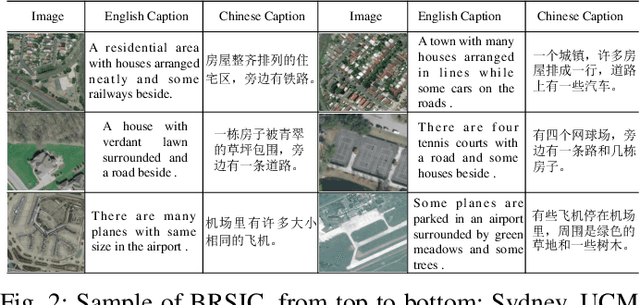
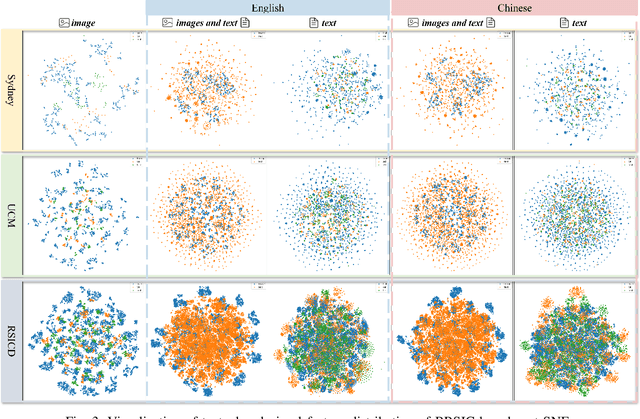

Remote Sensing Image Captioning (RSIC) is a cross-modal field bridging vision and language, aimed at automatically generating natural language descriptions of features and scenes in remote sensing imagery. Despite significant advances in developing sophisticated methods and large-scale datasets for training vision-language models (VLMs), two critical challenges persist: the scarcity of non-English descriptive datasets and the lack of multilingual capability evaluation for models. These limitations fundamentally impede the progress and practical deployment of RSIC, particularly in the era of large VLMs. To address these challenges, this paper presents several significant contributions to the field. First, we introduce and analyze BRSIC (Bilingual Remote Sensing Image Captioning), a comprehensive bilingual dataset that enriches three established English RSIC datasets with Chinese descriptions, encompassing 13,634 images paired with 68,170 bilingual captions. Building upon this foundation, we develop a systematic evaluation framework that addresses the prevalent inconsistency in evaluation protocols, enabling rigorous assessment of model performance through standardized retraining procedures on BRSIC. Furthermore, we present an extensive empirical study of eight state-of-the-art large vision-language models (LVLMs), examining their capabilities across multiple paradigms including zero-shot inference, supervised fine-tuning, and multi-lingual training. This comprehensive evaluation provides crucial insights into the strengths and limitations of current LVLMs in handling multilingual remote sensing tasks. Additionally, our cross-dataset transfer experiments reveal interesting findings. The code and data will be available at https://github.com/mrazhou/BRSIC.