 Add to Chrome
 Add to Firefox
 Add to Edge
Scaling Representation Diversity: Modulated Attention and Reconstructive Regularization for Visual Grounding
Aug 13, 2026
Referring Expression Comprehension (REC) is commonly studied under dataset-specific fine-tuning, resulting in specialist models with limited cross-dataset generalization. In this work, we revisit REC from the perspective of unified open-vocabulary grounding and identify representation degeneration as a key obstacle to scaling a single generalist model. To preserve representation diversity, we propose a holistic data-model co-design framework. Architecturally, we introduce the Modulated Attention-Contrastive Head (mACH) for efficient token-level vision-language alignment and a text-conditioned JEPA auxiliary stream that provides complementary gradient support to preserve alignment-active representations without inference overhead. On the data side, we introduce Objects365-Caption, enriching Objects365 with context-aware referring expressions for large-scale language supervision. We further provide a theoretical analysis showing that complementary gradient subspaces preserve alignment capacity and thereby scale representation diversity. Extensive experiments demonstrate that our single-checkpoint framework achieves highly competitive performance on standard REC benchmarks while exhibiting strong generalization across heterogeneous grounding datasets without benchmark-specific adaptation.

H+ Embedding: Harmonizing Global and Token-Level Retrieval with Context-Dependent Phrases
Jul 29, 2026Terminology-intensive retrieval, especially in medical settings, depends on preserving multi-word entities, abbreviations, numerical constraints, and compositional concepts. However, existing representations lie at two extremes: single-vector retrievers often over-compress local relevance signals, while token-level late interaction retains every tokenizer subword at substantial indexing, storage, and scoring cost. This mismatch raises a natural question: can context-dependent phrases provide a useful retrieval unit between global vectors and tokens? We introduce H+ Embedding, a unified multi-granularity retriever that predicts variable-length phrase partitions, preserves uncovered tokens as singletons, and applies importance-guided unit selection with weighted MaxSim interaction. Across 16 scientific, medical, and bilingual tasks, its phrase retrieval branch exceeds the global retrieval branch by 6.91 macro nDCG@10. It also nearly matches Token while using 13.7% fewer document vectors and outperforms content-independent grouping rules under moderate vector budgets. Context-dependent phrase interaction therefore provides an intermediate quality-cost point between global compression and token-level interaction for practical retrieval systems.
Learning Adaptive Safety Margins for Visual Navigation
Jul 20, 2026Robots in cluttered indoor spaces often fail not because they cannot generate collision-free paths, but because a fixed safety margin is mis-calibrated: conservative margins cause detours and timeouts, while permissive margins lead to near-boundary shortcuts under perception bias. Diffusion-based planners propose diverse trajectory candidates from egocentric RGB-D, yet reliable selection remains the bottleneck. We propose a context-conditioned safety critic that learns an adaptive clearance preference for ranking diffusion proposals, decomposed into three complementary terms: (i) a safety term with a clearance-budget penalty and a control-barrier-function residual for waypoint- and transition-wise safety, (ii) an efficiency term combining a smoothness penalty with a safety-gated detour-ratio penalty that avoids detours without incentivizing risky shortcuts, and (iii) a distance-constraint matching term that anchors the learned budget to realized ESDF clearances to prevent margin collapse. We train the critic with privileged ESDF geometry in simulation and distill it into a perception-only selector via a two-stage teacher-student procedure. On PointGoal navigation in HM3D and MP3D, including cross-dataset transfer, our method achieves the highest success rate (SR) and success weighted by path length (SPL) among strong diffusion, optimization, and RL baselines. Trained purely in simulation, it transfers to a Unitree G1 humanoid and navigates cluttered indoor scenes without task-specific tuning.
VTaMo: Video-Text Alignment Model for Sign Language Translation
Jul 10, 2026Sign language translation (SLT) converts continuous sign videos into spoken language text. Gloss-free approaches leverage pre-trained visual encoders and language models but rely on implicit cross-modal alignment from translation supervision alone. We present VTaMo, a framework that introduces explicit multi-granularity alignment at three levels: (1) local alignment via entropy-regularized optimal transport with a learnable null token for fine-grained frame-to-token correspondences; (2) global alignment via a learnable orthogonal transformation that calibrates embedding space geometry through Earth Mover's Distance; and (3) position-aligned contrastive learning for discriminative token-level representations. Experiments on Phoenix-2014T, CSL-Daily, How2Sign, and OpenASL demonstrate consistent state-of-the-art performance, with ablations confirming the complementary contributions of each component. Code is available at https://github.com/junyi2005/vtamo.
SignNet-1M: Large-Scale Multilingual Sign Language Video Dataset with Downstream Benchmarks
Jun 23, 2026Sign language models are typically trained on datasets captured under constrained conditions, with limited viewpoint, background, and signer-identity diversity, leading to poor robustness under real-world distribution shifts. We introduce SignNet-1M, a large-scale augmented dataset spanning ASL, CSL, and German Sign Language (DGS). SignNet-1M synthesizes realistic variations along three axes: (i) novel-view rendering (rotation and zoom) via 3D Gaussian Splatting (3DGS), (ii) scene/identity editing via diffusion models for background replacement and signer substitution while preserving sign motion and linguistic content, and (iii) post-rendering augmentations that emulate capture and compression artifacts (e.g., pose/temporal perturbations and video-level corruptions) to better match in-the-wild recordings. Beyond data release, we provide a unified benchmark suite across downstream tasks (e.g., translation and recognition) and ablations that isolate each augmentation component. Experiments across backbones show that training with SignNet-1M consistently improves generalization under cross-view, cross-background, cross-identity, and post-rendering shifts, while maintaining strong in-distribution performance. The dataset, full augmentation pipeline, and benchmark are available at https://signnet.chatsign.ai/.
ExpAlign: Expectation-Guided Vision-Language Alignment for Open-Vocabulary Grounding
Jan 30, 2026Open-vocabulary grounding requires accurate vision-language alignment under weak supervision, yet existing methods either rely on global sentence embeddings that lack fine-grained expressiveness or introduce token-level alignment with explicit supervision or heavy cross-attention designs. We propose ExpAlign, a theoretically grounded vision-language alignment framework built on a principled multiple instance learning formulation. ExpAlign introduces an Expectation Alignment Head that performs attention-based soft MIL pooling over token-region similarities, enabling implicit token and instance selection without additional annotations. To further stabilize alignment learning, we develop an energy-based multi-scale consistency regularization scheme, including a Top-K multi-positive contrastive objective and a Geometry-Aware Consistency Objective derived from a Lagrangian-constrained free-energy minimization. Extensive experiments show that ExpAlign consistently improves open-vocabulary detection and zero-shot instance segmentation, particularly on long-tail categories. Most notably, it achieves 36.2 AP$_r$ on the LVIS minival split, outperforming other state-of-the-art methods at comparable model scale, while remaining lightweight and inference-efficient.
Pyramid Sparse Transformer: Enhancing Multi-Scale Feature Fusion with Dynamic Token Selection
May 19, 2025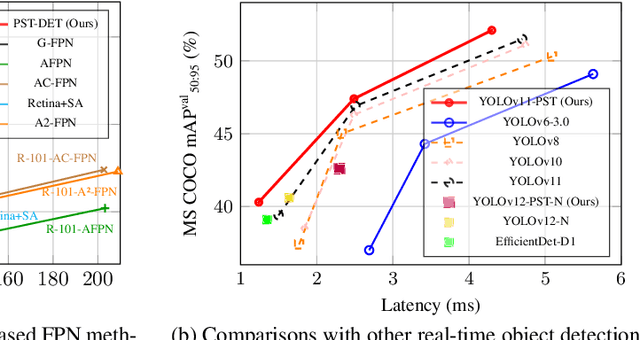
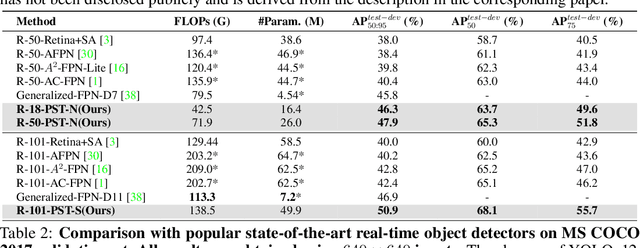
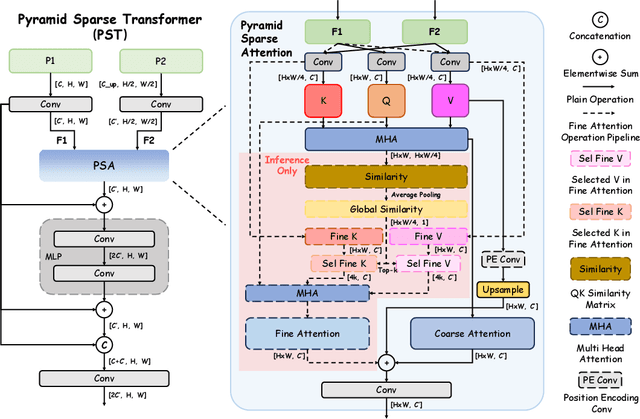
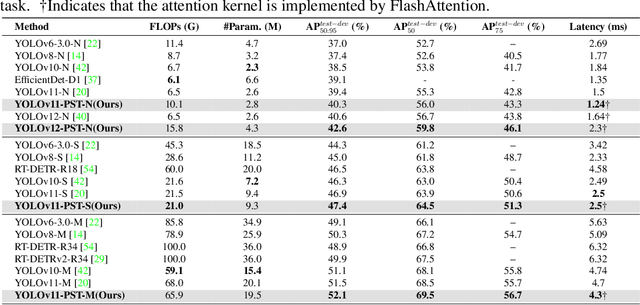
Feature fusion is critical for high-performance vision models but often incurs prohibitive complexity. However, prevailing attention-based fusion methods often involve significant computational complexity and implementation challenges, limiting their efficiency in resource-constrained environments. To address these issues, we introduce the Pyramid Sparse Transformer (PST), a lightweight, plug-and-play module that integrates coarse-to-fine token selection and shared attention parameters to reduce computation while preserving spatial detail. PST can be trained using only coarse attention and seamlessly activated at inference for further accuracy gains without retraining. When added to state-of-the-art real-time detection models, such as YOLOv11-N/S/M, PST yields mAP improvements of 0.9%, 0.5%, and 0.4% on MS COCO with minimal latency impact. Likewise, embedding PST into ResNet-18/50/101 as backbones, boosts ImageNet top-1 accuracy by 6.5%, 1.7%, and 1.0%, respectively. These results demonstrate PST's effectiveness as a simple, hardware-friendly enhancement for both detection and classification tasks.
SayAnything: Audio-Driven Lip Synchronization with Conditional Video Diffusion
Feb 17, 2025
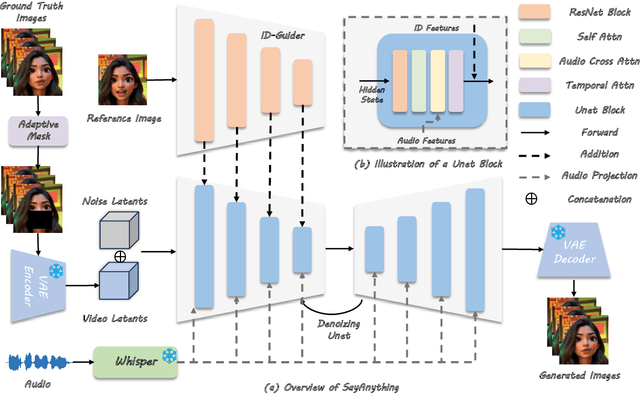
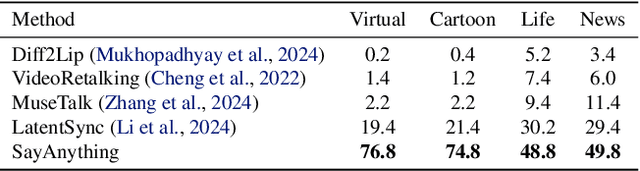
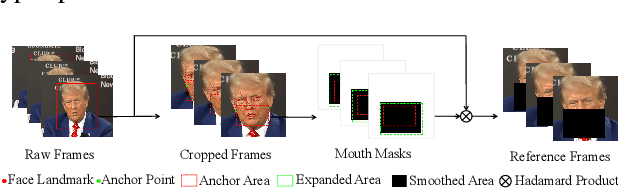
Recent advances in diffusion models have led to significant progress in audio-driven lip synchronization. However, existing methods typically rely on constrained audio-visual alignment priors or multi-stage learning of intermediate representations to force lip motion synthesis. This leads to complex training pipelines and limited motion naturalness. In this paper, we present SayAnything, a conditional video diffusion framework that directly synthesizes lip movements from audio input while preserving speaker identity. Specifically, we propose three specialized modules including identity preservation module, audio guidance module, and editing control module. Our novel design effectively balances different condition signals in the latent space, enabling precise control over appearance, motion, and region-specific generation without requiring additional supervision signals or intermediate representations. Extensive experiments demonstrate that SayAnything generates highly realistic videos with improved lip-teeth coherence, enabling unseen characters to say anything, while effectively generalizing to animated characters.
Intrinsic Evaluation of RAG Systems for Deep-Logic Questions
Oct 03, 2024


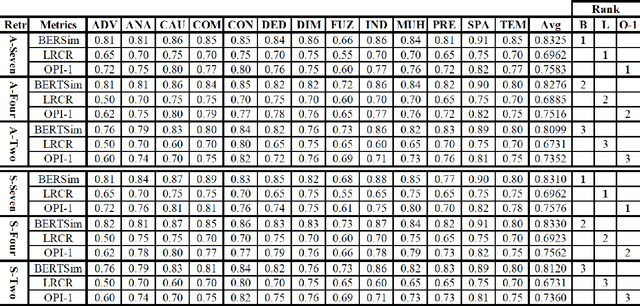
We introduce the Overall Performance Index (OPI), an intrinsic metric to evaluate retrieval-augmented generation (RAG) mechanisms for applications involving deep-logic queries. OPI is computed as the harmonic mean of two key metrics: the Logical-Relation Correctness Ratio and the average of BERT embedding similarity scores between ground-truth and generated answers. We apply OPI to assess the performance of LangChain, a popular RAG tool, using a logical relations classifier fine-tuned from GPT-4o on the RAG-Dataset-12000 from Hugging Face. Our findings show a strong correlation between BERT embedding similarity scores and extrinsic evaluation scores. Among the commonly used retrievers, the cosine similarity retriever using BERT-based embeddings outperforms others, while the Euclidean distance-based retriever exhibits the weakest performance. Furthermore, we demonstrate that combining multiple retrievers, either algorithmically or by merging retrieved sentences, yields superior performance compared to using any single retriever alone.
Dynamical Isometry based Rigorous Fair Neural Architecture Search
Jul 06, 2023Recently, the weight-sharing technique has significantly speeded up the training and evaluation procedure of neural architecture search. However, most existing weight-sharing strategies are solely based on experience or observation, which makes the searching results lack interpretability and rationality. In addition, due to the negligence of fairness, current methods are prone to make misjudgments in module evaluation. To address these problems, we propose a novel neural architecture search algorithm based on dynamical isometry. We use the fix point analysis method in the mean field theory to analyze the dynamics behavior in the steady state random neural network, and how dynamic isometry guarantees the fairness of weight-sharing based NAS. Meanwhile, we prove that our module selection strategy is rigorous fair by estimating the generalization error of all modules with well-conditioned Jacobian. Extensive experiments show that, with the same size, the architecture searched by the proposed method can achieve state-of-the-art top-1 validation accuracy on ImageNet classification. In addition, we demonstrate that our method is able to achieve better and more stable training performance without loss of generality.