 Add to Chrome
 Add to Firefox
 Add to Edge
SwiftGS: Episodic Priors for Immediate Satellite Surface Recovery
Mar 19, 2026
Rapid, large-scale 3D reconstruction from multi-date satellite imagery is vital for environmental monitoring, urban planning, and disaster response, yet remains difficult due to illumination changes, sensor heterogeneity, and the cost of per-scene optimization. We introduce SwiftGS, a meta-learned system that reconstructs 3D surfaces in a single forward pass by predicting geometry-radiation-decoupled Gaussian primitives together with a lightweight SDF, replacing expensive per-scene fitting with episodic training that captures transferable priors. The model couples a differentiable physics graph for projection, illumination, and sensor response with spatial gating that blends sparse Gaussian detail and global SDF structure, and incorporates semantic-geometric fusion, conditional lightweight task heads, and multi-view supervision from a frozen geometric teacher under an uncertainty-aware multi-task loss. At inference, SwiftGS operates zero-shot with optional compact calibration and achieves accurate DSM reconstruction and view-consistent rendering at significantly reduced computational cost, with ablations highlighting the benefits of the hybrid representation, physics-aware rendering, and episodic meta-training.

Directing the Narrative: A Finetuning Method for Controlling Coherence and Style in Story Generation
Mar 18, 2026Story visualization requires generating sequential imagery that aligns semantically with evolving narratives while maintaining rigorous consistency in character identity and visual style. However, existing methodologies often struggle with subject inconsistency and identity drift, particularly when depicting complex interactions or extended narrative arcs. To address these challenges, we propose a cohesive two-stage framework designed for robust and consistent story generation. First, we introduce Group-Shared Attention (GSA), a mechanism that fosters intrinsic consistency by enabling lossless cross-sample information flow within attention layers. This allows the model to structurally encode identity correspondence across frames without relying on external encoders. Second, we leverage Direct Preference Optimization (DPO) to align generated outputs with human aesthetic and narrative standards. Unlike conventional methods that rely on conflicting auxiliary losses, our approach simultaneously enhances visual fidelity and identity preservation by learning from holistic preference data. Extensive evaluations on the ViStoryBench benchmark demonstrate that our method establishes a new state-of-the-art, significantly outperforming strong baselines with gains of +10.0 in Character Identity (CIDS) and +18.7 in Style Consistency (CSD), all while preserving high-fidelity generation.
DEP: A Decentralized Large Language Model Evaluation Protocol
Mar 01, 2026With the rapid development of Large Language Models (LLMs), a large number of benchmarks have been proposed. However, most benchmarks lack unified evaluation standard and require the manual implementation of custom scripts, making results hard to ensure consistency and reproducibility. Furthermore, mainstream evaluation frameworks are centralized, with datasets and answers, which increases the risk of benchmark leakage. To address these issues, we propose a Decentralized Evaluation Protocol (DEP), a decentralized yet unified and standardized evaluation framework through a matching server without constraining benchmarks. The server can be mounted locally or deployed remotely, and once adapted, it can be reused over the long term. By decoupling users, LLMs, and benchmarks, DEP enables modular, plug-and-play evaluation: benchmark files and evaluation logic stay exclusively on the server side. In remote setting, users cannot access the ground truth, thereby achieving data isolation and leak-proof evaluation. To facilitate practical adoption, we develop DEP Toolkit, a protocol-compatible toolkit that supports features such as breakpoint resume, concurrent requests, and congestion control. We also provide detailed documentation for adapting new benchmarks to DEP. Using DEP toolkit, we evaluate multiple LLMs across benchmarks. Experimental results verify the effectiveness of DEP and show that it reduces the cost of deploying benchmark evaluations. As of February 2026, we have adapted over 60 benchmarks and continue to promote community co-construction to support unified evaluation across various tasks and domains.
From Subtle to Significant: Prompt-Driven Self-Improving Optimization in Test-Time Graph OOD Detection
Feb 19, 2026Graph Out-of-Distribution (OOD) detection aims to identify whether a test graph deviates from the distribution of graphs observed during training, which is critical for ensuring the reliability of Graph Neural Networks (GNNs) when deployed in open-world scenarios. Recent advances in graph OOD detection have focused on test-time training techniques that facilitate OOD detection without accessing potential supervisory information (e.g., training data). However, most of these methods employ a one-pass inference paradigm, which prevents them from progressively correcting erroneous predictions to amplify OOD signals. To this end, we propose a \textbf{S}elf-\textbf{I}mproving \textbf{G}raph \textbf{O}ut-\textbf{o}f-\textbf{D}istribution detector (SIGOOD), which is an unsupervised framework that integrates continuous self-learning with test-time training for effective graph OOD detection. Specifically, SIGOOD generates a prompt to construct a prompt-enhanced graph that amplifies potential OOD signals. To optimize prompts, SIGOOD introduces an Energy Preference Optimization (EPO) loss, which leverages energy variations between the original test graph and the prompt-enhanced graph. By iteratively optimizing the prompt by involving it into the detection model in a self-improving loop, the resulting optimal prompt-enhanced graph is ultimately used for OOD detection. Comprehensive evaluations on 21 real-world datasets confirm the effectiveness and outperformance of our SIGOOD method. The code is at https://github.com/Ee1s/SIGOOD.
Dimension-Reduction Attack! Video Generative Models are Experts on Controllable Image Synthesis
May 29, 2025Video generative models can be regarded as world simulators due to their ability to capture dynamic, continuous changes inherent in real-world environments. These models integrate high-dimensional information across visual, temporal, spatial, and causal dimensions, enabling predictions of subjects in various status. A natural and valuable research direction is to explore whether a fully trained video generative model in high-dimensional space can effectively support lower-dimensional tasks such as controllable image generation. In this work, we propose a paradigm for video-to-image knowledge compression and task adaptation, termed \textit{Dimension-Reduction Attack} (\texttt{DRA-Ctrl}), which utilizes the strengths of video models, including long-range context modeling and flatten full-attention, to perform various generation tasks. Specially, to address the challenging gap between continuous video frames and discrete image generation, we introduce a mixup-based transition strategy that ensures smooth adaptation. Moreover, we redesign the attention structure with a tailored masking mechanism to better align text prompts with image-level control. Experiments across diverse image generation tasks, such as subject-driven and spatially conditioned generation, show that repurposed video models outperform those trained directly on images. These results highlight the untapped potential of large-scale video generators for broader visual applications. \texttt{DRA-Ctrl} provides new insights into reusing resource-intensive video models and lays foundation for future unified generative models across visual modalities. The project page is https://dra-ctrl-2025.github.io/DRA-Ctrl/.
CoE: Chain-of-Explanation via Automatic Visual Concept Circuit Description and Polysemanticity Quantification
Mar 19, 2025Explainability is a critical factor influencing the wide deployment of deep vision models (DVMs). Concept-based post-hoc explanation methods can provide both global and local insights into model decisions. However, current methods in this field face challenges in that they are inflexible to automatically construct accurate and sufficient linguistic explanations for global concepts and local circuits. Particularly, the intrinsic polysemanticity in semantic Visual Concepts (VCs) impedes the interpretability of concepts and DVMs, which is underestimated severely. In this paper, we propose a Chain-of-Explanation (CoE) approach to address these issues. Specifically, CoE automates the decoding and description of VCs to construct global concept explanation datasets. Further, to alleviate the effect of polysemanticity on model explainability, we design a concept polysemanticity disentanglement and filtering mechanism to distinguish the most contextually relevant concept atoms. Besides, a Concept Polysemanticity Entropy (CPE), as a measure of model interpretability, is formulated to quantify the degree of concept uncertainty. The modeling of deterministic concepts is upgraded to uncertain concept atom distributions. Finally, CoE automatically enables linguistic local explanations of the decision-making process of DVMs by tracing the concept circuit. GPT-4o and human-based experiments demonstrate the effectiveness of CPE and the superiority of CoE, achieving an average absolute improvement of 36% in terms of explainability scores.
Large Language Model Safety: A Holistic Survey
Dec 23, 2024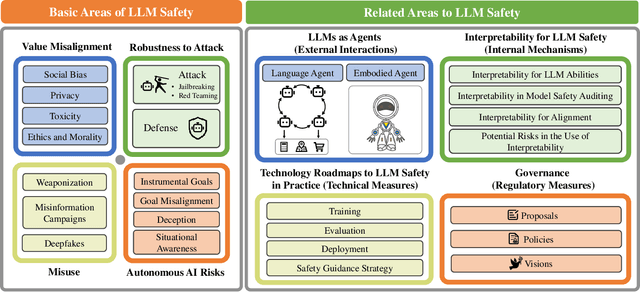

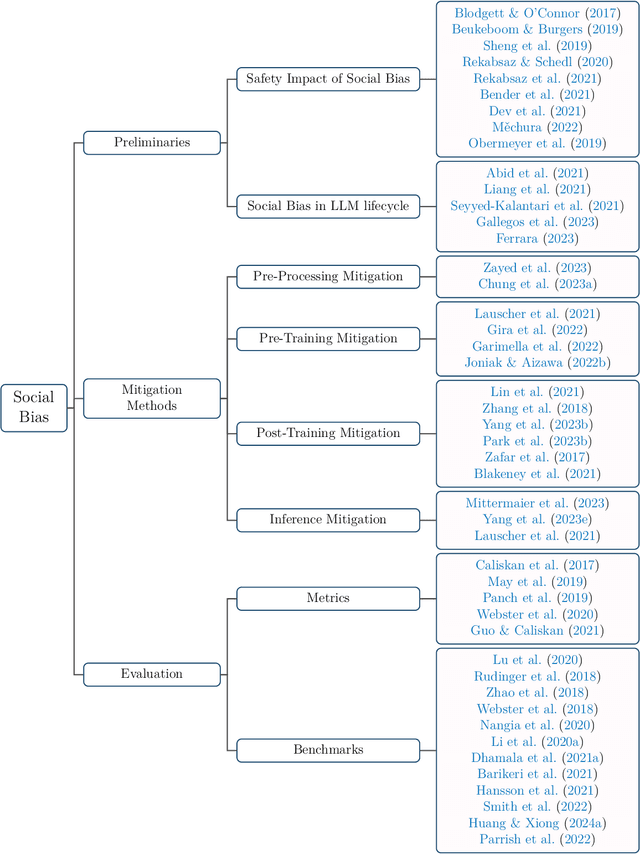

The rapid development and deployment of large language models (LLMs) have introduced a new frontier in artificial intelligence, marked by unprecedented capabilities in natural language understanding and generation. However, the increasing integration of these models into critical applications raises substantial safety concerns, necessitating a thorough examination of their potential risks and associated mitigation strategies. This survey provides a comprehensive overview of the current landscape of LLM safety, covering four major categories: value misalignment, robustness to adversarial attacks, misuse, and autonomous AI risks. In addition to the comprehensive review of the mitigation methodologies and evaluation resources on these four aspects, we further explore four topics related to LLM safety: the safety implications of LLM agents, the role of interpretability in enhancing LLM safety, the technology roadmaps proposed and abided by a list of AI companies and institutes for LLM safety, and AI governance aimed at LLM safety with discussions on international cooperation, policy proposals, and prospective regulatory directions. Our findings underscore the necessity for a proactive, multifaceted approach to LLM safety, emphasizing the integration of technical solutions, ethical considerations, and robust governance frameworks. This survey is intended to serve as a foundational resource for academy researchers, industry practitioners, and policymakers, offering insights into the challenges and opportunities associated with the safe integration of LLMs into society. Ultimately, it seeks to contribute to the safe and beneficial development of LLMs, aligning with the overarching goal of harnessing AI for societal advancement and well-being. A curated list of related papers has been publicly available at https://github.com/tjunlp-lab/Awesome-LLM-Safety-Papers.
DA-MoE: Addressing Depth-Sensitivity in Graph-Level Analysis through Mixture of Experts
Nov 05, 2024
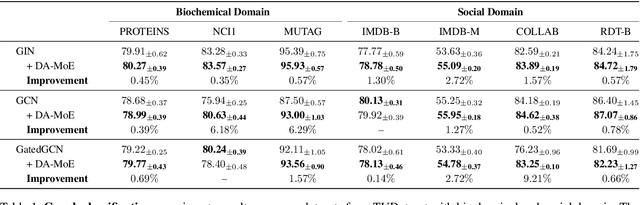

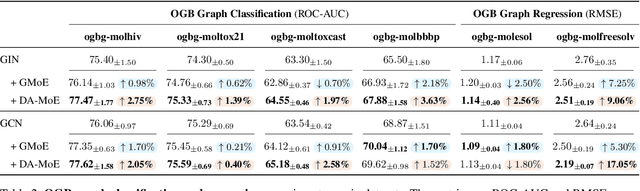
Graph neural networks (GNNs) are gaining popularity for processing graph-structured data. In real-world scenarios, graph data within the same dataset can vary significantly in scale. This variability leads to depth-sensitivity, where the optimal depth of GNN layers depends on the scale of the graph data. Empirically, fewer layers are sufficient for message passing in smaller graphs, while larger graphs typically require deeper networks to capture long-range dependencies and global features. However, existing methods generally use a fixed number of GNN layers to generate representations for all graphs, overlooking the depth-sensitivity issue in graph structure data. To address this challenge, we propose the depth adaptive mixture of expert (DA-MoE) method, which incorporates two main improvements to GNN backbone: \textbf{1)} DA-MoE employs different GNN layers, each considered an expert with its own parameters. Such a design allows the model to flexibly aggregate information at different scales, effectively addressing the depth-sensitivity issue in graph data. \textbf{2)} DA-MoE utilizes GNN to capture the structural information instead of the linear projections in the gating network. Thus, the gating network enables the model to capture complex patterns and dependencies within the data. By leveraging these improvements, each expert in DA-MoE specifically learns distinct graph patterns at different scales. Furthermore, comprehensive experiments on the TU dataset and open graph benchmark (OGB) have shown that DA-MoE consistently surpasses existing baselines on various tasks, including graph, node, and link-level analyses. The code are available at \url{https://github.com/Celin-Yao/DA-MoE}.
Dual-perspective Cross Contrastive Learning in Graph Transformers
Jun 01, 2024Graph contrastive learning (GCL) is a popular method for leaning graph representations by maximizing the consistency of features across augmented views. Traditional GCL methods utilize single-perspective i.e. data or model-perspective) augmentation to generate positive samples, restraining the diversity of positive samples. In addition, these positive samples may be unreliable due to uncontrollable augmentation strategies that potentially alter the semantic information. To address these challenges, this paper proposed a innovative framework termed dual-perspective cross graph contrastive learning (DC-GCL), which incorporates three modifications designed to enhance positive sample diversity and reliability: 1) We propose dual-perspective augmentation strategy that provide the model with more diverse training data, enabling the model effective learning of feature consistency across different views. 2) From the data perspective, we slightly perturb the original graphs using controllable data augmentation, effectively preserving their semantic information. 3) From the model perspective, we enhance the encoder by utilizing more powerful graph transformers instead of graph neural networks. Based on the model's architecture, we propose three pruning-based strategies to slightly perturb the encoder, providing more reliable positive samples. These modifications collectively form the DC-GCL's foundation and provide more diverse and reliable training inputs, offering significant improvements over traditional GCL methods. Extensive experiments on various benchmarks demonstrate that DC-GCL consistently outperforms different baselines on various datasets and tasks.
Hi-GMAE: Hierarchical Graph Masked Autoencoders
May 17, 2024Graph Masked Autoencoders (GMAEs) have emerged as a notable self-supervised learning approach for graph-structured data. Existing GMAE models primarily focus on reconstructing node-level information, categorizing them as single-scale GMAEs. This methodology, while effective in certain contexts, tends to overlook the complex hierarchical structures inherent in many real-world graphs. For instance, molecular graphs exhibit a clear hierarchical organization in the form of the atoms-functional groups-molecules structure. Hence, the inability of single-scale GMAE models to incorporate these hierarchical relationships often leads to their inadequate capture of crucial high-level graph information, resulting in a noticeable decline in performance. To address this limitation, we propose Hierarchical Graph Masked AutoEncoders (Hi-GMAE), a novel multi-scale GMAE framework designed to handle the hierarchical structures within graphs. First, Hi-GMAE constructs a multi-scale graph hierarchy through graph pooling, enabling the exploration of graph structures across different granularity levels. To ensure masking uniformity of subgraphs across these scales, we propose a novel coarse-to-fine strategy that initiates masking at the coarsest scale and progressively back-projects the mask to the finer scales. Furthermore, we integrate a gradual recovery strategy with the masking process to mitigate the learning challenges posed by completely masked subgraphs. Diverging from the standard graph neural network (GNN) used in GMAE models, Hi-GMAE modifies its encoder and decoder into hierarchical structures. This entails using GNN at the finer scales for detailed local graph analysis and employing a graph transformer at coarser scales to capture global information. Our experiments on 15 graph datasets consistently demonstrate that Hi-GMAE outperforms 17 state-of-the-art self-supervised competitors.