 Add to Chrome
 Add to Firefox
 Add to Edge
Scaling Representation Diversity: Modulated Attention and Reconstructive Regularization for Visual Grounding
Aug 13, 2026
Referring Expression Comprehension (REC) is commonly studied under dataset-specific fine-tuning, resulting in specialist models with limited cross-dataset generalization. In this work, we revisit REC from the perspective of unified open-vocabulary grounding and identify representation degeneration as a key obstacle to scaling a single generalist model. To preserve representation diversity, we propose a holistic data-model co-design framework. Architecturally, we introduce the Modulated Attention-Contrastive Head (mACH) for efficient token-level vision-language alignment and a text-conditioned JEPA auxiliary stream that provides complementary gradient support to preserve alignment-active representations without inference overhead. On the data side, we introduce Objects365-Caption, enriching Objects365 with context-aware referring expressions for large-scale language supervision. We further provide a theoretical analysis showing that complementary gradient subspaces preserve alignment capacity and thereby scale representation diversity. Extensive experiments demonstrate that our single-checkpoint framework achieves highly competitive performance on standard REC benchmarks while exhibiting strong generalization across heterogeneous grounding datasets without benchmark-specific adaptation.

UAMD-Net: A Unified Adaptive Multimodal Neural Network for Dense Depth Completion
Apr 16, 2022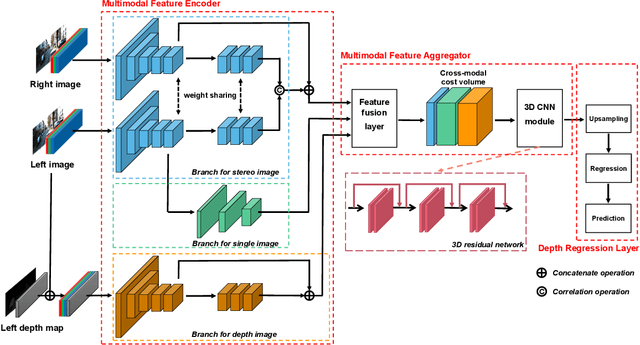

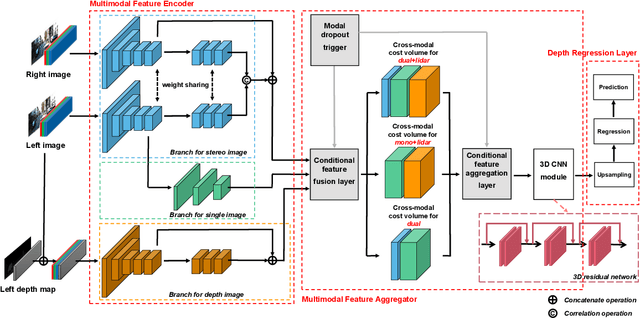
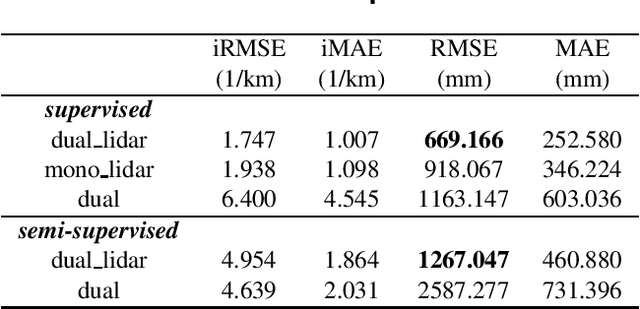
Depth prediction is a critical problem in robotics applications especially autonomous driving. Generally, depth prediction based on binocular stereo matching and fusion of monocular image and laser point cloud are two mainstream methods. However, the former usually suffers from overfitting while building cost volume, and the latter has a limited generalization due to the lack of geometric constraint. To solve these problems, we propose a novel multimodal neural network, namely UAMD-Net, for dense depth completion based on fusion of binocular stereo matching and the weak constrain from the sparse point clouds. Specifically, the sparse point clouds are converted to sparse depth map and sent to the multimodal feature encoder (MFE) with binocular image, constructing a cross-modal cost volume. Then, it will be further processed by the multimodal feature aggregator (MFA) and the depth regression layer. Furthermore, the existing multimodal methods ignore the problem of modal dependence, that is, the network will not work when a certain modal input has a problem. Therefore, we propose a new training strategy called Modal-dropout which enables the network to be adaptively trained with multiple modal inputs and inference with specific modal inputs. Benefiting from the flexible network structure and adaptive training method, our proposed network can realize unified training under various modal input conditions. Comprehensive experiments conducted on KITTI depth completion benchmark demonstrate that our method produces robust results and outperforms other state-of-the-art methods.