 Add to Chrome
 Add to Firefox
 Add to Edge
LocusGS: Spatially Grounded Tokens for Feed-Forward 3D Gaussian Splatting
Aug 13, 2026
Recent query-based feed-forward 3DGS methods represent a scene using learnable queries, each aggregating multi-view evidence and decoding a group of Gaussians. Ideally, different queries should specialize in coherent local regions of the scene. However, we observe that Gaussians decoded from the same query often scatter across distant scene regions, resulting in weak query-level spatial coherence and poor alignment with the scene structure. We attribute this behavior to the purely latent representation of existing Gaussian queries. To address this limitation, we introduce LocusGS, which augments each Gaussian query with a 3D anchor state consisting of a center and a support radius. The anchor state is progressively refined across decoder layers and is used throughout query interaction, multi-view feature aggregation, and Gaussian generation. Specifically, an anchor-to-ray geometric bias guides each query toward spatially relevant image observations, while anchor-centered decoding organizes its Gaussians within a local region. Experiments on novel view synthesis benchmarks show that LocusGS improves rendering quality over query-based Gaussian token baselines under the same Gaussian budget. Further analysis shows that the learned anchors form coherent spatial layouts and lead to more structured Gaussian distributions, demonstrating that explicit anchor states improve the spatial organization. Our project page: https://leo-frank.github.io/LocusGS_viewer.

LLM-Enhanced Hierarchical Heterogeneous Graph Representation Learning for Malicious Python Package Detection
Jul 03, 2026Malicious Python packages have become a major threat to software supply chain ecosystems due to the widespread adoption of open-source repositories such as PyPI. Existing learning-based detection methods struggle to capture the hierarchical organization and heterogeneous interactions among different program entities. Although Large Language Models (LLMs) have demonstrated strong capabilities in code understanding and semantic reasoning, they are rarely integrated with structural program representations for fine-grained malicious behavior analysis. In this paper, we propose an LLM-enhanced hierarchical heterogeneous graph representation learning framework for malicious Python package detection. The framework constructs a hierarchical heterogeneous code graph that explicitly models heterogeneous code entities and different types of structural dependencies. LLMs are further leveraged to infer function-level semantic roles, introducing an additional layer of semantic heterogeneity. Based on this graph, we develop a hierarchical heterogeneous graph neural network that performs type-aware message passing over different node and edge categories, effectively modeling malicious behavior propagation for accurate package-level classification. The framework also incorporates a function-level attribution mechanism which, combined with LLM reasoning, automatically identifies suspicious functions and localizes fine-grained malicious behaviors without human expert intervention. Extensive experiments on real-world datasets show that our framework consistently outperforms traditional machine learning methods, graph-based detectors, and state-of-the-art LLMs across packages with varying sizes and dependency complexities, while providing accurate, robust, and interpretable malicious behavior localization.
Sparrow: Text-Anchored Window Attention with Visual-Semantic Glimpsing for Speculative Decoding in Video LLMs
Feb 17, 2026Although speculative decoding is widely used to accelerate Vision-Language Models (VLMs) inference, it faces severe performance collapse when applied to Video Large Language Models (Vid-LLMs). The draft model typically falls into the trap of attention dilution and negative visual gain due to key-value cache explosion and context window mismatches. We observe a visual semantic internalization phenomenon in Vid-LLMs, indicating that critical visual semantics are implicitly encoded into text hidden states during deep-layer interactions, which renders raw visual inputs structurally redundant during deep inference. To address this, we propose the Sparrow framework, which first utilizes visually-aware text-anchored window attention via hidden state reuse to fully offload visual computation to the target model, and leverages intermediate-layer visual state bridging to train the draft model with semantic-rich intermediate states, thereby filtering out low-level visual noise. Additionally, a multi-token prediction strategy is introduced to bridge the training-inference distribution shift. Experiments show that Sparrow achieves an average speedup of 2.82x even with 25k visual tokens, effectively resolving the performance degradation in long sequences and offering a practical solution for real-time long video tasks.
Transolver is a Linear Transformer: Revisiting Physics-Attention through the Lens of Linear Attention
Nov 11, 2025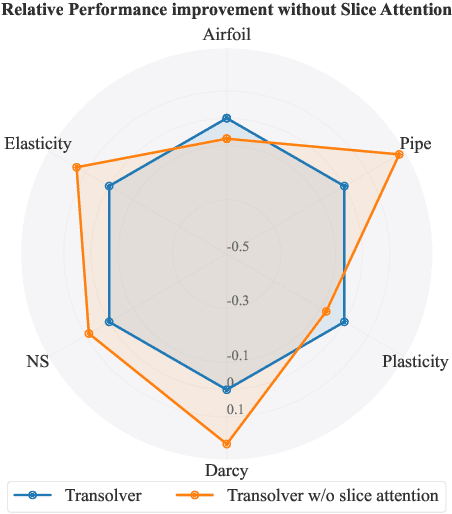
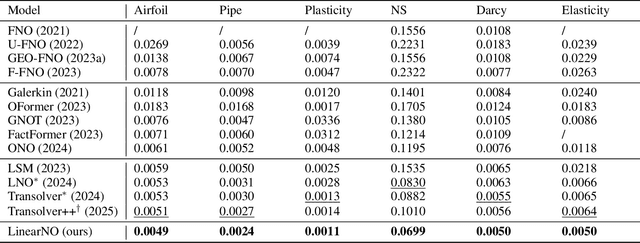
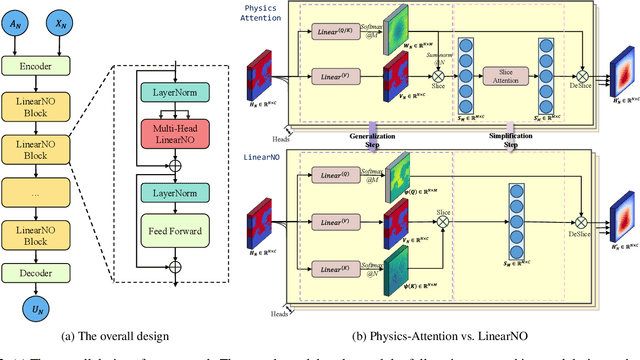
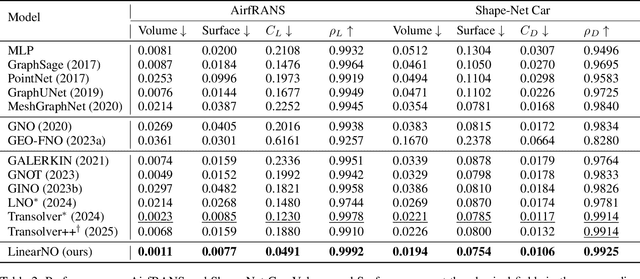
Recent advances in Transformer-based Neural Operators have enabled significant progress in data-driven solvers for Partial Differential Equations (PDEs). Most current research has focused on reducing the quadratic complexity of attention to address the resulting low training and inference efficiency. Among these works, Transolver stands out as a representative method that introduces Physics-Attention to reduce computational costs. Physics-Attention projects grid points into slices for slice attention, then maps them back through deslicing. However, we observe that Physics-Attention can be reformulated as a special case of linear attention, and that the slice attention may even hurt the model performance. Based on these observations, we argue that its effectiveness primarily arises from the slice and deslice operations rather than interactions between slices. Building on this insight, we propose a two-step transformation to redesign Physics-Attention into a canonical linear attention, which we call Linear Attention Neural Operator (LinearNO). Our method achieves state-of-the-art performance on six standard PDE benchmarks, while reducing the number of parameters by an average of 40.0% and computational cost by 36.2%. Additionally, it delivers superior performance on two challenging, industrial-level datasets: AirfRANS and Shape-Net Car.
Mono3R: Exploiting Monocular Cues for Geometric 3D Reconstruction
Apr 18, 2025Recent advances in data-driven geometric multi-view 3D reconstruction foundation models (e.g., DUSt3R) have shown remarkable performance across various 3D vision tasks, facilitated by the release of large-scale, high-quality 3D datasets. However, as we observed, constrained by their matching-based principles, the reconstruction quality of existing models suffers significant degradation in challenging regions with limited matching cues, particularly in weakly textured areas and low-light conditions. To mitigate these limitations, we propose to harness the inherent robustness of monocular geometry estimation to compensate for the inherent shortcomings of matching-based methods. Specifically, we introduce a monocular-guided refinement module that integrates monocular geometric priors into multi-view reconstruction frameworks. This integration substantially enhances the robustness of multi-view reconstruction systems, leading to high-quality feed-forward reconstructions. Comprehensive experiments across multiple benchmarks demonstrate that our method achieves substantial improvements in both mutli-view camera pose estimation and point cloud accuracy.
Regist3R: Incremental Registration with Stereo Foundation Model
Apr 16, 2025Multi-view 3D reconstruction has remained an essential yet challenging problem in the field of computer vision. While DUSt3R and its successors have achieved breakthroughs in 3D reconstruction from unposed images, these methods exhibit significant limitations when scaling to multi-view scenarios, including high computational cost and cumulative error induced by global alignment. To address these challenges, we propose Regist3R, a novel stereo foundation model tailored for efficient and scalable incremental reconstruction. Regist3R leverages an incremental reconstruction paradigm, enabling large-scale 3D reconstructions from unordered and many-view image collections. We evaluate Regist3R on public datasets for camera pose estimation and 3D reconstruction. Our experiments demonstrate that Regist3R achieves comparable performance with optimization-based methods while significantly improving computational efficiency, and outperforms existing multi-view reconstruction models. Furthermore, to assess its performance in real-world applications, we introduce a challenging oblique aerial dataset which has long spatial spans and hundreds of views. The results highlight the effectiveness of Regist3R. We also demonstrate the first attempt to reconstruct large-scale scenes encompassing over thousands of views through pointmap-based foundation models, showcasing its potential for practical applications in large-scale 3D reconstruction tasks, including urban modeling, aerial mapping, and beyond.
Highly Parallelized Reinforcement Learning Training with Relaxed Assignment Dependencies
Feb 27, 2025As the demands for superior agents grow, the training complexity of Deep Reinforcement Learning (DRL) becomes higher. Thus, accelerating training of DRL has become a major research focus. Dividing the DRL training process into subtasks and using parallel computation can effectively reduce training costs. However, current DRL training systems lack sufficient parallelization due to data assignment between subtask components. This assignment issue has been ignored, but addressing it can further boost training efficiency. Therefore, we propose a high-throughput distributed RL training system called TianJi. It relaxes assignment dependencies between subtask components and enables event-driven asynchronous communication. Meanwhile, TianJi maintains clear boundaries between subtask components. To address convergence uncertainty from relaxed assignment dependencies, TianJi proposes a distributed strategy based on the balance of sample production and consumption. The strategy controls the staleness of samples to correct their quality, ensuring convergence. We conducted extensive experiments. TianJi achieves a convergence time acceleration ratio of up to 4.37 compared to related comparison systems. When scaled to eight computational nodes, TianJi shows a convergence time speedup of 1.6 and a throughput speedup of 7.13 relative to XingTian, demonstrating its capability to accelerate training and scalability. In data transmission efficiency experiments, TianJi significantly outperforms other systems, approaching hardware limits. TianJi also shows effectiveness in on-policy algorithms, achieving convergence time acceleration ratios of 4.36 and 2.95 compared to RLlib and XingTian. TianJi is accessible at https://github.com/HiPRL/TianJi.git.
Acceleration for Deep Reinforcement Learning using Parallel and Distributed Computing: A Survey
Nov 08, 2024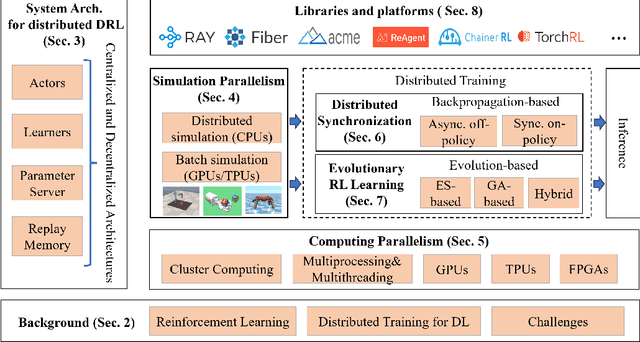
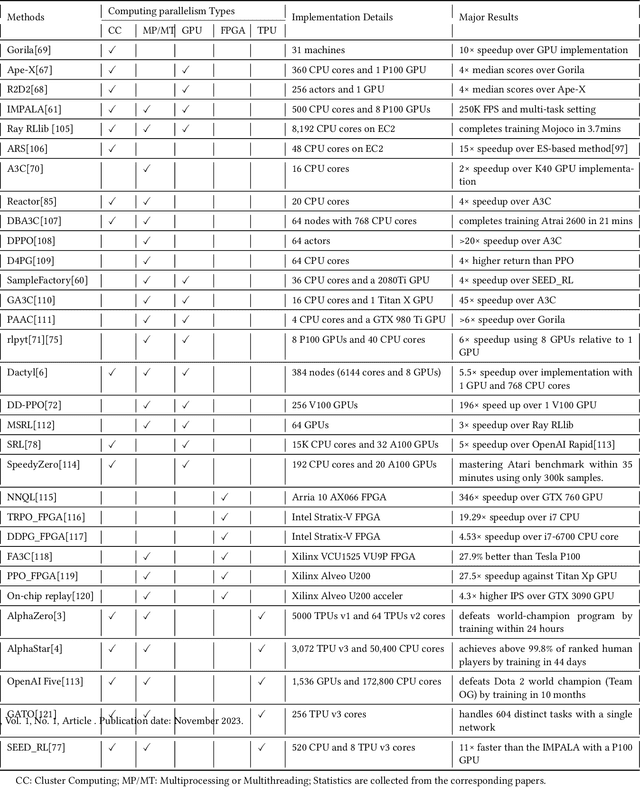
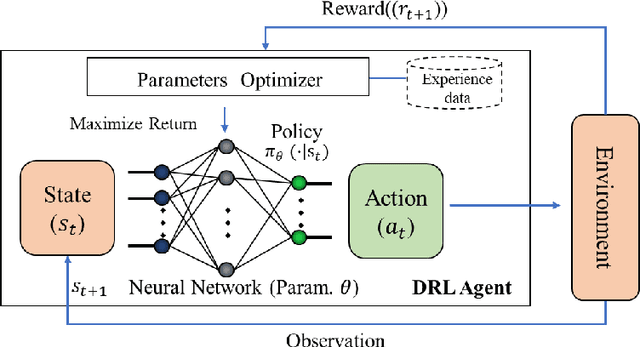
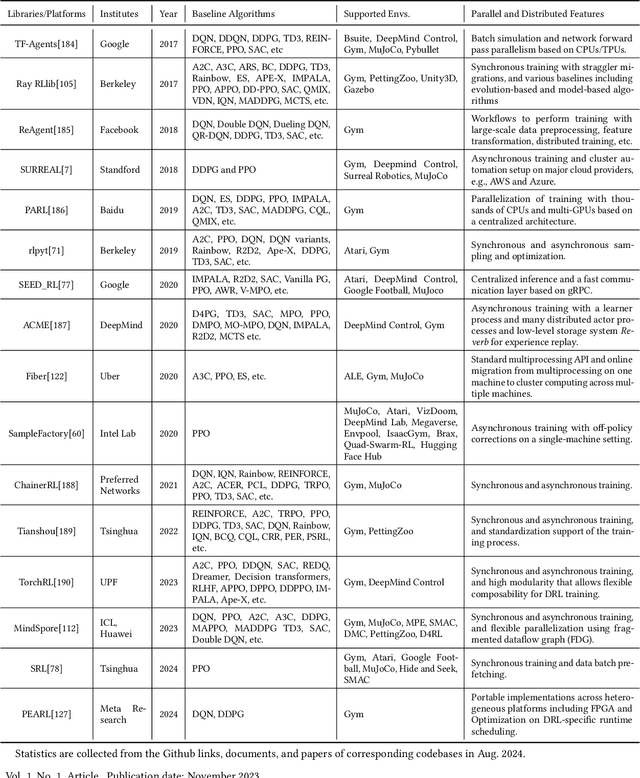
Deep reinforcement learning has led to dramatic breakthroughs in the field of artificial intelligence for the past few years. As the amount of rollout experience data and the size of neural networks for deep reinforcement learning have grown continuously, handling the training process and reducing the time consumption using parallel and distributed computing is becoming an urgent and essential desire. In this paper, we perform a broad and thorough investigation on training acceleration methodologies for deep reinforcement learning based on parallel and distributed computing, providing a comprehensive survey in this field with state-of-the-art methods and pointers to core references. In particular, a taxonomy of literature is provided, along with a discussion of emerging topics and open issues. This incorporates learning system architectures, simulation parallelism, computing parallelism, distributed synchronization mechanisms, and deep evolutionary reinforcement learning. Further, we compare 16 current open-source libraries and platforms with criteria of facilitating rapid development. Finally, we extrapolate future directions that deserve further research.
Introducing Diminutive Causal Structure into Graph Representation Learning
Jun 13, 2024When engaging in end-to-end graph representation learning with Graph Neural Networks (GNNs), the intricate causal relationships and rules inherent in graph data pose a formidable challenge for the model in accurately capturing authentic data relationships. A proposed mitigating strategy involves the direct integration of rules or relationships corresponding to the graph data into the model. However, within the domain of graph representation learning, the inherent complexity of graph data obstructs the derivation of a comprehensive causal structure that encapsulates universal rules or relationships governing the entire dataset. Instead, only specialized diminutive causal structures, delineating specific causal relationships within constrained subsets of graph data, emerge as discernible. Motivated by empirical insights, it is observed that GNN models exhibit a tendency to converge towards such specialized causal structures during the training process. Consequently, we posit that the introduction of these specific causal structures is advantageous for the training of GNN models. Building upon this proposition, we introduce a novel method that enables GNN models to glean insights from these specialized diminutive causal structures, thereby enhancing overall performance. Our method specifically extracts causal knowledge from the model representation of these diminutive causal structures and incorporates interchange intervention to optimize the learning process. Theoretical analysis serves to corroborate the efficacy of our proposed method. Furthermore, empirical experiments consistently demonstrate significant performance improvements across diverse datasets.
VoxNeuS: Enhancing Voxel-Based Neural Surface Reconstruction via Gradient Interpolation
Jun 11, 2024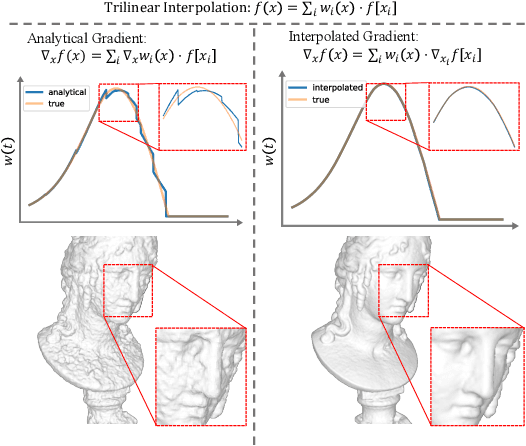
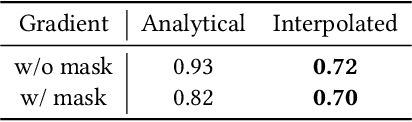
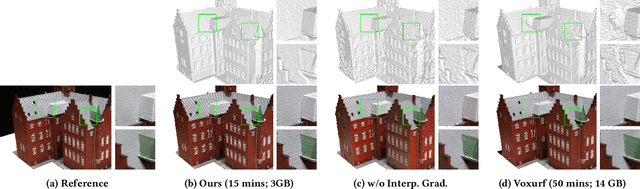
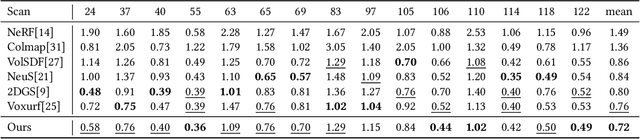
Neural Surface Reconstruction learns a Signed Distance Field~(SDF) to reconstruct the 3D model from multi-view images. Previous works adopt voxel-based explicit representation to improve efficiency. However, they ignored the gradient instability of interpolation in the voxel grid, leading to degradation on convergence and smoothness. Besides, previous works entangled the optimization of geometry and radiance, which leads to the deformation of geometry to explain radiance, causing artifacts when reconstructing textured planes. In this work, we reveal that the instability of gradient comes from its discontinuity during trilinear interpolation, and propose to use the interpolated gradient instead of the original analytical gradient to eliminate the discontinuity. Based on gradient interpolation, we propose VoxNeuS, a lightweight surface reconstruction method for computational and memory efficient neural surface reconstruction. Thanks to the explicit representation, the gradient of regularization terms, i.e. Eikonal and curvature loss, are directly solved, avoiding computation and memory-access overhead. Further, VoxNeuS adopts a geometry-radiance disentangled architecture to handle the geometry deformation from radiance optimization. The experimental results show that VoxNeuS achieves better reconstruction quality than previous works. The entire training process takes 15 minutes and less than 3 GB of memory on a single 2080ti GPU.