 Add to Chrome
 Add to Firefox
 Add to Edge
SkillTrace: Traversing a Query-Skill Graph for Composable LLM Agents
Aug 03, 2026
Large language model agents increasingly solve complex tasks by composing reusable skills from a library. To address this, the key challenge is not merely to retrieve individually relevant skills, but to identify a complete and executable skill composition. In this paper, we argue that this problem can be solved in a graph with three levels: compositional relations among skill queries, similarity between queries and candidates in the skill library, and the dependencies among the selected candidates. We introduce SkillTrace, which organizes the user query into a semantic hierarchy, matches skill queries and candidates, and propagates over the skill dependencies. Experiments on SkillsBench and ALFWorld demonstrate that SkillTrace achieves state-of-the-art performance, reaching a success rate of 53.17% on SkillsBench and 91.43% on ALFWorld. SkillTrace also delivers consistent improvements across different backbone language models, demonstrating the generality and robustness of graph-based skill retrieval.

ST-SimDiff: Balancing Spatiotemporal Similarity and Difference for Efficient Video Understanding with MLLMs
May 21, 2026Multimodal Large Language Models (MLLMs) face significant computational overhead when processing long videos due to the massive number of visual tokens required. To improve efficiency, existing methods primarily reduce redundancy by pruning or merging tokens based on importance or similarity. However, these approaches largely overlook a critical dimension of video content, i.e., changes and turning points, and they lack a collaborative model for spatio-temporal relationships. To address this, we propose a new perspective: similarity is for identifying redundancy, while difference is for capturing key events. Based on this, we designed a training-free framework named ST-SimDiff. We first construct a spatio-temporal graph from the visual tokens to uniformly model their complex associations. Subsequently, we employ a parallel dual-selection strategy: 1) similarity-based selection uses community detection to retain representative tokens, compressing static information; 2) temporal difference-based selection precisely locates content-changing points to preserve tokens that capture key dynamic shifts. This allows it to preserve both static and dynamic content with a minimal number of tokens. Extensive experiments show our method significantly outperforms state-of-the-art approaches while substantially reducing computational costs. Our code is available in https://github.com/bingjunluo/ST-SimDiff.
Enhancing Visual Token Representations for Video Large Language Models via Training-Free Spatial-Temporal Pooling and Gridding
May 21, 2026Recent advances in Multimodal Large Language Models (MLLMs) have significantly advanced video understanding tasks, yet challenges remain in efficiently compressing visual tokens while preserving spatiotemporal interactions. Existing methods, such as LLaVA family, utilize simplistic pooling or interpolation techniques that overlook the intricate dynamics of visual tokens. To bridge this gap, we propose ST-GridPool, a novel training-free visual token enhancement method designed specifically for Video LLMs. Our approach integrates Pyramid Temporal Gridding (PTG), which captures multi-grained spatiotemporal interactions through hierarchical temporal gridding, and Norm-based Spatial Pooling (NSP), which preserves high-information visual regions by leveraging the correlation between token norms and semantic richness. Extensive experiments on various benchmarks demonstrate that ST-GridPool consistently enhances performance of Video LLMs without requiring costly retraining. Our method offers an efficient and plug-and-play solution for improving visual token representations. Our code is available in https://github.com/bingjunluo/ST-GridPool.
Graph-Based Cross-Domain Knowledge Distillation for Cross-Dataset Text-to-Image Person Retrieval
Jan 25, 2025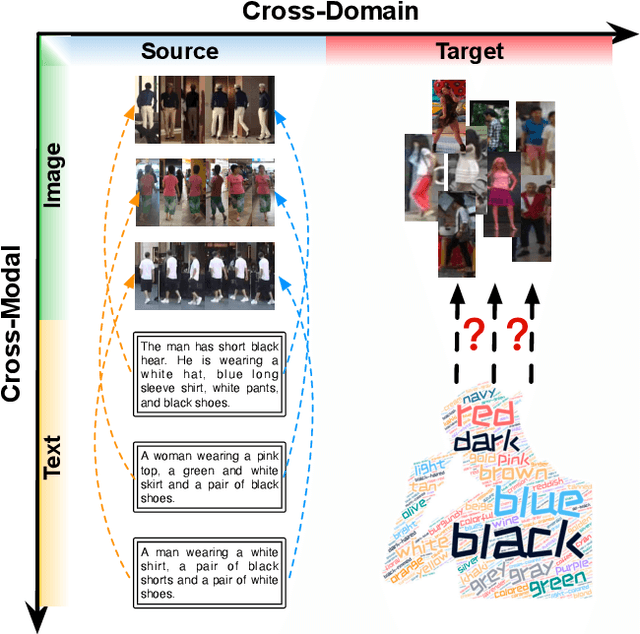
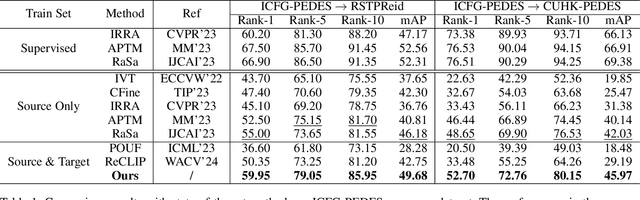
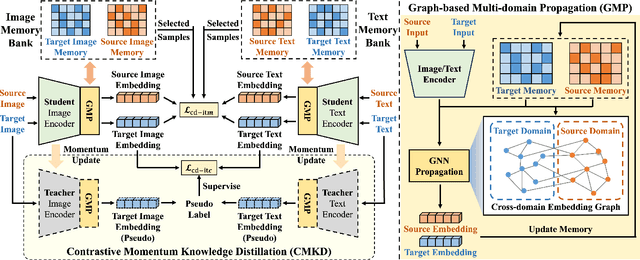
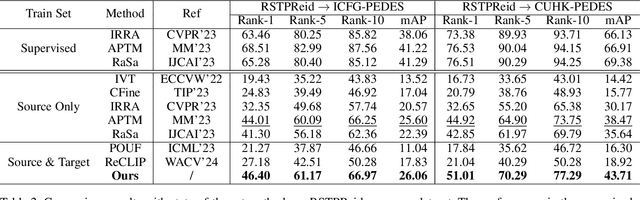
Video surveillance systems are crucial components for ensuring public safety and management in smart city. As a fundamental task in video surveillance, text-to-image person retrieval aims to retrieve the target person from an image gallery that best matches the given text description. Most existing text-to-image person retrieval methods are trained in a supervised manner that requires sufficient labeled data in the target domain. However, it is common in practice that only unlabeled data is available in the target domain due to the difficulty and cost of data annotation, which limits the generalization of existing methods in practical application scenarios. To address this issue, we propose a novel unsupervised domain adaptation method, termed Graph-Based Cross-Domain Knowledge Distillation (GCKD), to learn the cross-modal feature representation for text-to-image person retrieval in a cross-dataset scenario. The proposed GCKD method consists of two main components. Firstly, a graph-based multi-modal propagation module is designed to bridge the cross-domain correlation among the visual and textual samples. Secondly, a contrastive momentum knowledge distillation module is proposed to learn the cross-modal feature representation using the online knowledge distillation strategy. By jointly optimizing the two modules, the proposed method is able to achieve efficient performance for cross-dataset text-to-image person retrieval. acExtensive experiments on three publicly available text-to-image person retrieval datasets demonstrate the effectiveness of the proposed GCKD method, which consistently outperforms the state-of-the-art baselines.
Hypergraph-Guided Disentangled Spectrum Transformer Networks for Near-Infrared Facial Expression Recognition
Dec 10, 2023


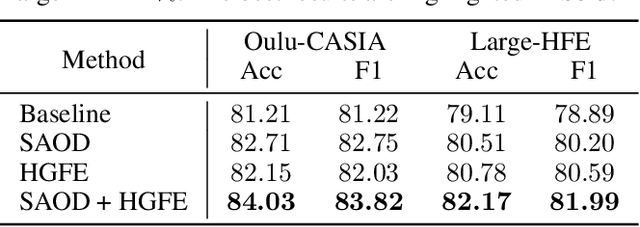
With the strong robusticity on illumination variations, near-infrared (NIR) can be an effective and essential complement to visible (VIS) facial expression recognition in low lighting or complete darkness conditions. However, facial expression recognition (FER) from NIR images presents more challenging problem than traditional FER due to the limitations imposed by the data scale and the difficulty of extracting discriminative features from incomplete visible lighting contents. In this paper, we give the first attempt to deep NIR facial expression recognition and proposed a novel method called near-infrared facial expression transformer (NFER-Former). Specifically, to make full use of the abundant label information in the field of VIS, we introduce a Self-Attention Orthogonal Decomposition mechanism that disentangles the expression information and spectrum information from the input image, so that the expression features can be extracted without the interference of spectrum variation. We also propose a Hypergraph-Guided Feature Embedding method that models some key facial behaviors and learns the structure of the complex correlations between them, thereby alleviating the interference of inter-class similarity. Additionally, we have constructed a large NIR-VIS Facial Expression dataset that includes 360 subjects to better validate the efficiency of NFER-Former. Extensive experiments and ablation studies show that NFER-Former significantly improves the performance of NIR FER and achieves state-of-the-art results on the only two available NIR FER datasets, Oulu-CASIA and Large-HFE.
Multi-Energy Guided Image Translation with Stochastic Differential Equations for Near-Infrared Facial Expression Recognition
Dec 10, 2023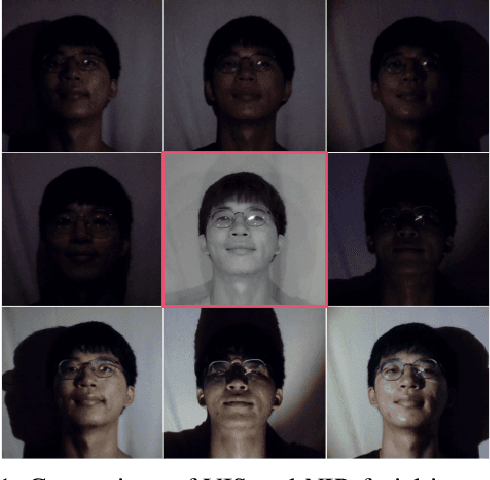
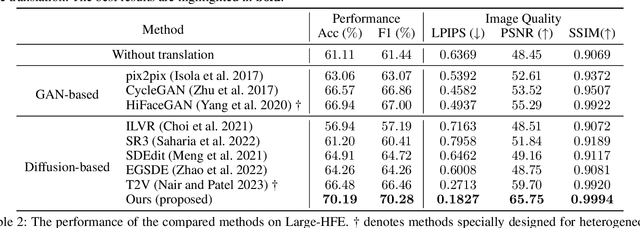

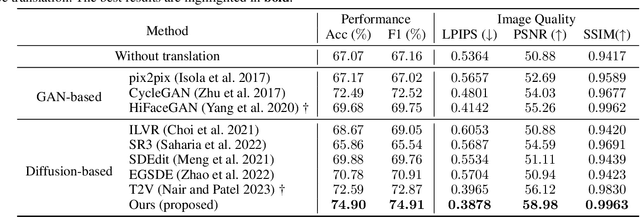
Illumination variation has been a long-term challenge in real-world facial expression recognition(FER). Under uncontrolled or non-visible light conditions, Near-infrared (NIR) can provide a simple and alternative solution to obtain high-quality images and supplement the geometric and texture details that are missing in the visible domain. Due to the lack of existing large-scale NIR facial expression datasets, directly extending VIS FER methods to the NIR spectrum may be ineffective. Additionally, previous heterogeneous image synthesis methods are restricted by low controllability without prior task knowledge. To tackle these issues, we present the first approach, called for NIR-FER Stochastic Differential Equations (NFER-SDE), that transforms face expression appearance between heterogeneous modalities to the overfitting problem on small-scale NIR data. NFER-SDE is able to take the whole VIS source image as input and, together with domain-specific knowledge, guide the preservation of modality-invariant information in the high-frequency content of the image. Extensive experiments and ablation studies show that NFER-SDE significantly improves the performance of NIR FER and achieves state-of-the-art results on the only two available NIR FER datasets, Oulu-CASIA and Large-HFE.