 Add to Chrome
 Add to Firefox
 Add to Edge
MCLMR: A Model-Agnostic Causal Learning Framework for Multi-Behavior Recommendation
Mar 26, 2026
Multi-Behavior Recommendation (MBR) leverages multiple user interaction types (e.g., views, clicks, purchases) to enrich preference modeling and alleviate data sparsity issues in traditional single-behavior approaches. However, existing MBR methods face fundamental challenges: they lack principled frameworks to model complex confounding effects from user behavioral habits and item multi-behavior distributions, struggle with effective aggregation of heterogeneous auxiliary behaviors, and fail to align behavioral representations across semantic gaps while accounting for bias distortions. To address these limitations, we propose MCLMR, a novel model-agnostic causal learning framework that can be seamlessly integrated into various MBR architectures. MCLMR first constructs a causal graph to model confounding effects and performs interventions for unbiased preference estimation. Under this causal framework, it employs an Adaptive Aggregation module based on Mixture-of-Experts to dynamically fuse auxiliary behavior information and a Bias-aware Contrastive Learning module to align cross-behavior representations in a bias-aware manner. Extensive experiments on three real-world datasets demonstrate that MCLMR achieves significant performance improvements across various baseline models, validating its effectiveness and generality. All data and code will be made publicly available. For anonymous review, our code is available at the following the link: https://github.com/gitrxh/MCLMR.

Turning Semantics into Topology: LLM-Driven Attribute Augmentation for Collaborative Filtering
Feb 24, 2026Large Language Models (LLMs) have shown great potential for enhancing recommender systems through their extensive world knowledge and reasoning capabilities. However, effectively translating these semantic signals into traditional collaborative embeddings remains an open challenge. Existing approaches typically fall into two extremes: direct inference methods are computationally prohibitive for large-scale retrieval, while embedding-based methods primarily focus on unilateral feature augmentation rather than holistic collaborative signal enhancement. To bridge this gap, we propose Topology-Augmented Graph Collaborative Filtering (TAGCF), a novel framework that transforms semantic knowledge into topological connectivity. Unlike existing approaches that depend on textual features or direct interaction synthesis, TAGCF employs LLMs to infer interaction intents and underlying causal relationships from user-item pairs, representing these insights as intermediate attribute nodes within an enriched User-Attribute-Item (U-A-I) graph. Furthermore, to effectively model the heterogeneous relations in this augmented structure, we propose Adaptive Relation-weighted Graph Convolution (ARGC), which employs relation-specific prediction networks to dynamically estimate the importance of each relation type. Extensive experiments across multiple benchmark datasets and CF backbones demonstrate consistent improvements, with comprehensive evaluations including cold-start scenarios validating the effectiveness and robustness of our framework. All code will be made publicly available. For anonymous review, our code is available at the following anonymous link: https://anonymous.4open.science/r/AGCF-2441353190/.
MOS: Model Synergy for Test-Time Adaptation on LiDAR-Based 3D Object Detection
Jun 21, 2024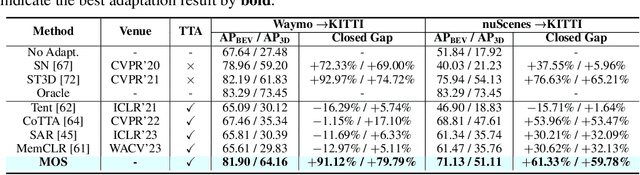
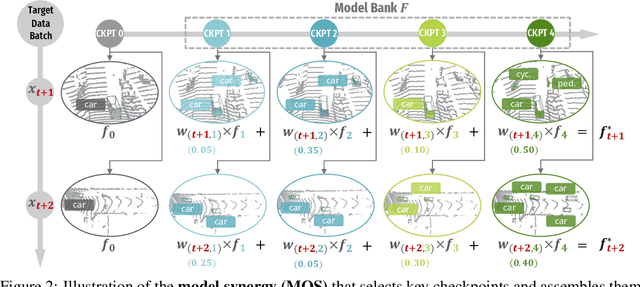
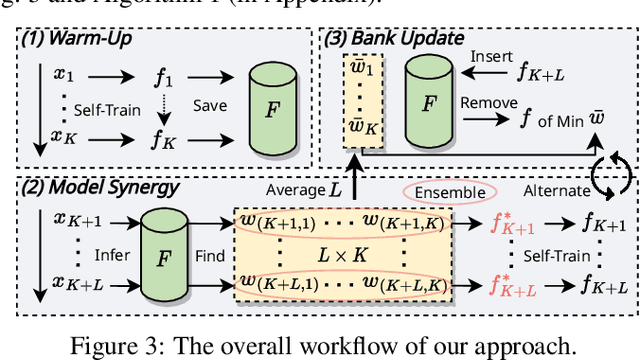
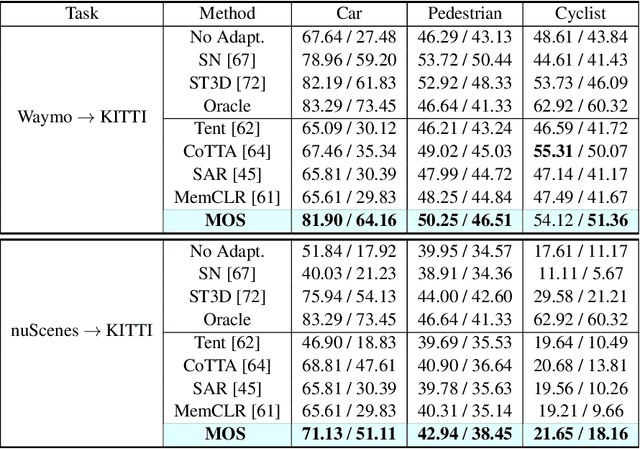
LiDAR-based 3D object detection is pivotal across many applications, yet the performance of such detection systems often degrades after deployment, especially when faced with unseen test point clouds originating from diverse locations or subjected to corruption. In this work, we introduce a new online adaptation framework for detectors named Model Synergy (MOS). Specifically, MOS dynamically assembles best-fit supermodels for each test batch from a bank of historical checkpoints, leveraging long-term knowledge to guide model updates without forgetting. The model assembly is directed by the proposed synergy weights (SW), employed for weighted averaging of the selected checkpoints to minimize redundancy in the composite supermodel. These weights are calculated by evaluating the similarity of predicted bounding boxes on test data and the feature independence among model pairs in the bank. To maintain an informative yet compact model bank, we pop out checkpoints with the lowest average SW scores and insert newly updated model weights. Our method was rigorously tested against prior test-time domain adaptation strategies on three datasets and under eight types of corruptions, demonstrating its superior adaptability to changing scenes and conditions. Remarkably, our approach achieved a 67.3% increase in performance in a complex "cross-corruption" scenario, which involves cross-dataset inconsistencies and real-world scene corruptions, providing a more realistic testbed of adaptation capabilities. The code is available at https://github.com/zhuoxiao-chen/MOS.