 Add to Chrome
 Add to Firefox
 Add to Edge
AMBUSH: Collaborative Capture in Complex Environments with Neural Acceleration
Jul 01, 2026
Collaborative capture of dynamic targets is common in nature as an essential strategy for weaker species against the strong. Similar concepts have shown to be useful for numerous robotic applications, such as security and surveillance, search and rescue. However, most existing works focus on analytical and geometric solutions or end-to-end reinforcement learning methods, which are largely constrained to obstacle-free environments or scenarios with sparse, regularly distributed obstacles. This work tackles the problem from a unique perspective: the renowned strategy of``ambush'' alone would suffice for multiple slower pursuers to capture one faster evader with different levels of intelligence efficiently in complex environments. A parameterized strategy of ambush (including discrete and continuous parameters) is designed first, which takes into account the topological properties of the workspace, the truncated line-of-sight visibility, the relative speed ratio and the limited capture range. Then, a Hybrid Monte Carlo Tree Search (H-MCTS) algorithm is proposed to optimize the associated parameters through long-term planning, enabling the identification of highly promising parameters for future capture. Lastly, the neural acceleration is trained offline to learn the ranking of different choices of parameters across various environments, and to directly predict scores, replacing the rollout process in H-MCTS. The neural acceleration is adopted during online H-MCTS to accelerate the planning procedure while guaranteeing the planning quality. Its efficiency and effectiveness are validated in extensive simulations and hardware experiments, against evaders with different capabilities and intelligence levels, including two-times higher velocity and human-controlled behavior.

CLOSER-VLN: Closed-Loop Self-Verified Retrieval-Augmented Reasoning for Aerial Vision-Language Navigation
Jun 24, 2026Vision-language navigation (VLN) has recently advanced with large language and multimodal models, enabling agents to follow natural-language instructions in unseen environments without training a task-specific navigation policy. However, most existing VLN methods relying on large models still adopt an open-loop decision-execution approach, where candidate actions are generated from instructions and observations but are rarely verified or corrected before execution. This causes critical issues in aerial VLN, where minor errors in intermediate actions may quickly accumulate into large trajectory deviations and lead to target loss. To address this issue, we propose Closed-loop Self-verified Retrieval-augmented Reasoning (CLOSER), a training-policy-free method that sequentially performs action reasoning, reliability verification, targeted retrieval, and action correction in a closed-loop manner before executing concrete actions. We instantiate the CLOSER in aerial VLN tasks and develop a CLOSER-VLN framework, which is composed of three components: a hierarchical reasoner for generating candidate actions based on available information, a multidimensional action verifier for assessing the reliability of actions generated by the reasoner, and a verification-triggered multimodal retriever for retrieving targeted exemplars from a memory bank only when verification fails. We conduct experimental evaluations on the CityNav benchmark, where CLOSER-VLN achieves 32.01% SR and 21.28% SPL on the test-unseen split, confirming the effectiveness of closed-loop reasoning.
The conditional-mean barrier: From deterministic regression to conditional distribution learning
May 27, 2026Many problems in computational science and engineering become one-to-many after coarse graining, partial observation, or inverse reconstruction: a resolved state may not determine a unique subgrid forcing, a structural descriptor may not determine a unique effective response, and a low-resolution observation may correspond to many plausible high-resolution fields. In such settings, deterministic surrogates may learn a well-defined mathematical object while still missing application-relevant uncertainty. This tutorial develops a self-contained module centered on the conditional-mean barrier: the point at which a squared-loss predictor has reached the conditional mean and the remaining error is irreducible aleatoric variance. We give two diagnostics for locating this barrier, residual-feature orthogonality and the coefficient of determination against its explained-variance ceiling, and prove that adding latent randomness to a squared-loss predictor collapses it back to the conditional mean. Crossing the barrier therefore requires a loss that scores distributions rather than point predictions. We briefly organize common distributional objectives, including negative log-likelihood, moment and observable matching, variational objectives, adversarial divergences, and score matching, by the feature of the conditional law each targets. The emphasis is the boundary itself and a finite-data procedure for recognizing it, rather than a survey of methods beyond it. CPU-based demonstrations on a two-branch law and a two-scale Lorenz-96 closure problem show how the diagnostics distinguish deterministic underfitting from residual distributional variability.
CoCoPlan: Adaptive Coordination and Communication for Multi-robot Systems in Dynamic and Unknown Environments
Jan 15, 2026Multi-robot systems can greatly enhance efficiency through coordination and collaboration, yet in practice, full-time communication is rarely available and interactions are constrained to close-range exchanges. Existing methods either maintain all-time connectivity, rely on fixed schedules, or adopt pairwise protocols, but none adapt effectively to dynamic spatio-temporal task distributions under limited communication, resulting in suboptimal coordination. To address this gap, we propose CoCoPlan, a unified framework that co-optimizes collaborative task planning and team-wise intermittent communication. Our approach integrates a branch-and-bound architecture that jointly encodes task assignments and communication events, an adaptive objective function that balances task efficiency against communication latency, and a communication event optimization module that strategically determines when, where and how the global connectivity should be re-established. Extensive experiments demonstrate that it outperforms state-of-the-art methods by achieving a 22.4% higher task completion rate, reducing communication overhead by 58.6%, and improving the scalability by supporting up to 100 robots in dynamic environments. Hardware experiments include the complex 2D office environment and large-scale 3D disaster-response scenario.
SLEI3D: Simultaneous Exploration and Inspection via Heterogeneous Fleets under Limited Communication
Jan 01, 2026Robotic fleets such as unmanned aerial and ground vehicles have been widely used for routine inspections of static environments, where the areas of interest are known and planned in advance. However, in many applications, such areas of interest are unknown and should be identified online during exploration. Thus, this paper considers the problem of simultaneous exploration, inspection of unknown environments and then real-time communication to a mobile ground control station to report the findings. The heterogeneous robots are equipped with different sensors, e.g., long-range lidars for fast exploration and close-range cameras for detailed inspection. Furthermore, global communication is often unavailable in such environments, where the robots can only communicate with each other via ad-hoc wireless networks when they are in close proximity and free of obstruction. This work proposes a novel planning and coordination framework (SLEI3D) that integrates the online strategies for collaborative 3D exploration, adaptive inspection and timely communication (via the intermit-tent or proactive protocols). To account for uncertainties w.r.t. the number and location of features, a multi-layer and multi-rate planning mechanism is developed for inter-and-intra robot subgroups, to actively meet and coordinate their local plans. The proposed framework is validated extensively via high-fidelity simulations of numerous large-scale missions with up to 48 robots and 384 thousand cubic meters. Hardware experiments of 7 robots are also conducted. Project website is available at https://junfengchen-robotics.github.io/SLEI3D/.
DEXTER-LLM: Dynamic and Explainable Coordination of Multi-Robot Systems in Unknown Environments via Large Language Models
Aug 20, 2025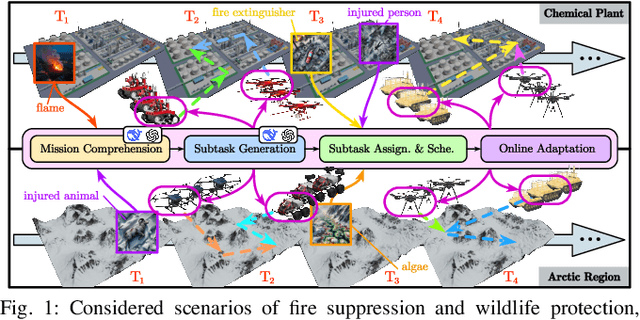
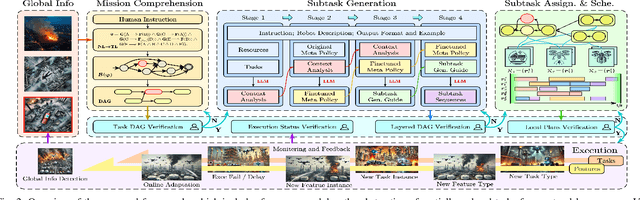
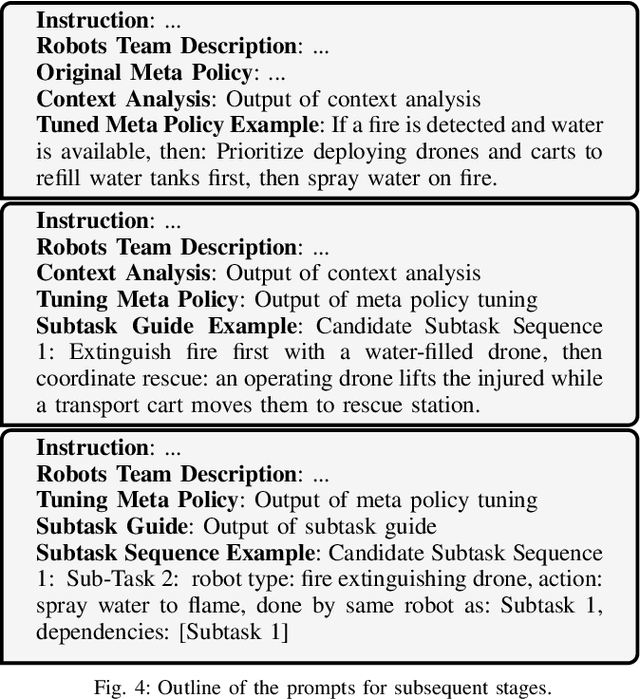
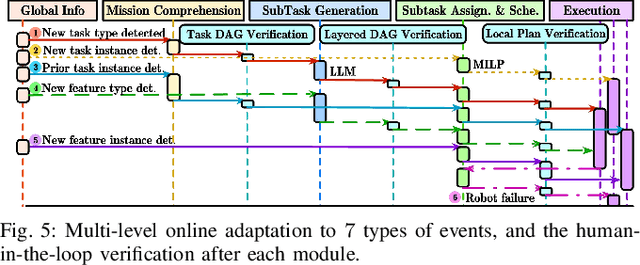
Online coordination of multi-robot systems in open and unknown environments faces significant challenges, particularly when semantic features detected during operation dynamically trigger new tasks. Recent large language model (LLMs)-based approaches for scene reasoning and planning primarily focus on one-shot, end-to-end solutions in known environments, lacking both dynamic adaptation capabilities for online operation and explainability in the processes of planning. To address these issues, a novel framework (DEXTER-LLM) for dynamic task planning in unknown environments, integrates four modules: (i) a mission comprehension module that resolves partial ordering of tasks specified by natural languages or linear temporal logic formulas (LTL); (ii) an online subtask generator based on LLMs that improves the accuracy and explainability of task decomposition via multi-stage reasoning; (iii) an optimal subtask assigner and scheduler that allocates subtasks to robots via search-based optimization; and (iv) a dynamic adaptation and human-in-the-loop verification module that implements multi-rate, event-based updates for both subtasks and their assignments, to cope with new features and tasks detected online. The framework effectively combines LLMs' open-world reasoning capabilities with the optimality of model-based assignment methods, simultaneously addressing the critical issue of online adaptability and explainability. Experimental evaluations demonstrate exceptional performances, with 100% success rates across all scenarios, 160 tasks and 480 subtasks completed on average (3 times the baselines), 62% less queries to LLMs during adaptation, and superior plan quality (2 times higher) for compound tasks. Project page at https://tcxm.github.io/DEXTER-LLM/
DUE: A Deep Learning Framework and Library for Modeling Unknown Equations
Apr 14, 2025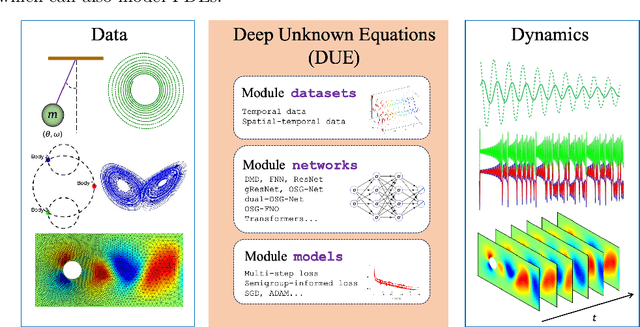
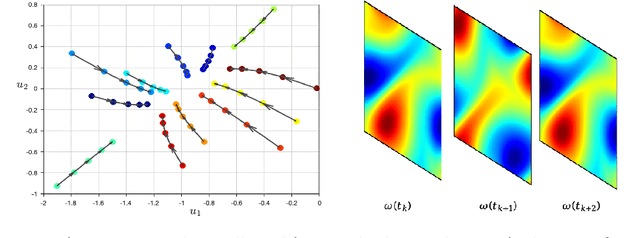
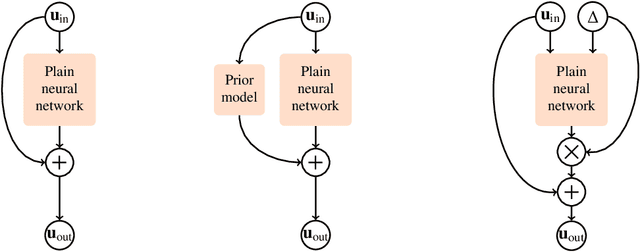
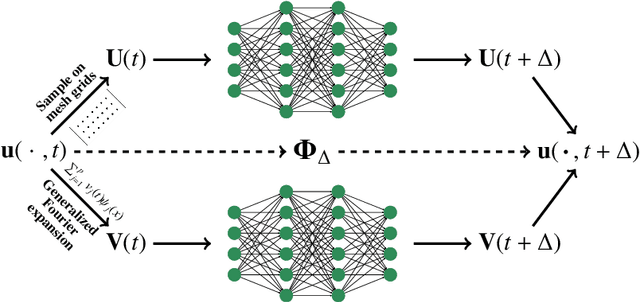
Equations, particularly differential equations, are fundamental for understanding natural phenomena and predicting complex dynamics across various scientific and engineering disciplines. However, the governing equations for many complex systems remain unknown due to intricate underlying mechanisms. Recent advancements in machine learning and data science offer a new paradigm for modeling unknown equations from measurement or simulation data. This paradigm shift, known as data-driven discovery or modeling, stands at the forefront of AI for science, with significant progress made in recent years. In this paper, we introduce a systematic framework for data-driven modeling of unknown equations using deep learning. This versatile framework is capable of learning unknown ODEs, PDEs, DAEs, IDEs, SDEs, reduced or partially observed systems, and non-autonomous differential equations. Based on this framework, we have developed Deep Unknown Equations (DUE), an open-source software package designed to facilitate the data-driven modeling of unknown equations using modern deep learning techniques. DUE serves as an educational tool for classroom instruction, enabling students and newcomers to gain hands-on experience with differential equations, data-driven modeling, and contemporary deep learning approaches such as FNN, ResNet, generalized ResNet, operator semigroup networks (OSG-Net), and Transformers. Additionally, DUE is a versatile and accessible toolkit for researchers across various scientific and engineering fields. It is applicable not only for learning unknown equations from data but also for surrogate modeling of known, yet complex, equations that are costly to solve using traditional numerical methods. We provide detailed descriptions of DUE and demonstrate its capabilities through diverse examples, which serve as templates that can be easily adapted for other applications.
IU4Rec: Interest Unit-Based Product Organization and Recommendation for E-Commerce Platform
Feb 11, 2025Most recommendation systems typically follow a product-based paradigm utilizing user-product interactions to identify the most engaging items for users. However, this product-based paradigm has notable drawbacks for Xianyu~\footnote{Xianyu is China's largest online C2C e-commerce platform where a large portion of the product are post by individual sellers}. Most of the product on Xianyu posted from individual sellers often have limited stock available for distribution, and once the product is sold, it's no longer available for distribution. This result in most items distributed product on Xianyu having relatively few interactions, affecting the effectiveness of traditional recommendation depending on accumulating user-item interactions. To address these issues, we introduce \textbf{IU4Rec}, an \textbf{I}nterest \textbf{U}nit-based two-stage \textbf{Rec}ommendation system framework. We first group products into clusters based on attributes such as category, image, and semantics. These IUs are then integrated into the Recommendation system, delivering both product and technological innovations. IU4Rec begins by grouping products into clusters based on attributes such as category, image, and semantics, forming Interest Units (IUs). Then we redesign the recommendation process into two stages. In the first stage, the focus is on recommend these Interest Units, capturing broad-level interests. In the second stage, it guides users to find the best option among similar products within the selected Interest Unit. User-IU interactions are incorporated into our ranking models, offering the advantage of more persistent IU behaviors compared to item-specific interactions. Experimental results on the production dataset and online A/B testing demonstrate the effectiveness and superiority of our proposed IU-centric recommendation approach.
Positional Knowledge is All You Need: Position-induced Transformer for Operator Learning
May 15, 2024Operator learning for Partial Differential Equations (PDEs) is rapidly emerging as a promising approach for surrogate modeling of intricate systems. Transformers with the self-attention mechanism$\unicode{x2013}$a powerful tool originally designed for natural language processing$\unicode{x2013}$have recently been adapted for operator learning. However, they confront challenges, including high computational demands and limited interpretability. This raises a critical question: Is there a more efficient attention mechanism for Transformer-based operator learning? This paper proposes the Position-induced Transformer (PiT), built on an innovative position-attention mechanism, which demonstrates significant advantages over the classical self-attention in operator learning. Position-attention draws inspiration from numerical methods for PDEs. Different from self-attention, position-attention is induced by only the spatial interrelations of sampling positions for input functions of the operators, and does not rely on the input function values themselves, thereby greatly boosting efficiency. PiT exhibits superior performance over current state-of-the-art neural operators in a variety of complex operator learning tasks across diverse PDE benchmarks. Additionally, PiT possesses an enhanced discretization convergence feature, compared to the widely-used Fourier neural operator.
Accelerated K-Serial Stable Coalition for Dynamic Capture and Resource Defense
May 25, 2023
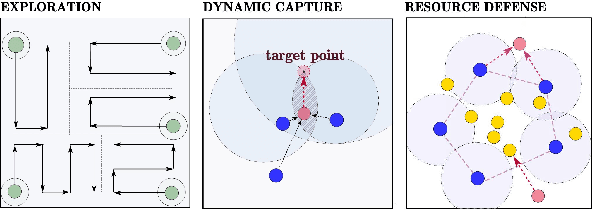


Coalition is an important mean of multi-robot systems to collaborate on common tasks. An effective and adaptive coalition strategy is essential for the online performance in dynamic and unknown environments. In this work, the problem of territory defense by large-scale heterogeneous robotic teams is considered. The tasks include surveillance, capture of dynamic targets, and perimeter defense over valuable resources. Since each robot can choose among many tasks, it remains a challenging problem to coordinate jointly these robots such that the overall utility is maximized. This work proposes a generic coalition strategy called K-serial stable coalition algorithm (KS-COAL). Different from centralized approaches, it is distributed and anytime, meaning that only local communication is required and a K-serial Nash-stable solution is ensured. Furthermore, to accelerate adaptation to dynamic targets and resource distribution that are only perceived online, a heterogeneous graph attention network (HGAN)-based heuristic is learned to select more appropriate parameters and promising initial solutions during local optimization. Compared with manual heuristics or end-to-end predictors, it is shown to both improve online adaptability and retain the quality guarantee. The proposed methods are validated rigorously via large-scale simulations with hundreds of robots, against several strong baselines including GreedyNE and FastMaxSum.