 Add to Chrome
 Add to Firefox
 Add to Edge
CoCoPlan: Adaptive Coordination and Communication for Multi-robot Systems in Dynamic and Unknown Environments
Jan 15, 2026
Multi-robot systems can greatly enhance efficiency through coordination and collaboration, yet in practice, full-time communication is rarely available and interactions are constrained to close-range exchanges. Existing methods either maintain all-time connectivity, rely on fixed schedules, or adopt pairwise protocols, but none adapt effectively to dynamic spatio-temporal task distributions under limited communication, resulting in suboptimal coordination. To address this gap, we propose CoCoPlan, a unified framework that co-optimizes collaborative task planning and team-wise intermittent communication. Our approach integrates a branch-and-bound architecture that jointly encodes task assignments and communication events, an adaptive objective function that balances task efficiency against communication latency, and a communication event optimization module that strategically determines when, where and how the global connectivity should be re-established. Extensive experiments demonstrate that it outperforms state-of-the-art methods by achieving a 22.4% higher task completion rate, reducing communication overhead by 58.6%, and improving the scalability by supporting up to 100 robots in dynamic environments. Hardware experiments include the complex 2D office environment and large-scale 3D disaster-response scenario.

SLEI3D: Simultaneous Exploration and Inspection via Heterogeneous Fleets under Limited Communication
Jan 01, 2026Robotic fleets such as unmanned aerial and ground vehicles have been widely used for routine inspections of static environments, where the areas of interest are known and planned in advance. However, in many applications, such areas of interest are unknown and should be identified online during exploration. Thus, this paper considers the problem of simultaneous exploration, inspection of unknown environments and then real-time communication to a mobile ground control station to report the findings. The heterogeneous robots are equipped with different sensors, e.g., long-range lidars for fast exploration and close-range cameras for detailed inspection. Furthermore, global communication is often unavailable in such environments, where the robots can only communicate with each other via ad-hoc wireless networks when they are in close proximity and free of obstruction. This work proposes a novel planning and coordination framework (SLEI3D) that integrates the online strategies for collaborative 3D exploration, adaptive inspection and timely communication (via the intermit-tent or proactive protocols). To account for uncertainties w.r.t. the number and location of features, a multi-layer and multi-rate planning mechanism is developed for inter-and-intra robot subgroups, to actively meet and coordinate their local plans. The proposed framework is validated extensively via high-fidelity simulations of numerous large-scale missions with up to 48 robots and 384 thousand cubic meters. Hardware experiments of 7 robots are also conducted. Project website is available at https://junfengchen-robotics.github.io/SLEI3D/.
DEXTER-LLM: Dynamic and Explainable Coordination of Multi-Robot Systems in Unknown Environments via Large Language Models
Aug 20, 2025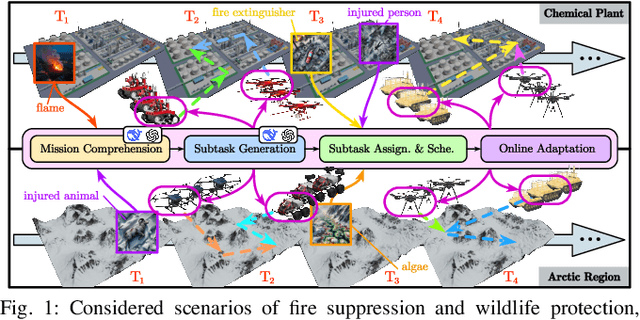
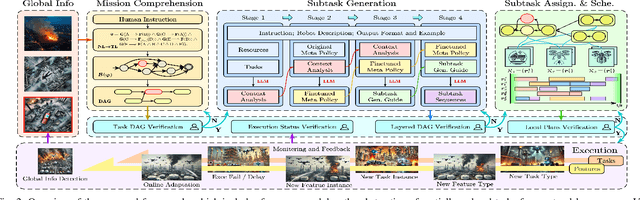
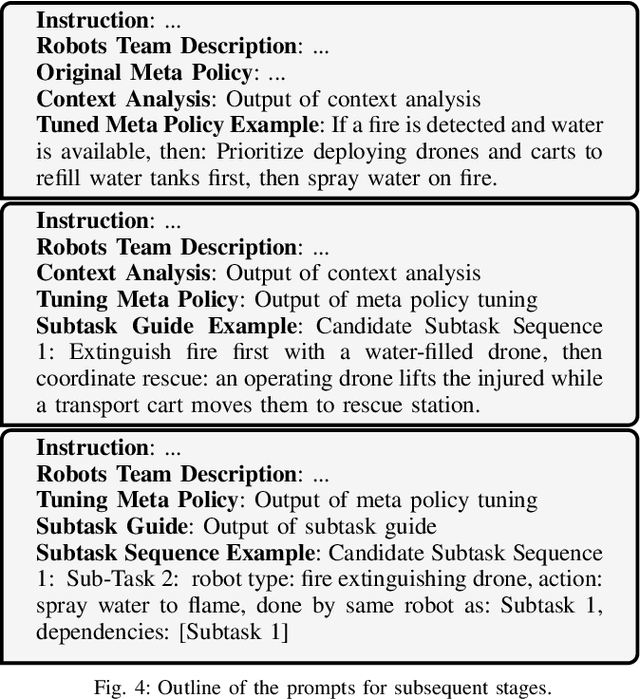
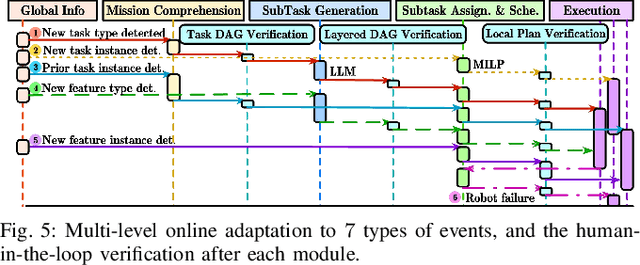
Online coordination of multi-robot systems in open and unknown environments faces significant challenges, particularly when semantic features detected during operation dynamically trigger new tasks. Recent large language model (LLMs)-based approaches for scene reasoning and planning primarily focus on one-shot, end-to-end solutions in known environments, lacking both dynamic adaptation capabilities for online operation and explainability in the processes of planning. To address these issues, a novel framework (DEXTER-LLM) for dynamic task planning in unknown environments, integrates four modules: (i) a mission comprehension module that resolves partial ordering of tasks specified by natural languages or linear temporal logic formulas (LTL); (ii) an online subtask generator based on LLMs that improves the accuracy and explainability of task decomposition via multi-stage reasoning; (iii) an optimal subtask assigner and scheduler that allocates subtasks to robots via search-based optimization; and (iv) a dynamic adaptation and human-in-the-loop verification module that implements multi-rate, event-based updates for both subtasks and their assignments, to cope with new features and tasks detected online. The framework effectively combines LLMs' open-world reasoning capabilities with the optimality of model-based assignment methods, simultaneously addressing the critical issue of online adaptability and explainability. Experimental evaluations demonstrate exceptional performances, with 100% success rates across all scenarios, 160 tasks and 480 subtasks completed on average (3 times the baselines), 62% less queries to LLMs during adaptation, and superior plan quality (2 times higher) for compound tasks. Project page at https://tcxm.github.io/DEXTER-LLM/