 Add to Chrome
 Add to Firefox
 Add to Edge
MODAL: Multi-Modal Object Re-ID via Model-Driven Sparse Decoupling and Text-Image Differential Filtering
Aug 15, 2026
Multi-modal object re-identification (Re-ID) aims to facilitate cross-camera object retrieval in complex environments by leveraging complementary information from visual (e.g., RGB, NIR, TIR) and textual modalities. However, existing approaches often lack principled feature disentanglement and coherent multi-modal integration, leading to entangled representations that introduce cross-modal conflicts, obscure discriminative cues, and suffer distribution shift under modality-missing conditions. To tackle these challenges, we propose MODAL, a novel multi-modal object re-identification framework, grounded in coupled sparse coding theory and differential suppression principles. A core component of MODAL is a Multi-modal Feature Sparse Decoupling module, developed in a model-driven deep unrolling manner based on multi-modal coupled sparse coding. It explicitly decomposes multi-modal features into uni-modal specific, bi-modal and tri-modal shared representations, thereby achieving more transparent and effective feature disentanglement. Benefiting from the principled feature disentanglement, MODAL naturally mitigates performance degradation in incomplete-modality scenarios via a Modality-Aware Subspace Activation that selectively activates only the consistently shared subspaces. Moreover, we propose a Text-Image Differential Filtering module that leverages coarse-grained textual semantics to adaptively suppress task-irrelevant responses in the decoupled visual representations, thereby enhancing discriminative information. Extensive experiments on four datasets demonstrate that MODAL achieves state-of-the-art performance with superior transparency.

IDATA: Scalable Invertible Diffusion for Unrestricted Adversarial Transfer Attack
Aug 09, 2026Unrestricted adversarial transfer attacks are important for evaluating the black-box robustness of deep visual models. Diffusion-based attacks have shown promising transferability and visual imperceptibility by optimizing adversarial perturbations along denoising trajectories in latent space. However, existing methods are limited by two challenges: memory-intensive multistep backpropagation and frequency-agnostic perturbation over intermediate latents. To address these issues, we propose IDATA, a memory-efficient diffusion framework for unrestricted adversarial transfer attack. IDATA consists of two key components: an Invertible Diffusion Module (IDM) and a Low-Frequency Constraint Module (LFCM). Specifically, IDM reformulates adversarial optimization over diffusion trajectories as an invertible process, enabling constant-memory backpropagation through on-demand reconstruction of intermediate states instead of storing the full denoising chain. Moreover, LFCM leverages Discrete Wavelet Transform (DWT) to decompose latent variables into low- and high-frequency components, restricting perturbations to semantically stable low-frequency subspaces, thereby improving transferability while preserving visual imperceptibility. Extensive experiments on multiple benchmarks and diverse model architectures demonstrate that IDATA consistently outperforms state-of-the-art baselines in attack success rate, memory efficiency, and visual imperceptibility. These results suggest that IDATA is a promising tool for black-box robustness evaluation of deep visual models. Code is available at https://github.com/colourful-pan/IDATA.
LHSDet: High-Resolution AI-Generated Image Detection via Visual Question Answering
Aug 08, 2026Driven by advances in diffusion models and autoregressive models, the fidelity and resolution of AI-generated images now rival those of real images. However, existing AI-generated image detection methods often downsample the images, inevitably overlooking critical low-level texture details in high-resolution AI-generated images, therefore limiting their detection performance. In addition, the ceaseless emergence of unknown generative models makes large-scale pre-training datasets inaccessible. To address these challenges, we propose a novel high-resolution AI-generated image detector, termed LHSDet. Specifically, we formulate the AI-generated image detection task as a Visual Question Answering problem, leveraging a fine-tuned vision-language framework to fully exploit the complementary information between visual and textual modalities. Recognizing that the default visual encoder of existing vision-language models is not tailored for AI-generated image detection, we redesign a visual encoder to better capture both the low-level and high-level artifacts inherent in AI-generated images. Furthermore, we incorporate a semantic-level textual branch to enable multi-modal feature fusion and detection. Consequently, LHSDet employs a triple-branch architecture to extract complementary multi-modal features: a low-level visual branch that aggregates non-overlapping patches for local texture cues, a high-level visual branch based on SigLIP2 for global perception feature extraction, and a semantic-level textual branch that generates captions using BLIP-2. Extensive experimental results demonstrate that LHSDet achieves high detection accuracy and robust performance across diverse generative models, including both diffusion and autoregressive models.
Enhancing Kernel Power K-means: Scalable and Robust Clustering with Random Fourier Features and Possibilistic Method
Nov 13, 2025Kernel power $k$-means (KPKM) leverages a family of means to mitigate local minima issues in kernel $k$-means. However, KPKM faces two key limitations: (1) the computational burden of the full kernel matrix restricts its use on extensive data, and (2) the lack of authentic centroid-sample assignment learning reduces its noise robustness. To overcome these challenges, we propose RFF-KPKM, introducing the first approximation theory for applying random Fourier features (RFF) to KPKM. RFF-KPKM employs RFF to generate efficient, low-dimensional feature maps, bypassing the need for the whole kernel matrix. Crucially, we are the first to establish strong theoretical guarantees for this combination: (1) an excess risk bound of $\mathcal{O}(\sqrt{k^3/n})$, (2) strong consistency with membership values, and (3) a $(1+\varepsilon)$ relative error bound achievable using the RFF of dimension $\mathrm{poly}(\varepsilon^{-1}\log k)$. Furthermore, to improve robustness and the ability to learn multiple kernels, we propose IP-RFF-MKPKM, an improved possibilistic RFF-based multiple kernel power $k$-means. IP-RFF-MKPKM ensures the scalability of MKPKM via RFF and refines cluster assignments by combining the merits of the possibilistic membership and fuzzy membership. Experiments on large-scale datasets demonstrate the superior efficiency and clustering accuracy of the proposed methods compared to the state-of-the-art alternatives.
SMILENet: Unleashing Extra-Large Capacity Image Steganography via a Synergistic Mosaic InvertibLE Hiding Network
Mar 07, 2025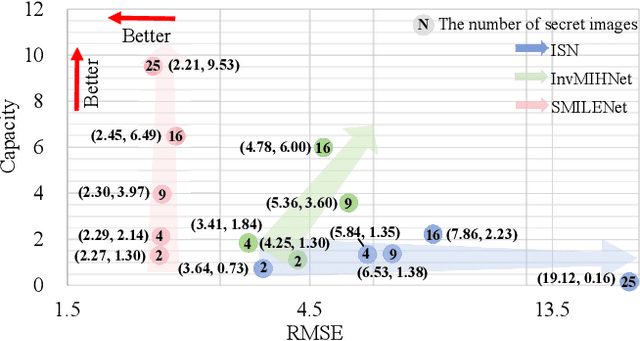
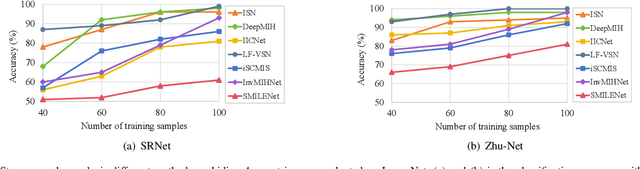
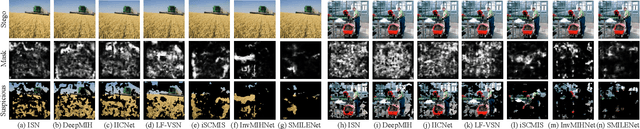
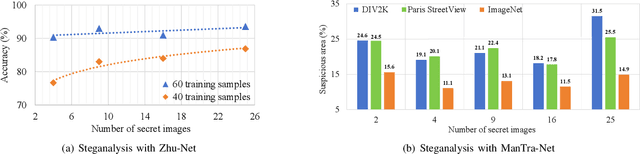
Existing image steganography methods face fundamental limitations in hiding capacity (typically $1\sim7$ images) due to severe information interference and uncoordinated capacity-distortion trade-off. We propose SMILENet, a novel synergistic framework that achieves 25 image hiding through three key innovations: (i) A synergistic network architecture coordinates reversible and non-reversible operations to efficiently exploit information redundancy in both secret and cover images. The reversible Invertible Cover-Driven Mosaic (ICDM) module and Invertible Mosaic Secret Embedding (IMSE) module establish cover-guided mosaic transformations and representation embedding with mathematically guaranteed invertibility for distortion-free embedding. The non-reversible Secret Information Selection (SIS) module and Secret Detail Enhancement (SDE) module implement learnable feature modulation for critical information selection and enhancement. (ii) A unified training strategy that coordinates complementary modules to achieve 3.0x higher capacity than existing methods with superior visual quality. (iii) Last but not least, we introduce a new metric to model Capacity-Distortion Trade-off for evaluating the image steganography algorithms that jointly considers hiding capacity and distortion, and provides a unified evaluation approach for accessing results with different number of secret image. Extensive experiments on DIV2K, Paris StreetView and ImageNet1K show that SMILENet outperforms state-of-the-art methods in terms of hiding capacity, recovery quality as well as security against steganalysis methods.
A Lightweight Deep Exclusion Unfolding Network for Single Image Reflection Removal
Mar 03, 2025Single Image Reflection Removal (SIRR) is a canonical blind source separation problem and refers to the issue of separating a reflection-contaminated image into a transmission and a reflection image. The core challenge lies in minimizing the commonalities among different sources. Existing deep learning approaches either neglect the significance of feature interactions or rely on heuristically designed architectures. In this paper, we propose a novel Deep Exclusion unfolding Network (DExNet), a lightweight, interpretable, and effective network architecture for SIRR. DExNet is principally constructed by unfolding and parameterizing a simple iterative Sparse and Auxiliary Feature Update (i-SAFU) algorithm, which is specifically designed to solve a new model-based SIRR optimization formulation incorporating a general exclusion prior. This general exclusion prior enables the unfolded SAFU module to inherently identify and penalize commonalities between the transmission and reflection features, ensuring more accurate separation. The principled design of DExNet not only enhances its interpretability but also significantly improves its performance. Comprehensive experiments on four benchmark datasets demonstrate that DExNet achieves state-of-the-art visual and quantitative results while utilizing only approximately 8\% of the parameters required by leading methods.
SVASTIN: Sparse Video Adversarial Attack via Spatio-Temporal Invertible Neural Networks
Jun 04, 2024
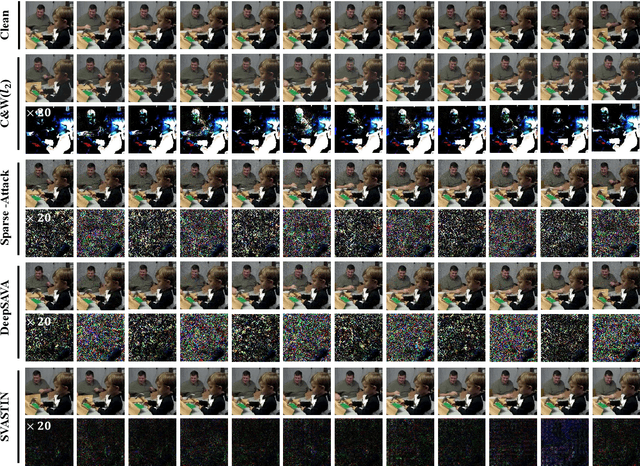
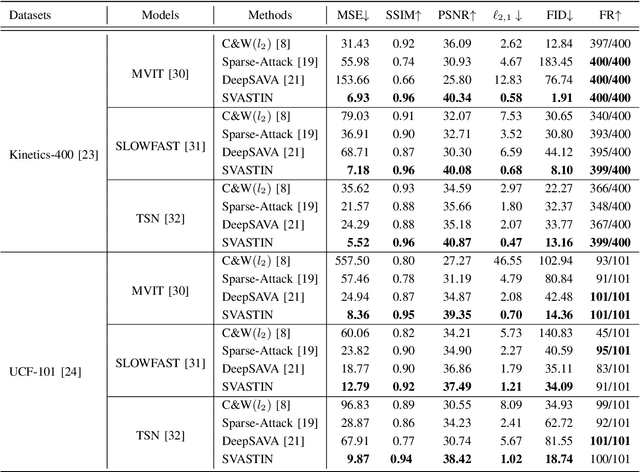
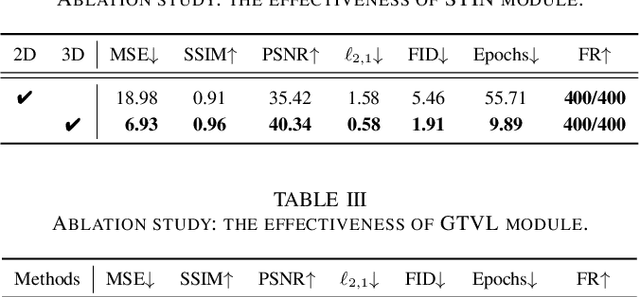
Robust and imperceptible adversarial video attack is challenging due to the spatial and temporal characteristics of videos. The existing video adversarial attack methods mainly take a gradient-based approach and generate adversarial videos with noticeable perturbations. In this paper, we propose a novel Sparse Adversarial Video Attack via Spatio-Temporal Invertible Neural Networks (SVASTIN) to generate adversarial videos through spatio-temporal feature space information exchanging. It consists of a Guided Target Video Learning (GTVL) module to balance the perturbation budget and optimization speed and a Spatio-Temporal Invertible Neural Network (STIN) module to perform spatio-temporal feature space information exchanging between a source video and the target feature tensor learned by GTVL module. Extensive experiments on UCF-101 and Kinetics-400 demonstrate that our proposed SVASTIN can generate adversarial examples with higher imperceptibility than the state-of-the-art methods with the higher fooling rate. Code is available at \href{https://github.com/Brittany-Chen/SVASTIN}{https://github.com/Brittany-Chen/SVASTIN}.
Learning-based Reconstruction of FRI Signals
Dec 16, 2022Finite Rate of Innovation (FRI) sampling theory enables reconstruction of classes of continuous non-bandlimited signals that have a small number of free parameters from their low-rate discrete samples. This task is often translated into a spectral estimation problem that is solved using methods involving estimating signal subspaces, which tend to break down at a certain peak signal-to-noise ratio (PSNR). To avoid this breakdown, we consider alternative approaches that make use of information from labelled data. We propose two model-based learning methods, including deep unfolding the denoising process in spectral estimation, and constructing an encoder-decoder deep neural network that models the acquisition process. Simulation results of both learning algorithms indicate significant improvements of the breakdown PSNR over classical subspace-based methods. While the deep unfolded network achieves similar performance as the classical FRI techniques and outperforms the encoder-decoder network in the low noise regimes, the latter allows to reconstruct the FRI signal even when the sampling kernel is unknown. We also achieve competitive results in detecting pulses from in vivo calcium imaging data in terms of true positive and false positive rate while providing more precise estimations.
A Fast Automatic Method for Deconvoluting Macro X-ray Fluorescence Data Collected from Easel Paintings
Oct 31, 2022Macro X-ray Fluorescence (MA-XRF) scanning is increasingly widely used by researchers in heritage science to analyse easel paintings as one of a suite of non-invasive imaging techniques. The task of processing the resulting MA-XRF datacube generated in order to produce individual chemical element maps is called MA-XRF deconvolution. While there are several existing methods that have been proposed for MA-XRF deconvolution, they require a degree of manual intervention from the user that can affect the final results. The state-of-the-art AFRID approach can automatically deconvolute the datacube without user input, but it has a long processing time and does not exploit spatial dependency. In this paper, we propose two versions of a fast automatic deconvolution (FAD) method for MA-XRF datacubes collected from easel paintings with ADMM (alternating direction method of multipliers) and FISTA (fast iterative shrinkage-thresholding algorithm). The proposed FAD method not only automatically analyses the datacube and produces element distribution maps of high-quality with spatial dependency considered, but also significantly reduces the running time. The results generated on the MA-XRF datacubes collected from two easel paintings from the National Gallery, London, verify the performance of the proposed FAD method.
DURRNet: Deep Unfolded Single Image Reflection Removal Network
Mar 12, 2022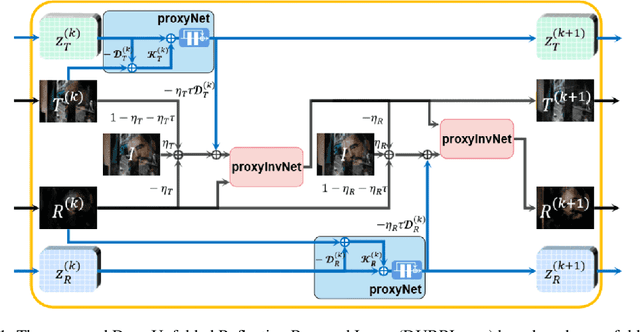

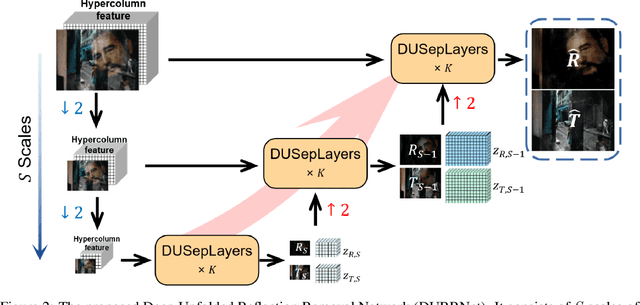

Single image reflection removal problem aims to divide a reflection-contaminated image into a transmission image and a reflection image. It is a canonical blind source separation problem and is highly ill-posed. In this paper, we present a novel deep architecture called deep unfolded single image reflection removal network (DURRNet) which makes an attempt to combine the best features from model-based and learning-based paradigms and therefore leads to a more interpretable deep architecture. Specifically, we first propose a model-based optimization with transform-based exclusion prior and then design an iterative algorithm with simple closed-form solutions for solving each sub-problems. With the deep unrolling technique, we build the DURRNet with ProxNets to model natural image priors and ProxInvNets which are constructed with invertible networks to impose the exclusion prior. Comprehensive experimental results on commonly used datasets demonstrate that the proposed DURRNet achieves state-of-the-art results both visually and quantitatively.