 Add to Chrome
 Add to Firefox
 Add to Edge
MODAL: Multi-Modal Object Re-ID via Model-Driven Sparse Decoupling and Text-Image Differential Filtering
Aug 15, 2026
Multi-modal object re-identification (Re-ID) aims to facilitate cross-camera object retrieval in complex environments by leveraging complementary information from visual (e.g., RGB, NIR, TIR) and textual modalities. However, existing approaches often lack principled feature disentanglement and coherent multi-modal integration, leading to entangled representations that introduce cross-modal conflicts, obscure discriminative cues, and suffer distribution shift under modality-missing conditions. To tackle these challenges, we propose MODAL, a novel multi-modal object re-identification framework, grounded in coupled sparse coding theory and differential suppression principles. A core component of MODAL is a Multi-modal Feature Sparse Decoupling module, developed in a model-driven deep unrolling manner based on multi-modal coupled sparse coding. It explicitly decomposes multi-modal features into uni-modal specific, bi-modal and tri-modal shared representations, thereby achieving more transparent and effective feature disentanglement. Benefiting from the principled feature disentanglement, MODAL naturally mitigates performance degradation in incomplete-modality scenarios via a Modality-Aware Subspace Activation that selectively activates only the consistently shared subspaces. Moreover, we propose a Text-Image Differential Filtering module that leverages coarse-grained textual semantics to adaptively suppress task-irrelevant responses in the decoupled visual representations, thereby enhancing discriminative information. Extensive experiments on four datasets demonstrate that MODAL achieves state-of-the-art performance with superior transparency.

BeyondFacial: Identity-Preserving Personalized Generation Beyond Facial Close-ups
Nov 15, 2025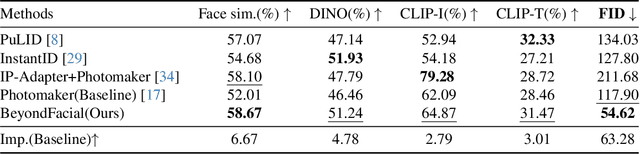
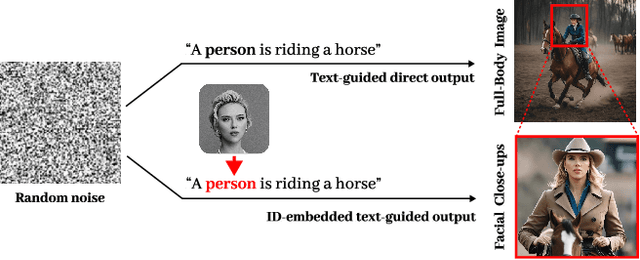
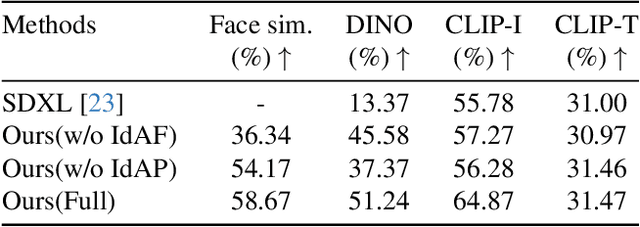
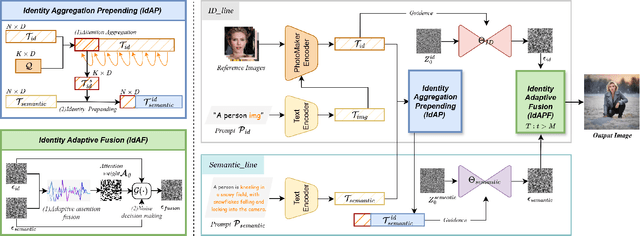
Identity-Preserving Personalized Generation (IPPG) has advanced film production and artistic creation, yet existing approaches overemphasize facial regions, resulting in outputs dominated by facial close-ups.These methods suffer from weak visual narrativity and poor semantic consistency under complex text prompts, with the core limitation rooted in identity (ID) feature embeddings undermining the semantic expressiveness of generative models. To address these issues, this paper presents an IPPG method that breaks the constraint of facial close-ups, achieving synergistic optimization of identity fidelity and scene semantic creation. Specifically, we design a Dual-Line Inference (DLI) pipeline with identity-semantic separation, resolving the representation conflict between ID and semantics inherent in traditional single-path architectures. Further, we propose an Identity Adaptive Fusion (IdAF) strategy that defers ID-semantic fusion to the noise prediction stage, integrating adaptive attention fusion and noise decision masking to avoid ID embedding interference on semantics without manual masking. Finally, an Identity Aggregation Prepending (IdAP) module is introduced to aggregate ID information and replace random initializations, further enhancing identity preservation. Experimental results validate that our method achieves stable and effective performance in IPPG tasks beyond facial close-ups, enabling efficient generation without manual masking or fine-tuning. As a plug-and-play component, it can be rapidly deployed in existing IPPG frameworks, addressing the over-reliance on facial close-ups, facilitating film-level character-scene creation, and providing richer personalized generation capabilities for related domains.