 Add to Chrome
 Add to Firefox
 Add to Edge
LHSDet: High-Resolution AI-Generated Image Detection via Visual Question Answering
Aug 08, 2026
Driven by advances in diffusion models and autoregressive models, the fidelity and resolution of AI-generated images now rival those of real images. However, existing AI-generated image detection methods often downsample the images, inevitably overlooking critical low-level texture details in high-resolution AI-generated images, therefore limiting their detection performance. In addition, the ceaseless emergence of unknown generative models makes large-scale pre-training datasets inaccessible. To address these challenges, we propose a novel high-resolution AI-generated image detector, termed LHSDet. Specifically, we formulate the AI-generated image detection task as a Visual Question Answering problem, leveraging a fine-tuned vision-language framework to fully exploit the complementary information between visual and textual modalities. Recognizing that the default visual encoder of existing vision-language models is not tailored for AI-generated image detection, we redesign a visual encoder to better capture both the low-level and high-level artifacts inherent in AI-generated images. Furthermore, we incorporate a semantic-level textual branch to enable multi-modal feature fusion and detection. Consequently, LHSDet employs a triple-branch architecture to extract complementary multi-modal features: a low-level visual branch that aggregates non-overlapping patches for local texture cues, a high-level visual branch based on SigLIP2 for global perception feature extraction, and a semantic-level textual branch that generates captions using BLIP-2. Extensive experimental results demonstrate that LHSDet achieves high detection accuracy and robust performance across diverse generative models, including both diffusion and autoregressive models.

Multivariate Gaussian Representation Learning for Medical Action Evaluation
Nov 13, 2025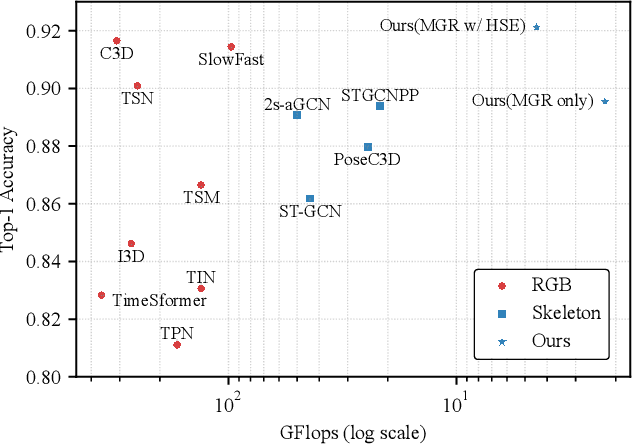
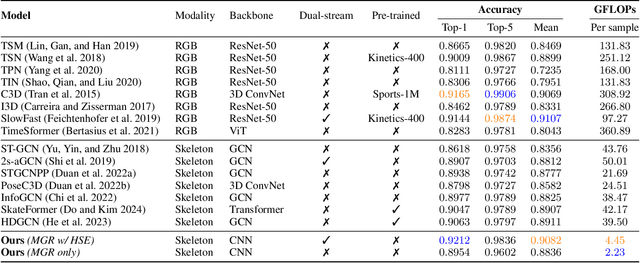
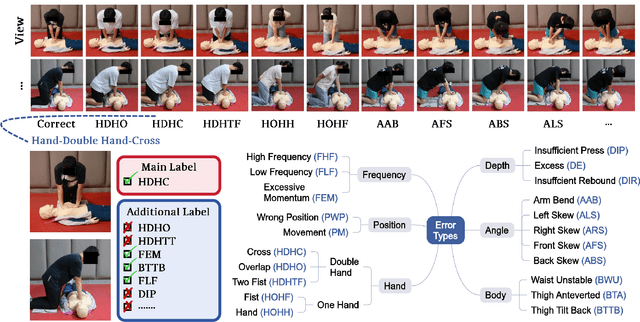
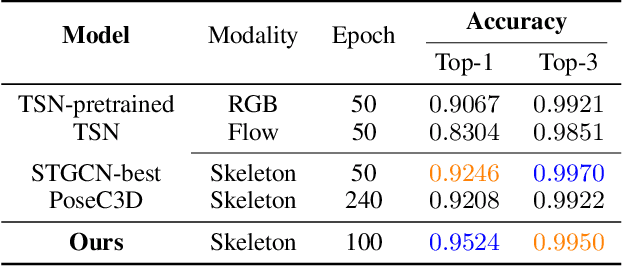
Fine-grained action evaluation in medical vision faces unique challenges due to the unavailability of comprehensive datasets, stringent precision requirements, and insufficient spatiotemporal dynamic modeling of very rapid actions. To support development and evaluation, we introduce CPREval-6k, a multi-view, multi-label medical action benchmark containing 6,372 expert-annotated videos with 22 clinical labels. Using this dataset, we present GaussMedAct, a multivariate Gaussian encoding framework, to advance medical motion analysis through adaptive spatiotemporal representation learning. Multivariate Gaussian Representation projects the joint motions to a temporally scaled multi-dimensional space, and decomposes actions into adaptive 3D Gaussians that serve as tokens. These tokens preserve motion semantics through anisotropic covariance modeling while maintaining robustness to spatiotemporal noise. Hybrid Spatial Encoding, employing a Cartesian and Vector dual-stream strategy, effectively utilizes skeletal information in the form of joint and bone features. The proposed method achieves 92.1% Top-1 accuracy with real-time inference on the benchmark, outperforming the ST-GCN baseline by +5.9% accuracy with only 10% FLOPs. Cross-dataset experiments confirm the superiority of our method in robustness.
Tensorized Ant Colony Optimization for GPU Acceleration
Apr 12, 2024Ant Colony Optimization (ACO) is renowned for its effectiveness in solving Traveling Salesman Problems, yet it faces computational challenges in CPU-based environments, particularly with large-scale instances. In response, we introduce a Tensorized Ant Colony Optimization (TensorACO) to utilize the advancements of GPU acceleration. As the core, TensorACO fully transforms ant system and ant path into tensor forms, a process we refer to as tensorization. For the tensorization of ant system, we propose a preprocessing method to reduce the computational overhead by calculating the probability transition matrix. In the tensorization of ant path, we propose an index mapping method to accelerate the update of pheromone matrix by replacing the mechanism of sequential path update with parallel matrix operations. Additionally, we introduce an Adaptive Independent Roulette (AdaIR) method to overcome the challenges of parallelizing ACO's selection mechanism on GPUs. Comprehensive experiments demonstrate the superior performance of TensorACO achieving up to 1921$\times$ speedup over standard ACO. Moreover, the AdaIR method further improves TensorACO's convergence speed by 80% and solution quality by 2%. Source codes are available at https://github.com/EMI-Group/tensoraco.