 Add to Chrome
 Add to Firefox
 Add to Edge
Weakly Guided and Autoregressive Beamformer Parameterization for Generalizable Moving Speaker Extraction in Higher-Order Ambisonics
Jul 05, 2026
Linear spatial filters (beamformers) enable robust, generalizable and interpretable speech enhancement with performance guarantees under ideal parameterization. Modern beamformers are often parameterized by deep neural networks, whose performance degrades in dynamic scenarios with multiple moving speakers of unknown directions. We propose a data-driven beamforming pipeline, which only requires an estimate of the target's initial direction. Building on a higher-order ambisonics representation, we show that neural temporal-spectral processing can be decoupled from linear spatial processing, and thereby achieve generalizable and array-agnostic enhancement. By incorporating autoregression into a frame-wise causal framework, we maintain consistent performance throughout fast speaker motion and long recordings. Evaluation on synthetic data demonstrates robust enhancement under challenging conditions with closely spaced and crossing speakers. Real-world recordings in a dynamic office meeting scenario complement these findings and show generalizability across varying ambisonics orders.

Too Good to Be True: A Study on Modern Automatic Speech Recognition for the Evaluation of Speech Enhancement
May 12, 2026Speech enhancement (SE) systems are typically evaluated using a variety of instrumental metrics. The use of automatic speech recognition (ASR) systems to evaluate SE performance is common in literature, usually in terms of word error rate (WER). However, WER scores depend heavily on the choice of ASR system and text normalization pipeline. In this paper, we investigate how modern ASR models correlate with human recognition of enhanced speech. A listening experiment reveals that modern ASR models with large-scale noisy training and embedded language models correlate more with human WER than simpler ones, with a transducer model providing the most reliable transcriptions. Nevertheless, we also show that these models' robustness to noise and use of context can be uninformative to an acoustics-focused evaluation of enhancement performance.
Real-Time Streamable Generative Speech Restoration with Flow Matching
Dec 22, 2025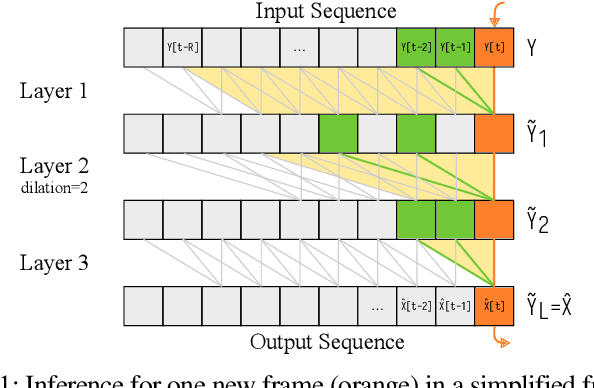
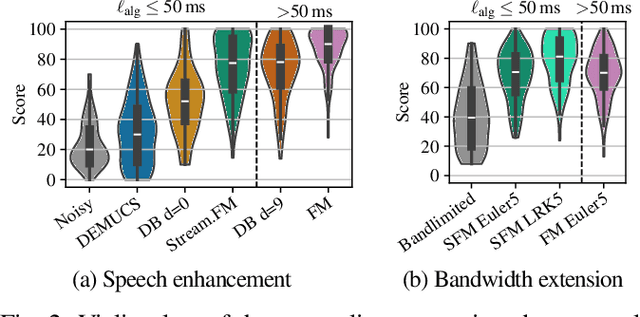
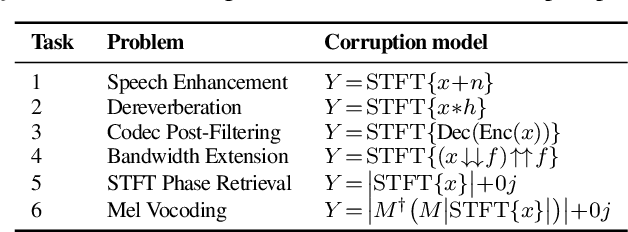
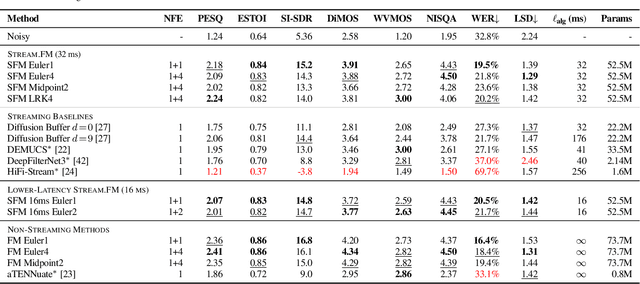
Diffusion-based generative models have greatly impacted the speech processing field in recent years, exhibiting high speech naturalness and spawning a new research direction. Their application in real-time communication is, however, still lagging behind due to their computation-heavy nature involving multiple calls of large DNNs. Here, we present Stream.FM, a frame-causal flow-based generative model with an algorithmic latency of 32 milliseconds (ms) and a total latency of 48 ms, paving the way for generative speech processing in real-time communication. We propose a buffered streaming inference scheme and an optimized DNN architecture, show how learned few-step numerical solvers can boost output quality at a fixed compute budget, explore model weight compression to find favorable points along a compute/quality tradeoff, and contribute a model variant with 24 ms total latency for the speech enhancement task. Our work looks beyond theoretical latencies, showing that high-quality streaming generative speech processing can be realized on consumer GPUs available today. Stream.FM can solve a variety of speech processing tasks in a streaming fashion: speech enhancement, dereverberation, codec post-filtering, bandwidth extension, STFT phase retrieval, and Mel vocoding. As we verify through comprehensive evaluations and a MUSHRA listening test, Stream.FM establishes a state-of-the-art for generative streaming speech restoration, exhibits only a reasonable reduction in quality compared to a non-streaming variant, and outperforms our recent work (Diffusion Buffer) on generative streaming speech enhancement while operating at a lower latency.
Real-Time Streaming Mel Vocoding with Generative Flow Matching
Sep 18, 2025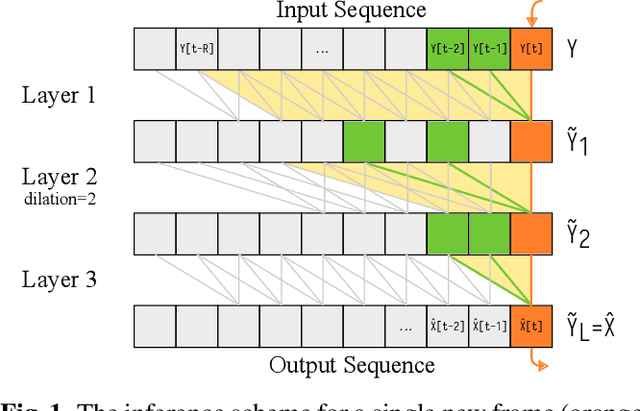
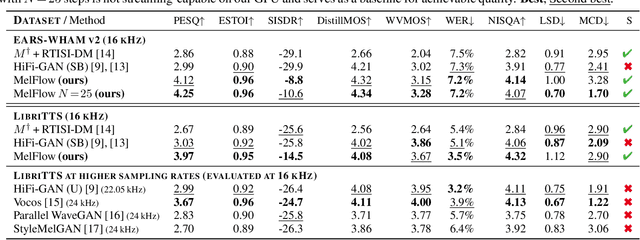
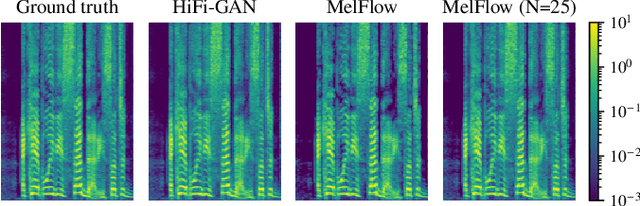
The task of Mel vocoding, i.e., the inversion of a Mel magnitude spectrogram to an audio waveform, is still a key component in many text-to-speech (TTS) systems today. Based on generative flow matching, our prior work on generative STFT phase retrieval (DiffPhase), and the pseudoinverse operator of the Mel filterbank, we develop MelFlow, a streaming-capable generative Mel vocoder for speech sampled at 16 kHz with an algorithmic latency of only 32 ms and a total latency of 48 ms. We show real-time streaming capability at this latency not only in theory, but in practice on a consumer laptop GPU. Furthermore, we show that our model achieves substantially better PESQ and SI-SDR values compared to well-established not streaming-capable baselines for Mel vocoding including HiFi-GAN.
LipDiffuser: Lip-to-Speech Generation with Conditional Diffusion Models
May 16, 2025We present LipDiffuser, a conditional diffusion model for lip-to-speech generation synthesizing natural and intelligible speech directly from silent video recordings. Our approach leverages the magnitude-preserving ablated diffusion model (MP-ADM) architecture as a denoiser model. To effectively condition the model, we incorporate visual features using magnitude-preserving feature-wise linear modulation (MP-FiLM) alongside speaker embeddings. A neural vocoder then reconstructs the speech waveform from the generated mel-spectrograms. Evaluations on LRS3 and TCD-TIMIT demonstrate that LipDiffuser outperforms existing lip-to-speech baselines in perceptual speech quality and speaker similarity, while remaining competitive in downstream automatic speech recognition (ASR). These findings are also supported by a formal listening experiment. Extensive ablation studies and cross-dataset evaluation confirm the effectiveness and generalization capabilities of our approach.
Live Iterative Ptychography with projection-based algorithms
Sep 19, 2023In this work, we demonstrate that the ptychographic phase problem can be solved in a live fashion during scanning, while data is still being collected. We propose a generally applicable modification of the widespread projection-based algorithms such as Error Reduction (ER) and Difference Map (DM). This novel variant of ptychographic phase retrieval enables immediate visual feedback during experiments, reconstruction of arbitrary-sized objects with a fixed amount of computational resources, and adaptive scanning. By building upon the Real-Time Iterative Spectrogram Inversion (RTISI) family of algorithms from the audio processing literature, we show that live variants of projection-based methods such as DM can be derived naturally and may even achieve higher-quality reconstructions than their classic non-live counterparts with comparable effective computational load.
A Flexible Online Framework for Projection-Based STFT Phase Retrieval
Sep 13, 2023Several recent contributions in the field of iterative STFT phase retrieval have demonstrated that the performance of the classical Griffin-Lim method can be considerably improved upon. By using the same projection operators as Griffin-Lim, but combining them in innovative ways, these approaches achieve better results in terms of both reconstruction quality and required number of iterations, while retaining a similar computational complexity per iteration. However, like Griffin-Lim, these algorithms operate in an offline manner and thus require an entire spectrogram as input, which is an unrealistic requirement for many real-world speech communication applications. We propose to extend RTISI -- an existing online (frame-by-frame) variant of the Griffin-Lim algorithm -- into a flexible framework that enables straightforward online implementation of any algorithm based on iterative projections. We further employ this framework to implement online variants of the fast Griffin-Lim algorithm, the accelerated Griffin-Lim algorithm, and two algorithms from the optics domain. Evaluation results on speech signals show that, similarly to the offline case, these algorithms can achieve a considerable performance gain compared to RTISI.
On the Behavior of Intrusive and Non-intrusive Speech Enhancement Metrics in Predictive and Generative Settings
Jun 05, 2023Since its inception, the field of deep speech enhancement has been dominated by predictive (discriminative) approaches, such as spectral mapping or masking. Recently, however, novel generative approaches have been applied to speech enhancement, attaining good denoising performance with high subjective quality scores. At the same time, advances in deep learning also allowed for the creation of neural network-based metrics, which have desirable traits such as being able to work without a reference (non-intrusively). Since generatively enhanced speech tends to exhibit radically different residual distortions, its evaluation using instrumental speech metrics may behave differently compared to predictively enhanced speech. In this paper, we evaluate the performance of the same speech enhancement backbone trained under predictive and generative paradigms on a variety of metrics and show that intrusive and non-intrusive measures correlate differently for each paradigm. This analysis motivates the search for metrics that can together paint a complete and unbiased picture of speech enhancement performance, irrespective of the model's training process.
Speech Signal Improvement Using Causal Generative Diffusion Models
Mar 15, 2023
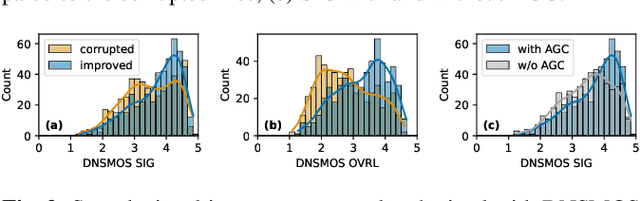
In this paper, we present a causal speech signal improvement system that is designed to handle different types of distortions. The method is based on a generative diffusion model which has been shown to work well in scenarios with missing data and non-linear corruptions. To guarantee causal processing, we modify the network architecture of our previous work and replace global normalization with causal adaptive gain control. We generate diverse training data containing a broad range of distortions. This work was performed in the context of an "ICASSP Signal Processing Grand Challenge" and submitted to the non-real-time track of the "Speech Signal Improvement Challenge 2023", where it was ranked fifth.
DiffPhase: Generative Diffusion-based STFT Phase Retrieval
Nov 08, 2022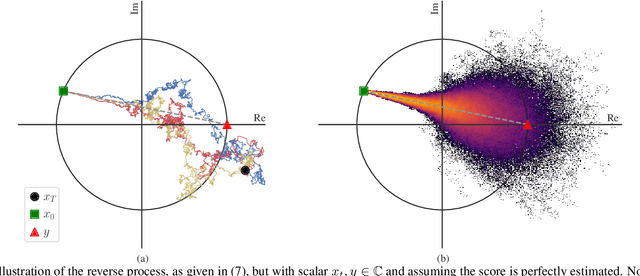
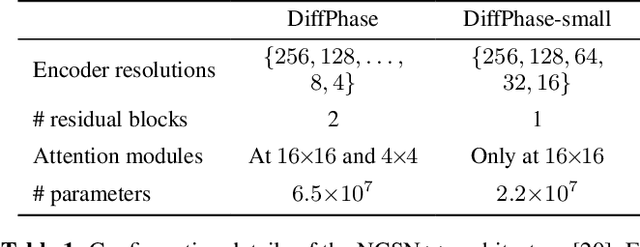
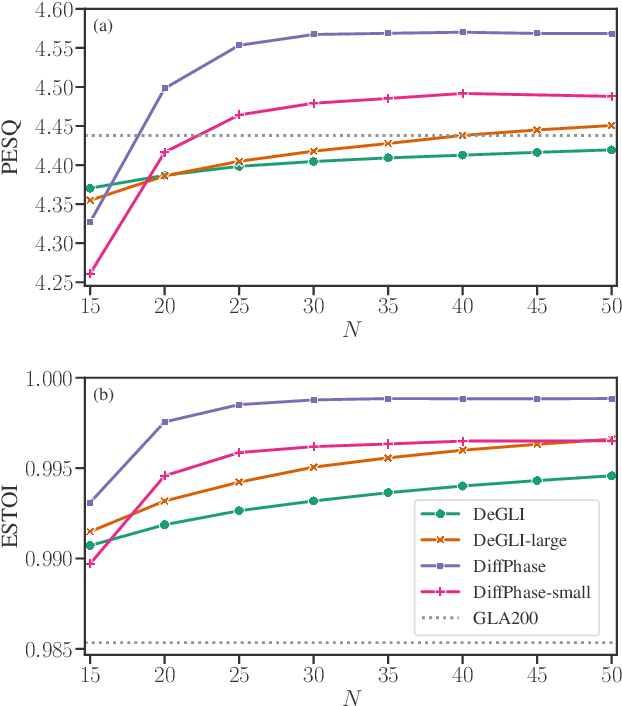
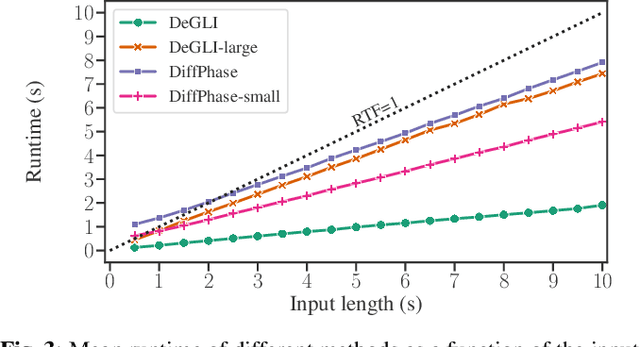
Diffusion probabilistic models have been recently used in a variety of tasks, including speech enhancement and synthesis. As a generative approach, diffusion models have been shown to be especially suitable for imputation problems, where missing data is generated based on existing data. Phase retrieval is inherently an imputation problem, where phase information has to be generated based on the given magnitude. In this work we build upon previous work in the speech domain, adapting a speech enhancement diffusion model specifically for STFT phase retrieval. Evaluation using speech quality and intelligibility metrics shows the diffusion approach is well-suited to the phase retrieval task, with performance surpassing both classical and modern methods.