 Add to Chrome
 Add to Firefox
 Add to Edge
Anomalous Sound Detection Meets Noise-Aware Self-Supervised Learning
Aug 01, 2026
In this paper, we introduce noise-aware self-supervised learning (NA-SSL) models for noise-aware anomalous sound detection (NA-ASD). NA-ASD is an ASD task with two-channel audio recordings, where one microphone is located close to the target machine and the other is located farther away to capture noise. For this task, we simulate two-channel recordings using diverse audio datasets and train NA-SSL models to extract clean SSL representations of the close-microphone signal by using the far-microphone recording dominated by background noise as auxiliary information. The NA-SSL models are then used as frontends in the standard ASD framework. Our experimental evaluation on the DCASE 2026 Challenge Task 2 development dataset demonstrates the effectiveness of the NA-SSL framework across three base SSL models (BEATs, EAT, and Dasheng), both with and without discriminative fine-tuning. Furthermore, the challenge results proved the effectiveness of the proposed approach, where the NA-BEATs system won the challenge by a large margin, achieving an official score of 70.24%, while the second-place system achieved 65.46%.

NABEATs: Noise-Aware Audio Representation Learning
Jul 18, 2026We propose the concept of noise-aware audio self-supervised learning (SSL), whose goal is to encode audio mixtures while suppressing undesired noise, and present Noise-Aware BEATs (NABEATs) as a BEATs-based realization of this framework. Audio SSL models are designed to handle a wide range of audio signals. Consequently, under noisy conditions, they cannot effectively focus on the target sounds relevant to a downstream task, resulting in degraded performance. To address this issue, NABEATs is trained to estimate clean BEATs representations from a noisy audio signal with an auxiliary reference noise input. This reference noise enables the model to account for specific noise characteristics at inference time, thereby achieving better generalization across operating environments. Our experimental evaluations demonstrate that NABEATs significantly improves performance of various downstream tasks under noisy conditions and also generalizes well to unseen noise types.
Technical Report for MERL's Real-TSE Challenge Submission
Jul 10, 2026Target speech extraction (TSE) has largely been dominated by neural network-based approaches trained and evaluated on synthetic fully overlapped data. The Real-TSE Challenge aims to advance performance on real-world far-field noisy and reverberant recordings. This technical report describes MERL's submission to the Real-TSE Challenge. Rather than proposing a novel model architecture, we built upon the baseline model and focused primarily on data preparation and cleaning. Our system was trained in four stages, beginning with pre-training on fully overlapped mixtures and simulated multi-talker conversations with noise and reverberation applied to both the mixture and the enrollment utterances. We then adapted the model to real-world conditions using noisy far-field recordings with pseudo-targets derived from processed close-talk microphone signals. Our submission achieved first place in the second track, demonstrating the critical importance of high-quality data preparation. Furthermore, we observed that DNSMOS and speaker similarity are susceptible to over-optimization, motivating an investigation of their robustness using adversarial attacks. The results show that both metrics can be driven to extreme values without degrading the token error rate or the VAD-based F1 score.
Predictive-Generative Drift Decomposition for Speech Enhancement and Separation
May 07, 2026We propose a plug-and-play framework for speech enhancement and separation that augments predictive methods with a generative speech prior. Our approach, termed Stochastic Interpolant Prior for Speech (SIPS), builds on stochastic interpolants and leverages their flexibility to bridge predictive and generative modeling. Specifically, we decompose the interpolation dynamics into a task-specific drift and a stochastic denoising component, allowing a predictive estimate to be integrated directly into the generative sampling process. This results in a mathematically grounded framework for combining strong pretrained predictors with the expressive power of generative models. To this end, we train a score model using only clean speech, yielding a degradation-agnostic prior that can be reused across tasks. During inference, the predictor provides a deterministic drift that steers the sampling process toward a task-consistent estimate, while the score model preserves perceptual naturalness. Unlike prior hybrid approaches, which typically rely on architecture-specific conditioning and are tied to particular predictors or degradation settings, SIPS provides a unified framework that generalizes across predictors and additive degradation tasks. We demonstrate its effectiveness for both speech enhancement and speech separation using recent predictors such as SEMamba and FlexIO. The proposed method consistently improves perceptual quality, achieving gains up +1.0 NISQA for speech separation.
Loose coupling of spectral and spatial models for multi-channel diarization and enhancement of meetings in dynamic environments
Jan 22, 2026Sound capture by microphone arrays opens the possibility to exploit spatial, in addition to spectral, information for diarization and signal enhancement, two important tasks in meeting transcription. However, there is no one-to-one mapping of positions in space to speakers if speakers move. Here, we address this by proposing a novel joint spatial and spectral mixture model, whose two submodels are loosely coupled by modeling the relationship between speaker and position index probabilistically. Thus, spatial and spectral information can be jointly exploited, while at the same time allowing for speakers speaking from different positions. Experiments on the LibriCSS data set with simulated speaker position changes show great improvements over tightly coupled subsystems.
Microphone Array Signal Processing and Deep Learning for Speech Enhancement
Jan 13, 2025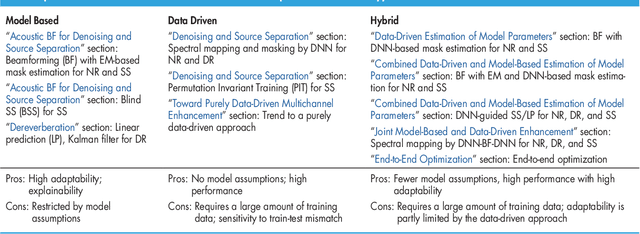
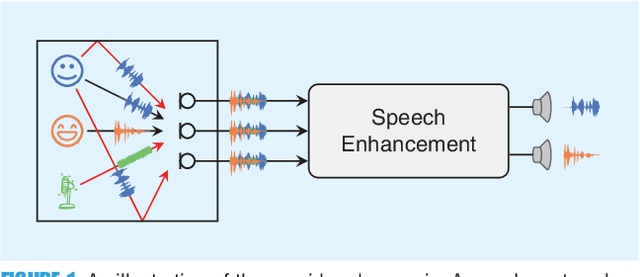
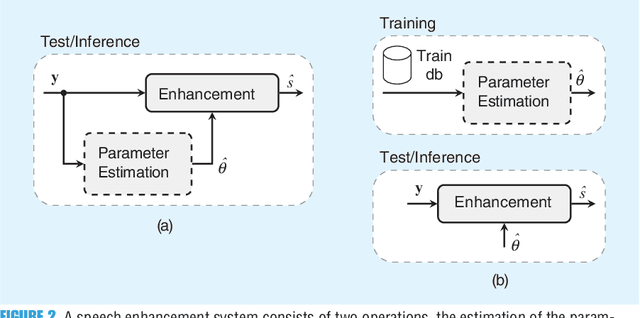
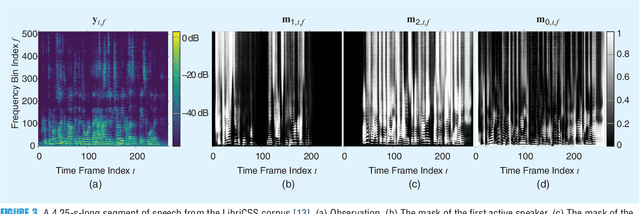
Multi-channel acoustic signal processing is a well-established and powerful tool to exploit the spatial diversity between a target signal and non-target or noise sources for signal enhancement. However, the textbook solutions for optimal data-dependent spatial filtering rest on the knowledge of second-order statistical moments of the signals, which have traditionally been difficult to acquire. In this contribution, we compare model-based, purely data-driven, and hybrid approaches to parameter estimation and filtering, where the latter tries to combine the benefits of model-based signal processing and data-driven deep learning to overcome their individual deficiencies. We illustrate the underlying design principles with examples from noise reduction, source separation, and dereverberation.
* Accepted for IEEE Signal Processing Magazine
Simultaneous Diarization and Separation of Meetings through the Integration of Statistical Mixture Models
Oct 28, 2024

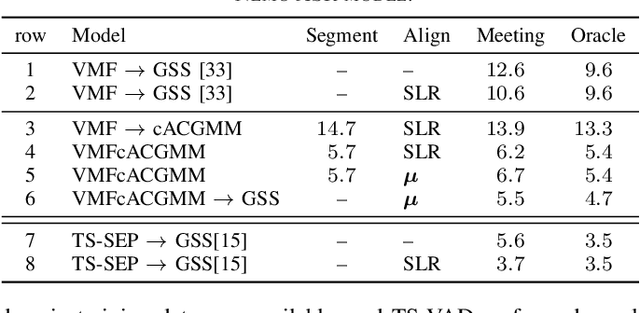
We propose an approach for simultaneous diarization and separation of meeting data. It consists of a complex Angular Central Gaussian Mixture Model (cACGMM) for speech source separation, and a von-Mises-Fisher Mixture Model (VMFMM) for diarization in a joint statistical framework. Through the integration, both spatial and spectral information are exploited for diarization and separation. We also develop a method for counting the number of active speakers in a segment of a meeting to support block-wise processing. While the total number of speakers in a meeting may be known, it is usually not known on a per-segment level. With the proposed speaker counting, joint diarization and source separation can be done segment-by-segment, and the permutation problem across segments is solved, thus allowing for block-online processing in the future. Experimental results on the LibriCSS meeting corpus show that the integrated approach outperforms a cascaded approach of diarization and speech enhancement in terms of WER, both on a per-segment and on a per-meeting level.
The CHiME-8 DASR Challenge for Generalizable and Array Agnostic Distant Automatic Speech Recognition and Diarization
Jul 23, 2024


This paper presents the CHiME-8 DASR challenge which carries on from the previous edition CHiME-7 DASR (C7DASR) and the past CHiME-6 challenge. It focuses on joint multi-channel distant speech recognition (DASR) and diarization with one or more, possibly heterogeneous, devices. The main goal is to spur research towards meeting transcription approaches that can generalize across arbitrary number of speakers, diverse settings (formal vs. informal conversations), meeting duration, wide-variety of acoustic scenarios and different recording configurations. Novelties with respect to C7DASR include: i) the addition of NOTSOFAR-1, an additional office/corporate meeting scenario, ii) a manually corrected Mixer 6 development set, iii) a new track in which we allow the use of large-language models (LLM) iv) a jury award mechanism to encourage participants to explore also more practical and innovative solutions. To lower the entry barrier for participants, we provide a standalone toolkit for downloading and preparing such datasets as well as performing text normalization and scoring their submissions. Furthermore, this year we also provide two baseline systems, one directly inherited from C7DASR and based on ESPnet and another one developed on NeMo and based on NeMo team submission in last year C7DASR. Baseline system results suggest that the addition of the NOTSOFAR-1 scenario significantly increases the task's difficulty due to its high number of speakers and very short duration.
Once more Diarization: Improving meeting transcription systems through segment-level speaker reassignment
Jun 05, 2024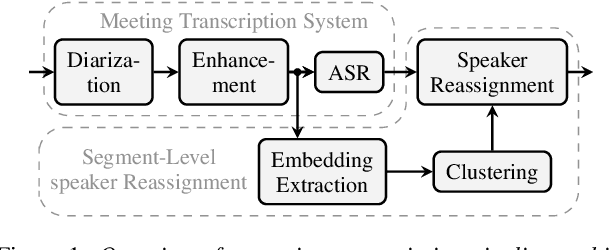
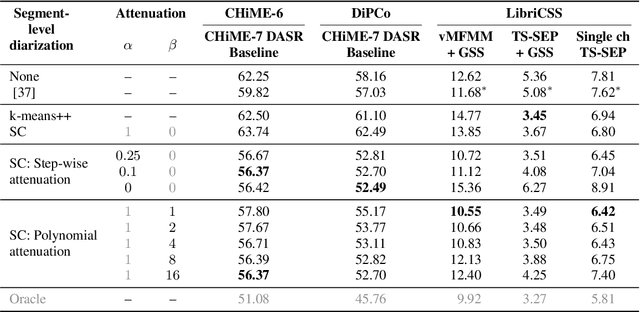
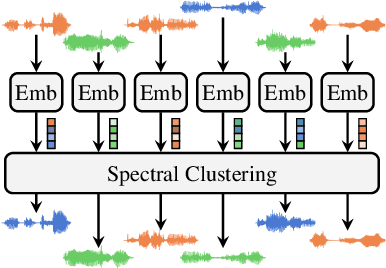
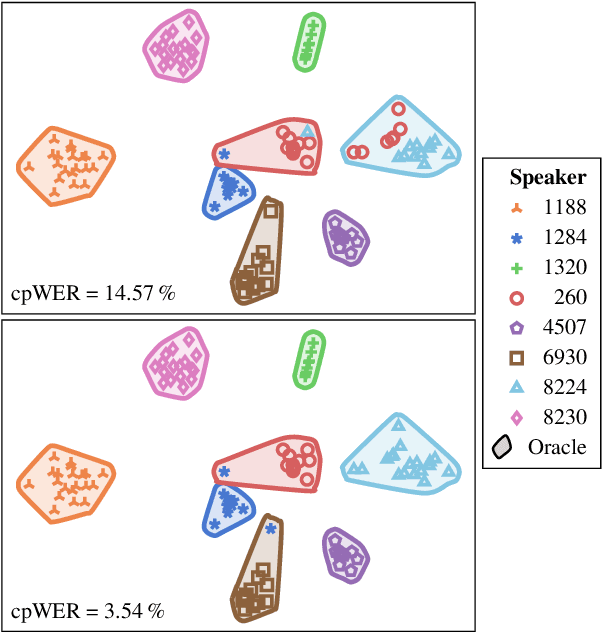
Diarization is a crucial component in meeting transcription systems to ease the challenges of speech enhancement and attribute the transcriptions to the correct speaker. Particularly in the presence of overlapping or noisy speech, these systems have problems reliably assigning the correct speaker labels, leading to a significant amount of speaker confusion errors. We propose to add segment-level speaker reassignment to address this issue. By revisiting, after speech enhancement, the speaker attribution for each segment, speaker confusion errors from the initial diarization stage are significantly reduced. Through experiments across different system configurations and datasets, we further demonstrate the effectiveness and applicability in various domains. Our results show that segment-level speaker reassignment successfully rectifies at least 40% of speaker confusion word errors, highlighting its potential for enhancing diarization accuracy in meeting transcription systems.
Geodesic interpolation of frame-wise speaker embeddings for the diarization of meeting scenarios
Jan 08, 2024
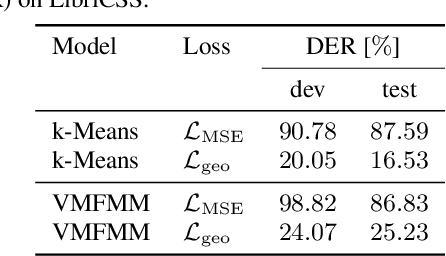
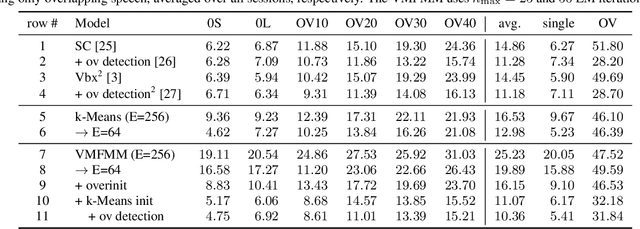

We propose a modified teacher-student training for the extraction of frame-wise speaker embeddings that allows for an effective diarization of meeting scenarios containing partially overlapping speech. To this end, a geodesic distance loss is used that enforces the embeddings computed from regions with two active speakers to lie on the shortest path on a sphere between the points given by the d-vectors of each of the active speakers. Using those frame-wise speaker embeddings in clustering-based diarization outperforms segment-level clustering-based diarization systems such as VBx and Spectral Clustering. By extending our approach to a mixture-model-based diarization, the performance can be further improved, approaching the diarization error rates of diarization systems that use a dedicated overlap detection, and outperforming these systems when also employing an additional overlap detection.