 Add to Chrome
 Add to Firefox
 Add to Edge
Reconstructive Latent-Space Neural Radiance Fields for Efficient 3D Scene Representations
Oct 27, 2023
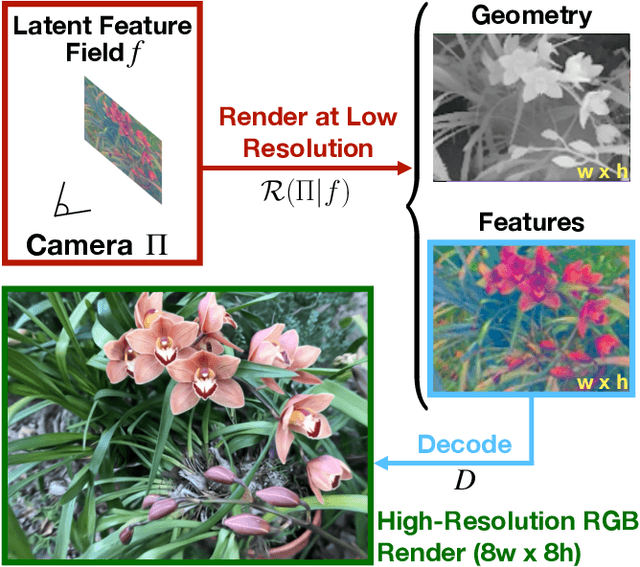
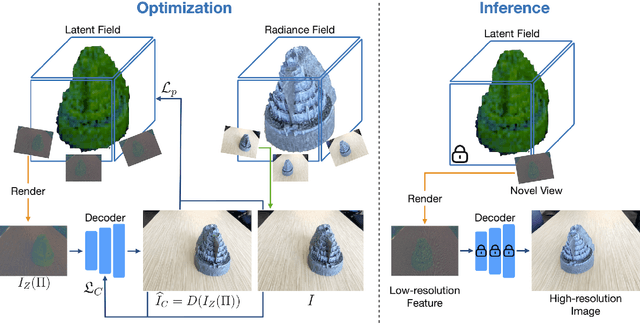
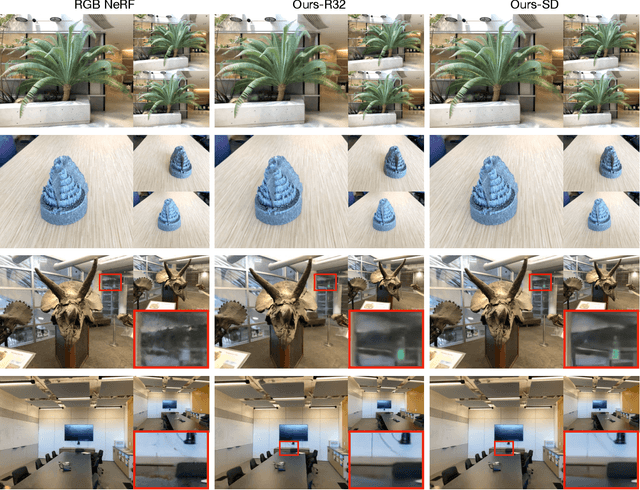
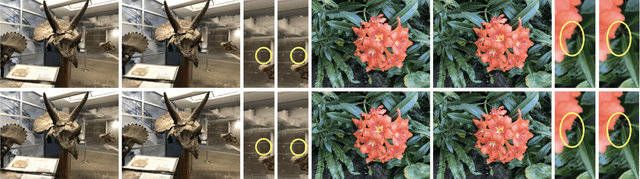
Neural Radiance Fields (NeRFs) have proven to be powerful 3D representations, capable of high quality novel view synthesis of complex scenes. While NeRFs have been applied to graphics, vision, and robotics, problems with slow rendering speed and characteristic visual artifacts prevent adoption in many use cases. In this work, we investigate combining an autoencoder (AE) with a NeRF, in which latent features (instead of colours) are rendered and then convolutionally decoded. The resulting latent-space NeRF can produce novel views with higher quality than standard colour-space NeRFs, as the AE can correct certain visual artifacts, while rendering over three times faster. Our work is orthogonal to other techniques for improving NeRF efficiency. Further, we can control the tradeoff between efficiency and image quality by shrinking the AE architecture, achieving over 13 times faster rendering with only a small drop in performance. We hope that our approach can form the basis of an efficient, yet high-fidelity, 3D scene representation for downstream tasks, especially when retaining differentiability is useful, as in many robotics scenarios requiring continual learning.

Watch Your Steps: Local Image and Scene Editing by Text Instructions
Aug 17, 2023Denoising diffusion models have enabled high-quality image generation and editing. We present a method to localize the desired edit region implicit in a text instruction. We leverage InstructPix2Pix (IP2P) and identify the discrepancy between IP2P predictions with and without the instruction. This discrepancy is referred to as the relevance map. The relevance map conveys the importance of changing each pixel to achieve the edits, and is used to to guide the modifications. This guidance ensures that the irrelevant pixels remain unchanged. Relevance maps are further used to enhance the quality of text-guided editing of 3D scenes in the form of neural radiance fields. A field is trained on relevance maps of training views, denoted as the relevance field, defining the 3D region within which modifications should be made. We perform iterative updates on the training views guided by rendered relevance maps from the relevance field. Our method achieves state-of-the-art performance on both image and NeRF editing tasks. Project page: https://ashmrz.github.io/WatchYourSteps/
Recovery Policies for Safe Exploration of Lunar Permanently Shadowed Regions by a Solar-Powered Rover
Jul 31, 2023The success of a multi-kilometre drive by a solar-powered rover at the lunar south pole depends upon careful planning in space and time due to highly dynamic solar illumination conditions. An additional challenge is that real-world robots may be subject to random faults that can temporarily delay long-range traverses. The majority of existing global spatiotemporal planners assume a deterministic rover-environment model and do not account for random faults. In this paper, we consider a random fault profile with a known, average spatial fault rate. We introduce a methodology to compute recovery policies that maximize the probability of survival of a solar-powered rover from different start states. A recovery policy defines a set of recourse actions to reach a location with sufficient battery energy remaining, given the local solar illumination conditions. We solve a stochastic reach-avoid problem using dynamic programming to find such optimal recovery policies. Our focus, in part, is on the implications of state space discretization, which is often required in practical implementations. We propose a modified dynamic programming algorithm that conservatively accounts for approximation errors. To demonstrate the benefits of our approach, we compare against existing methods in scenarios where a solar-powered rover seeks to safely exit from permanently shadowed regions in the Cabeus area at the lunar south pole. We also highlight the relevance of our methodology for mission formulation and trade safety analysis by empirically comparing different rover mobility models in simulated recovery drives from the LCROSS crash region.
Euclidean Equivariant Models for Generative Graphical Inverse Kinematics
Jul 04, 2023


Quickly and reliably finding accurate inverse kinematics (IK) solutions remains a challenging problem for robotic manipulation. Existing numerical solvers typically produce a single solution only and rely on local search techniques to minimize a highly nonconvex objective function. Recently, learning-based approaches that approximate the entire feasible set of solutions have shown promise as a means to generate multiple fast and accurate IK results in parallel. However, existing learning-based techniques have a significant drawback: each robot of interest requires a specialized model that must be trained from scratch. To address this shortcoming, we investigate a novel distance-geometric robot representation coupled with a graph structure that allows us to leverage the flexibility of graph neural networks (GNNs). We use this approach to train a generative graphical inverse kinematics solver (GGIK) that is able to produce a large number of diverse solutions in parallel while also generalizing well -- a single learned model can be used to produce IK solutions for a variety of different robots. The graphical formulation elegantly exposes the symmetry and Euclidean equivariance of the IK problem that stems from the spatial nature of robot manipulators. We exploit this symmetry by encoding it into the architecture of our learned model, yielding a flexible solver that is able to produce sets of IK solutions for multiple robots.
CIDGIKc: Distance-Geometric Inverse Kinematics for Continuum Robots
Jun 23, 2023The small size, high dexterity, and intrinsic compliance of continuum robots (CRs) make them well suited for constrained environments. Solving the inverse kinematics (IK), that is finding robot joint configurations that satisfy desired position or pose queries, is a fundamental challenge in motion planning, control, and calibration for any robot structure. For CRs, the need to avoid obstacles in tightly confined workspaces greatly complicates the search for feasible IK solutions. Without an accurate initialization or multiple re-starts, existing algorithms often fail to find a solution. We present CIDGIKc (Convex Iteration for Distance-Geometric Inverse Kinematics for Continuum Robots), an algorithm that solves these nonconvex feasibility problems with a sequence of semidefinite programs whose objectives are designed to encourage low-rank minimizers. CIDGIKc is enabled by a novel distance-geometric parameterization of constant curvature segment geometry for CRs with extensible segments. The resulting IK formulation involves only quadratic expressions and can efficiently incorporate a large number of collision avoidance constraints. Our experimental results demonstrate >98% solve success rates within complex, highly cluttered environments which existing algorithms cannot account for.
aUToLights: A Robust Multi-Camera Traffic Light Detection and Tracking System
May 15, 2023Following four successful years in the SAE AutoDrive Challenge Series I, the University of Toronto is participating in the Series II competition to develop a Level 4 autonomous passenger vehicle capable of handling various urban driving scenarios by 2025. Accurate detection of traffic lights and correct identification of their states is essential for safe autonomous operation in cities. Herein, we describe our recently-redesigned traffic light perception system for autonomous vehicles like the University of Toronto's self-driving car, Artemis. Similar to most traffic light perception systems, we rely primarily on camera-based object detectors. We deploy the YOLOv5 detector for bounding box regression and traffic light classification across multiple cameras and fuse the observations. To improve robustness, we incorporate priors from high-definition semantic maps and perform state filtering using hidden Markov models. We demonstrate a multi-camera, real time-capable traffic light perception pipeline that handles complex situations including multiple visible intersections, traffic light variations, temporary occlusion, and flashing light states. To validate our system, we collected and annotated a varied dataset incorporating flashing states and a range of occlusion types. Our results show superior performance in challenging real-world scenarios compared to single-frame, single-camera object detection.
Living in a Material World: Learning Material Properties from Full-Waveform Flash Lidar Data for Semantic Segmentation
May 07, 2023Advances in lidar technology have made the collection of 3D point clouds fast and easy. While most lidar sensors return per-point intensity (or reflectance) values along with range measurements, flash lidar sensors are able to provide information about the shape of the return pulse. The shape of the return waveform is affected by many factors, including the distance that the light pulse travels and the angle of incidence with a surface. Importantly, the shape of the return waveform also depends on the material properties of the reflecting surface. In this paper, we investigate whether the material type or class can be determined from the full-waveform response. First, as a proof of concept, we demonstrate that the extra information about material class, if known accurately, can improve performance on scene understanding tasks such as semantic segmentation. Next, we learn two different full-waveform material classifiers: a random forest classifier and a temporal convolutional neural network (TCN) classifier. We find that, in some cases, material types can be distinguished, and that the TCN generally performs better across a wider range of materials. However, factors such as angle of incidence, material colour, and material similarity may hinder overall performance.
Reference-guided Controllable Inpainting of Neural Radiance Fields
Apr 20, 2023


The popularity of Neural Radiance Fields (NeRFs) for view synthesis has led to a desire for NeRF editing tools. Here, we focus on inpainting regions in a view-consistent and controllable manner. In addition to the typical NeRF inputs and masks delineating the unwanted region in each view, we require only a single inpainted view of the scene, i.e., a reference view. We use monocular depth estimators to back-project the inpainted view to the correct 3D positions. Then, via a novel rendering technique, a bilateral solver can construct view-dependent effects in non-reference views, making the inpainted region appear consistent from any view. For non-reference disoccluded regions, which cannot be supervised by the single reference view, we devise a method based on image inpainters to guide both the geometry and appearance. Our approach shows superior performance to NeRF inpainting baselines, with the additional advantage that a user can control the generated scene via a single inpainted image. Project page: https://ashmrz.github.io/reference-guided-3d
The Sum of Its Parts: Visual Part Segmentation for Inertial Parameter Identification of Manipulated Objects
Feb 13, 2023To operate safely and efficiently alongside human workers, collaborative robots (cobots) require the ability to quickly understand the dynamics of manipulated objects. However, traditional methods for estimating the full set of inertial parameters rely on motions that are necessarily fast and unsafe (to achieve a sufficient signal-to-noise ratio). In this work, we take an alternative approach: by combining visual and force-torque measurements, we develop an inertial parameter identification algorithm that requires slow or 'stop-and-go' motions only, and hence is ideally tailored for use around humans. Our technique, called Homogeneous Part Segmentation (HPS), leverages the observation that man-made objects are often composed of distinct, homogeneous parts. We combine a surface-based point clustering method with a volumetric shape segmentation algorithm to quickly produce a part-level segmentation of a manipulated object; the segmented representation is then used by HPS to accurately estimate the object's inertial parameters. To benchmark our algorithm, we create and utilize a novel dataset consisting of realistic meshes, segmented point clouds, and inertial parameters for 20 common workshop tools. Finally, we demonstrate the real-world performance and accuracy of HPS by performing an intricate 'hammer balancing act' autonomously and online with a low-cost collaborative robotic arm. Our code and dataset are open source and freely available.
Extrinsic Calibration of 2D mm-Wavelength Radar Pairs Using Ego-Velocity Estimates
Feb 01, 2023Correct radar data fusion depends on knowledge of the spatial transform between sensor pairs. Current methods for determining this transform operate by aligning identifiable features in different radar scans, or by relying on measurements from another, more accurate sensor (e.g., a lidar unit). Feature-based alignment requires the sensors to have overlapping fields of view or necessitates the construction of an environment map. Several existing methods require bespoke retroreflective radar targets. These requirements limit both where and how calibration can be performed. In this paper, we take a different approach: instead of attempting to track targets or features, which can be difficult in noisy radar data, we instead rely on ego-velocity estimates from each radar to perform calibration. Our method enables calibration of a subset of the transform parameters, including the yaw and axis of translation between the radar pair, without the need for a shared field of view or for specialized structures in the environment. In general, the yaw and axis of translation are the most important parameters for data fusion, the most likely to vary over time, and the most difficult to calibrate manually. We formulate calibration as a batch optimization problem, prove that the radar-radar system is identifiable, and specify the platform excitation requirements. Through simulations studies and real-world experiments, we establish that our method is more reliable and accurate at estimating the yaw and translation axis than state-of-the-art methods. Finally, we show that the full rigid-body transform can be recovered if relatively coarse information about the rotation rate is available.