 Add to Chrome
 Add to Firefox
 Add to Edge
SeekBrain: An Autonomous Multi-Agent System for Accelerating Neuroscience Discovery
Jul 31, 2026
Modern neuroscience relies on integrating multi-scale, multimodal datasets to uncover the neural principles underlying intelligence. However, analytical challenges posed by highly heterogeneous data and fragmented workflows increasingly constrain discoveries. Here we introduce SeekBrain, an autonomous multi-agent framework designed to accelerate neuroscience discovery through domain-grounded hierarchical planning and cross-modal data analysis. SeekBrain dynamically constructs a repertoire of analysis recipes extracted from code-paper pairs. By coupling this codified expertise with agentic planning and execution engines, the framework scalably generates hypotheses and analytical pipelines on demand. Systematic evaluation on the expert-annotated BrainArena benchmark demonstrates that SeekBrain substantially outperforms state-of-the-art agent baselines across various analysis tasks. Crucially, when deployed in real-world research, SeekBrain integrated behavioral, neural, and anatomical data to reveal structured, distributed neural representations of larval zebrafish behavior and a shared axis of regional decoding strength across the brain in a mouse decision-making task. These results establish SeekBrain as a scalable and practical tool for accelerating data-driven discoveries in neuroscience.

P-GenRM: Personalized Generative Reward Model with Test-time User-based Scaling
Feb 12, 2026Personalized alignment of large language models seeks to adapt responses to individual user preferences, typically via reinforcement learning. A key challenge is obtaining accurate, user-specific reward signals in open-ended scenarios. Existing personalized reward models face two persistent limitations: (1) oversimplifying diverse, scenario-specific preferences into a small, fixed set of evaluation principles, and (2) struggling with generalization to new users with limited feedback. To this end, we propose P-GenRM, the first Personalized Generative Reward Model with test-time user-based scaling. P-GenRM transforms preference signals into structured evaluation chains that derive adaptive personas and scoring rubrics across various scenarios. It further clusters users into User Prototypes and introduces a dual-granularity scaling mechanism: at the individual level, it adaptively scales and aggregates each user's scoring scheme; at the prototype level, it incorporates preferences from similar users. This design mitigates noise in inferred preferences and enhances generalization to unseen users through prototype-based transfer. Empirical results show that P-GenRM achieves state-of-the-art results on widely-used personalized reward model benchmarks, with an average improvement of 2.31%, and demonstrates strong generalization on an out-of-distribution dataset. Notably, Test-time User-based scaling provides an additional 3% boost, demonstrating stronger personalized alignment with test-time scalability.
Xiaomi MiMo-VL-Miloco Technical Report
Dec 22, 2025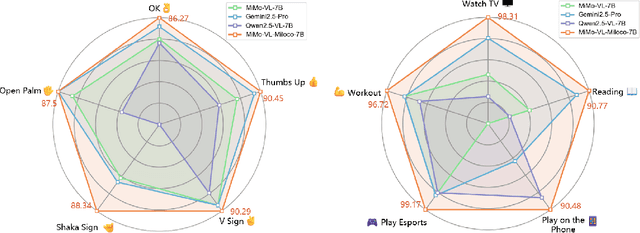
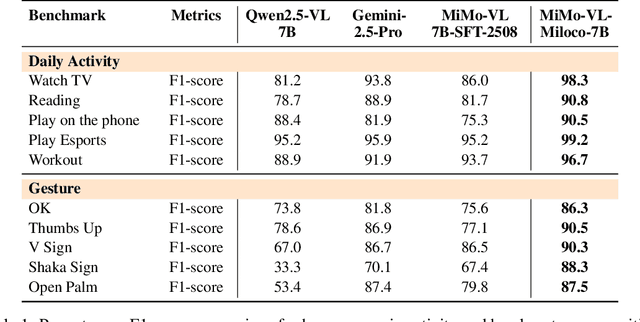
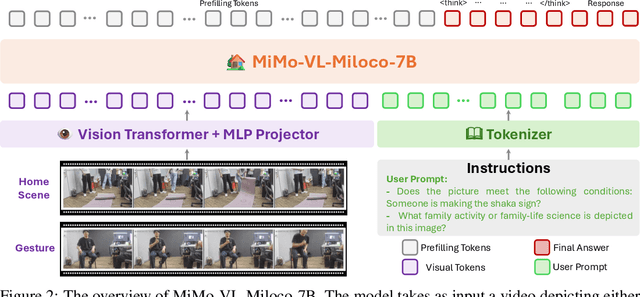
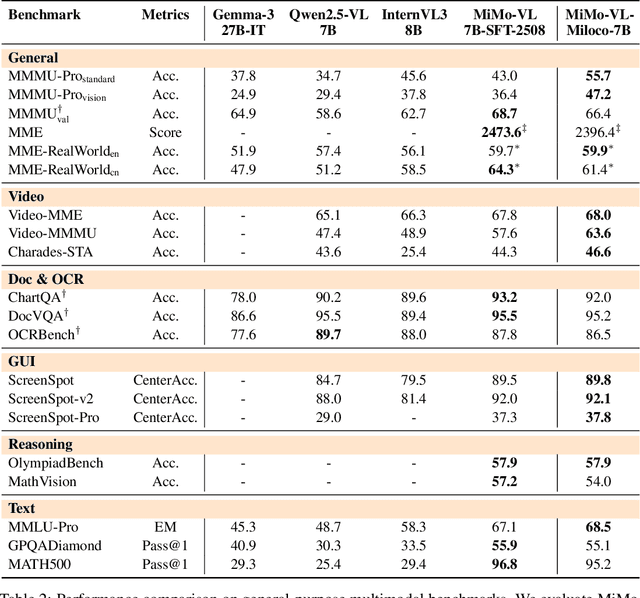
We open-source MiMo-VL-Miloco-7B and its quantized variant MiMo-VL-Miloco-7B-GGUF, a pair of home-centric vision-language models that achieve strong performance on both home-scenario understanding and general multimodal reasoning. Built on the MiMo-VL-7B backbone, MiMo-VL-Miloco-7B is specialized for smart-home environments, attaining leading F1 scores on gesture recognition and common home-scenario understanding, while also delivering consistent gains across video benchmarks such as Video-MME, Video-MMMU, and Charades-STA, as well as language understanding benchmarks including MMMU-Pro and MMLU-Pro. In our experiments, MiMo-VL-Miloco-7B outperforms strong closed-source and open-source baselines on home-scenario understanding and several multimodal reasoning benchmarks. To balance specialization and generality, we design a two-stage training pipeline that combines supervised fine-tuning with reinforcement learning based on Group Relative Policy Optimization, leveraging efficient multi-domain data. We further incorporate chain-of-thought supervision and token-budget-aware reasoning, enabling the model to learn knowledge in a data-efficient manner while also performing reasoning efficiently. Our analysis shows that targeted home-scenario training not only enhances activity and gesture understanding, but also improves text-only reasoning with only modest trade-offs on document-centric tasks. Model checkpoints, quantized GGUF weights, and our home-scenario evaluation toolkit are publicly available at https://github.com/XiaoMi/xiaomi-mimo-vl-miloco to support research and deployment in real-world smart-home applications.
REVISOR: Beyond Textual Reflection, Towards Multimodal Introspective Reasoning in Long-Form Video Understanding
Nov 17, 2025Self-reflection mechanisms that rely on purely text-based rethinking processes perform well in most multimodal tasks. However, when directly applied to long-form video understanding scenarios, they exhibit clear limitations. The fundamental reasons for this lie in two points: (1)long-form video understanding involves richer and more dynamic visual input, meaning rethinking only the text information is insufficient and necessitates a further rethinking process specifically targeting visual information; (2) purely text-based reflection mechanisms lack cross-modal interaction capabilities, preventing them from fully integrating visual information during reflection. Motivated by these insights, we propose REVISOR (REflective VIsual Segment Oriented Reasoning), a novel framework for tool-augmented multimodal reflection. REVISOR enables MLLMs to collaboratively construct introspective reflection processes across textual and visual modalities, significantly enhancing their reasoning capability for long-form video understanding. To ensure that REVISOR can learn to accurately review video segments highly relevant to the question during reinforcement learning, we designed the Dual Attribution Decoupled Reward (DADR) mechanism. Integrated into the GRPO training strategy, this mechanism enforces causal alignment between the model's reasoning and the selected video evidence. Notably, the REVISOR framework significantly enhances long-form video understanding capability of MLLMs without requiring supplementary supervised fine-tuning or external models, achieving impressive results on four benchmarks including VideoMME, LongVideoBench, MLVU, and LVBench.