 Add to Chrome
 Add to Firefox
 Add to Edge
SpecPL: Disentangling Spectral Granularity for Prompt Learning
May 06, 2026
Existing prompt learning for VLMs exhibits a modality asymmetry, predominantly optimizing text tokens while still relying on frozen visual encoder as holistic extractor and neglecting the spectral granularity essential for fine-grained discrimination. To bridge this, we introduce Disentangling Spectral Granularity for Prompt Learning (SpecPL), which approaches prompt learning from a novel spectral perspective via Counterfactual Granule Supervision. Specifically, we leverage a frozen VAE to decompose visual signals into semantic low-frequency bands and granular high-frequency details. A frozen Visual Semantic Bank anchors text representations to universal low-frequency invariants, mitigating overfitting. Crucially, fine-grained discrimination is driven by counterfactual granule training: by permuting high-frequency signals, we compel the model to explicitly distinguish visual granularity from semantic invariance. Uniquely, SpecPL serves as a universal plug-and-play booster, revitalizing text-oriented baselines like CoOp and MaPLe via visual-side guidance. Experiments on 11 benchmarks demonstrate competitive state-of-the-art performance, achieving a new performance ceiling of 81.51\% harmonic-mean accuracy. These results validate that spectral disentanglement with counterfactual supervision effectively bridges the gap in the stability-generalization trade-off. Code is released at https://github.com/Mlrac1e/SpecPL-Prompt-Learning.

GSwap: Realistic Head Swapping with Dynamic Neural Gaussian Field
Mar 24, 2026We present GSwap, a novel consistent and realistic video head-swapping system empowered by dynamic neural Gaussian portrait priors, which significantly advances the state of the art in face and head replacement. Unlike previous methods that rely primarily on 2D generative models or 3D Morphable Face Models (3DMM), our approach overcomes their inherent limitations, including poor 3D consistency, unnatural facial expressions, and restricted synthesis quality. Moreover, existing techniques struggle with full head-swapping tasks due to insufficient holistic head modeling and ineffective background blending, often resulting in visible artifacts and misalignments. To address these challenges, GSwap introduces an intrinsic 3D Gaussian feature field embedded within a full-body SMPL-X surface, effectively elevating 2D portrait videos into a dynamic neural Gaussian field. This innovation ensures high-fidelity, 3D-consistent portrait rendering while preserving natural head-torso relationships and seamless motion dynamics. To facilitate training, we adapt a pretrained 2D portrait generative model to the source head domain using only a few reference images, enabling efficient domain adaptation. Furthermore, we propose a neural re-rendering strategy that harmoniously integrates the synthesized foreground with the original background, eliminating blending artifacts and enhancing realism. Extensive experiments demonstrate that GSwap surpasses existing methods in multiple aspects, including visual quality, temporal coherence, identity preservation, and 3D consistency.
ToolGrad: Efficient Tool-use Dataset Generation with Textual "Gradients"
Aug 06, 2025Prior work synthesizes tool-use LLM datasets by first generating a user query, followed by complex tool-use annotations like DFS. This leads to inevitable annotation failures and low efficiency in data generation. We introduce ToolGrad, an agentic framework that inverts this paradigm. ToolGrad first constructs valid tool-use chains through an iterative process guided by textual "gradients", and then synthesizes corresponding user queries. This "answer-first" approach led to ToolGrad-5k, a dataset generated with more complex tool use, lower cost, and 100% pass rate. Experiments show that models trained on ToolGrad-5k outperform those on expensive baseline datasets and proprietary LLMs, even on OOD benchmarks.
Controlling Avatar Diffusion with Learnable Gaussian Embedding
Mar 20, 2025Recent advances in diffusion models have made significant progress in digital human generation. However, most existing models still struggle to maintain 3D consistency, temporal coherence, and motion accuracy. A key reason for these shortcomings is the limited representation ability of commonly used control signals(e.g., landmarks, depth maps, etc.). In addition, the lack of diversity in identity and pose variations in public datasets further hinders progress in this area. In this paper, we analyze the shortcomings of current control signals and introduce a novel control signal representation that is optimizable, dense, expressive, and 3D consistent. Our method embeds a learnable neural Gaussian onto a parametric head surface, which greatly enhances the consistency and expressiveness of diffusion-based head models. Regarding the dataset, we synthesize a large-scale dataset with multiple poses and identities. In addition, we use real/synthetic labels to effectively distinguish real and synthetic data, minimizing the impact of imperfections in synthetic data on the generated head images. Extensive experiments show that our model outperforms existing methods in terms of realism, expressiveness, and 3D consistency. Our code, synthetic datasets, and pre-trained models will be released in our project page: https://ustc3dv.github.io/Learn2Control/
InstructPipe: Building Visual Programming Pipelines with Human Instructions
Dec 15, 2023


Visual programming provides beginner-level programmers with a coding-free experience to build their customized pipelines. Existing systems require users to build a pipeline entirely from scratch, implying that novice users need to set up and link appropriate nodes all by themselves, starting from a blank workspace. We present InstructPipe, an AI assistant that enables users to start prototyping machine learning (ML) pipelines with text instructions. We designed two LLM modules and a code interpreter to execute our solution. LLM modules generate pseudocode of a target pipeline, and the interpreter renders a pipeline in the node-graph editor for further human-AI collaboration. Technical evaluations reveal that InstructPipe reduces user interactions by 81.1% compared to traditional methods. Our user study (N=16) showed that InstructPipe empowers novice users to streamline their workflow in creating desired ML pipelines, reduce their learning curve, and spark innovative ideas with open-ended commands.
IntrinsicNGP: Intrinsic Coordinate based Hash Encoding for Human NeRF
Mar 09, 2023Recently, many works have been proposed to utilize the neural radiance field for novel view synthesis of human performers. However, most of these methods require hours of training, making them difficult for practical use. To address this challenging problem, we propose IntrinsicNGP, which can train from scratch and achieve high-fidelity results in few minutes with videos of a human performer. To achieve this target, we introduce a continuous and optimizable intrinsic coordinate rather than the original explicit Euclidean coordinate in the hash encoding module of instant-NGP. With this novel intrinsic coordinate, IntrinsicNGP can aggregate inter-frame information for dynamic objects with the help of proxy geometry shapes. Moreover, the results trained with the given rough geometry shapes can be further refined with an optimizable offset field based on the intrinsic coordinate.Extensive experimental results on several datasets demonstrate the effectiveness and efficiency of IntrinsicNGP. We also illustrate our approach's ability to edit the shape of reconstructed subjects.
SelfNeRF: Fast Training NeRF for Human from Monocular Self-rotating Video
Oct 04, 2022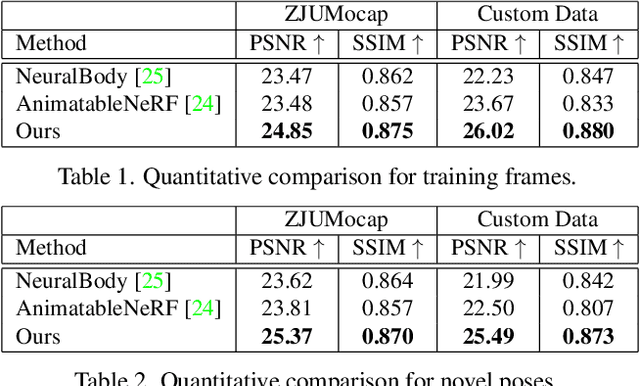
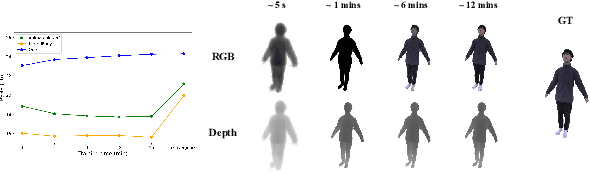
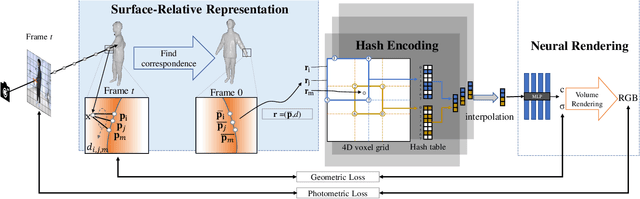
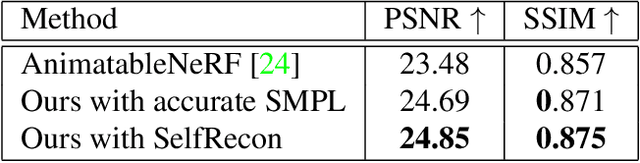
In this paper, we propose SelfNeRF, an efficient neural radiance field based novel view synthesis method for human performance. Given monocular self-rotating videos of human performers, SelfNeRF can train from scratch and achieve high-fidelity results in about twenty minutes. Some recent works have utilized the neural radiance field for dynamic human reconstruction. However, most of these methods need multi-view inputs and require hours of training, making it still difficult for practical use. To address this challenging problem, we introduce a surface-relative representation based on multi-resolution hash encoding that can greatly improve the training speed and aggregate inter-frame information. Extensive experimental results on several different datasets demonstrate the effectiveness and efficiency of SelfNeRF to challenging monocular videos.