 Add to Chrome
 Add to Firefox
 Add to Edge
AlloGen: Conformation-Selective Binder Generation with Differential State Scoring
Jun 03, 2026
Protein binder design has largely optimized for affinity alone, leaving conformational selectivity unaddressed: for allosteric targets such as kinases, nuclear receptors, and GPCRs, a binder that engages both active and inactive states provides no functional specificity regardless of how tightly it binds. We introduce AlloGen, a modular framework that decouples backbone generation from a learned state-selectivity scorer $Q_θ$, an SE(3)-invariant interface graph transformer trained via a two-phase curriculum that first learns interface geometry before imposing conformational discrimination. Because $Q_θ$ is fully differentiable and generator-agnostic, it integrates with any backbone generator as a passive reranker or an active gradient-based guide without retraining. Across a diverse benchmark of proteins spanning multiple families and conformational mechanisms, AlloGen consistently identifies binders that preferentially recognize desired structural states while rejecting alternative conformations. Experimental validation on calmodulin further demonstrates that these computational selectivity signals translate to physical molecules, yielding de novo peptides that bind the desired holo conformation while exhibiting no detectable binding to the apo state. Together, these results establish conformational selectivity as a learnable property and provide a general framework for state-selective protein binder design.

TD3B: Transition-Directed Discrete Diffusion for Allosteric Binder Generation
May 10, 2026Protein function is often controlled by ligands that bias the direction of state transitions, such as agonists and antagonists, rather than stabilizing a single conformation. This is especially important for clinically relevant G protein-coupled receptors (GPCRs), where therapeutic efficacy depends on functional directionality. Structure-based design methods optimize binding to static conformations and cannot represent non-reversible, directional effects or systematically distinguish agonist from antagonist behavior. To address this gap, we introduce Transition-Directed Discrete Diffusion for Allosteric Binder Design (TD3B), a sequence-based generative framework that designs binders with specified agonist or antagonist behavior via a directional transition control objective. TD3B combines a target-aware Direction Oracle, a soft binding-affinity gate, and amortized fine-tuning of a pre-trained discrete diffusion model, enabling targeted agonist and antagonist generation decoupled from binding affinity and unattainable by equilibrium-based or inference-only guidance baselines. The code and checkpoints are available at https://huggingface.co/ChatterjeeLab/TD3B.
Seedance 1.5 pro: A Native Audio-Visual Joint Generation Foundation Model
Dec 23, 2025Recent strides in video generation have paved the way for unified audio-visual generation. In this work, we present Seedance 1.5 pro, a foundational model engineered specifically for native, joint audio-video generation. Leveraging a dual-branch Diffusion Transformer architecture, the model integrates a cross-modal joint module with a specialized multi-stage data pipeline, achieving exceptional audio-visual synchronization and superior generation quality. To ensure practical utility, we implement meticulous post-training optimizations, including Supervised Fine-Tuning (SFT) on high-quality datasets and Reinforcement Learning from Human Feedback (RLHF) with multi-dimensional reward models. Furthermore, we introduce an acceleration framework that boosts inference speed by over 10X. Seedance 1.5 pro distinguishes itself through precise multilingual and dialect lip-syncing, dynamic cinematic camera control, and enhanced narrative coherence, positioning it as a robust engine for professional-grade content creation. Seedance 1.5 pro is now accessible on Volcano Engine at https://console.volcengine.com/ark/region:ark+cn-beijing/experience/vision?type=GenVideo.
Conditional Automated Channel Pruning for Deep Neural Networks
Sep 27, 2020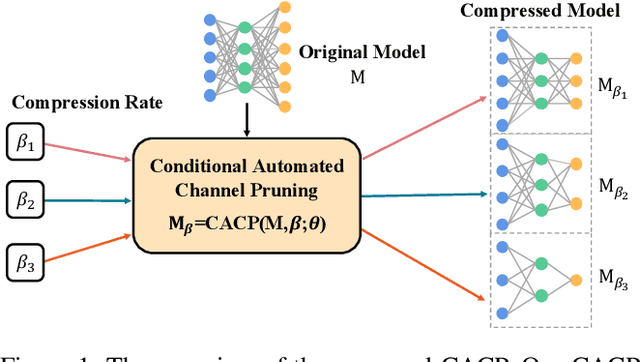
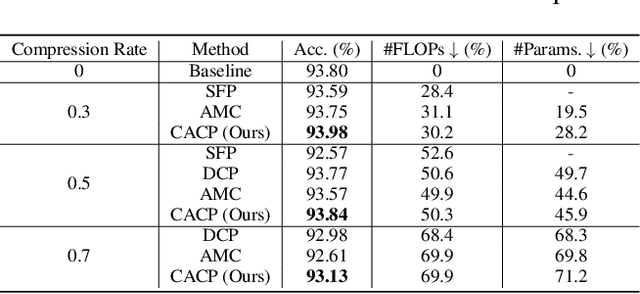
Model compression aims to reduce the redundancy of deep networks to obtain compact models. Recently, channel pruning has become one of the predominant compression methods to deploy deep models on resource-constrained devices. Most channel pruning methods often use a fixed compression rate for all the layers of the model, which, however, may not be optimal. To address this issue, given a target compression rate for the whole model, one can search for the optimal compression rate for each layer. Nevertheless, these methods perform channel pruning for a specific target compression rate. When we consider multiple compression rates, they have to repeat the channel pruning process multiple times, which is very inefficient yet unnecessary. To address this issue, we propose a Conditional Automated Channel Pruning(CACP) method to obtain the compressed models with different compression rates through single channel pruning process. To this end, we develop a conditional model that takes an arbitrary compression rate as input and outputs the corresponding compressed model. In the experiments, the resultant models with different compression rates consistently outperform the models compressed by existing methods with a channel pruning process for each target compression rate.