 Add to Chrome
 Add to Firefox
 Add to Edge
AlloGen: Conformation-Selective Binder Generation with Differential State Scoring
Jun 03, 2026
Protein binder design has largely optimized for affinity alone, leaving conformational selectivity unaddressed: for allosteric targets such as kinases, nuclear receptors, and GPCRs, a binder that engages both active and inactive states provides no functional specificity regardless of how tightly it binds. We introduce AlloGen, a modular framework that decouples backbone generation from a learned state-selectivity scorer $Q_θ$, an SE(3)-invariant interface graph transformer trained via a two-phase curriculum that first learns interface geometry before imposing conformational discrimination. Because $Q_θ$ is fully differentiable and generator-agnostic, it integrates with any backbone generator as a passive reranker or an active gradient-based guide without retraining. Across a diverse benchmark of proteins spanning multiple families and conformational mechanisms, AlloGen consistently identifies binders that preferentially recognize desired structural states while rejecting alternative conformations. Experimental validation on calmodulin further demonstrates that these computational selectivity signals translate to physical molecules, yielding de novo peptides that bind the desired holo conformation while exhibiting no detectable binding to the apo state. Together, these results establish conformational selectivity as a learnable property and provide a general framework for state-selective protein binder design.

Steering Masked Discrete Diffusion Models via Discrete Denoising Posterior Prediction
Oct 10, 2024
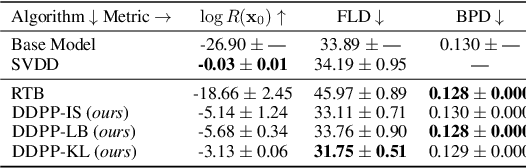


Generative modeling of discrete data underlies important applications spanning text-based agents like ChatGPT to the design of the very building blocks of life in protein sequences. However, application domains need to exert control over the generated data by steering the generative process - typically via RLHF - to satisfy a specified property, reward, or affinity metric. In this paper, we study the problem of steering Masked Diffusion Models (MDMs), a recent class of discrete diffusion models that offer a compelling alternative to traditional autoregressive models. We introduce Discrete Denoising Posterior Prediction (DDPP), a novel framework that casts the task of steering pre-trained MDMs as a problem of probabilistic inference by learning to sample from a target Bayesian posterior. Our DDPP framework leads to a family of three novel objectives that are all simulation-free, and thus scalable while applying to general non-differentiable reward functions. Empirically, we instantiate DDPP by steering MDMs to perform class-conditional pixel-level image modeling, RLHF-based alignment of MDMs using text-based rewards, and finetuning protein language models to generate more diverse secondary structures and shorter proteins. We substantiate our designs via wet-lab validation, where we observe transient expression of reward-optimized protein sequences.