 Add to Chrome
 Add to Firefox
 Add to Edge
Identifying parameter couplings and uncertainties of mixed-noise stochastic systems via full-covariance Gaussian mixture network
Aug 15, 2026
Parameter identification of stochastic dynamical systems driven by mixed noises is challenging due to intractable likelihood functions. We propose PENN-GMD, a parameter estimation neural network that maps partially observed trajectories to a Gaussian mixture distribution (GMD) over the system parameters. Unlike conventional uncertainty estimates, the GMD employs full covariance matrices to explicitly reveal parameter couplings and multi-modal likelihood structures. The network is trained by minimizing the negative log-likelihood via a surjective parameterization that hard-encodes all GMD constraints, thereby approximating the true likelihood. We validate the method on five numerical examples with increasing complexity, including systems driven by fractional Gaussian and Lévy noises, oscillators with colored noise, coupled neurons under different observability, and an aeroelastic airfoil with unidentifiable stochastic disturbances. Results demonstrate that PENN-GMD accurately recovers likelihood distributions, captures parameter couplings, and naturally diagnoses non-identifiability through variance broadening or mode splitting. These capabilities establish PENN-GMD as a practical tool for uncertainty-aware parameter identification in complex stochastic systems where conventional likelihood-based methods are infeasible.

Kimi K3: Open Frontier Intelligence
Jul 27, 2026We introduce Kimi K3, a 2.8T parameter Mixture-of-Experts model with 104 billion activated parameters, native vision capabilities, and a 1-million-token context window. Kimi K3 is built on Kimi Delta Attention and Attention Residuals, which improve information flow across sequence length and model depth. Together with Stable LatentMoE, which effectively activates 16 of 896 routed experts per token, and refined training and data recipes, these advances yield an approximately 2.5x improvement in overall scaling efficiency over Kimi K2. Post-training highlights reinforcement learning across general, agentic, and coding domains and multiple reasoning-effort levels, enabling compositional generalization and robust long-horizon execution. At 2.8T scale, Kimi K3 is supported by infrastructure advances in multiple areas: algorithm-system co-design for KDA, perfectly balanced expert-parallel training with efficient memory management, million-token agentic RL with persistent rollout and sandbox states, and deployment innovations. Extensive evaluations show that Kimi K3 achieves frontier-level performance across long-horizon coding, agentic, knowledge, reasoning, and vision tasks. While its overall performance still trails the most powerful proprietary models, namely Claude Fable 5 and GPT-5.6 Sol, Kimi K3 consistently outperforms other open and proprietary models evaluated in our suite. We release the full Kimi K3 model weights to facilitate future research and accelerate the broader deployment and adoption of frontier intelligence.
A deep learning framework for jointly solving transient Fokker-Planck equations with arbitrary parameters and initial distributions
Apr 07, 2026Efficiently solving the Fokker-Planck equation (FPE) is central to analyzing complex parameterized stochastic systems. However, current numerical methods lack parallel computation capabilities across varying conditions, severely limiting comprehensive parameter exploration and transient analysis. This paper introduces a deep learning-based pseudo-analytical probability solution (PAPS) that, via a single training process, simultaneously resolves transient FPE solutions for arbitrary multi-modal initial distributions, system parameters, and time points. The core idea is to unify initial, transient, and stationary distributions via Gaussian mixture distributions (GMDs) and develop a constraint-preserving autoencoder that bijectively maps constrained GMD parameters to unconstrained, low-dimensional latent representations. In this representation space, the panoramic transient dynamics across varying initial conditions and system parameters can be modeled by a single evolution network. Extensive experiments on paradigmatic systems demonstrate that the proposed PAPS maintains high accuracy while achieving inference speeds four orders of magnitude faster than GPU-accelerated Monte Carlo simulations. This efficiency leap enables previously intractable real-time parameter sweeps and systematic investigations of stochastic bifurcations. By decoupling representation learning from physics-informed transient dynamics, our work establishes a scalable paradigm for probabilistic modeling of multi-dimensional, parameterized stochastic systems.
Uncovering What, Why and How: A Comprehensive Benchmark for Causation Understanding of Video Anomaly
Apr 30, 2024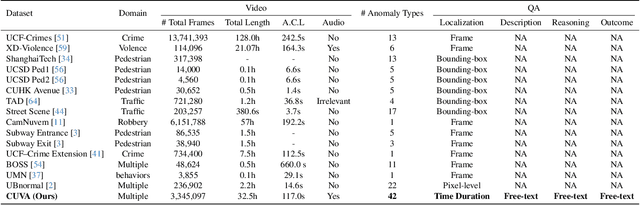
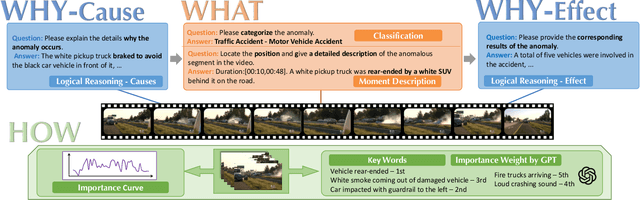
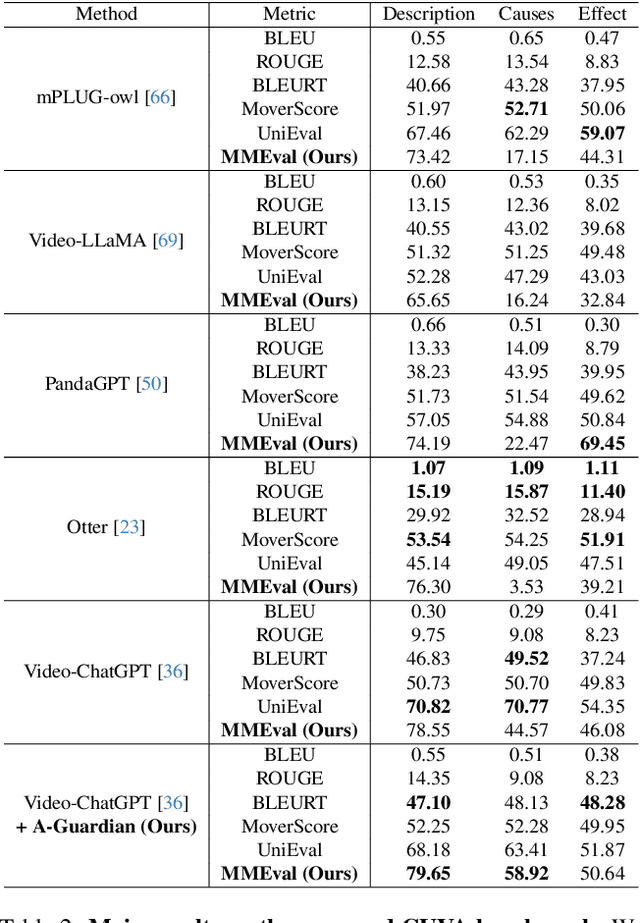

Video anomaly understanding (VAU) aims to automatically comprehend unusual occurrences in videos, thereby enabling various applications such as traffic surveillance and industrial manufacturing. While existing VAU benchmarks primarily concentrate on anomaly detection and localization, our focus is on more practicality, prompting us to raise the following crucial questions: "what anomaly occurred?", "why did it happen?", and "how severe is this abnormal event?". In pursuit of these answers, we present a comprehensive benchmark for Causation Understanding of Video Anomaly (CUVA). Specifically, each instance of the proposed benchmark involves three sets of human annotations to indicate the "what", "why" and "how" of an anomaly, including 1) anomaly type, start and end times, and event descriptions, 2) natural language explanations for the cause of an anomaly, and 3) free text reflecting the effect of the abnormality. In addition, we also introduce MMEval, a novel evaluation metric designed to better align with human preferences for CUVA, facilitating the measurement of existing LLMs in comprehending the underlying cause and corresponding effect of video anomalies. Finally, we propose a novel prompt-based method that can serve as a baseline approach for the challenging CUVA. We conduct extensive experiments to show the superiority of our evaluation metric and the prompt-based approach. Our code and dataset are available at https://github.com/fesvhtr/CUVA.
Deeply Supervised Layer Selective Attention Network: Towards Label-Efficient Learning for Medical Image Classification
Sep 28, 2022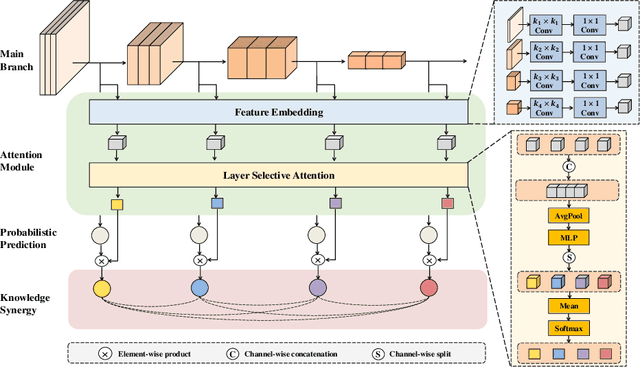

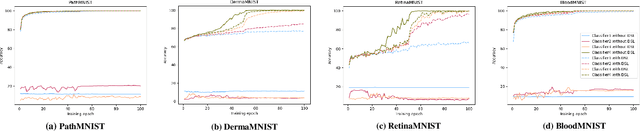
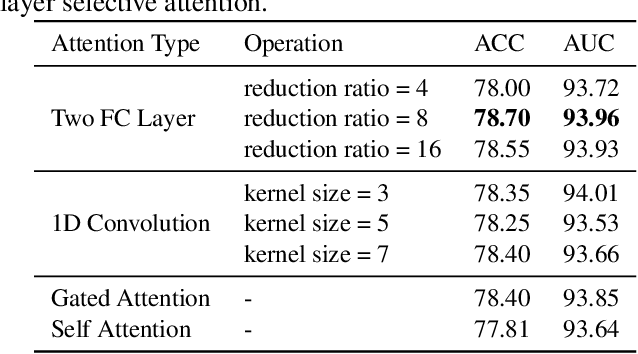
Labeling medical images depends on professional knowledge, making it difficult to acquire large amount of annotated medical images with high quality in a short time. Thus, making good use of limited labeled samples in a small dataset to build a high-performance model is the key to medical image classification problem. In this paper, we propose a deeply supervised Layer Selective Attention Network (LSANet), which comprehensively uses label information in feature-level and prediction-level supervision. For feature-level supervision, in order to better fuse the low-level features and high-level features, we propose a novel visual attention module, Layer Selective Attention (LSA), to focus on the feature selection of different layers. LSA introduces a weight allocation scheme which can dynamically adjust the weighting factor of each auxiliary branch during the whole training process to further enhance deeply supervised learning and ensure its generalization. For prediction-level supervision, we adopt the knowledge synergy strategy to promote hierarchical information interactions among all supervision branches via pairwise knowledge matching. Using the public dataset, MedMNIST, which is a large-scale benchmark for biomedical image classification covering diverse medical specialties, we evaluate LSANet on multiple mainstream CNN architectures and various visual attention modules. The experimental results show the substantial improvements of our proposed method over its corresponding counterparts, demonstrating that LSANet can provide a promising solution for label-efficient learning in the field of medical image classification.
DrugOOD: Out-of-Distribution (OOD) Dataset Curator and Benchmark for AI-aided Drug Discovery -- A Focus on Affinity Prediction Problems with Noise Annotations
Jan 24, 2022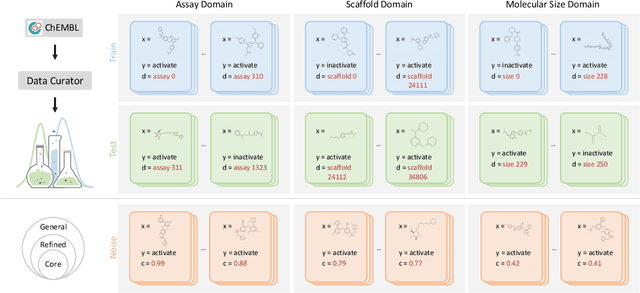
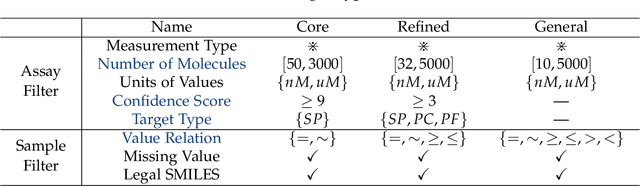
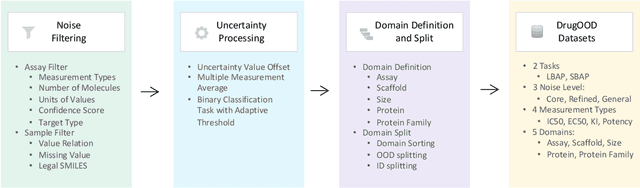
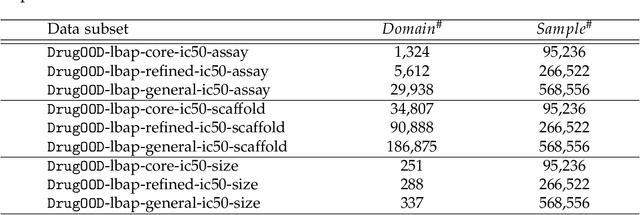
AI-aided drug discovery (AIDD) is gaining increasing popularity due to its promise of making the search for new pharmaceuticals quicker, cheaper and more efficient. In spite of its extensive use in many fields, such as ADMET prediction, virtual screening, protein folding and generative chemistry, little has been explored in terms of the out-of-distribution (OOD) learning problem with \emph{noise}, which is inevitable in real world AIDD applications. In this work, we present DrugOOD, a systematic OOD dataset curator and benchmark for AI-aided drug discovery, which comes with an open-source Python package that fully automates the data curation and OOD benchmarking processes. We focus on one of the most crucial problems in AIDD: drug target binding affinity prediction, which involves both macromolecule (protein target) and small-molecule (drug compound). In contrast to only providing fixed datasets, DrugOOD offers automated dataset curator with user-friendly customization scripts, rich domain annotations aligned with biochemistry knowledge, realistic noise annotations and rigorous benchmarking of state-of-the-art OOD algorithms. Since the molecular data is often modeled as irregular graphs using graph neural network (GNN) backbones, DrugOOD also serves as a valuable testbed for \emph{graph OOD learning} problems. Extensive empirical studies have shown a significant performance gap between in-distribution and out-of-distribution experiments, which highlights the need to develop better schemes that can allow for OOD generalization under noise for AIDD.