 Add to Chrome
 Add to Firefox
 Add to Edge
Over-Sampling Strategy in Feature Space for Graphs based Class-imbalanced Bot Detection
Feb 14, 2023
The presence of a large number of bots in Online Social Networks (OSN) leads to undesirable social effects. Graph neural networks (GNNs) have achieved state-of-the-art performance in bot detection since they can effectively utilize user interaction. In most scenarios, the distribution of bots and humans is imbalanced, resulting in under-represent minority class samples and sub-optimal performance. However, previous GNN-based methods for bot detection seldom consider the impact of class-imbalanced issues. In this paper, we propose an over-sampling strategy for GNN (OS-GNN) that can mitigate the effect of class imbalance in bot detection. Compared with previous over-sampling methods for GNNs, OS-GNN does not call for edge synthesis, eliminating the noise inevitably introduced during the edge construction. Specifically, node features are first mapped to a feature space through neighborhood aggregation and then generated samples for the minority class in the feature space. Finally, the augmented features are fed into GNNs to train the classifiers. This framework is general and can be easily extended into different GNN architectures. The proposed framework is evaluated using three real-world bot detection benchmark datasets, and it consistently exhibits superiority over the baselines.

ControversialQA: Exploring Controversy in Question Answering
Feb 10, 2023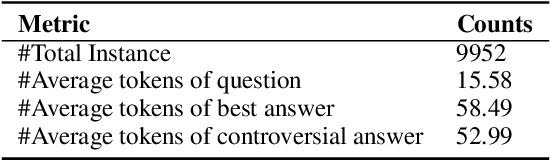

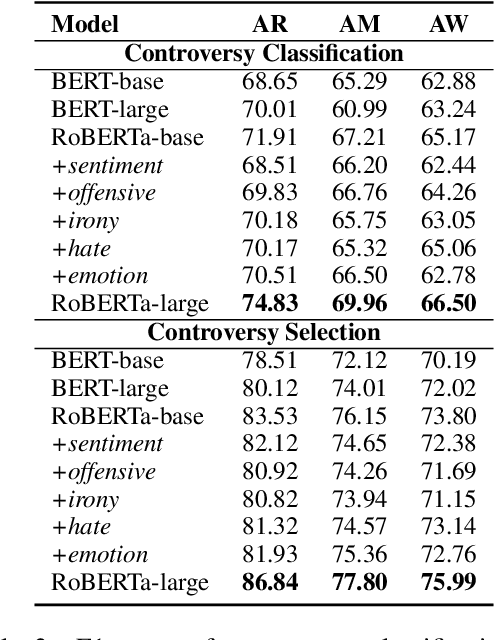
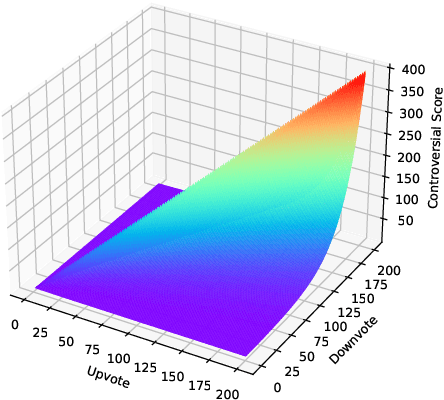
Controversy is widespread online. Previous studies mainly define controversy based on vague assumptions of its relation to sentiment such as hate speech and offensive words. This paper introduces the first question-answering dataset that defines content controversy by user perception, i.e., votes from plenty of users. It contains nearly 10K questions, and each question has a best answer and a most controversial answer. Experimental results reveal that controversy detection in question answering is essential and challenging, and there is no strong correlation between controversy and sentiment tasks.
Eliminating Prior Bias for Semantic Image Editing via Dual-Cycle Diffusion
Feb 07, 2023The recent success of text-to-image generation diffusion models has also revolutionized semantic image editing, enabling the manipulation of images based on query/target texts. Despite these advancements, a significant challenge lies in the potential introduction of prior bias in pre-trained models during image editing, e.g., making unexpected modifications to inappropriate regions. To this point, we present a novel Dual-Cycle Diffusion model that addresses the issue of prior bias by generating an unbiased mask as the guidance of image editing. The proposed model incorporates a Bias Elimination Cycle that consists of both a forward path and an inverted path, each featuring a Structural Consistency Cycle to ensure the preservation of image content during the editing process. The forward path utilizes the pre-trained model to produce the edited image, while the inverted path converts the result back to the source image. The unbiased mask is generated by comparing differences between the processed source image and the edited image to ensure that both conform to the same distribution. Our experiments demonstrate the effectiveness of the proposed method, as it significantly improves the D-CLIP score from 0.272 to 0.283. The code will be available at https://github.com/JohnDreamer/DualCycleDiffsion.
Explicit Box Detection Unifies End-to-End Multi-Person Pose Estimation
Feb 03, 2023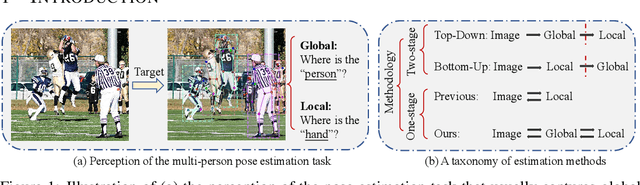

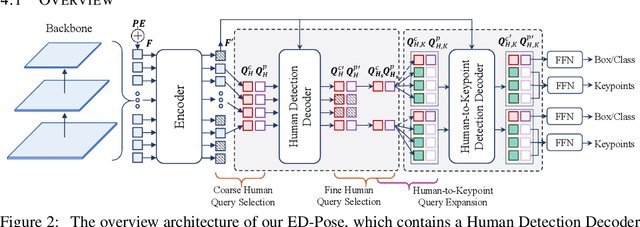
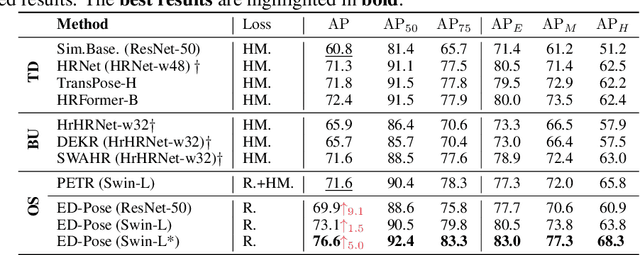
This paper presents a novel end-to-end framework with Explicit box Detection for multi-person Pose estimation, called ED-Pose, where it unifies the contextual learning between human-level (global) and keypoint-level (local) information. Different from previous one-stage methods, ED-Pose re-considers this task as two explicit box detection processes with a unified representation and regression supervision. First, we introduce a human detection decoder from encoded tokens to extract global features. It can provide a good initialization for the latter keypoint detection, making the training process converge fast. Second, to bring in contextual information near keypoints, we regard pose estimation as a keypoint box detection problem to learn both box positions and contents for each keypoint. A human-to-keypoint detection decoder adopts an interactive learning strategy between human and keypoint features to further enhance global and local feature aggregation. In general, ED-Pose is conceptually simple without post-processing and dense heatmap supervision. It demonstrates its effectiveness and efficiency compared with both two-stage and one-stage methods. Notably, explicit box detection boosts the pose estimation performance by 4.5 AP on COCO and 9.9 AP on CrowdPose. For the first time, as a fully end-to-end framework with a L1 regression loss, ED-Pose surpasses heatmap-based Top-down methods under the same backbone by 1.2 AP on COCO and achieves the state-of-the-art with 76.6 AP on CrowdPose without bells and whistles. Code is available at https://github.com/IDEA-Research/ED-Pose.
Deep Learning for Short-Latency Epileptic Seizure Detection with Probabilistic Classification
Jan 04, 2023In this manuscript, we propose a novel deep learning (DL)-based framework intended for obtaining short latency in real-time electroencephalogram-based epileptic seizure detection using multiscale 3D convolutional neural networks. We pioneer converting seizure detection task from traditional binary classification of samples from ictal and interictal periods to probabilistic classification of samples from interictal, ictal, and crossing periods. We introduce a crossing period from seizure-oriented EEG recording and propose a labelling rule using soft-label for samples from the crossing period to build a probabilistic classification task. A novel multiscale short-time Fourier transform feature extraction method and 3D convolution neural network architecture are proposed to accurately capture predictive probabilities of samples. Furthermore, we also propose rectified weighting strategy to enhance predictive probabilities, and accumulative decision-making rule to achieve short detection latency. We implement leave-one-seizure-out cross validation on two prevalent datasets -- CHB-MIT scalp EEG dataset and SWEC-ETHZ intracranial EEG dataset. Eventually, the proposed algorithm achieved 94 out of 99 seizures detected during the crossing period, averaged 14.84% rectified predictive ictal probability (RPIP) errors of crossing samples, 2.3 s detection latency, 0.32/h false detection rate on CHB-MIT dataset, meanwhile 84 out of 89 detected seizures, 16.17% RPIP errors, 4.7 s detection latency, and 0.75/h FDR are achieved on SWEC-ETHZ dataset. The obtained detection latencies are at least 50% faster than state-of-the-art results reported in previous studies.
MGTAB: A Multi-Relational Graph-Based Twitter Account Detection Benchmark
Jan 03, 2023The development of social media user stance detection and bot detection methods rely heavily on large-scale and high-quality benchmarks. However, in addition to low annotation quality, existing benchmarks generally have incomplete user relationships, suppressing graph-based account detection research. To address these issues, we propose a Multi-Relational Graph-Based Twitter Account Detection Benchmark (MGTAB), the first standardized graph-based benchmark for account detection. To our knowledge, MGTAB was built based on the largest original data in the field, with over 1.55 million users and 130 million tweets. MGTAB contains 10,199 expert-annotated users and 7 types of relationships, ensuring high-quality annotation and diversified relations. In MGTAB, we extracted the 20 user property features with the greatest information gain and user tweet features as the user features. In addition, we performed a thorough evaluation of MGTAB and other public datasets. Our experiments found that graph-based approaches are generally more effective than feature-based approaches and perform better when introducing multiple relations. By analyzing experiment results, we identify effective approaches for account detection and provide potential future research directions in this field. Our benchmark and standardized evaluation procedures are freely available at: https://github.com/GraphDetec/MGTAB.
FoPro: Few-Shot Guided Robust Webly-Supervised Prototypical Learning
Dec 01, 2022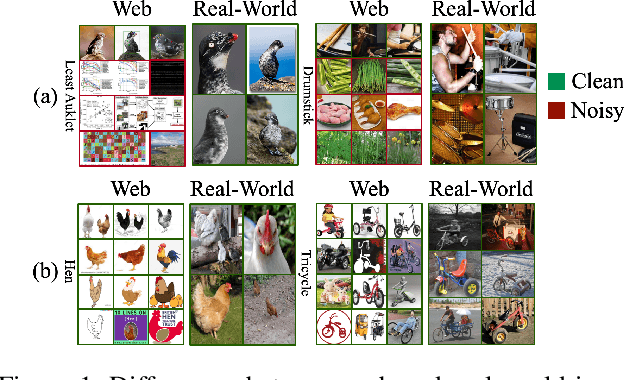
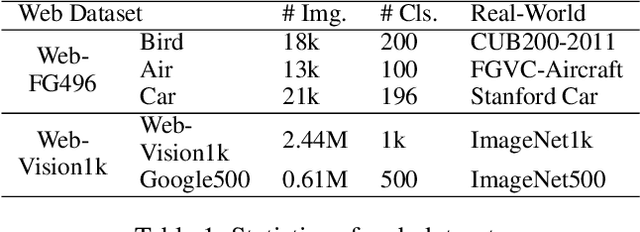
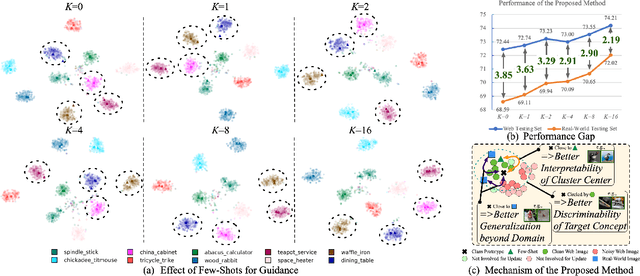
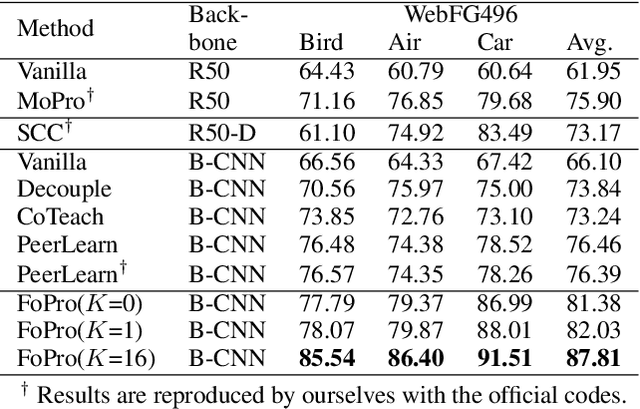
Recently, webly supervised learning (WSL) has been studied to leverage numerous and accessible data from the Internet. Most existing methods focus on learning noise-robust models from web images while neglecting the performance drop caused by the differences between web domain and real-world domain. However, only by tackling the performance gap above can we fully exploit the practical value of web datasets. To this end, we propose a Few-shot guided Prototypical (FoPro) representation learning method, which only needs a few labeled examples from reality and can significantly improve the performance in the real-world domain. Specifically, we initialize each class center with few-shot real-world data as the ``realistic" prototype. Then, the intra-class distance between web instances and ``realistic" prototypes is narrowed by contrastive learning. Finally, we measure image-prototype distance with a learnable metric. Prototypes are polished by adjacent high-quality web images and involved in removing distant out-of-distribution samples. In experiments, FoPro is trained on web datasets with a few real-world examples guided and evaluated on real-world datasets. Our method achieves the state-of-the-art performance on three fine-grained datasets and two large-scale datasets. Compared with existing WSL methods under the same few-shot settings, FoPro still excels in real-world generalization. Code is available at https://github.com/yuleiqin/fopro.
A 97 fJ/Conversion Neuron-ADC with Reconfigurable Sampling and Static Power Reduction
Nov 28, 2022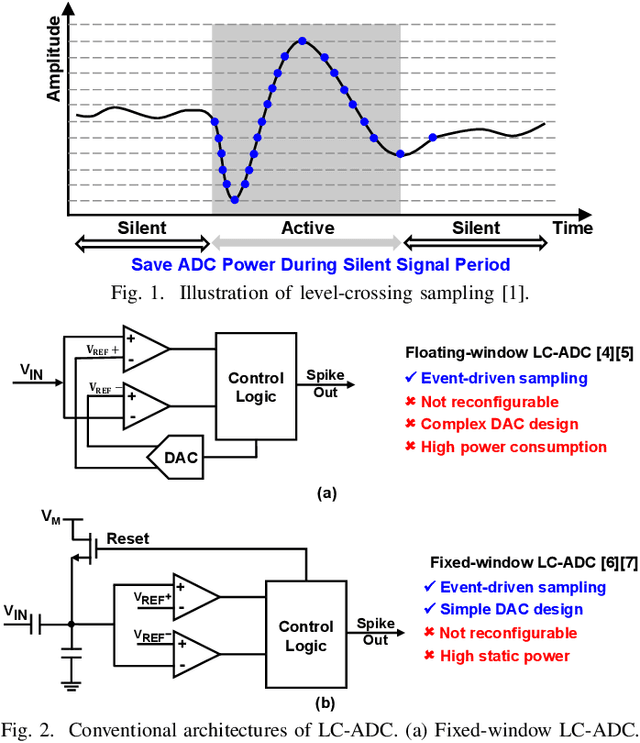
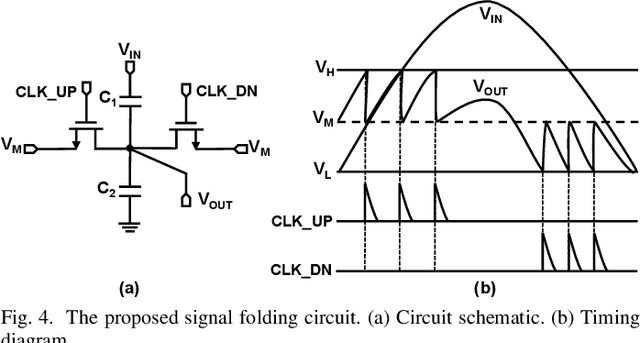
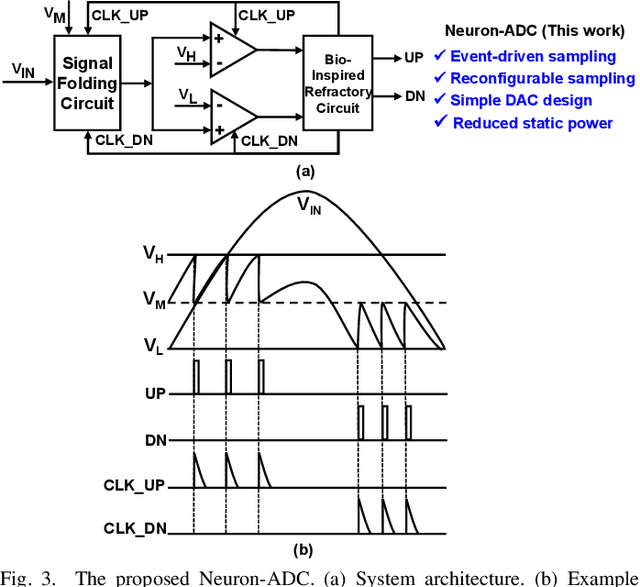
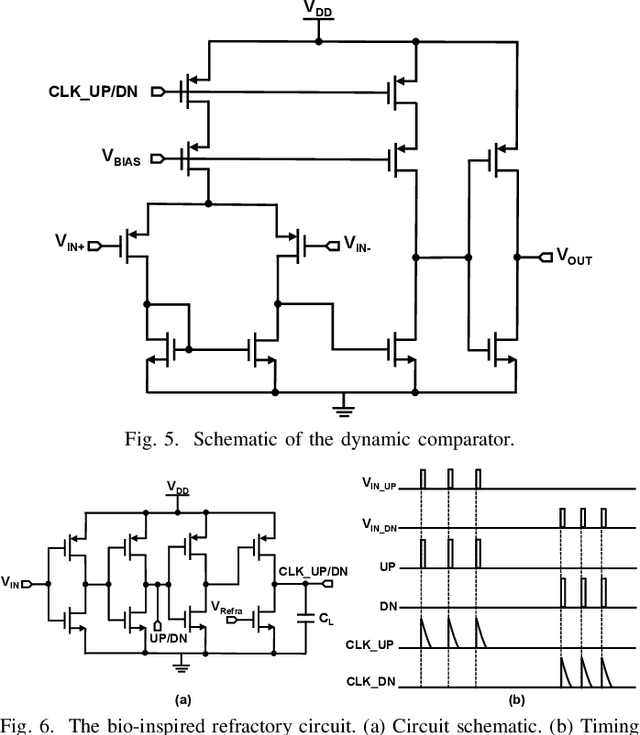
A bio-inspired Neuron-ADC with reconfigurable sampling and static power reduction for biomedical applications is proposed in this work. The Neuron-ADC leverages level-crossing sampling and a bio-inspired refractory circuit to compressively converts bio-signal to digital spikes and information-of-interest. The proposed design can not only avoid dissipating ADC energy on unnecessary data but also achieve reconfigurable sampling, making it appropriate for either low power operation or high accuracy conversion when dealing with various kinds of bio-signals. Moreover, the proposed dynamic comparator can reduce static power up to 41.1% when tested with a 10 kHz sinusoidal input. Simulation results of 40 nm CMOS process show that the Neuron-ADC achieves a maximum ENOB of 6.9 bits with a corresponding FoM of 97 fJ/conversion under 0.6 V supply voltage.
Sub-1ms Instinctual Interference Adaptive GaN LNA Front-End with Power and Linearity Tuning
Nov 27, 2022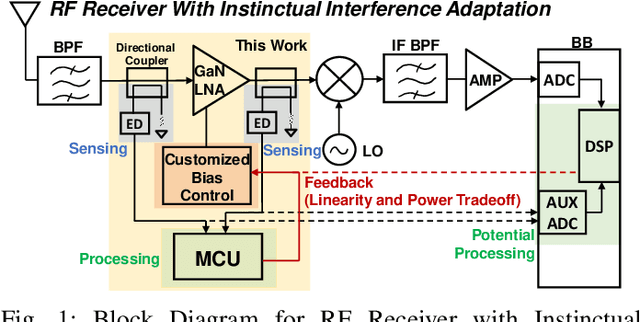
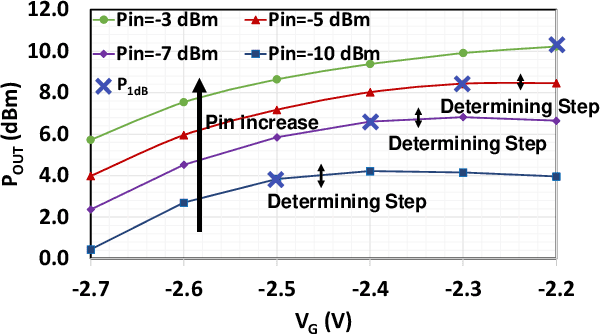
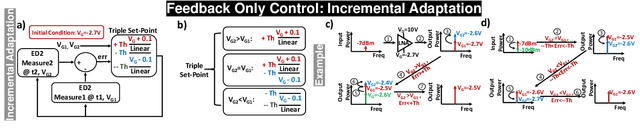
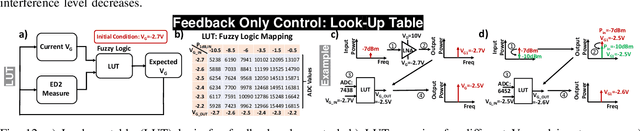
One of the major challenges in communication, radar, and electronic warfare receivers arises from nearby device interference. The paper presents a 2-6 GHz GaN LNA front-end with onboard sensing, processing, and feedback utilizing microcontroller-based controls to achieve adaptation to a variety of interference scenarios through power and linearity regulations. The utilization of GaN LNA provides high power handling capability (30 dBm) and high linearity (OIP3= 30 dBm) for radar and EW applications. The system permits an LNA power consumption to tune from 500 mW to 2 W (4X increase) in order to adjust the linearity from P\textsubscript{1dB,IN}=-10.5 dBm to 0.5 dBm (>10X increase). Across the tuning range, the noise figure increases by approximately 0.4 dB. Feedback control methods are presented with backgrounds from control theory. The rest of the controls consume $\leq$10$\%$ (100 mW) of nominal LNA power (1 W) to achieve an adaptation time <1 ms.
On Multi-head Ensemble of Smoothed Classifiers for Certified Robustness
Nov 20, 2022Randomized Smoothing (RS) is a promising technique for certified robustness, and recently in RS the ensemble of multiple deep neural networks (DNNs) has shown state-of-the-art performances. However, such an ensemble brings heavy computation burdens in both training and certification, and yet under-exploits individual DNNs and their mutual effects, as the communication between these classifiers is commonly ignored in optimization. In this work, starting from a single DNN, we augment the network with multiple heads, each of which pertains a classifier for the ensemble. A novel training strategy, namely Self-PAced Circular-TEaching (SPACTE), is proposed accordingly. SPACTE enables a circular communication flow among those augmented heads, i.e., each head teaches its neighbor with the self-paced learning using smoothed losses, which are specifically designed in relation to certified robustness. The deployed multi-head structure and the circular-teaching scheme of SPACTE jointly contribute to diversify and enhance the classifiers in augmented heads for ensemble, leading to even stronger certified robustness than ensembling multiple DNNs (effectiveness) at the cost of much less computational expenses (efficiency), verified by extensive experiments and discussions.