 Add to Chrome
 Add to Firefox
 Add to Edge
LoHoSearch: Benchmarking Long-Horizon Search Agents Beyond the Human Difficulty Ceiling
Jun 11, 2026
Search agent benchmarks exemplified by BrowseComp have rapidly saturated over the past year, with the strongest models surpassing 90% accuracy. Since these benchmarks are predominantly human-authored, annotators lack a global perspective on entity statistics and cannot systematically maximize search space size and structural complexity. This creates a difficulty ceiling that is hard to break. To address this, we introduce LoHoSearch (Long-Horizon Search Agents), a challenging benchmark comprising 544 human-verified questions across 11 domains. LoHoSearch is constructed via an automated pipeline built upon a knowledge graph covering over 7 million Wikipedia entities, which selects relations with large search spaces and assembles them into structurally complex questions with KG-verified unique answers. Our evaluation demonstrates that even the strongest model achieves only 34.74% accuracy, and existing context management strategies (best +6.8%) yield far smaller gains than on prior benchmarks. LoHoSearch provides a more demanding standard for evaluating long-horizon reasoning and context management in search agents.

SpikeHash: Learning Binary Codes with Spiking Neural Networks for Cross-Modal Hashing Retrieval
May 30, 2026Cross-modal hashing retrieval encodes heterogeneous data into compact binary codes for efficient Hamming-space search. Existing methods usually learn cross-modal semantics in continuous feature spaces and generate binary codes through a final sign operation, which weakly couples training optimization with discrete hash retrieval. We propose SpikeHash, a unified spiking framework that formulates cross-modal hashing as spike-state evolution, directional spike interaction, and competitive spike readout. Specifically, SpikeHash converts image and text features into multi-timestep spike sequences. In a shared Hamming space, the two spike sequences jointly drive the temporal evolution of a shared hash state. Cross-modal interaction is further performed through directional spike modulation, enabling each modality to influence the firing dynamics of the other. Crucially, SpikeHash replaces the conventional continuous hash head with a positive-negative spiking hash readout, where each hash bit is produced by temporal competition between paired spike channels. Experimental results show that SpikeHash achieves competitive retrieval accuracy on three benchmark datasets while reducing the parameter size, operation count, and estimated energy of the hash learning stage, suggesting a compact spiking alternative to conventional continuous hash mapping. The project page is available at https://shuqiao-111.github.io/.
Teacher-Guided Student Self-Knowledge Distillation Using Diffusion Model
Feb 02, 2026Existing Knowledge Distillation (KD) methods often align feature information between teacher and student by exploring meaningful feature processing and loss functions. However, due to the difference in feature distributions between the teacher and student, the student model may learn incompatible information from the teacher. To address this problem, we propose teacher-guided student Diffusion Self-KD, dubbed as DSKD. Instead of the direct teacher-student alignment, we leverage the teacher classifier to guide the sampling process of denoising student features through a light-weight diffusion model. We then propose a novel locality-sensitive hashing (LSH)-guided feature distillation method between the original and denoised student features. The denoised student features encapsulate teacher knowledge and could be regarded as a teacher role. In this way, our DSKD method could eliminate discrepancies in mapping manners and feature distributions between the teacher and student, while learning meaningful knowledge from the teacher. Experiments on visual recognition tasks demonstrate that DSKD significantly outperforms existing KD methods across various models and datasets. Our code is attached in supplementary material.
LongCat-Flash-Thinking-2601 Technical Report
Jan 23, 2026We introduce LongCat-Flash-Thinking-2601, a 560-billion-parameter open-source Mixture-of-Experts (MoE) reasoning model with superior agentic reasoning capability. LongCat-Flash-Thinking-2601 achieves state-of-the-art performance among open-source models on a wide range of agentic benchmarks, including agentic search, agentic tool use, and tool-integrated reasoning. Beyond benchmark performance, the model demonstrates strong generalization to complex tool interactions and robust behavior under noisy real-world environments. Its advanced capability stems from a unified training framework that combines domain-parallel expert training with subsequent fusion, together with an end-to-end co-design of data construction, environments, algorithms, and infrastructure spanning from pre-training to post-training. In particular, the model's strong generalization capability in complex tool-use are driven by our in-depth exploration of environment scaling and principled task construction. To optimize long-tailed, skewed generation and multi-turn agentic interactions, and to enable stable training across over 10,000 environments spanning more than 20 domains, we systematically extend our asynchronous reinforcement learning framework, DORA, for stable and efficient large-scale multi-environment training. Furthermore, recognizing that real-world tasks are inherently noisy, we conduct a systematic analysis and decomposition of real-world noise patterns, and design targeted training procedures to explicitly incorporate such imperfections into the training process, resulting in improved robustness for real-world applications. To further enhance performance on complex reasoning tasks, we introduce a Heavy Thinking mode that enables effective test-time scaling by jointly expanding reasoning depth and width through intensive parallel thinking.
DCL-SE: Dynamic Curriculum Learning for Spatiotemporal Encoding of Brain Imaging
Nov 19, 2025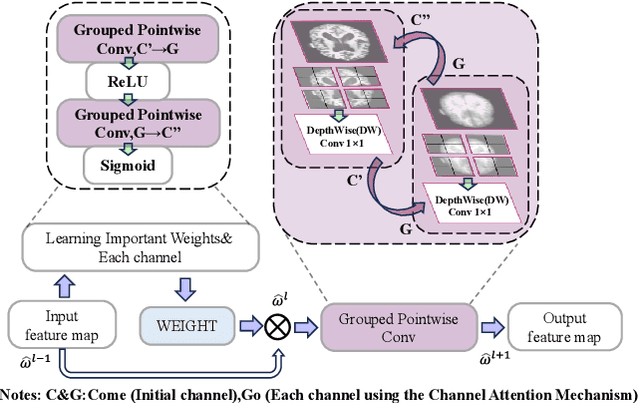
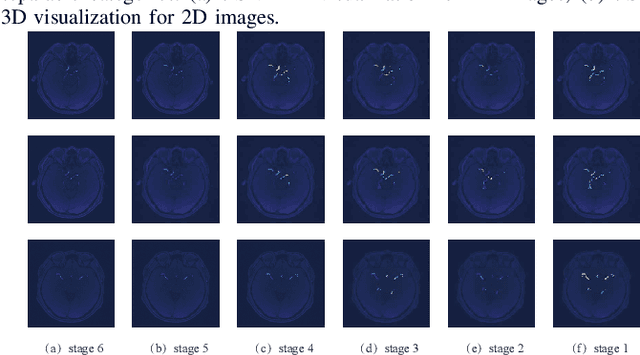
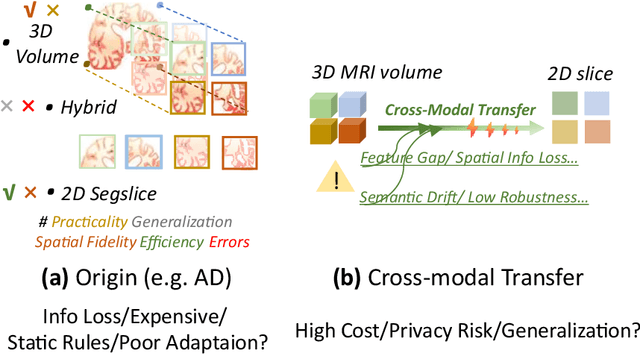
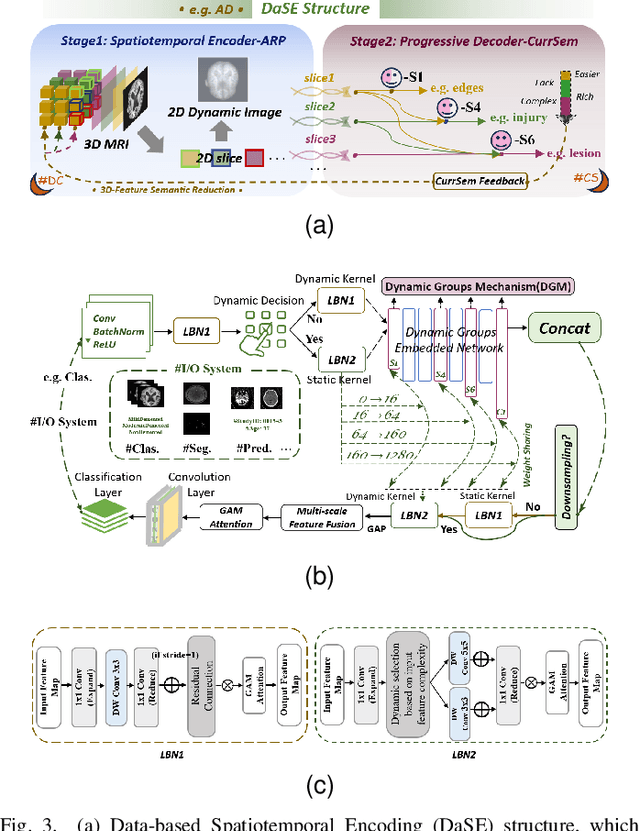
High-dimensional neuroimaging analyses for clinical diagnosis are often constrained by compromises in spatiotemporal fidelity and by the limited adaptability of large-scale, general-purpose models. To address these challenges, we introduce Dynamic Curriculum Learning for Spatiotemporal Encoding (DCL-SE), an end-to-end framework centered on data-driven spatiotemporal encoding (DaSE). We leverage Approximate Rank Pooling (ARP) to efficiently encode three-dimensional volumetric brain data into information-rich, two-dimensional dynamic representations, and then employ a dynamic curriculum learning strategy, guided by a Dynamic Group Mechanism (DGM), to progressively train the decoder, refining feature extraction from global anatomical structures to fine pathological details. Evaluated across six publicly available datasets, including Alzheimer's disease and brain tumor classification, cerebral artery segmentation, and brain age prediction, DCL-SE consistently outperforms existing methods in accuracy, robustness, and interpretability. These findings underscore the critical importance of compact, task-specific architectures in the era of large-scale pretrained networks.
Message Feedback Interference Cancellation Aided UAMP Iterative Detector for OTFS Systems
Jan 05, 2024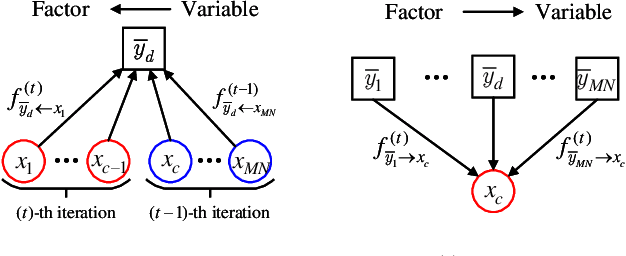
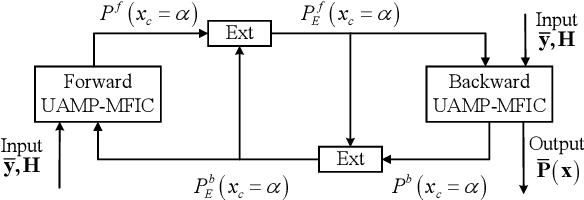
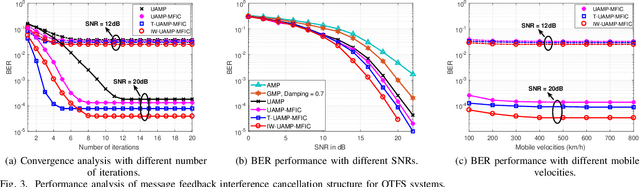
The designing of efficient signal detectors is important and yet challenge for orthogonal time frequency space (OTFS) systems in high-mobility scenarios. In this letter, we develop an efficient message feedback interference cancellation aided unitary approximate message passing (denoted as UAMPMFIC) iterative detector, where the latest feedback messages from variable nodes are utilized for more reliable interference cancellation and performance improvement. A fast recursive scheme is leveraged in the proposed UAMP-MFIC detector to prevent complexity increasing. To further alleviate the error-propagation and improve the receiver performance, we also develop the bidirectional symbol detection structures, where Turbo UAMP-MFIC detector and iterative weight UAMP-MFIC detector are proposed to efficiently fuse the estimation results of forward and backward UAMP-MFIC detectors. The simulation results are finally provided to demonstrate performance improvement of our proposed detectors over existing detectors.