 Add to Chrome
 Add to Firefox
 Add to Edge
DCL-SE: Dynamic Curriculum Learning for Spatiotemporal Encoding of Brain Imaging
Nov 19, 2025
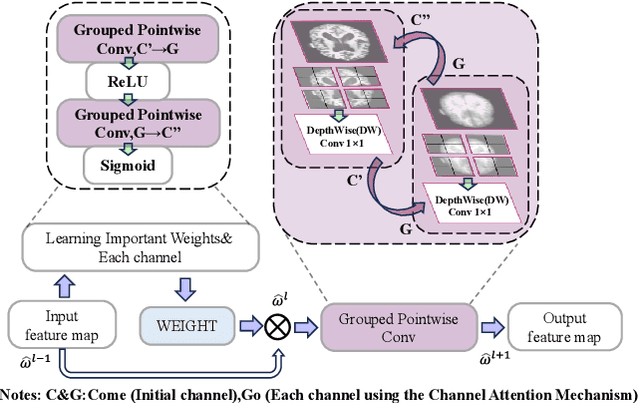
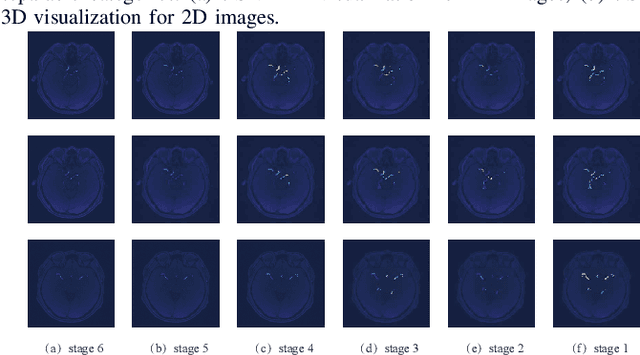
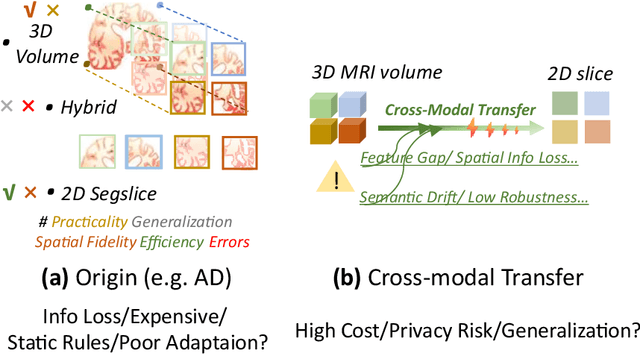
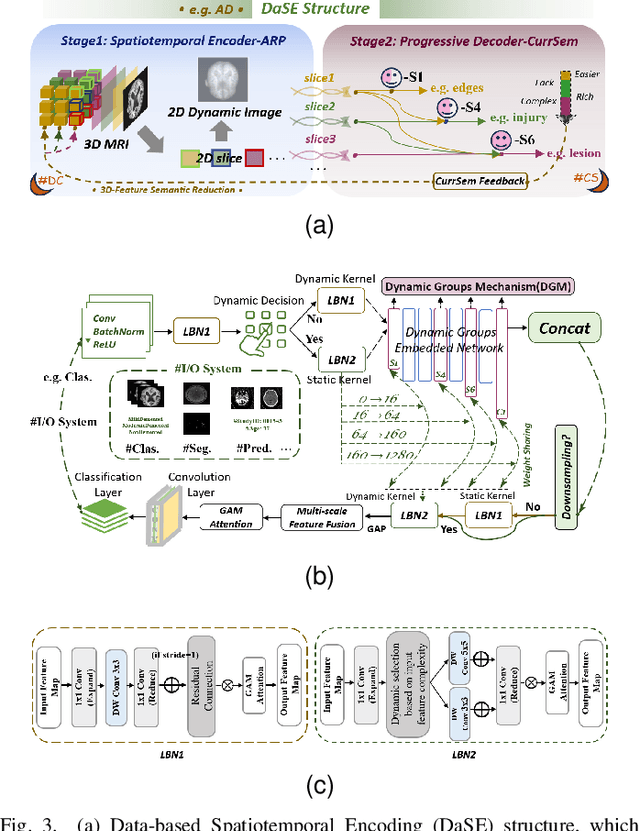
High-dimensional neuroimaging analyses for clinical diagnosis are often constrained by compromises in spatiotemporal fidelity and by the limited adaptability of large-scale, general-purpose models. To address these challenges, we introduce Dynamic Curriculum Learning for Spatiotemporal Encoding (DCL-SE), an end-to-end framework centered on data-driven spatiotemporal encoding (DaSE). We leverage Approximate Rank Pooling (ARP) to efficiently encode three-dimensional volumetric brain data into information-rich, two-dimensional dynamic representations, and then employ a dynamic curriculum learning strategy, guided by a Dynamic Group Mechanism (DGM), to progressively train the decoder, refining feature extraction from global anatomical structures to fine pathological details. Evaluated across six publicly available datasets, including Alzheimer's disease and brain tumor classification, cerebral artery segmentation, and brain age prediction, DCL-SE consistently outperforms existing methods in accuracy, robustness, and interpretability. These findings underscore the critical importance of compact, task-specific architectures in the era of large-scale pretrained networks.

LostNet: A smart way for lost and find
Jan 05, 2023Due to the enormous population growth of cities in recent years, objects are frequently lost and unclaimed on public transportation, in restaurants, or any other public areas. While services like Find My iPhone can easily identify lost electronic devices, more valuable objects cannot be tracked in an intelligent manner, making it impossible for administrators to reclaim a large number of lost and found items in a timely manner. We present a method that significantly reduces the complexity of searching by comparing previous images of lost and recovered things provided by the owner with photos taken when registered lost and found items are received. In this research, we will primarily design a photo matching network by combining the fine-tuning method of MobileNetv2 with CBAM Attention and using the Internet framework to develop an online lost and found image identification system. Our implementation gets a testing accuracy of 96.8% using only 665.12M GLFOPs and 3.5M training parameters. It can recognize practice images and can be run on a regular laptop.