 Add to Chrome
 Add to Firefox
 Add to Edge
SemDINO: A DINOv3-Driven Network for Cross-Temporal Semantic Alignment in Change Detection
Jun 08, 2026
Semantic change detection (SCD) aims to simultaneously locate land-cover changes and identify semantic categories before and after transition. However, existing methods suffer from insufficient cross-temporal alignment, weak multi-scale representation, and poor robustness to pseudo-changes caused by illumination, season, and registration noise. To address these issues, we propose a novel end-to-end semantic change detection network named SemDINO, which integrates a dual-branch encoder, multi-scale temporal interaction, semantic purification, change enhancement, and decoupled multi-task prediction into a unified framework. Specifically, we construct a dual-branch encoder that combines a CNN backbone and frozen DINOv3 features via gated pyramid fusion, enabling rich multi-scale semantic representation. Then, a multi-scale temporal bidirectional transformer interaction (M-TBTT) module is proposed to achieve global cross-temporal feature alignment and information interaction. To further enhance genuine changes and suppress pseudo-variations, we introduce semantic purification (SCP), bidirectional change enhancement (BiChangeEnhance), and multi-scale change enhancement (MCE) modules collaboratively. Finally, a multi-branch CD prediction head is designed to jointly output binary change mask, bi-temporal semantic maps, and edge constraint. Extensive experiments on public remote sensing CD datasets demonstrate that SemDINO achieves superior performance and generalization ability against state-of-the-art methods, especially in complex scenarios with interference factors.

M\textsuperscript{4}Fuse: Lightweight State-Space MoE with a Cross-Scale Gating Bridge for Brain Tumor Segmentation
May 04, 2026Encoder-decoder imbalance and the reliance on large input volumes make many 3D brain tumor segmentation models both compute-heavy and brittle. We present M\textsuperscript{4}Fuse, a lightweight network that prioritizes discriminative brain tumor cues over exhaustive appearance reconstruction. Our method balances encoder and decoder capacity and replaces depth expansion with a synergistic design: it propagates long-range context with linear complexity via a grouped state space mixer, denoises and aligns skip features using a cross-scale dual-stage gating bridge, and absorbs cross-site acquisition shifts with a sample-level mixture-of-experts. On the BraTS2019 and BraTS2021 benchmarks, M\textsuperscript{4}Fuse outperforms other lightweight excellent methods in both parameter count and performance. Even at a challenging input resolution of \(64\times128\times128\) (half that of existing excellent models), M\textsuperscript{4}Fuse reduces parameters by 62.63\% and improves average performance by 0.09\%. Ablations of key components validate the method's exceptional parameter-to-accuracy efficiency and robustness across diverse data centers.
* 10 pages,3 figures,CVPR 2026 findings
CLoE: Expert Consistency Learning for Missing Modality Segmentation
Mar 10, 2026Multimodal medical image segmentation often faces missing modalities at inference, which induces disagreement among modality experts and makes fusion unstable, particularly on small foreground structures. We propose Consistency Learning of Experts (CLoE), a consistency-driven framework for missing-modality segmentation that preserves strong performance when all modalities are available. CLoE formulates robustness as decision-level expert consistency control and introduces a dual-branch Expert Consistency Learning objective. Modality Expert Consistency enforces global agreement among expert predictions to reduce case-wise drift under partial inputs, while Region Expert Consistency emphasizes agreement on clinically critical foreground regions to avoid background-dominated regularization. We further map consistency scores to modality reliability weights using a lightweight gating network, enabling reliability-aware feature recalibration before fusion. Extensive experiments on BraTS 2020 and MSD Prostate demonstrate that CLoE outperforms state-of-the-art methods in incomplete multimodal segmentation, while exhibiting strong cross-dataset generalization and improving robustness on clinically critical structures.
DCL-SE: Dynamic Curriculum Learning for Spatiotemporal Encoding of Brain Imaging
Nov 19, 2025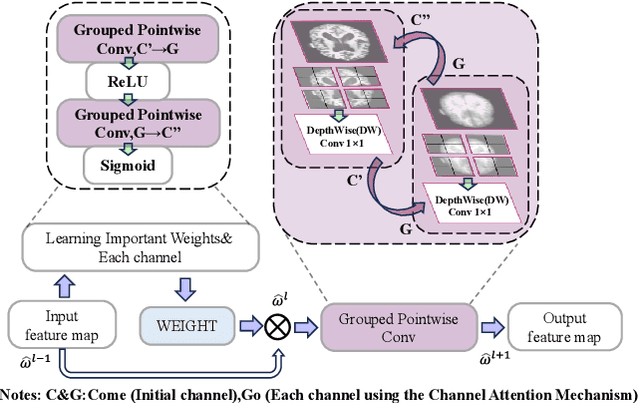
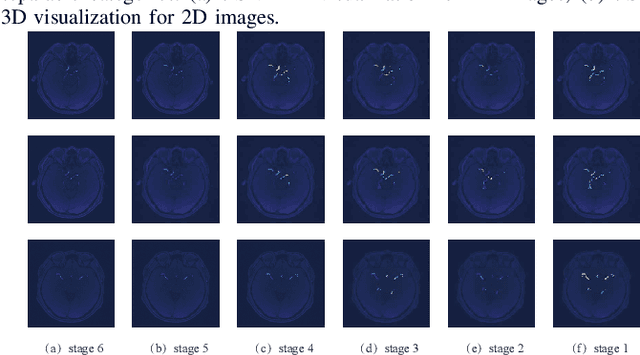
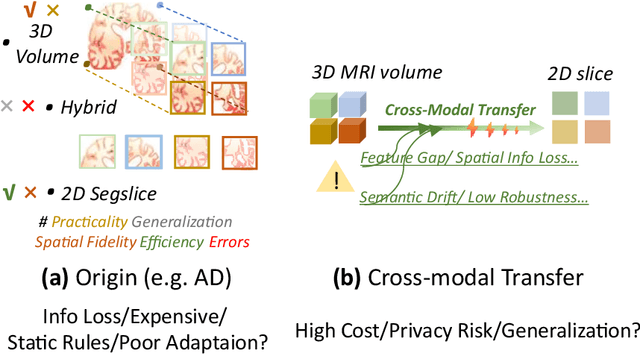
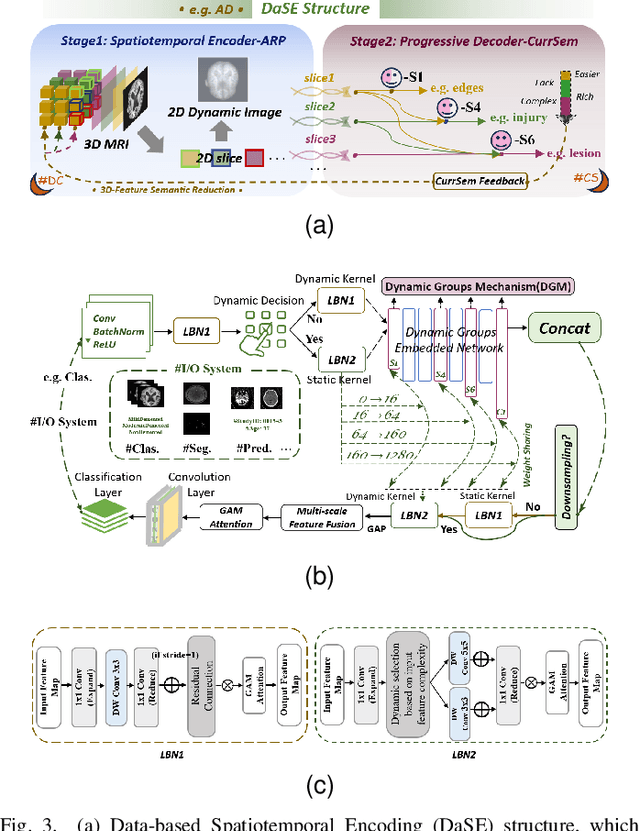
High-dimensional neuroimaging analyses for clinical diagnosis are often constrained by compromises in spatiotemporal fidelity and by the limited adaptability of large-scale, general-purpose models. To address these challenges, we introduce Dynamic Curriculum Learning for Spatiotemporal Encoding (DCL-SE), an end-to-end framework centered on data-driven spatiotemporal encoding (DaSE). We leverage Approximate Rank Pooling (ARP) to efficiently encode three-dimensional volumetric brain data into information-rich, two-dimensional dynamic representations, and then employ a dynamic curriculum learning strategy, guided by a Dynamic Group Mechanism (DGM), to progressively train the decoder, refining feature extraction from global anatomical structures to fine pathological details. Evaluated across six publicly available datasets, including Alzheimer's disease and brain tumor classification, cerebral artery segmentation, and brain age prediction, DCL-SE consistently outperforms existing methods in accuracy, robustness, and interpretability. These findings underscore the critical importance of compact, task-specific architectures in the era of large-scale pretrained networks.