 Add to Chrome
 Add to Firefox
 Add to Edge
Searth Transformer: A Transformer Architecture Incorporating Earth's Geospheric Physical Priors for Global Mid-Range Weather Forecasting
Jan 14, 2026
Accurate global medium-range weather forecasting is fundamental to Earth system science. Most existing Transformer-based forecasting models adopt vision-centric architectures that neglect the Earth's spherical geometry and zonal periodicity. In addition, conventional autoregressive training is computationally expensive and limits forecast horizons due to error accumulation. To address these challenges, we propose the Shifted Earth Transformer (Searth Transformer), a physics-informed architecture that incorporates zonal periodicity and meridional boundaries into window-based self-attention for physically consistent global information exchange. We further introduce a Relay Autoregressive (RAR) fine-tuning strategy that enables learning long-range atmospheric evolution under constrained memory and computational budgets. Based on these methods, we develop YanTian, a global medium-range weather forecasting model. YanTian achieves higher accuracy than the high-resolution forecast of the European Centre for Medium-Range Weather Forecasts and performs competitively with state-of-the-art AI models at one-degree resolution, while requiring roughly 200 times lower computational cost than standard autoregressive fine-tuning. Furthermore, YanTian attains a longer skillful forecast lead time for Z500 (10.3 days) than HRES (9 days). Beyond weather forecasting, this work establishes a robust algorithmic foundation for predictive modeling of complex global-scale geophysical circulation systems, offering new pathways for Earth system science.

YanTian: An Application Platform for AI Global Weather Forecasting Models
Oct 06, 2024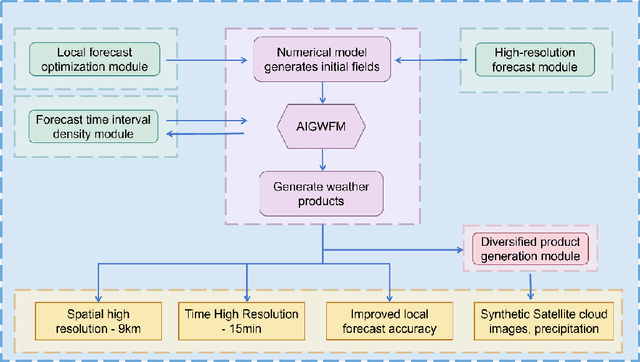
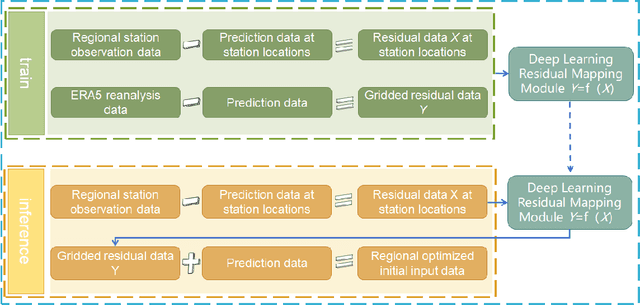

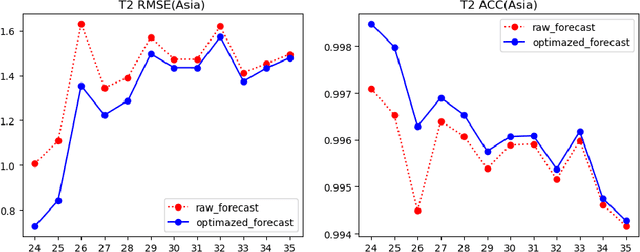
To promote the practical application of AI Global Weather Forecasting Models (AIGWFM), we have developed an adaptable application platform named 'YanTian'. This platform enhances existing open-source AIGWFM with a suite of capability-enhancing modules and is constructed by a "loosely coupled" plug-in architecture. The goal of 'YanTian' is to address the limitations of current open-source AIGWFM in operational application, including improving local forecast accuracy, providing spatial high-resolution forecasts, increasing density of forecast intervals, and generating diverse products with the provision of AIGC capabilities. 'YianTian' also provides a simple, visualized user interface, allowing meteorologists easily access both basic and extended capabilities of the platform by simply configuring the platform UI. Users do not need to possess the complex artificial intelligence knowledge and the coding techniques. Additionally, 'YianTian' can be deployed on a PC with GPUs. We hope 'YianTian' can facilitate the operational widespread adoption of AIGWFMs.
Interpretable Machine Learning for Weather and Climate Prediction: A Survey
Mar 24, 2024
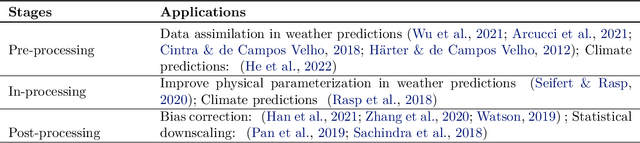
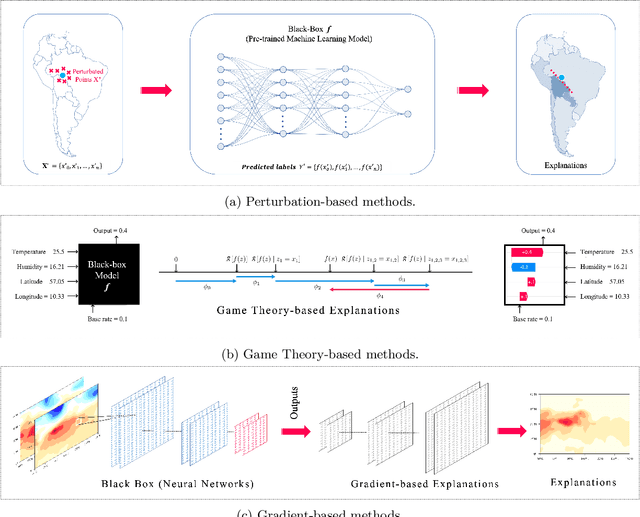
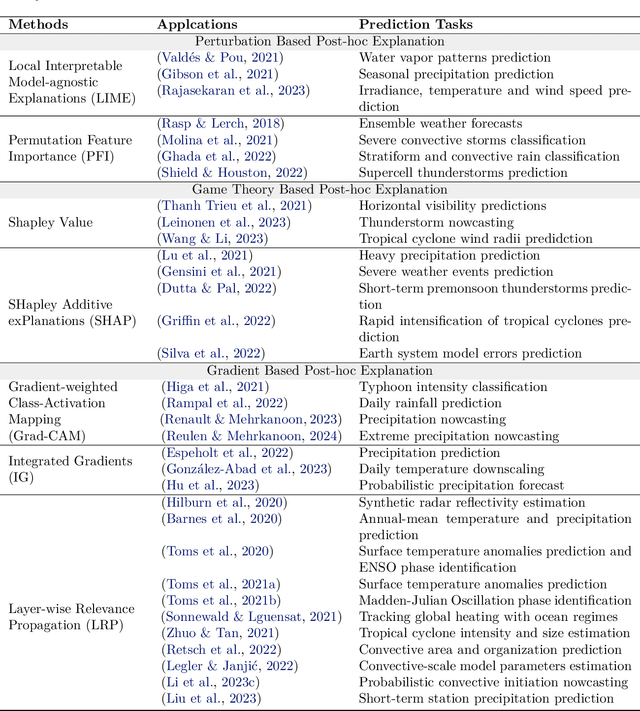
Advanced machine learning models have recently achieved high predictive accuracy for weather and climate prediction. However, these complex models often lack inherent transparency and interpretability, acting as "black boxes" that impede user trust and hinder further model improvements. As such, interpretable machine learning techniques have become crucial in enhancing the credibility and utility of weather and climate modeling. In this survey, we review current interpretable machine learning approaches applied to meteorological predictions. We categorize methods into two major paradigms: 1) Post-hoc interpretability techniques that explain pre-trained models, such as perturbation-based, game theory based, and gradient-based attribution methods. 2) Designing inherently interpretable models from scratch using architectures like tree ensembles and explainable neural networks. We summarize how each technique provides insights into the predictions, uncovering novel meteorological relationships captured by machine learning. Lastly, we discuss research challenges around achieving deeper mechanistic interpretations aligned with physical principles, developing standardized evaluation benchmarks, integrating interpretability into iterative model development workflows, and providing explainability for large foundation models.
The Compatibility between the Pangu Weather Forecasting Model and Meteorological Operational Data
Aug 07, 2023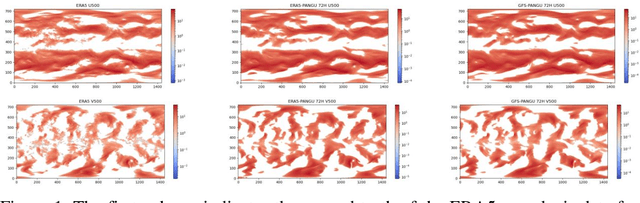
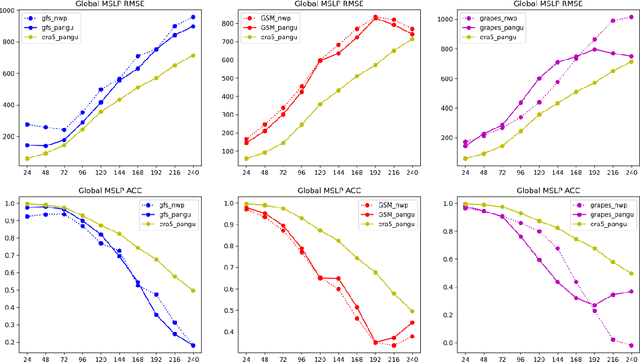
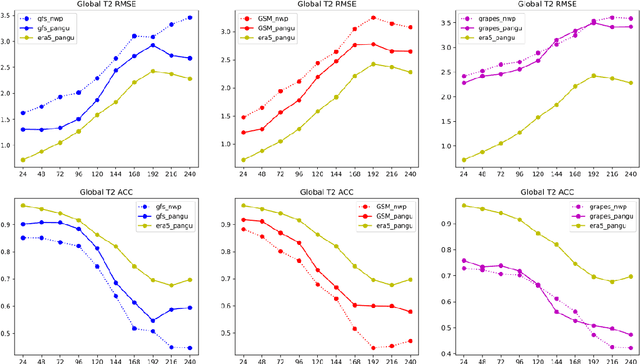
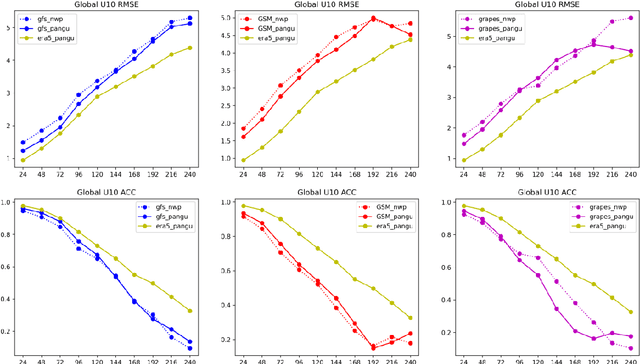
Recently, multiple data-driven models based on machine learning for weather forecasting have emerged. These models are highly competitive in terms of accuracy compared to traditional numerical weather prediction (NWP) systems. In particular, the Pangu-Weather model, which is open source for non-commercial use, has been validated for its forecasting performance by the European Centre for Medium-Range Weather Forecasts (ECMWF) and has recently been published in the journal "Nature". In this paper, we evaluate the compatibility of the Pangu-Weather model with several commonly used NWP operational analyses through case studies. The results indicate that the Pangu-Weather model is compatible with different operational analyses from various NWP systems as the model initial conditions, and it exhibits a relatively stable forecasting capability. Furthermore, we have verified that improving the quality of global or local initial conditions significantly contributes to enhancing the forecasting performance of the Pangu-Weather model.