 Add to Chrome
 Add to Firefox
 Add to Edge
Do Emotions in Prompts Matter? Effects of Emotional Framing on Large Language Models
Apr 02, 2026
Emotional tone is pervasive in human communication, yet its influence on large language model (LLM) behaviour remains unclear. Here, we examine how first-person emotional framing in user-side queries affect LLM performance across six benchmark domains, including mathematical reasoning, medical question answering, reading comprehension, commonsense reasoning and social inference. Across models and tasks, static emotional prefixes usually produce only small changes in accuracy, suggesting that affective phrasing is typically a mild perturbation rather than a reliable general-purpose intervention. This stability is not uniform: effects are more variable in socially grounded tasks, where emotional context more plausibly interacts with interpersonal reasoning. Additional analyses show that stronger emotional wording induces only modest extra change, and that human-written prefixes reproduce the same qualitative pattern as LLM-generated ones. We then introduce EmotionRL, an adaptive emotional prompting framework that selects emotional framing adaptively for each query. Although no single emotion is consistently beneficial, adaptive selection yields more reliable gains than fixed emotional prompting. Together, these findings show that emotional tone is neither a dominant driver of LLM performance nor irrelevant noise, but a weak and input-dependent signal that can be exploited through adaptive control.

LLM Review: Enhancing Creative Writing via Blind Peer Review Feedback
Jan 12, 2026Large Language Models (LLMs) often struggle with creative generation, and multi-agent frameworks that improve reasoning through interaction can paradoxically hinder creativity by inducing content homogenization. We introduce LLM Review, a peer-review-inspired framework implementing Blind Peer Review: agents exchange targeted feedback while revising independently, preserving divergent creative trajectories. To enable rigorous evaluation, we propose SciFi-100, a science fiction writing dataset with a unified framework combining LLM-as-a-judge scoring, human annotation, and rule-based novelty metrics. Experiments demonstrate that LLM Review consistently outperforms multi-agent baselines, and smaller models with our framework can surpass larger single-agent models, suggesting interaction structure may substitute for model scale.
Interpretable Machine Learning for Weather and Climate Prediction: A Survey
Mar 24, 2024
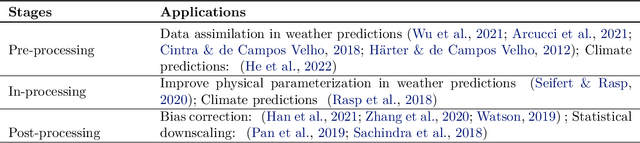
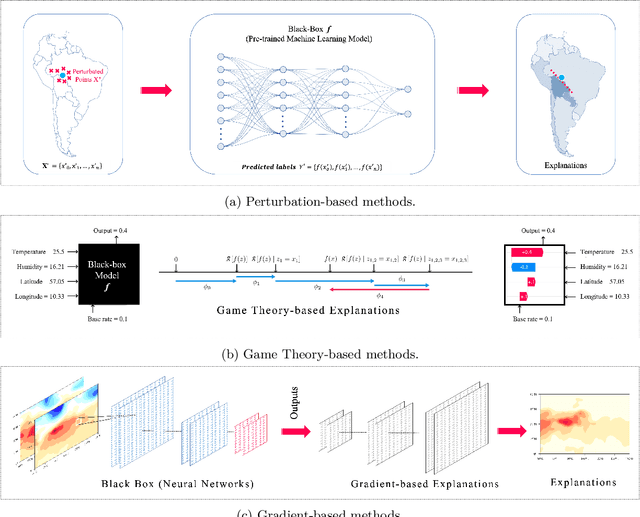
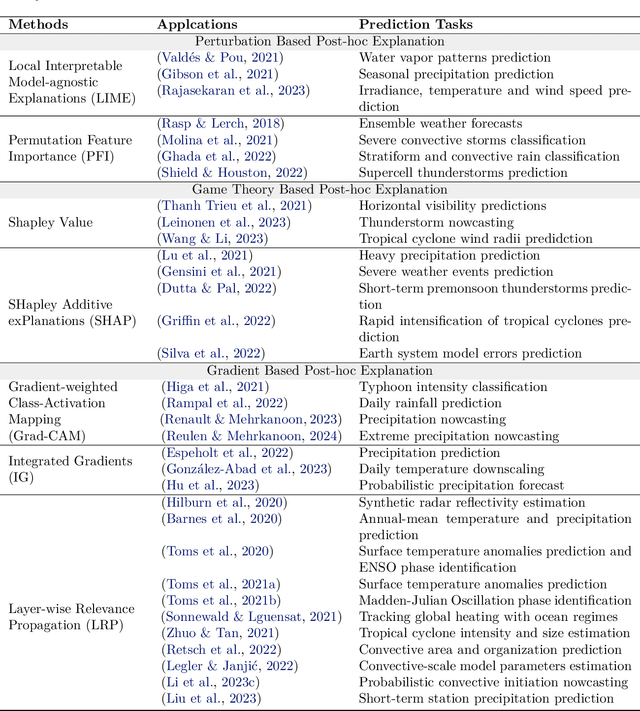
Advanced machine learning models have recently achieved high predictive accuracy for weather and climate prediction. However, these complex models often lack inherent transparency and interpretability, acting as "black boxes" that impede user trust and hinder further model improvements. As such, interpretable machine learning techniques have become crucial in enhancing the credibility and utility of weather and climate modeling. In this survey, we review current interpretable machine learning approaches applied to meteorological predictions. We categorize methods into two major paradigms: 1) Post-hoc interpretability techniques that explain pre-trained models, such as perturbation-based, game theory based, and gradient-based attribution methods. 2) Designing inherently interpretable models from scratch using architectures like tree ensembles and explainable neural networks. We summarize how each technique provides insights into the predictions, uncovering novel meteorological relationships captured by machine learning. Lastly, we discuss research challenges around achieving deeper mechanistic interpretations aligned with physical principles, developing standardized evaluation benchmarks, integrating interpretability into iterative model development workflows, and providing explainability for large foundation models.