 Add to Chrome
 Add to Firefox
 Add to Edge
MOSAIC: Composable Safety Alignment with Modular Control Tokens
Mar 17, 2026
Safety alignment in large language models (LLMs) is commonly implemented as a single static policy embedded in model parameters. However, real-world deployments often require context-dependent safety rules that vary across users, regions, and applications. Existing approaches struggle to provide such conditional control: parameter-level alignment entangles safety behaviors with general capabilities, while prompt-based methods rely on natural language instructions that provide weak enforcement. We propose MOSAIC, a modular framework that enables compositional safety alignment through learnable control tokens optimized over a frozen backbone model. Each token represents a safety constraint and can be flexibly activated and composed at inference time. To train compositional tokens efficiently, we introduce order-based task sampling and a distribution-level alignment objective that mitigates over-refusal. Experiments show that MOSAIC achieves strong defense performance with substantially lower over-refusal while preserving model utility.

How to Utilize Complementary Vision-Text Information for 2D Structure Understanding
Mar 17, 2026LLMs typically linearize 2D tables into 1D sequences to fit their autoregressive architecture, which weakens row-column adjacency and other layout cues. In contrast, purely visual encoders can capture spatial cues, yet often struggle to preserve exact cell text. Our analysis reveals that these two modalities provide highly distinct information to LLMs and exhibit strong complementarity. However, direct concatenation and other fusion methods yield limited gains and frequently introduce cross-modal interference. To address this issue, we propose DiVA-Former, a lightweight architecture designed to effectively integrate vision and text information. DiVA-Former leverages visual tokens as dynamic queries to distill long textual sequences into digest vectors, thereby effectively exploiting complementary vision--text information. Evaluated across 13 table benchmarks, DiVA-Former improves upon the pure-text baseline by 23.9\% and achieves consistent gains over existing baselines using visual inputs, textual inputs, or a combination of both.
Enhancing Cross-View UAV Geolocalization via LVLM-Driven Relational Modeling
Mar 09, 2026The primary objective of cross-view UAV geolocalization is to identify the exact spatial coordinates of drone-captured imagery by aligning it with extensive, geo-referenced satellite databases. Current approaches typically extract features independently from each perspective and rely on basic heuristics to compute similarity, thereby failing to explicitly capture the essential interactions between different views. To address this limitation, we introduce a novel, plug-and-play ranking architecture designed to explicitly perform joint relational modeling for improved UAV-to-satellite image matching. By harnessing the capabilities of a Large Vision-Language Model (LVLM), our framework effectively learns the deep visual-semantic correlations linking UAV and satellite imagery. Furthermore, we present a novel relational-aware loss function to optimize the training phase. By employing soft labels, this loss provides fine-grained supervision that avoids overly penalizing near-positive matches, ultimately boosting both the model's discriminative power and training stability. Comprehensive evaluations across various baseline architectures and standard benchmarks reveal that the proposed method substantially boosts the retrieval accuracy of existing models, yielding superior performance even under highly demanding conditions.
Threshold Filtering Packing for Supervised Fine-Tuning: Training Related Samples within Packs
Aug 18, 2024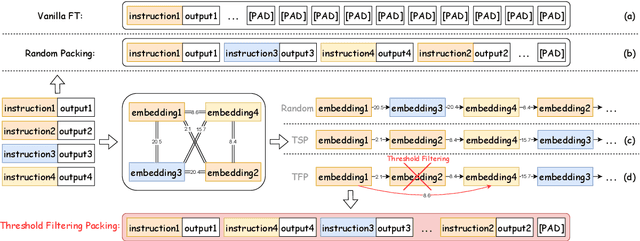
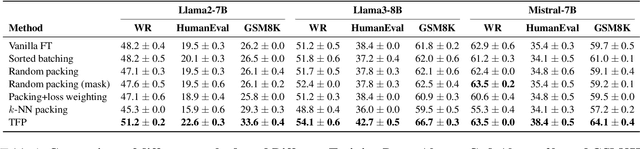
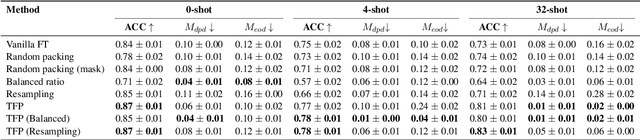
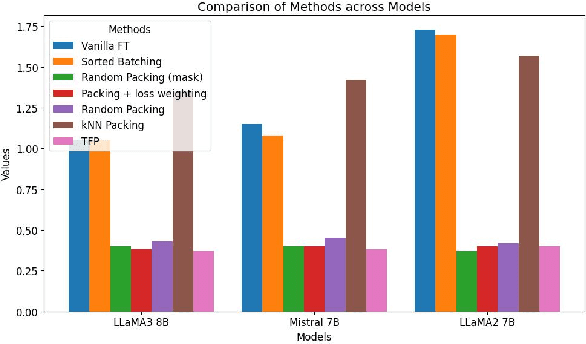
Packing for Supervised Fine-Tuning (SFT) in autoregressive models involves concatenating data points of varying lengths until reaching the designed maximum length to facilitate GPU processing. However, randomly concatenating data points and feeding them into an autoregressive transformer can lead to cross-contamination of sequences due to the significant difference in their subject matter. The mainstream approaches in SFT ensure that each token in the attention calculation phase only focuses on tokens within its own short sequence, without providing additional learning signals for the preceding context. To address these challenges, we introduce Threshold Filtering Packing (TFP), a method that selects samples with related context while maintaining sufficient diversity within the same pack. Our experiments show that TFP offers a simple-to-implement and scalable approach that significantly enhances SFT performance, with observed improvements of up to 7\% on GSM8K, 4\% on HumanEval, and 15\% on the adult-census-income dataset.