 Add to Chrome
 Add to Firefox
 Add to Edge
DynamicPTQ: Mitigating Activation Quantization Collapse via Residual-Stream Dynamics
Jun 10, 2026
Post-training quantization (PTQ) is essential for efficient large language model inference, but reliably quantizing activations remains challenging when weights, activations, and KV caches are all quantized to 4-bit precision. A key difficulty lies in massive activations, whose extreme values dominate the activation range and amplify quantization errors. State-of-the-art methods mainly mitigate massive activations through transformation-based smoothing, such as orthogonal rotations and affine scaling, but overlook the cross-layer dynamics of the residual stream. In this paper, we show that massive activations emerge and disappear in a phase-wise pattern across network depth, triggering large residual changes. These changes cause newly injected layer-wise updates to dominate the 4-bit quantization scale and weaken historical residual information. To characterize this behavior, we introduce Jump Ratio and Historical Feature SNR. This suggests that static transformation-based smoothing cannot fully resolve dynamic quantization instability caused by cross-layer residual changes. Based on this analysis, we propose DynamicPTQ, a Dynamic Post-Training Quantization policy for phase-aware mixed-precision activation quantization. DynamicPTQ identifies quantization-sensitive layers from residual-stream dynamics and assigns 8-bit activation precision only to these layers, while keeping weights, KV caches, and other activations in 4-bit precision. It can be directly integrated with strong PTQ baselines such as QuaRot, SpinQuant, and FlatQuant. Experiments on LLaMA-2 and LLaMA-3 show that DynamicPTQ consistently improves perplexity and zero-shot QA performance under W4A4KV4 quantization, while achieving 1.05 to 1.07 times throughput improvement with modest memory overhead. These results demonstrate a practical path toward robust low-bit LLM inference.

Enhancing Cross-View UAV Geolocalization via LVLM-Driven Relational Modeling
Mar 09, 2026The primary objective of cross-view UAV geolocalization is to identify the exact spatial coordinates of drone-captured imagery by aligning it with extensive, geo-referenced satellite databases. Current approaches typically extract features independently from each perspective and rely on basic heuristics to compute similarity, thereby failing to explicitly capture the essential interactions between different views. To address this limitation, we introduce a novel, plug-and-play ranking architecture designed to explicitly perform joint relational modeling for improved UAV-to-satellite image matching. By harnessing the capabilities of a Large Vision-Language Model (LVLM), our framework effectively learns the deep visual-semantic correlations linking UAV and satellite imagery. Furthermore, we present a novel relational-aware loss function to optimize the training phase. By employing soft labels, this loss provides fine-grained supervision that avoids overly penalizing near-positive matches, ultimately boosting both the model's discriminative power and training stability. Comprehensive evaluations across various baseline architectures and standard benchmarks reveal that the proposed method substantially boosts the retrieval accuracy of existing models, yielding superior performance even under highly demanding conditions.
GloPath: An Entity-Centric Foundation Model for Glomerular Lesion Assessment and Clinicopathological Insights
Mar 03, 2026Glomerular pathology is central to the diagnosis and prognosis of renal diseases, yet the heterogeneity of glomerular morphology and fine-grained lesion patterns remain challenging for current AI approaches. We present GloPath, an entity-centric foundation model trained on over one million glomeruli extracted from 14,049 renal biopsy specimens using multi-scale and multi-view self-supervised learning. GloPath addresses two major challenges in nephropathology: glomerular lesion assessment and clinicopathological insights discovery. For lesion assessment, GloPath was benchmarked across three independent cohorts on 52 tasks, including lesion recognition, grading, few-shot classification, and cross-modality diagnosis-outperforming state-of-the-art methods in 42 tasks (80.8%). In the large-scale real-world study, it achieved an ROC-AUC of 91.51% for lesion recognition, demonstrating strong robustness in routine clinical settings. For clinicopathological insights, GloPath systematically revealed statistically significant associations between glomerular morphological parameters and clinical indicators across 224 morphology-clinical variable pairs, demonstrating its capacity to connect tissue-level pathology with patient-level outcomes. Together, these results position GloPath as a scalable and interpretable platform for glomerular lesion assessment and clinicopathological discovery, representing a step toward clinically translatable AI in renal pathology.
Unlocking adaptive digital pathology through dynamic feature learning
Dec 29, 2024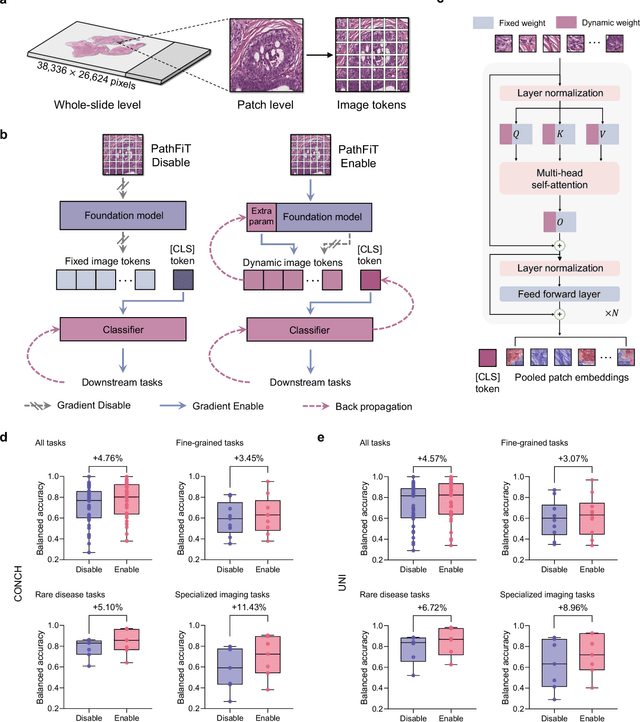
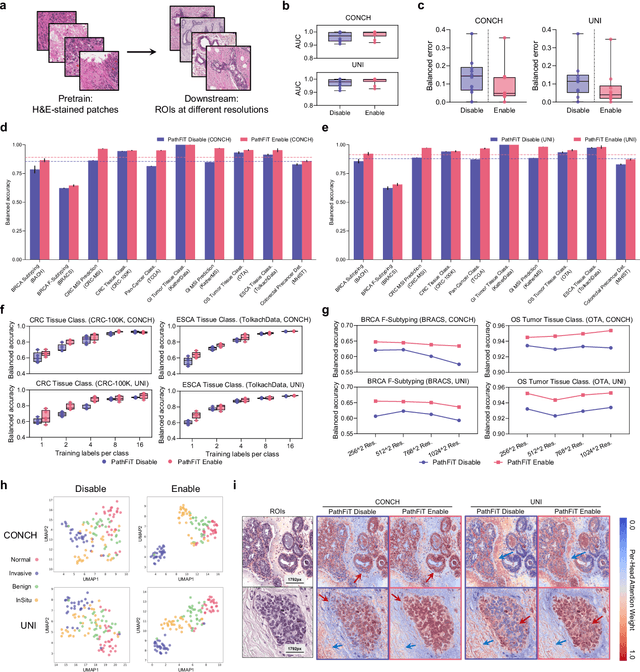
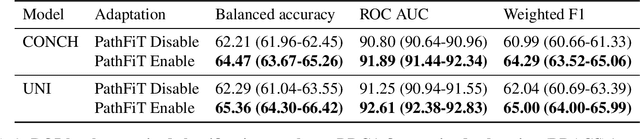
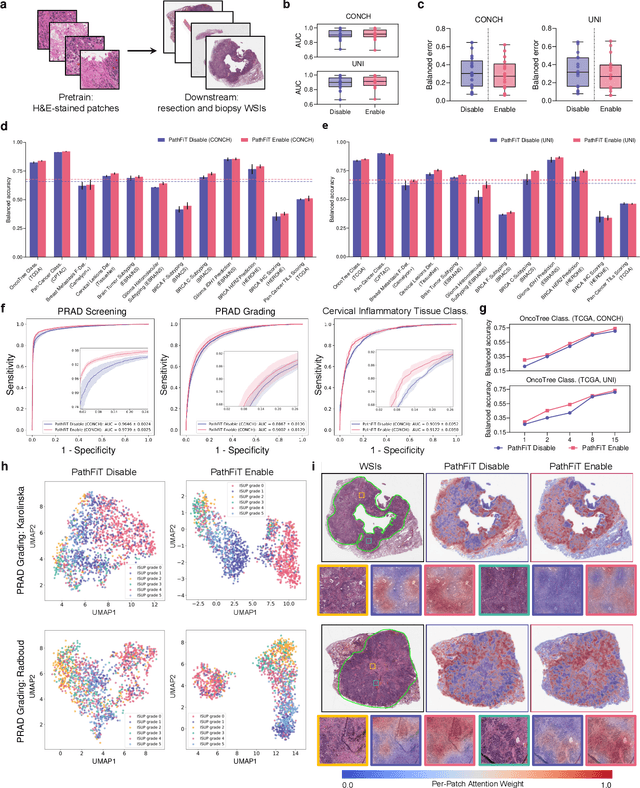
Foundation models have revolutionized the paradigm of digital pathology, as they leverage general-purpose features to emulate real-world pathological practices, enabling the quantitative analysis of critical histological patterns and the dissection of cancer-specific signals. However, these static general features constrain the flexibility and pathological relevance in the ever-evolving needs of clinical applications, hindering the broad use of the current models. Here we introduce PathFiT, a dynamic feature learning method that can be effortlessly plugged into various pathology foundation models to unlock their adaptability. Meanwhile, PathFiT performs seamless implementation across diverse pathology applications regardless of downstream specificity. To validate PathFiT, we construct a digital pathology benchmark with over 20 terabytes of Internet and real-world data comprising 28 H\&E-stained tasks and 7 specialized imaging tasks including Masson's Trichrome staining and immunofluorescence images. By applying PathFiT to the representative pathology foundation models, we demonstrate state-of-the-art performance on 34 out of 35 tasks, with significant improvements on 23 tasks and outperforming by 10.20% on specialized imaging tasks. The superior performance and versatility of PathFiT open up new avenues in computational pathology.