 Add to Chrome
 Add to Firefox
 Add to Edge
PHASE-Tree: Modeling Character-State Evolution in Long-Horizon Role-Playing Dialogue
Aug 07, 2026
Long-horizon role-playing demands that characters remain recognizable as they evolve with the narrative. Yet existing work falls short on two fronts: representations are typically static profiles that cannot be updated locally without destabilizing unchanged traits, and benchmarks mainly test persona preservation and memory recall rather than whether a model speaks from a character's currently evolved state. We address both. PHASE-Tree is a multi-timescale character-state tree with an immutable identity root and mutable persona, session, and moment layers, making each mutable field an addressable target for localized within- and cross-episode updates. It conditions generation through explicit textual provision or implicit parametric adaptation. To measure evolved-state generation, we introduce LongEvoRoleBench, which pairs four long-dialogue corpora for cross-episode evolution with four short-dialogue corpora as within-scene state-tracking checks, under a unified next-utterance protocol. On the long-dialogue core, textual PHASE-Tree ranks first in 11 of 12 dataset-metric cells against internal variants and all 12 cells against external textual baselines, improving character-level, semantic, and embedding scores by 19.7%, 12.4%, and 15.1% respectively. In a blinded 200-response study, human ratings correlate with the GPT-4.1 judge (Pearson r= 0.65); on descriptive n= 10 PT and NR prompt subsets, the Overall difference is +0.20. The long-dialogue Sem advantage persists across LLM judges and generation backbones.

SkillSmith: Learning to Compose Parametric Skills and Textual Knowledge
Jul 29, 2026Agentic systems driven by large language models (LLMs) regularly feature two key mechanisms to autonomously solve complex problems: synthesizing text-based knowledge and procedures from past experiences and building parametric (weight-space) skill libraries for recurring sub-goals. To date, research has largely treated these as orthogonal pursuits: either organizing textual knowledge through composition and reflection, or consolidating parametric skills via weight-space merging. Consequently, the seamless integration of text and model weights for targeted performance improvements remains largely unexplored. This work bridges this modality gap by treating model weights as an additional modality that an LLM can natively reason over. We instantiate parametric learning via prefix-tuning and augment an LLM to ingest both prefix weights and rich textual data which capture relationships to a target capability. Our augmented LLM, which we call SkillSmith, synthesizes these inputs to perform instruction-steered parametric synthesis, directly outputting new prefix weights that manifest the target skill. We demonstrate that our approach significantly outperforms both text-only and weight-space-only baselines, unlocking performance gains that are out of reach for uni-modal (text-only or weight-only) adaptations.
Context Training with Active Information Seeking
May 14, 2026Most existing large language models (LLMs) are expensive to adapt after deployment, especially when a task requires newly produced information or niche domain knowledge. Recent work has shown that, by manipulating and optimizing their context, LLMs can be tailored to downstream tasks without updating their weights. However, most existing methods remain closed-loop, relying solely on the model's intrinsic knowledge. In this paper, we equip these context optimizers with Wikipedia search and browser tools for active information seeking. We show that naively adding these tools to a standard sequential context optimization pipeline can actually degrade performance compared to baselines. However, when paired with a search-based training procedure that maintains and prunes multiple candidate contexts, active information seeking delivers consistent and substantial gains. We demonstrate these improvements across diverse domains, including low-resource translation (Flores+), health scenarios (HealthBench), and reasoning-heavy tasks (LiveCodeBench and Humanity's Last Exam). Furthermore, our method proves to be data-efficient, robust across different hyperparameters, and capable of generating effective textual contexts that generalize well across different models.
MemReranker: Reasoning-Aware Reranking for Agent Memory Retrieval
May 07, 2026In agent memory systems, the reranking model serves as the critical bridge connecting user queries with long-term memory. Most systems adopt the "retrieve-then-rerank" two-stage paradigm, but generic reranking models rely on semantic similarity matching and lack genuine reasoning capabilities, leading to a problem where recalled results are semantically highly relevant yet do not contain the key information needed to answer the question. This deficiency manifests in memory scenarios as three specific problems. First, relevance scores are miscalibrated, making threshold-based filtering difficult. Second, ranking degrades when facing temporal constraints, causal reasoning, and other complex queries. Third, the model cannot leverage dialogue context for semantic disambiguation. This report introduces MemReranker, a reranking model family (0.6B/4B) built on Qwen3-Reranker through multi-stage LLM knowledge distillation. Multi-teacher pairwise comparisons generate calibrated soft labels, BCE pointwise distillation establishes well-distributed scores, and InfoNCE contrastive learning enhances hard-sample discrimination. Training data combines general corpora with memory-specific multi-turn dialogue data covering temporal constraints, causal reasoning, and coreference resolution. On the memory retrieval benchmark, MemReranker-0.6B substantially outperforms BGE-Reranker and matches open-source 4B/8B models as well as GPT-4o-mini on key metrics. MemReranker-4B further achieves 0.737 MAP, with several metrics on par with Gemini-3-Flash, while maintaining inference latency at only 10--20\% of large models. On finance and healthcare vertical-domain benchmarks, the models preserve generalization capabilities on par with mainstream large-parameter rerankers.
Transparentize the Internal and External Knowledge Utilization in LLMs with Trustworthy Citation
Apr 21, 2025While hallucinations of large language models could been alleviated through retrieval-augmented generation and citation generation, how the model utilizes internal knowledge is still opaque, and the trustworthiness of its generated answers remains questionable. In this work, we introduce Context-Prior Augmented Citation Generation task, requiring models to generate citations considering both external and internal knowledge while providing trustworthy references, with 5 evaluation metrics focusing on 3 aspects: answer helpfulness, citation faithfulness, and trustworthiness. We introduce RAEL, the paradigm for our task, and also design INTRALIGN, an integrated method containing customary data generation and an alignment algorithm. Our experimental results show that our method achieves a better cross-scenario performance with regard to other baselines. Our extended experiments further reveal that retrieval quality, question types, and model knowledge have considerable influence on the trustworthiness in citation generation.
Streaming DiLoCo with overlapping communication: Towards a Distributed Free Lunch
Jan 30, 2025Training of large language models (LLMs) is typically distributed across a large number of accelerators to reduce training time. Since internal states and parameter gradients need to be exchanged at each and every single gradient step, all devices need to be co-located using low-latency high-bandwidth communication links to support the required high volume of exchanged bits. Recently, distributed algorithms like DiLoCo have relaxed such co-location constraint: accelerators can be grouped into ``workers'', where synchronizations between workers only occur infrequently. This in turn means that workers can afford being connected by lower bandwidth communication links without affecting learning quality. However, in these methods, communication across workers still requires the same peak bandwidth as before, as the synchronizations require all parameters to be exchanged across all workers. In this paper, we improve DiLoCo in three ways. First, we synchronize only subsets of parameters in sequence, rather than all at once, which greatly reduces peak bandwidth. Second, we allow workers to continue training while synchronizing, which decreases wall clock time. Third, we quantize the data exchanged by workers, which further reduces bandwidth across workers. By properly combining these modifications, we show experimentally that we can distribute training of billion-scale parameters and reach similar quality as before, but reducing required bandwidth by two orders of magnitude.
Citekit: A Modular Toolkit for Large Language Model Citation Generation
Aug 06, 2024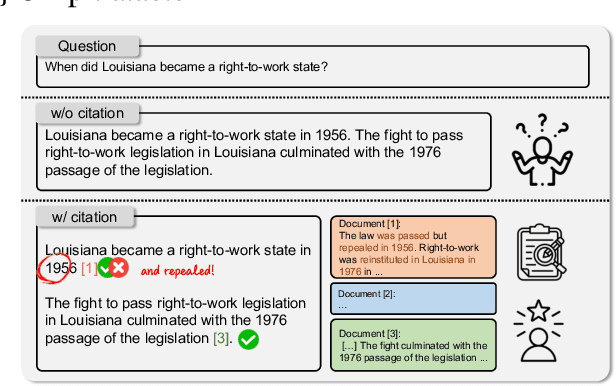
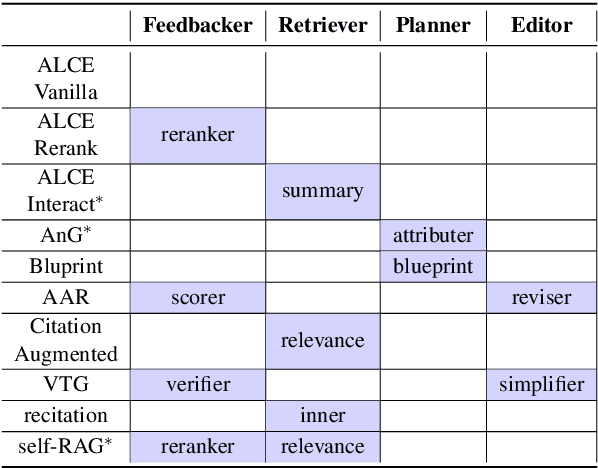
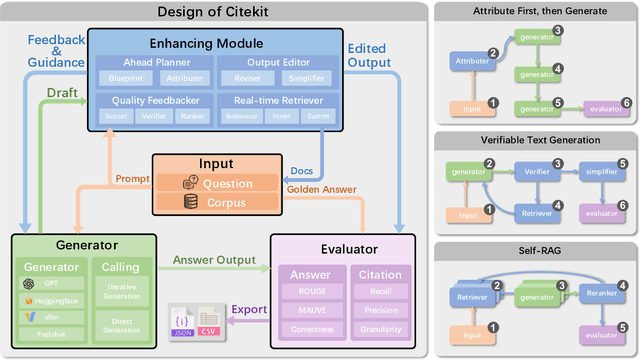
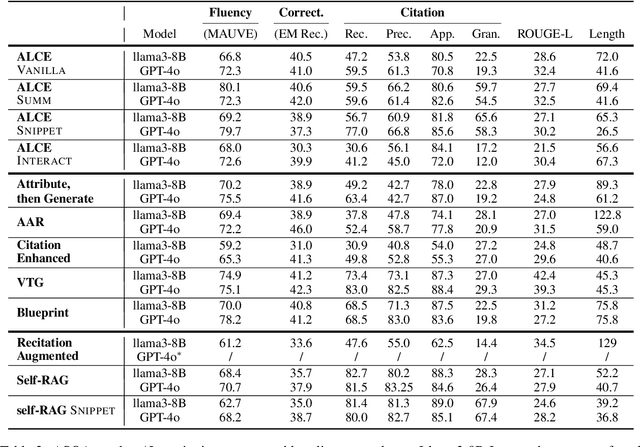
Enabling Large Language Models (LLMs) to generate citations in Question-Answering (QA) tasks is an emerging paradigm aimed at enhancing the verifiability of their responses when LLMs are utilizing external references to generate an answer. However, there is currently no unified framework to standardize and fairly compare different citation generation methods, leading to difficulties in reproducing different methods and a comprehensive assessment. To cope with the problems above, we introduce \name, an open-source and modular toolkit designed to facilitate the implementation and evaluation of existing citation generation methods, while also fostering the development of new approaches to improve citation quality in LLM outputs. This tool is highly extensible, allowing users to utilize 4 main modules and 14 components to construct a pipeline, evaluating an existing method or innovative designs. Our experiments with two state-of-the-art LLMs and 11 citation generation baselines demonstrate varying strengths of different modules in answer accuracy and citation quality improvement, as well as the challenge of enhancing granularity. Based on our analysis of the effectiveness of components, we propose a new method, self-RAG \snippet, obtaining a balanced answer accuracy and citation quality. Citekit is released at https://github.com/SjJ1017/Citekit.
DiPaCo: Distributed Path Composition
Mar 15, 2024Progress in machine learning (ML) has been fueled by scaling neural network models. This scaling has been enabled by ever more heroic feats of engineering, necessary for accommodating ML approaches that require high bandwidth communication between devices working in parallel. In this work, we propose a co-designed modular architecture and training approach for ML models, dubbed DIstributed PAth COmposition (DiPaCo). During training, DiPaCo distributes computation by paths through a set of shared modules. Together with a Local-SGD inspired optimization (DiLoCo) that keeps modules in sync with drastically reduced communication, Our approach facilitates training across poorly connected and heterogeneous workers, with a design that ensures robustness to worker failures and preemptions. At inference time, only a single path needs to be executed for each input, without the need for any model compression. We consider this approach as a first prototype towards a new paradigm of large-scale learning, one that is less synchronous and more modular. Our experiments on the widely used C4 benchmark show that, for the same amount of training steps but less wall-clock time, DiPaCo exceeds the performance of a 1 billion-parameter dense transformer language model by choosing one of 256 possible paths, each with a size of 150 million parameters.
Exploring Federated Self-Supervised Learning for General Purpose Audio Understanding
Feb 05, 2024The integration of Federated Learning (FL) and Self-supervised Learning (SSL) offers a unique and synergetic combination to exploit the audio data for general-purpose audio understanding, without compromising user data privacy. However, rare efforts have been made to investigate the SSL models in the FL regime for general-purpose audio understanding, especially when the training data is generated by large-scale heterogeneous audio sources. In this paper, we evaluate the performance of feature-matching and predictive audio-SSL techniques when integrated into large-scale FL settings simulated with non-independently identically distributed (non-iid) data. We propose a novel Federated SSL (F-SSL) framework, dubbed FASSL, that enables learning intermediate feature representations from large-scale decentralized heterogeneous clients, holding unlabelled audio data. Our study has found that audio F-SSL approaches perform on par with the centralized audio-SSL approaches on the audio-retrieval task. Extensive experiments demonstrate the effectiveness and significance of FASSL as it assists in obtaining the optimal global model for state-of-the-art FL aggregation methods.
Asynchronous Local-SGD Training for Language Modeling
Jan 17, 2024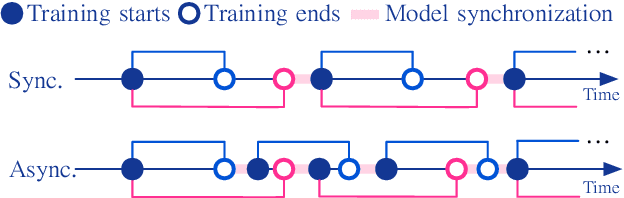


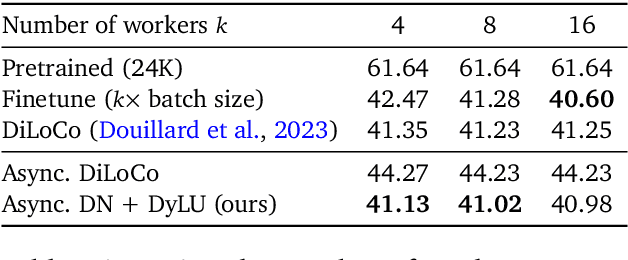
Local stochastic gradient descent (Local-SGD), also referred to as federated averaging, is an approach to distributed optimization where each device performs more than one SGD update per communication. This work presents an empirical study of {\it asynchronous} Local-SGD for training language models; that is, each worker updates the global parameters as soon as it has finished its SGD steps. We conduct a comprehensive investigation by examining how worker hardware heterogeneity, model size, number of workers, and optimizer could impact the learning performance. We find that with naive implementations, asynchronous Local-SGD takes more iterations to converge than its synchronous counterpart despite updating the (global) model parameters more frequently. We identify momentum acceleration on the global parameters when worker gradients are stale as a key challenge. We propose a novel method that utilizes a delayed Nesterov momentum update and adjusts the workers' local training steps based on their computation speed. This approach, evaluated with models up to 150M parameters on the C4 dataset, matches the performance of synchronous Local-SGD in terms of perplexity per update step, and significantly surpasses it in terms of wall clock time.