 Add to Chrome
 Add to Firefox
 Add to Edge
Decoupled DiLoCo for Resilient Distributed Pre-training
Apr 23, 2026
Modern large-scale language model pre-training relies heavily on the single program multiple data (SPMD) paradigm, which requires tight coupling across accelerators. Due to this coupling, transient slowdowns, hardware failures, and synchronization overhead stall the entire computation, wasting significant compute time at scale. While recent distributed methods like DiLoCo reduced communication bandwidth, they remained fundamentally synchronous and vulnerable to these system stalls. To address this, we introduce Decoupled DiLoCo, an evolution of the DiLoCo framework designed to break the lock-step synchronization barrier and go beyond SPMD to maximize training goodput. Decoupled DiLoCo partitions compute across multiple independent ``learners'' that execute local inner optimization steps. These learners asynchronously communicate parameter fragments to a central synchronizer, which circumvents failed or straggling learners by aggregating updates using a minimum quorum, an adaptive grace window, and dynamic token-weighted merging. Inspired by ``chaos engineering'', we achieve significantly improved training efficiency in failure-prone environments with millions of simulated chips with strictly zero global downtime, while maintaining competitive model performance across text and vision tasks, for both dense and mixture-of-expert architectures.

DiPaCo: Distributed Path Composition
Mar 15, 2024Progress in machine learning (ML) has been fueled by scaling neural network models. This scaling has been enabled by ever more heroic feats of engineering, necessary for accommodating ML approaches that require high bandwidth communication between devices working in parallel. In this work, we propose a co-designed modular architecture and training approach for ML models, dubbed DIstributed PAth COmposition (DiPaCo). During training, DiPaCo distributes computation by paths through a set of shared modules. Together with a Local-SGD inspired optimization (DiLoCo) that keeps modules in sync with drastically reduced communication, Our approach facilitates training across poorly connected and heterogeneous workers, with a design that ensures robustness to worker failures and preemptions. At inference time, only a single path needs to be executed for each input, without the need for any model compression. We consider this approach as a first prototype towards a new paradigm of large-scale learning, one that is less synchronous and more modular. Our experiments on the widely used C4 benchmark show that, for the same amount of training steps but less wall-clock time, DiPaCo exceeds the performance of a 1 billion-parameter dense transformer language model by choosing one of 256 possible paths, each with a size of 150 million parameters.
DiLoCo: Distributed Low-Communication Training of Language Models
Nov 14, 2023

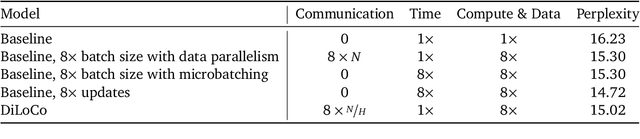
Large language models (LLM) have become a critical component in many applications of machine learning. However, standard approaches to training LLM require a large number of tightly interconnected accelerators, with devices exchanging gradients and other intermediate states at each optimization step. While it is difficult to build and maintain a single computing cluster hosting many accelerators, it might be easier to find several computing clusters each hosting a smaller number of devices. In this work, we propose a distributed optimization algorithm, Distributed Low-Communication (DiLoCo), that enables training of language models on islands of devices that are poorly connected. The approach is a variant of federated averaging, where the number of inner steps is large, the inner optimizer is AdamW, and the outer optimizer is Nesterov momentum. On the widely used C4 dataset, we show that DiLoCo on 8 workers performs as well as fully synchronous optimization while communicating 500 times less. DiLoCo exhibits great robustness to the data distribution of each worker. It is also robust to resources becoming unavailable over time, and vice versa, it can seamlessly leverage resources that become available during training.