 Add to Chrome
 Add to Firefox
 Add to Edge
Detail Continuation over a Trustworthy Coarse Scale for Autoregressive Super-Resolution
Aug 03, 2026
Hallucination remains a persistent challenge in generative super-resolution (GSR), where reconstructed results may contain visually plausible yet weakly supported content, structural deviations, or unnatural textures with respect to the low-resolution (LR) input. Existing GSR methods have extensively explored the trade-off between perceptual realism and reconstruction fidelity, but the division between preserving reliable coarse-scale information and restoring more uncertain fine details is often handled implicitly within the overall restoration process. Visual autoregressive (VAR) modeling provides a natural opportunity to revisit this issue, as its coarse-to-fine next-scale prediction offers an explicit scale-wise generation interface. However, existing VAR-based SR methods still inherit the original full 1-to-$N$ autoregressive generation path, even though, for super-resolution, coarse-scale information in LR is often relatively more reliable, while long autoregressive chains may accumulate prediction errors. Motivated by these observations, we propose \textbf{K2N}, which reformulates VAR-based SR from full-path generation into a $k$-to-$N$ detail continuation process. Specifically, early coarse-scale states are established directly from LR, while only the remaining finer scales are restored autoregressively. Experimental results show that K2N remains competitive with the VARSR baseline on standard SR metrics, while exhibiting clearer advantages on hallucination-focused evaluation. These findings suggest that explicitly rethinking the generation path in a scale-wise manner can be a promising direction for improving the reliability of generative super-resolution. Our code will be released soon at https://github.com/BRL-SYSU/K2NSR.

WrAFT: a Modularized Automated Writing Evaluation System for Argumentative Essays
Jul 16, 2026This study presents WrAFT, a Writing Assessment and Feedback Tool, that delivers both accurate and reliable scores and effective comprehensive feedback to argumentative essays. WrAFT adopts a modular design by dividing automated writing evaluation (AWE) tasks into scoring, surface-level feedback, and deep-level feedback. In building the system, various Large Language Models (LLMs) have been evaluated, including LLaMA-3.3-70B-Instruct, GPT-4o, and Claude 3.7, through both direct prompting and supervised fine-tuning approaches. A proprietary dataset of 480 TOEFL Independent Writing essays with official benchmark scores was utilized. Benchmark-based evaluation shows that WrAFT achieves state-of-the-art performance in scoring, with a quadratic weighted kappa (QWK) of 0.84 and a root mean square error (RMSE) of 0.44 against official scores on a scale of 0-5. Human evaluation of system-generated feedback also reveals high approval ratings: 96.14 percent for surface-level feedback, 93.03 percent for deep-level macro feedback, and 94.69 percent for deep-level micro feedback. An interactive user interface has been developed for the system and is publicly available and free to use.
ATLAS: Agentic Taxonomy of Large-Scale Software Ecosystems
Jun 19, 2026The open-source ecosystem on GitHub lacks a systematic hierarchical taxonomy of software repositories. GitHub Topics, the dominant organizational mechanism, is flat, inconsistent, and covers only 67% of projects. We present ATLAS, the first framework that automatically constructs a hierarchical taxonomy for software repositories and classifies projects into it end-to-end. By combining LLM global knowledge with real repository distributions, ATLAS proposes meaningful splitting dimensions and iteratively corrects those that fail to accommodate real projects. A Designer Agent proposes splitting dimensions while a Classifier Agent assigns repositories; a self-corrective refinement loop uses classification failures to drive dimension revision through escalating strategies. We evaluate ATLAS on 54,387 GitHub repositories against six baselines spanning four paradigms, two downstream tasks, and three model families. On a stratified 2,001-repository benchmark, ATLAS achieves a Taxonomy Quality F-score (TQF) of 83.13%, outperforming the best baseline by 15 percentage points (on the full 54k corpus the approximate TQF is 73.0%, a gap driven by Path Granularity's all-or-nothing scoring on longer paths rather than lower classification accuracy). It is the only method to simultaneously achieve high structural quality and high practical applicability. On downstream tasks, ATLAS enables alternative discovery with P@1 = 85.71%, surpassing even human-curated lists (62.34%), and achieves the highest P@1 for repository retrieval. The taxonomy further reveals structural ecosystem trends that are difficult to obtain from flat tags or similarity methods: the shift from libraries to AI/ML applications (now 61% of newly community-adopted projects) becomes visible only through hierarchical, type-based categorization. An interactive taxonomy explorer is available at https://atlas-taxonomy.netlify.app/
Evaluating Semantic Fragility in Text-to-Audio Generation Systems Under Controlled Prompt Perturbations
Mar 14, 2026Recent advances in text-to-audio generation enable models to translate natural-language descriptions into diverse musical output. However, the robustness of these systems under semantically equivalent prompt variations remains largely unexplored. Small linguistic changes may lead to substantial variation in generated audio, raising concerns about reliability in practical use. In this study, we evaluate the semantic fragility of text-to-audio systems under controlled prompt perturbations. We selected MusicGen-small, MusicGen-large, and Stable Audio 2.5 as representative models, and we evaluated them under Minimal Lexical Substitution (MLS), Intensity Shifts (IS), and Structural Rephrasing (SR). The proposed dataset contains 75 prompt groups designed to preserve semantic intent while introducing localized linguistic variation. Generated outputs are compared through complementary spectral, temporal, and semantic similarity measures, enabling robustness analysis across multiple representational levels. Experimental results show that larger models achieve improved semantic consistency, with MusicGen-large reaching cosine similarities of 0.77 under MLS and 0.82 under IS. However, acoustic and temporal analyses reveal persistent divergence across all models, even when embedding similarity remains high. These findings indicate that fragility arises primarily during semantic-to-acoustic realization rather than multi-modal embedding alignment. Our study introduces a controlled framework for evaluating robustness in text-to-audio generation and highlights the need for multi-level stability assessment in generative audio systems.
UAMTERS: Uncertainty-Aware Mutation Analysis for DL-enabled Robotic Software
Feb 23, 2026Self-adaptive robots adjust their behaviors in response to unpredictable environmental changes. These robots often incorporate deep learning (DL) components into their software to support functionality such as perception, decision-making, and control, enhancing autonomy and self-adaptability. However, the inherent uncertainty of DL-enabled software makes it challenging to ensure its dependability in dynamic environments. Consequently, test generation techniques have been developed to test robot software, and classical mutation analysis injects faults into the software to assess the test suite's effectiveness in detecting the resulting failures. However, there is a lack of mutation analysis techniques to assess the effectiveness under the uncertainty inherent to DL-enabled software. To this end, we propose UAMTERS, an uncertainty-aware mutation analysis framework that introduces uncertainty-aware mutation operators to explicitly inject stochastic uncertainty into DL-enabled robotic software, simulating uncertainty in its behavior. We further propose mutation score metrics to quantify a test suite's ability to detect failures under varying levels of uncertainty. We evaluate UAMTERS across three robotic case studies, demonstrating that UAMTERS more effectively distinguishes test suite quality and captures uncertainty-induced failures in DL-enabled software.
Say Cheese! Detail-Preserving Portrait Collection Generation via Natural Language Edits
Jan 28, 2026As social media platforms proliferate, users increasingly demand intuitive ways to create diverse, high-quality portrait collections. In this work, we introduce Portrait Collection Generation (PCG), a novel task that generates coherent portrait collections by editing a reference portrait image through natural language instructions. This task poses two unique challenges to existing methods: (1) complex multi-attribute modifications such as pose, spatial layout, and camera viewpoint; and (2) high-fidelity detail preservation including identity, clothing, and accessories. To address these challenges, we propose CHEESE, the first large-scale PCG dataset containing 24K portrait collections and 573K samples with high-quality modification text annotations, constructed through an Large Vison-Language Model-based pipeline with inversion-based verification. We further propose SCheese, a framework that combines text-guided generation with hierarchical identity and detail preservation. SCheese employs adaptive feature fusion mechanism to maintain identity consistency, and ConsistencyNet to inject fine-grained features for detail consistency. Comprehensive experiments validate the effectiveness of CHEESE in advancing PCG, with SCheese achieving state-of-the-art performance.
StructVRM: Aligning Multimodal Reasoning with Structured and Verifiable Reward Models
Aug 07, 2025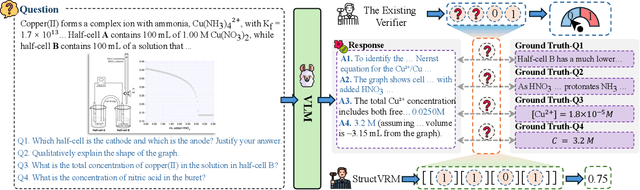
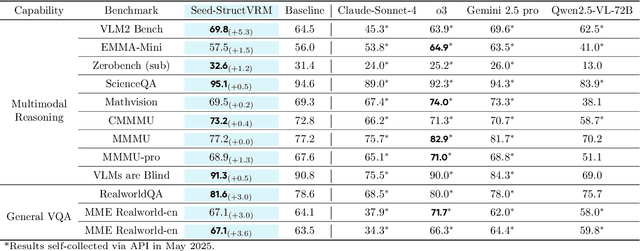
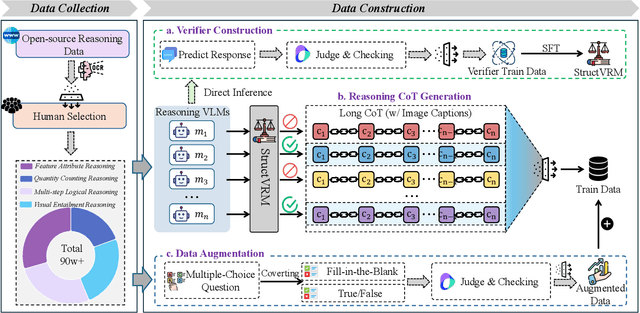
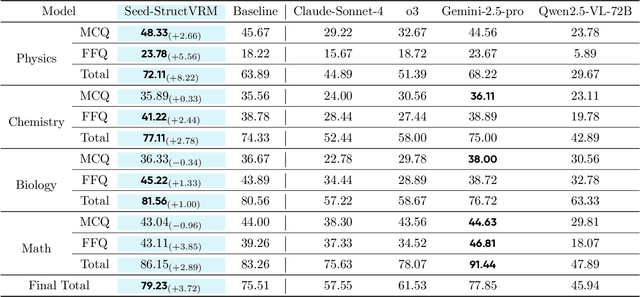
Existing Vision-Language Models often struggle with complex, multi-question reasoning tasks where partial correctness is crucial for effective learning. Traditional reward mechanisms, which provide a single binary score for an entire response, are too coarse to guide models through intricate problems with multiple sub-parts. To address this, we introduce StructVRM, a method that aligns multimodal reasoning with Structured and Verifiable Reward Models. At its core is a model-based verifier trained to provide fine-grained, sub-question-level feedback, assessing semantic and mathematical equivalence rather than relying on rigid string matching. This allows for nuanced, partial credit scoring in previously intractable problem formats. Extensive experiments demonstrate the effectiveness of StructVRM. Our trained model, Seed-StructVRM, achieves state-of-the-art performance on six out of twelve public multimodal benchmarks and our newly curated, high-difficulty STEM-Bench. The success of StructVRM validates that training with structured, verifiable rewards is a highly effective approach for advancing the capabilities of multimodal models in complex, real-world reasoning domains.
UniPTMs: The First Unified Multi-type PTM Site Prediction Model via Master-Slave Architecture-Based Multi-Stage Fusion Strategy and Hierarchical Contrastive Loss
Jun 05, 2025As a core mechanism of epigenetic regulation in eukaryotes, protein post-translational modifications (PTMs) require precise prediction to decipher dynamic life activity networks. To address the limitations of existing deep learning models in cross-modal feature fusion, domain generalization, and architectural optimization, this study proposes UniPTMs: the first unified framework for multi-type PTM prediction. The framework innovatively establishes a "Master-Slave" dual-path collaborative architecture: The master path dynamically integrates high-dimensional representations of protein sequences, structures, and evolutionary information through a Bidirectional Gated Cross-Attention (BGCA) module, while the slave path optimizes feature discrepancies and recalibration between structural and traditional features using a Low-Dimensional Fusion Network (LDFN). Complemented by a Multi-scale Adaptive convolutional Pyramid (MACP) for capturing local feature patterns and a Bidirectional Hierarchical Gated Fusion Network (BHGFN) enabling multi-level feature integration across paths, the framework employs a Hierarchical Dynamic Weighting Fusion (HDWF) mechanism to intelligently aggregate multimodal features. Enhanced by a novel Hierarchical Contrastive loss function for feature consistency optimization, UniPTMs demonstrates significant performance improvements (3.2%-11.4% MCC and 4.2%-14.3% AP increases) over state-of-the-art models across five modification types and transcends the Single-Type Prediction Paradigm. To strike a balance between model complexity and performance, we have also developed a lightweight variant named UniPTMs-mini.
Network-Based Transfer Learning Helps Improve Short-Term Crime Prediction Accuracy
Jun 10, 2024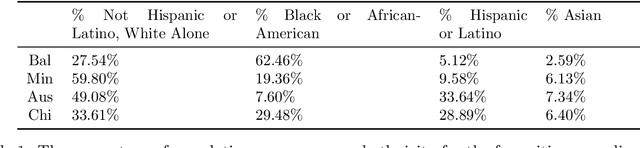
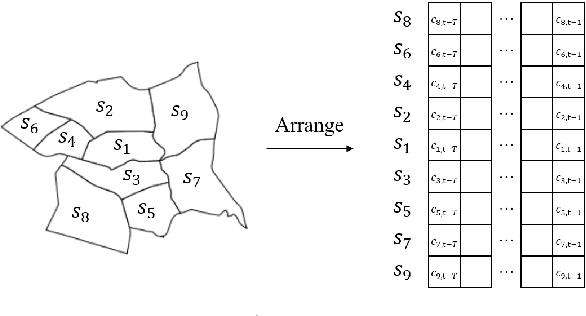
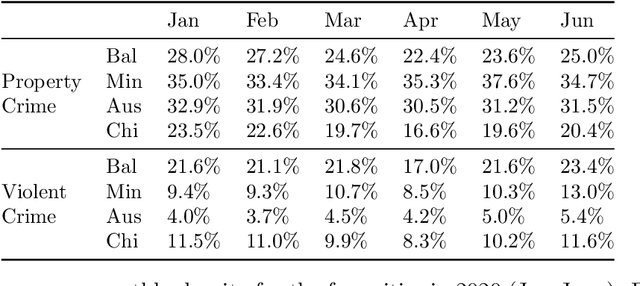
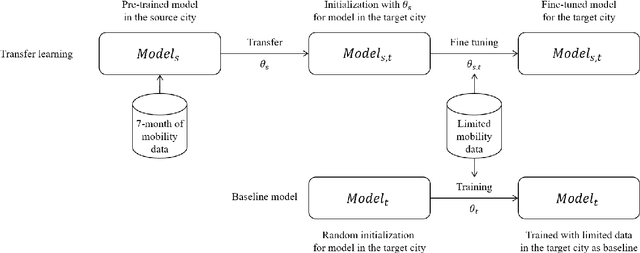
Deep learning architectures enhanced with human mobility data have been shown to improve the accuracy of short-term crime prediction models trained with historical crime data. However, human mobility data may be scarce in some regions, negatively impacting the correct training of these models. To address this issue, we propose a novel transfer learning framework for short-term crime prediction models, whereby weights from the deep learning crime prediction models trained in source regions with plenty of mobility data are transferred to target regions to fine-tune their local crime prediction models and improve crime prediction accuracy. Our results show that the proposed transfer learning framework improves the F1 scores for target cities with mobility data scarcity, especially when the number of months of available mobility data is small. We also show that the F1 score improvements are pervasive across different types of crimes and diverse cities in the US.
Improving the Fairness of Deep-Learning, Short-term Crime Prediction with Under-reporting-aware Models
Jun 06, 2024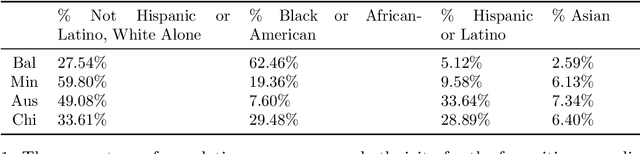
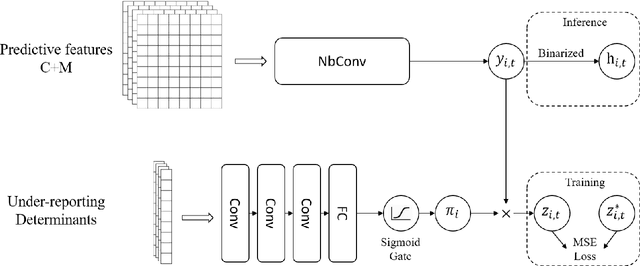
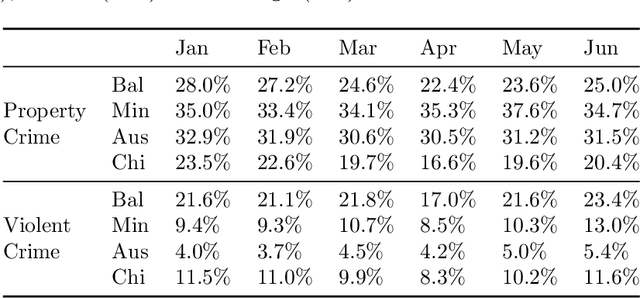
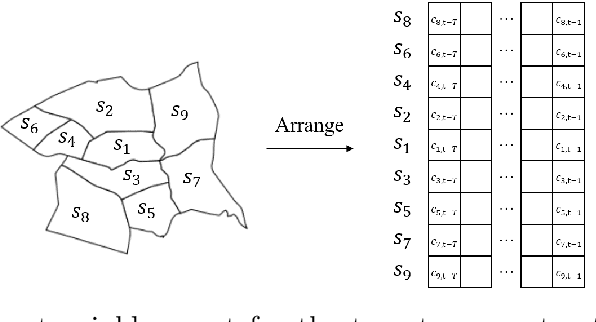
Deep learning crime predictive tools use past crime data and additional behavioral datasets to forecast future crimes. Nevertheless, these tools have been shown to suffer from unfair predictions across minority racial and ethnic groups. Current approaches to address this unfairness generally propose either pre-processing methods that mitigate the bias in the training datasets by applying corrections to crime counts based on domain knowledge or in-processing methods that are implemented as fairness regularizers to optimize for both accuracy and fairness. In this paper, we propose a novel deep learning architecture that combines the power of these two approaches to increase prediction fairness. Our results show that the proposed model improves the fairness of crime predictions when compared to models with in-processing de-biasing approaches and with models without any type of bias correction, albeit at the cost of reducing accuracy.