 Add to Chrome
 Add to Firefox
 Add to Edge
Adaptive Ability Decomposing for Unlocking Large Reasoning Model Effective Reinforcement Learning
Jan 31, 2026
Reinforcement learning with verifiable rewards (RLVR) has shown great potential to enhance the reasoning ability of large language models (LLMs). However, due to the limited amount of information provided during the RLVR process, the model can only engage in largely blind exploration, which often results in failure on challenging problems. To provide additional information for the RLVR process without relying on a teacher model, we propose A$^2$D, an Adaptive Ability Decomposing method for enhancing the effectiveness of RLVR. Specifically, we first train a decomposer via RLVR without distillation, enabling it to decompose complex questions into a set of simpler sub-questions. Next, we use this decomposer to annotate sub-questions for each question in the training dataset, and then train the reasoner under RLVR with sub-question guidance. To better understand A$^2$D, we first compare its performance with competitive baselines, showing its effectiveness. Next, we observe that our method functions as a plug-and-play module that can be applied to different RLVR algorithms. Furthermore, we conduct an analysis of the decomposer, revealing how the RLVR process affects its performance and behavior, and which type of guidance is better suited for enhancing the reasoner's exploration and exploitation abilities.

StructVRM: Aligning Multimodal Reasoning with Structured and Verifiable Reward Models
Aug 07, 2025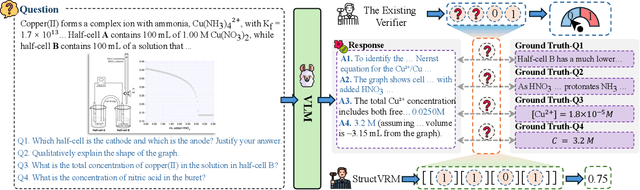
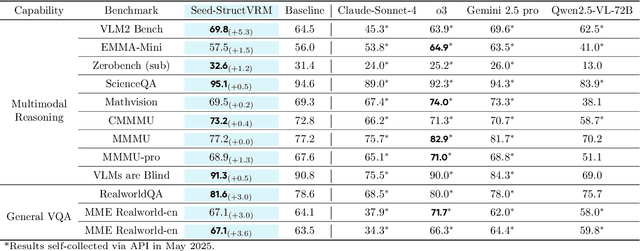
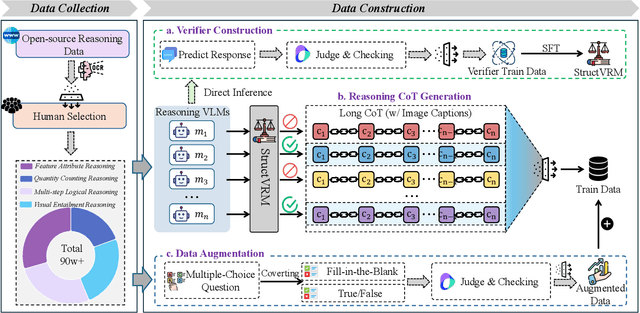
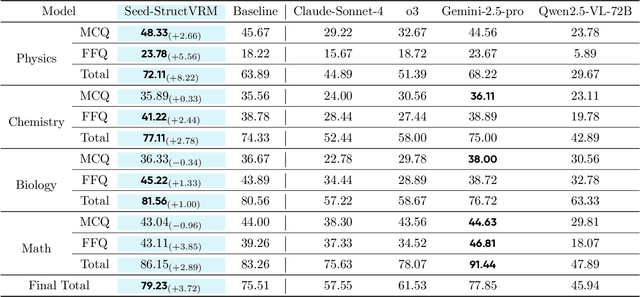
Existing Vision-Language Models often struggle with complex, multi-question reasoning tasks where partial correctness is crucial for effective learning. Traditional reward mechanisms, which provide a single binary score for an entire response, are too coarse to guide models through intricate problems with multiple sub-parts. To address this, we introduce StructVRM, a method that aligns multimodal reasoning with Structured and Verifiable Reward Models. At its core is a model-based verifier trained to provide fine-grained, sub-question-level feedback, assessing semantic and mathematical equivalence rather than relying on rigid string matching. This allows for nuanced, partial credit scoring in previously intractable problem formats. Extensive experiments demonstrate the effectiveness of StructVRM. Our trained model, Seed-StructVRM, achieves state-of-the-art performance on six out of twelve public multimodal benchmarks and our newly curated, high-difficulty STEM-Bench. The success of StructVRM validates that training with structured, verifiable rewards is a highly effective approach for advancing the capabilities of multimodal models in complex, real-world reasoning domains.
Seed1.5-VL Technical Report
May 11, 2025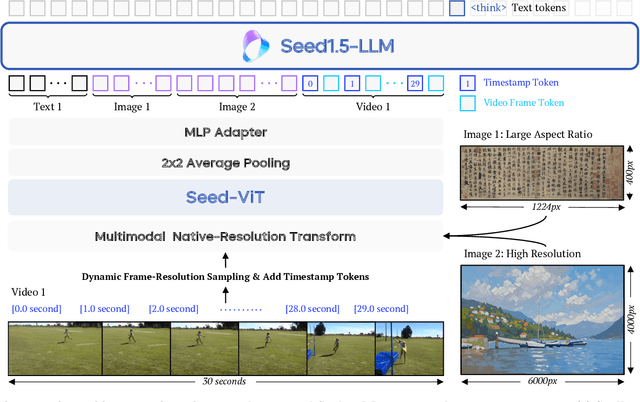

We present Seed1.5-VL, a vision-language foundation model designed to advance general-purpose multimodal understanding and reasoning. Seed1.5-VL is composed with a 532M-parameter vision encoder and a Mixture-of-Experts (MoE) LLM of 20B active parameters. Despite its relatively compact architecture, it delivers strong performance across a wide spectrum of public VLM benchmarks and internal evaluation suites, achieving the state-of-the-art performance on 38 out of 60 public benchmarks. Moreover, in agent-centric tasks such as GUI control and gameplay, Seed1.5-VL outperforms leading multimodal systems, including OpenAI CUA and Claude 3.7. Beyond visual and video understanding, it also demonstrates strong reasoning abilities, making it particularly effective for multimodal reasoning challenges such as visual puzzles. We believe these capabilities will empower broader applications across diverse tasks. In this report, we mainly provide a comprehensive review of our experiences in building Seed1.5-VL across model design, data construction, and training at various stages, hoping that this report can inspire further research. Seed1.5-VL is now accessible at https://www.volcengine.com/ (Volcano Engine Model ID: doubao-1-5-thinking-vision-pro-250428)