 Add to Chrome
 Add to Firefox
 Add to Edge
Learning Human-Like Badminton Skills for Humanoid Robots
Feb 09, 2026
Realizing versatile and human-like performance in high-demand sports like badminton remains a formidable challenge for humanoid robotics. Unlike standard locomotion or static manipulation, this task demands a seamless integration of explosive whole-body coordination and precise, timing-critical interception. While recent advances have achieved lifelike motion mimicry, bridging the gap between kinematic imitation and functional, physics-aware striking without compromising stylistic naturalness is non-trivial. To address this, we propose Imitation-to-Interaction, a progressive reinforcement learning framework designed to evolve a robot from a "mimic" to a capable "striker." Our approach establishes a robust motor prior from human data, distills it into a compact, model-based state representation, and stabilizes dynamics via adversarial priors. Crucially, to overcome the sparsity of expert demonstrations, we introduce a manifold expansion strategy that generalizes discrete strike points into a dense interaction volume. We validate our framework through the mastery of diverse skills, including lifts and drop shots, in simulation. Furthermore, we demonstrate the first zero-shot sim-to-real transfer of anthropomorphic badminton skills to a humanoid robot, successfully replicating the kinetic elegance and functional precision of human athletes in the physical world.

Massive Sound Embedding Benchmark (MSEB)
Feb 06, 2026Audio is a critical component of multimodal perception, and any truly intelligent system must demonstrate a wide range of auditory capabilities. These capabilities include transcription, classification, retrieval, reasoning, segmentation, clustering, reranking, and reconstruction. Fundamentally, each task involves transforming a raw audio signal into a meaningful 'embedding' - be it a single vector, a sequence of continuous or discrete representations, or another structured form - which then serves as the basis for generating the task's final response. To accelerate progress towards robust machine auditory intelligence, we present the Massive Sound Embedding Benchmark (MSEB): an extensible framework designed to evaluate the auditory components of any multimodal system. In its first release, MSEB offers a comprehensive suite of eight core tasks, with more planned for the future, supported by diverse datasets, including the new, large-scale Simple Voice Questions (SVQ) dataset. Our initial experiments establish clear performance headrooms, highlighting the significant opportunity to improve real-world multimodal experiences where audio is a core signal. We encourage the research community to use MSEB to assess their algorithms and contribute to its growth. The library is publicly hosted at github.
Retrieval Augmented Question Answering: When Should LLMs Admit Ignorance?
Dec 29, 2025The success of expanded context windows in Large Language Models (LLMs) has driven increased use of broader context in retrieval-augmented generation. We investigate the use of LLMs for retrieval augmented question answering. While longer contexts make it easier to incorporate targeted knowledge, they introduce more irrelevant information that hinders the model's generation process and degrades its performance. To address the issue, we design an adaptive prompting strategy which involves splitting the retrieved information into smaller chunks and sequentially prompting a LLM to answer the question using each chunk. Adjusting the chunk size allows a trade-off between incorporating relevant information and reducing irrelevant information. Experimental results on three open-domain question answering datasets demonstrate that the adaptive strategy matches the performance of standard prompting while using fewer tokens. Our analysis reveals that when encountering insufficient information, the LLM often generates incorrect answers instead of declining to respond, which constitutes a major source of error. This finding highlights the need for further research into enhancing LLMs' ability to effectively decline requests when faced with inadequate information.
Like Playing a Video Game: Spatial-Temporal Optimization of Foot Trajectories for Controlled Football Kicking in Bipedal Robots
Oct 02, 2025Humanoid robot soccer presents several challenges, particularly in maintaining system stability during aggressive kicking motions while achieving precise ball trajectory control. Current solutions, whether traditional position-based control methods or reinforcement learning (RL) approaches, exhibit significant limitations. Model predictive control (MPC) is a prevalent approach for ordinary quadruped and biped robots. While MPC has demonstrated advantages in legged robots, existing studies often oversimplify the leg swing progress, relying merely on simple trajectory interpolation methods. This severely constrains the foot's environmental interaction capability, hindering tasks such as ball kicking. This study innovatively adapts the spatial-temporal trajectory planning method, which has been successful in drone applications, to bipedal robotic systems. The proposed approach autonomously generates foot trajectories that satisfy constraints on target kicking position, velocity, and acceleration while simultaneously optimizing swing phase duration. Experimental results demonstrate that the optimized trajectories closely mimic human kicking behavior, featuring a backswing motion. Simulation and hardware experiments confirm the algorithm's efficiency, with trajectory planning times under 1 ms, and its reliability, achieving nearly 100 % task completion accuracy when the soccer goal is within the range of -90{\deg} to 90{\deg}.
Steering Prosocial AI Agents: Computational Basis of LLM's Decision Making in Social Simulation
Apr 16, 2025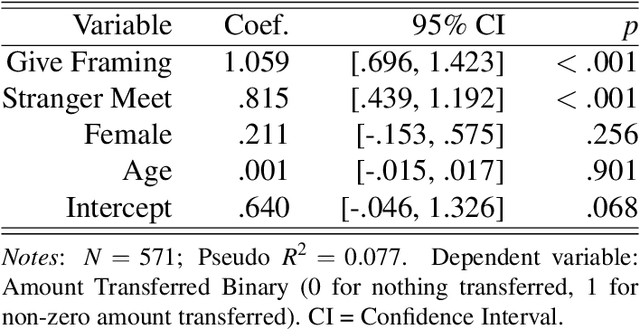
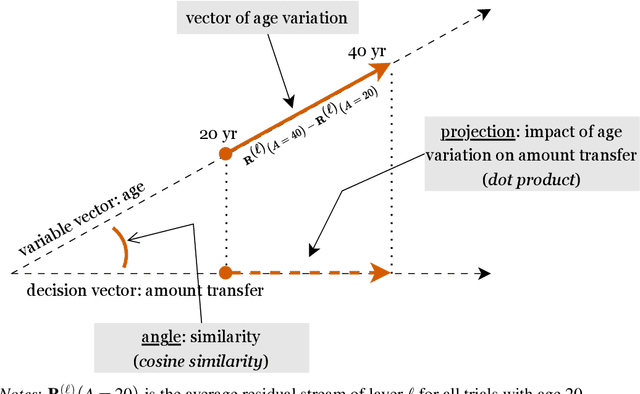
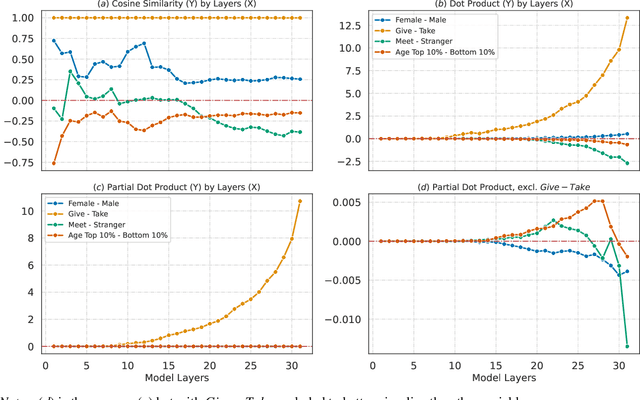
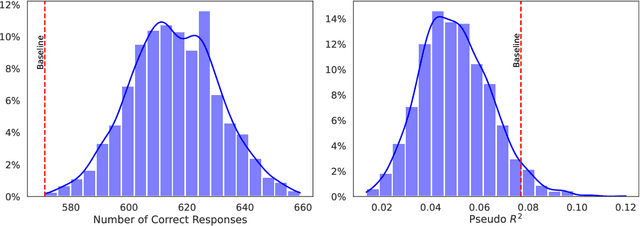
Large language models (LLMs) increasingly serve as human-like decision-making agents in social science and applied settings. These LLM-agents are typically assigned human-like characters and placed in real-life contexts. However, how these characters and contexts shape an LLM's behavior remains underexplored. This study proposes and tests methods for probing, quantifying, and modifying an LLM's internal representations in a Dictator Game -- a classic behavioral experiment on fairness and prosocial behavior. We extract ``vectors of variable variations'' (e.g., ``male'' to ``female'') from the LLM's internal state. Manipulating these vectors during the model's inference can substantially alter how those variables relate to the model's decision-making. This approach offers a principled way to study and regulate how social concepts can be encoded and engineered within transformer-based models, with implications for alignment, debiasing, and designing AI agents for social simulations in both academic and commercial applications.
A Unified Theoretic and Algorithmic Framework for Solving Multivariate Linear Model with $\ell^1$-norm Optimization
Apr 01, 2025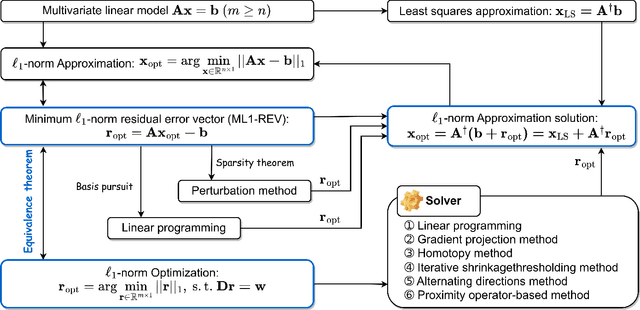
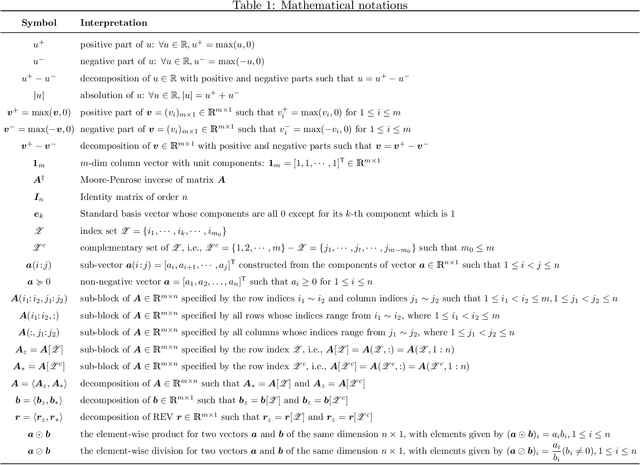
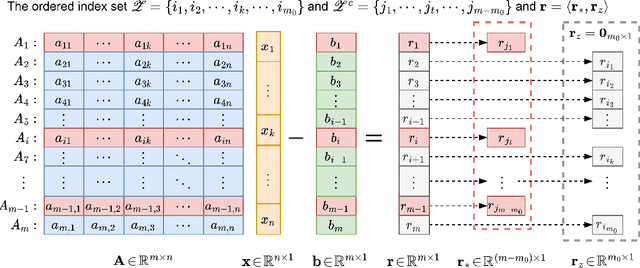
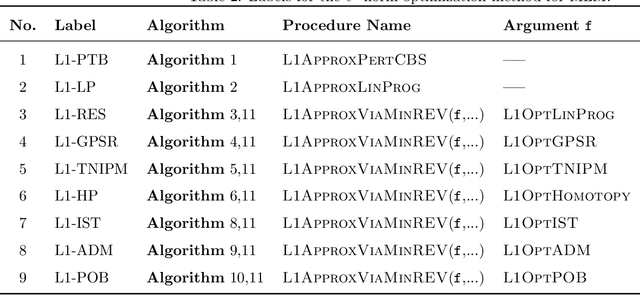
It is a challenging problem that solving the \textit{multivariate linear model} (MLM) $\mathbf{A}\mathbf{x}=\mathbf{b}$ with the $\ell_1 $-norm approximation method such that $||\mathbf{A}\mathbf{x}-\mathbf{b}||_1$, the $\ell_1$-norm of the \textit{residual error vector} (REV), is minimized. In this work, our contributions lie in two aspects: firstly, the equivalence theorem for the structure of the $\ell_1$-norm optimal solution to the MLM is proposed and proved; secondly, a unified algorithmic framework for solving the MLM with $\ell_1$-norm optimization is proposed and six novel algorithms (L1-GPRS, L1-TNIPM, L1-HP, L1-IST, L1-ADM, L1-POB) are designed. There are three significant characteristics in the algorithms discussed: they are implemented with simple matrix operations which do not depend on specific optimization solvers; they are described with algorithmic pseudo-codes and implemented with Python and Octave/MATLAB which means easy usage; and the high accuracy and efficiency of our six new algorithms can be achieved successfully in the scenarios with different levels of data redundancy. We hope that the unified theoretic and algorithmic framework with source code released on GitHub could motivate the applications of the $\ell_1$-norm optimization for parameter estimation of MLM arising in science, technology, engineering, mathematics, economics, and so on.
Learning an Adaptive Fall Recovery Controller for Quadrupeds on Complex Terrains
Dec 22, 2024Legged robots have shown promise in locomotion complex environments, but recovery from falls on challenging terrains remains a significant hurdle. This paper presents an Adaptive Fall Recovery (AFR) controller for quadrupedal robots on challenging terrains such as rocky, breams, steep slopes, and irregular stones. We leverage deep reinforcement learning to train the AFR, which can adapt to a wide range of terrain geometries and physical properties. Our method demonstrates improvements over existing approaches, showing promising results in recovery scenarios on challenging terrains. We trained our method in Isaac Gym using the Go1 and directly transferred it to several mainstream quadrupedal platforms, such as Spot and ANYmal. Additionally, we validated the controller's effectiveness in Gazebo. Our results indicate that the AFR controller generalizes well to complex terrains and outperforms baseline methods in terms of success rate and recovery speed.
Memory-Reduced Meta-Learning with Guaranteed Convergence
Dec 16, 2024


The optimization-based meta-learning approach is gaining increased traction because of its unique ability to quickly adapt to a new task using only small amounts of data. However, existing optimization-based meta-learning approaches, such as MAML, ANIL and their variants, generally employ backpropagation for upper-level gradient estimation, which requires using historical lower-level parameters/gradients and thus increases computational and memory overhead in each iteration. In this paper, we propose a meta-learning algorithm that can avoid using historical parameters/gradients and significantly reduce memory costs in each iteration compared to existing optimization-based meta-learning approaches. In addition to memory reduction, we prove that our proposed algorithm converges sublinearly with the iteration number of upper-level optimization, and the convergence error decays sublinearly with the batch size of sampled tasks. In the specific case in terms of deterministic meta-learning, we also prove that our proposed algorithm converges to an exact solution. Moreover, we quantify that the computational complexity of the algorithm is on the order of $\mathcal{O}(\epsilon^{-1})$, which matches existing convergence results on meta-learning even without using any historical parameters/gradients. Experimental results on meta-learning benchmarks confirm the efficacy of our proposed algorithm.
Pruning All-Rounder: Rethinking and Improving Inference Efficiency for Large Vision Language Models
Dec 09, 2024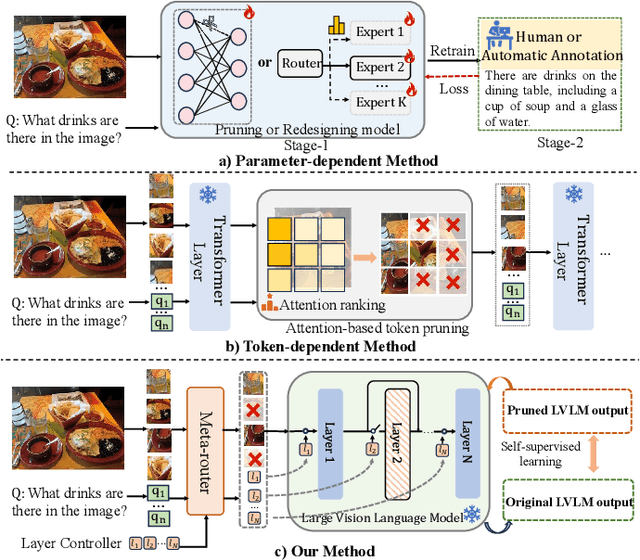


Although Large Vision-Language Models (LVLMs) have achieved impressive results, their high computational cost poses a significant barrier to wider application. To enhance inference efficiency, most existing approaches depend on parameter-dependent or token-dependent strategies to reduce computational demands. However, these methods typically require complex training processes and struggle to consistently select the most relevant tokens. In this paper, we systematically analyze the above challenges and provide a series of valuable insights for inference acceleration. Based on these findings, we propose a novel framework, the Pruning All-Rounder (PAR). Different from previous works, PAR develops a meta-router to adaptively organize pruning flows across both tokens and layers. With a self-supervised learning manner, our method achieves a superior balance between performance and efficiency. Notably, PAR is highly flexible, offering multiple pruning versions to address a range of pruning scenarios. The code for this work will be made publicly available.
Can Machines Think Like Humans? A Behavioral Evaluation of LLM-Agents in Dictator Games
Oct 28, 2024As Large Language Model (LLM)-based agents increasingly undertake real-world tasks and engage with human society, how well do we understand their behaviors? This study (1) investigates how LLM agents' prosocial behaviors -- a fundamental social norm -- can be induced by different personas and benchmarked against human behaviors; and (2) introduces a behavioral approach to evaluate the performance of LLM agents in complex decision-making scenarios. We explored how different personas and experimental framings affect these AI agents' altruistic behavior in dictator games and compared their behaviors within the same LLM family, across various families, and with human behaviors. Our findings reveal substantial variations and inconsistencies among LLMs and notable differences compared to human behaviors. Merely assigning a human-like identity to LLMs does not produce human-like behaviors. Despite being trained on extensive human-generated data, these AI agents cannot accurately predict human decisions. LLM agents are not able to capture the internal processes of human decision-making, and their alignment with human behavior is highly variable and dependent on specific model architectures and prompt formulations; even worse, such dependence does not follow a clear pattern.