 Add to Chrome
 Add to Firefox
 Add to Edge
Co-jump: Cooperative Jumping with Quadrupedal Robots via Multi-Agent Reinforcement Learning
Feb 11, 2026
While single-agent legged locomotion has witnessed remarkable progress, individual robots remain fundamentally constrained by physical actuation limits. To transcend these boundaries, we introduce Co-jump, a cooperative task where two quadrupedal robots synchronize to execute jumps far beyond their solo capabilities. We tackle the high-impulse contact dynamics of this task under a decentralized setting, achieving synchronization without explicit communication or pre-specified motion primitives. Our framework leverages Multi-Agent Proximal Policy Optimization (MAPPO) enhanced by a progressive curriculum strategy, which effectively overcomes the sparse-reward exploration challenges inherent in mechanically coupled systems. We demonstrate robust performance in simulation and successful transfer to physical hardware, executing multi-directional jumps onto platforms up to 1.5 m in height. Specifically, one of the robots achieves a foot-end elevation of 1.1 m, which represents a 144% improvement over the 0.45 m jump height of a standalone quadrupedal robot, demonstrating superior vertical performance. Notably, this precise coordination is achieved solely through proprioceptive feedback, establishing a foundation for communication-free collaborative locomotion in constrained environments.

Learning Human-Like Badminton Skills for Humanoid Robots
Feb 09, 2026Realizing versatile and human-like performance in high-demand sports like badminton remains a formidable challenge for humanoid robotics. Unlike standard locomotion or static manipulation, this task demands a seamless integration of explosive whole-body coordination and precise, timing-critical interception. While recent advances have achieved lifelike motion mimicry, bridging the gap between kinematic imitation and functional, physics-aware striking without compromising stylistic naturalness is non-trivial. To address this, we propose Imitation-to-Interaction, a progressive reinforcement learning framework designed to evolve a robot from a "mimic" to a capable "striker." Our approach establishes a robust motor prior from human data, distills it into a compact, model-based state representation, and stabilizes dynamics via adversarial priors. Crucially, to overcome the sparsity of expert demonstrations, we introduce a manifold expansion strategy that generalizes discrete strike points into a dense interaction volume. We validate our framework through the mastery of diverse skills, including lifts and drop shots, in simulation. Furthermore, we demonstrate the first zero-shot sim-to-real transfer of anthropomorphic badminton skills to a humanoid robot, successfully replicating the kinetic elegance and functional precision of human athletes in the physical world.
RAC-DMVC: Reliability-Aware Contrastive Deep Multi-View Clustering under Multi-Source Noise
Nov 17, 2025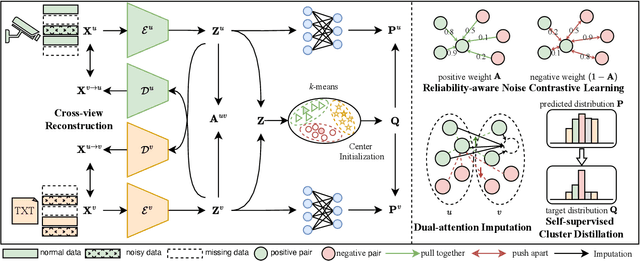
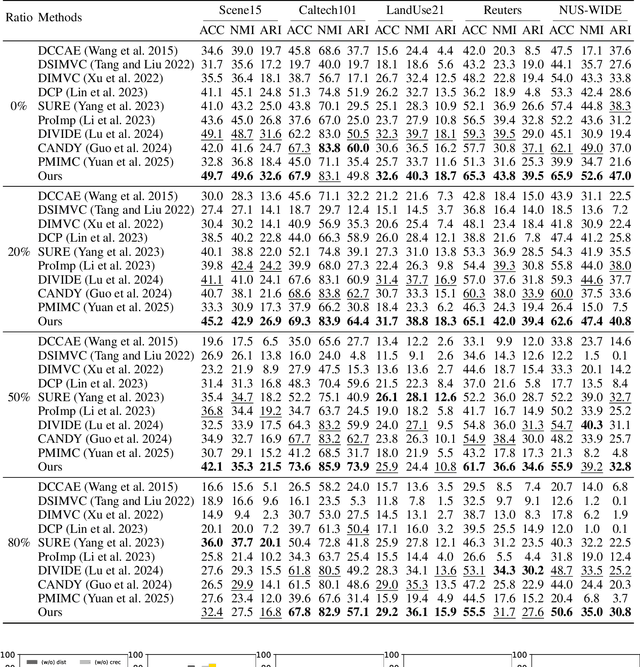

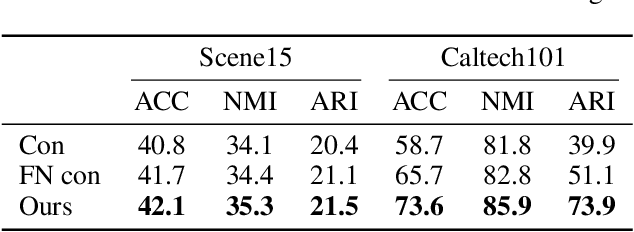
Multi-view clustering (MVC), which aims to separate the multi-view data into distinct clusters in an unsupervised manner, is a fundamental yet challenging task. To enhance its applicability in real-world scenarios, this paper addresses a more challenging task: MVC under multi-source noises, including missing noise and observation noise. To this end, we propose a novel framework, Reliability-Aware Contrastive Deep Multi-View Clustering (RAC-DMVC), which constructs a reliability graph to guide robust representation learning under noisy environments. Specifically, to address observation noise, we introduce a cross-view reconstruction to enhances robustness at the data level, and a reliability-aware noise contrastive learning to mitigates bias in positive and negative pairs selection caused by noisy representations. To handle missing noise, we design a dual-attention imputation to capture shared information across views while preserving view-specific features. In addition, a self-supervised cluster distillation module further refines the learned representations and improves the clustering performance. Extensive experiments on five benchmark datasets demonstrate that RAC-DMVC outperforms SOTA methods on multiple evaluation metrics and maintains excellent performance under varying ratios of noise.
Center-Oriented Prototype Contrastive Clustering
Aug 21, 2025Contrastive learning is widely used in clustering tasks due to its discriminative representation. However, the conflict problem between classes is difficult to solve effectively. Existing methods try to solve this problem through prototype contrast, but there is a deviation between the calculation of hard prototypes and the true cluster center. To address this problem, we propose a center-oriented prototype contrastive clustering framework, which consists of a soft prototype contrastive module and a dual consistency learning module. In short, the soft prototype contrastive module uses the probability that the sample belongs to the cluster center as a weight to calculate the prototype of each category, while avoiding inter-class conflicts and reducing prototype drift. The dual consistency learning module aligns different transformations of the same sample and the neighborhoods of different samples respectively, ensuring that the features have transformation-invariant semantic information and compact intra-cluster distribution, while providing reliable guarantees for the calculation of prototypes. Extensive experiments on five datasets show that the proposed method is effective compared to the SOTA. Our code is published on https://github.com/LouisDong95/CPCC.
Attack and Defense of Deep Learning Models in the Field of Web Attack Detection
Jun 18, 2024The challenge of WAD (web attack detection) is growing as hackers continuously refine their methods to evade traditional detection. Deep learning models excel in handling complex unknown attacks due to their strong generalization and adaptability. However, they are vulnerable to backdoor attacks, where contextually irrelevant fragments are inserted into requests, compromising model stability. While backdoor attacks are well studied in image recognition, they are largely unexplored in WAD. This paper introduces backdoor attacks in WAD, proposing five methods and corresponding defenses. Testing on textCNN, biLSTM, and tinybert models shows an attack success rate over 87%, reducible through fine-tuning. Future research should focus on backdoor defenses in WAD. All the code and data of this paper can be obtained at https://anonymous.4open.science/r/attackDefenceinDL-7E05