 Add to Chrome
 Add to Firefox
 Add to Edge
Encoded but Not Actionable: Auditing the Decode-Generate-Steer Gap in Frozen LLMs for Geometric Constraints
Aug 18, 2026
Large language models (LLMs) have demonstrated strong performance on structured reasoning tasks, but what they encode and whether it informs model behavior remain unclear. We investigate this question through geometric reasoning, using parametric CAD constraints as a controlled testbed for separating local pairwise relations from sketch-level constraint status. By probing the hidden states of six frozen decoder-only LLMs, we examine four properties: linear decodability, forced-choice generation, activation-level influence, and behavioral steerability. Pretraining substantially improves the decoding of local geometric relations, and this advantage persists after accounting for positional cues with shuffled-order controls. In contrast, sketch-level DOF status is already highly decodable from randomly initialized representations and improves only modestly with pretraining, indicating that much of its probe performance is available without learned weights. Further analyses show that decodable information is not always actionable. Generation often fails to express this information, and on the two intervention-tested backbones, activation-restoration effects at the patched entity position vanish while decodability persists across depth. Mean-difference steering also does not reliably control outputs. These results show that decodability, generation, activation-level influence, and steerability can diverge in the tested setting. The audit provides a controlled way to distinguish failures to encode geometric structure from failures to express or control encoded information.

Disentangling Language Roles in Multilingual LLM Task Execution
May 26, 2026Multilingual LLMs are increasingly used when instruction, source content, and required response languages do not coincide. Existing benchmarks have expanded multilingual instruction-following evaluation, but they rarely isolate these three roles within a fully crossed design. We introduce MTM-Bench, a controlled benchmark for language-conditioned task execution in which each instance is defined by a triplet \((L_{\text{instr}}, L_{\text{content}}, L_{\text{resp}})\). Across English, Spanish, and Chinese, MTM-Bench enumerates all 27 triplets and contains 2{,}430 instances per model across semantic reversal, final-state extraction, and language purity with update realization. We evaluate 20 frontier and open-weight LLMs using decomposed metrics for semantic correctness, target-language adherence, constraint satisfaction, contamination ratio, and joint success, with scoring validated by a targeted human audit. The fully crossed design reveals that degradation is organized by the role a language occupies in the task structure, not merely by mismatch count. The response-language role is the dominant axis of variation, and a single response-slot mismatch accounts for most degradation. The response-only and full-mismatch comparison suggests that mismatch count is not a monotonic predictor of difficulty, with model-level ordering varying across systems. Task families fail through distinct channels, showing that semantic correctness alone does not capture reliable multilingual task execution.
A Unified Theoretic and Algorithmic Framework for Solving Multivariate Linear Model with $\ell^1$-norm Optimization
Apr 01, 2025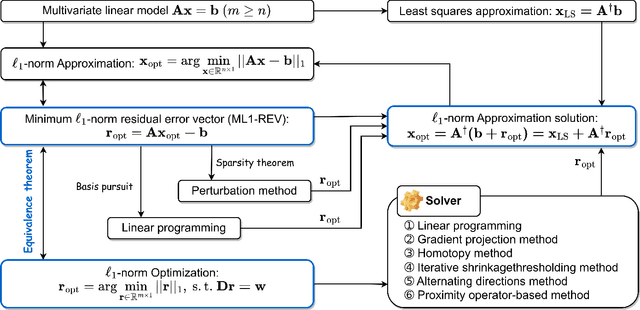
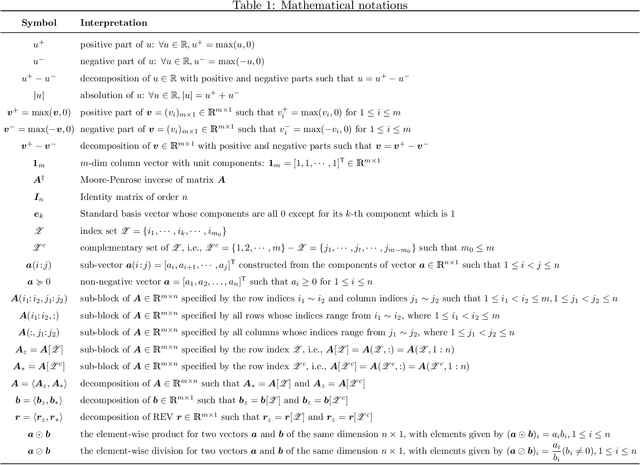
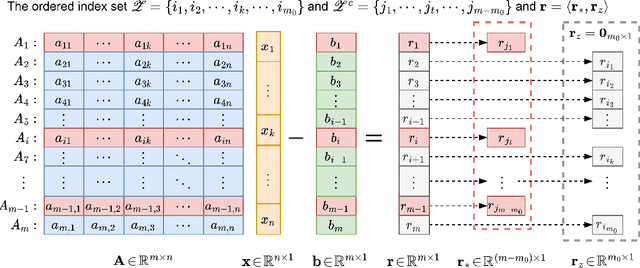
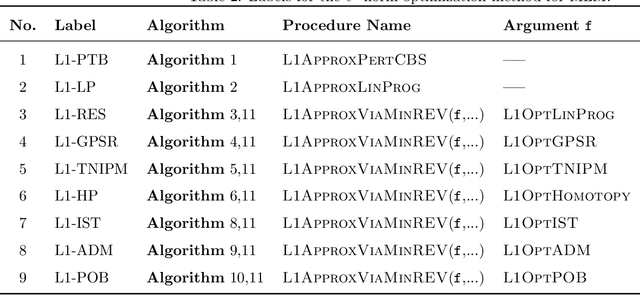
It is a challenging problem that solving the \textit{multivariate linear model} (MLM) $\mathbf{A}\mathbf{x}=\mathbf{b}$ with the $\ell_1 $-norm approximation method such that $||\mathbf{A}\mathbf{x}-\mathbf{b}||_1$, the $\ell_1$-norm of the \textit{residual error vector} (REV), is minimized. In this work, our contributions lie in two aspects: firstly, the equivalence theorem for the structure of the $\ell_1$-norm optimal solution to the MLM is proposed and proved; secondly, a unified algorithmic framework for solving the MLM with $\ell_1$-norm optimization is proposed and six novel algorithms (L1-GPRS, L1-TNIPM, L1-HP, L1-IST, L1-ADM, L1-POB) are designed. There are three significant characteristics in the algorithms discussed: they are implemented with simple matrix operations which do not depend on specific optimization solvers; they are described with algorithmic pseudo-codes and implemented with Python and Octave/MATLAB which means easy usage; and the high accuracy and efficiency of our six new algorithms can be achieved successfully in the scenarios with different levels of data redundancy. We hope that the unified theoretic and algorithmic framework with source code released on GitHub could motivate the applications of the $\ell_1$-norm optimization for parameter estimation of MLM arising in science, technology, engineering, mathematics, economics, and so on.