 Add to Chrome
 Add to Firefox
 Add to Edge
Co-jump: Cooperative Jumping with Quadrupedal Robots via Multi-Agent Reinforcement Learning
Feb 11, 2026
While single-agent legged locomotion has witnessed remarkable progress, individual robots remain fundamentally constrained by physical actuation limits. To transcend these boundaries, we introduce Co-jump, a cooperative task where two quadrupedal robots synchronize to execute jumps far beyond their solo capabilities. We tackle the high-impulse contact dynamics of this task under a decentralized setting, achieving synchronization without explicit communication or pre-specified motion primitives. Our framework leverages Multi-Agent Proximal Policy Optimization (MAPPO) enhanced by a progressive curriculum strategy, which effectively overcomes the sparse-reward exploration challenges inherent in mechanically coupled systems. We demonstrate robust performance in simulation and successful transfer to physical hardware, executing multi-directional jumps onto platforms up to 1.5 m in height. Specifically, one of the robots achieves a foot-end elevation of 1.1 m, which represents a 144% improvement over the 0.45 m jump height of a standalone quadrupedal robot, demonstrating superior vertical performance. Notably, this precise coordination is achieved solely through proprioceptive feedback, establishing a foundation for communication-free collaborative locomotion in constrained environments.

Learning Human-Like Badminton Skills for Humanoid Robots
Feb 09, 2026Realizing versatile and human-like performance in high-demand sports like badminton remains a formidable challenge for humanoid robotics. Unlike standard locomotion or static manipulation, this task demands a seamless integration of explosive whole-body coordination and precise, timing-critical interception. While recent advances have achieved lifelike motion mimicry, bridging the gap between kinematic imitation and functional, physics-aware striking without compromising stylistic naturalness is non-trivial. To address this, we propose Imitation-to-Interaction, a progressive reinforcement learning framework designed to evolve a robot from a "mimic" to a capable "striker." Our approach establishes a robust motor prior from human data, distills it into a compact, model-based state representation, and stabilizes dynamics via adversarial priors. Crucially, to overcome the sparsity of expert demonstrations, we introduce a manifold expansion strategy that generalizes discrete strike points into a dense interaction volume. We validate our framework through the mastery of diverse skills, including lifts and drop shots, in simulation. Furthermore, we demonstrate the first zero-shot sim-to-real transfer of anthropomorphic badminton skills to a humanoid robot, successfully replicating the kinetic elegance and functional precision of human athletes in the physical world.
Whole-Body Control Through Narrow Gaps From Pixels To Action
Sep 02, 2024


Flying through body-size narrow gaps in the environment is one of the most challenging moments for an underactuated multirotor. We explore a purely data-driven method to master this flight skill in simulation, where a neural network directly maps pixels and proprioception to continuous low-level control commands. This learned policy enables whole-body control through gaps with different geometries demanding sharp attitude changes (e.g., near-vertical roll angle). The policy is achieved by successive model-free reinforcement learning (RL) and online observation space distillation. The RL policy receives (virtual) point clouds of the gaps' edges for scalable simulation and is then distilled into the high-dimensional pixel space. However, this flight skill is fundamentally expensive to learn by exploring due to restricted feasible solution space. We propose to reset the agent as states on the trajectories by a model-based trajectory optimizer to alleviate this problem. The presented training pipeline is compared with baseline methods, and ablation studies are conducted to identify the key ingredients of our method. The immediate next step is to scale up the variation of gap sizes and geometries in anticipation of emergent policies and demonstrate the sim-to-real transformation.
Learning Agility Adaptation for Flight in Clutter
Mar 07, 2024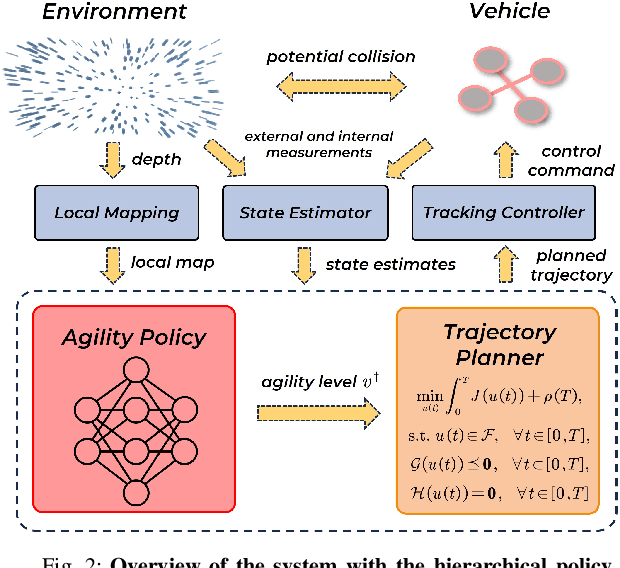
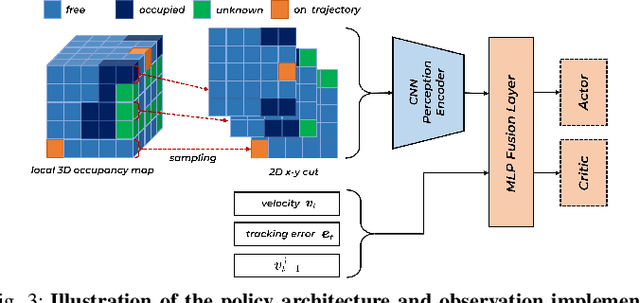
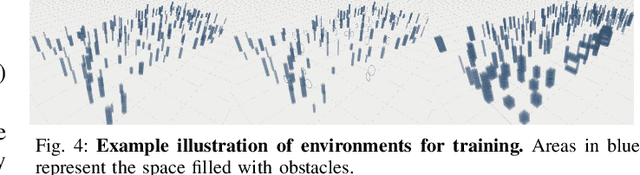
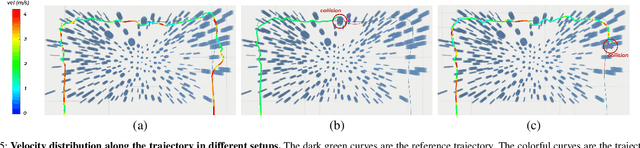
Animals learn to adapt agility of their movements to their capabilities and the environment they operate in. Mobile robots should also demonstrate this ability to combine agility and safety. The aim of this work is to endow flight vehicles with the ability of agility adaptation in prior unknown and partially observable cluttered environments. We propose a hierarchical learning and planning framework where we utilize both trial and error to comprehensively learn an agility policy with the vehicle's observation as the input, and well-established methods of model-based trajectory generation. Technically, we use online model-free reinforcement learning and a pre-training-fine-tuning reward scheme to obtain the deployable policy. The statistical results in simulation demonstrate the advantages of our method over the constant agility baselines and an alternative method in terms of flight efficiency and safety. In particular, the policy leads to intelligent behaviors, such as perception awareness, which distinguish it from other approaches. By deploying the policy to hardware, we verify that these advantages can be brought to the real world.