 Add to Chrome
 Add to Firefox
 Add to Edge
Distilling System 2 into System 1
Jul 09, 2024

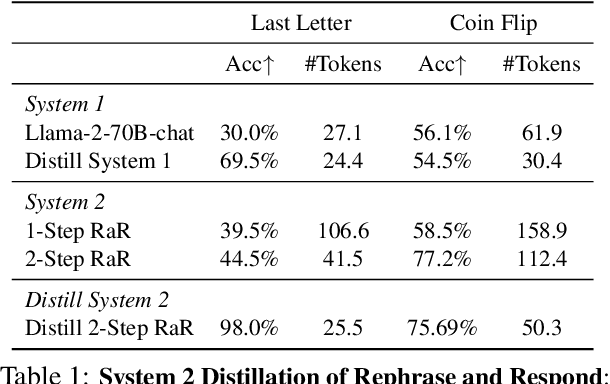
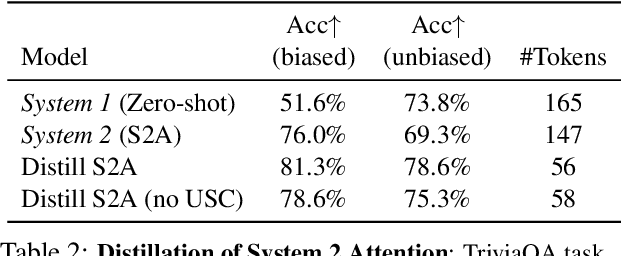

Large language models (LLMs) can spend extra compute during inference to generate intermediate thoughts, which helps to produce better final responses. Since Chain-of-Thought (Wei et al., 2022), many such System 2 techniques have been proposed such as Rephrase and Respond (Deng et al., 2023a), System 2 Attention (Weston and Sukhbaatar, 2023) and Branch-Solve-Merge (Saha et al., 2023). In this work we investigate self-supervised methods to ``compile'' (distill) higher quality outputs from System 2 techniques back into LLM generations without intermediate reasoning token sequences, as this reasoning has been distilled into System 1. We show that several such techniques can be successfully distilled, resulting in improved results compared to the original System 1 performance, and with less inference cost than System 2. We posit that such System 2 distillation will be an important feature of future continually learning AI systems, enabling them to focus System 2 capabilities on the reasoning tasks that they cannot yet do well.

Following Length Constraints in Instructions
Jun 25, 2024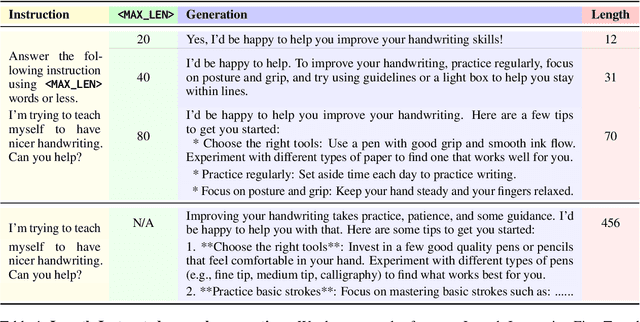


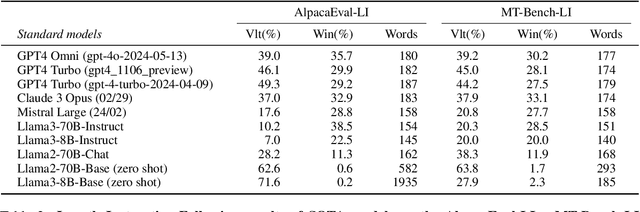
Aligned instruction following models can better fulfill user requests than their unaligned counterparts. However, it has been shown that there is a length bias in evaluation of such models, and that training algorithms tend to exploit this bias by learning longer responses. In this work we show how to train models that can be controlled at inference time with instructions containing desired length constraints. Such models are superior in length instructed evaluations, outperforming standard instruction following models such as GPT4, Llama 3 and Mixtral.
Contextual Position Encoding: Learning to Count What's Important
May 29, 2024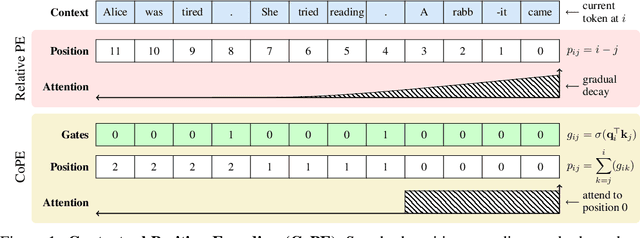


The attention mechanism is a critical component of Large Language Models (LLMs) that allows tokens in a sequence to interact with each other, but is order-invariant. Incorporating position encoding (PE) makes it possible to address by position, such as attending to the i-th token. However, current PE methods use token counts to derive position, and thus cannot generalize to higher levels of abstraction, such as attending to the i-th sentence. In this paper, we propose a new position encoding method, Contextual Position Encoding (CoPE), that allows positions to be conditioned on context by incrementing position only on certain tokens determined by the model. This allows more general position addressing such as attending to the $i$-th particular word, noun, or sentence. We show that CoPE can solve the selective copy, counting and Flip-Flop tasks where popular position embeddings fail, and improves perplexity on language modeling and coding tasks.
Iterative Reasoning Preference Optimization
Apr 30, 2024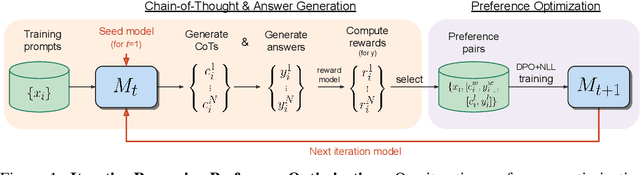
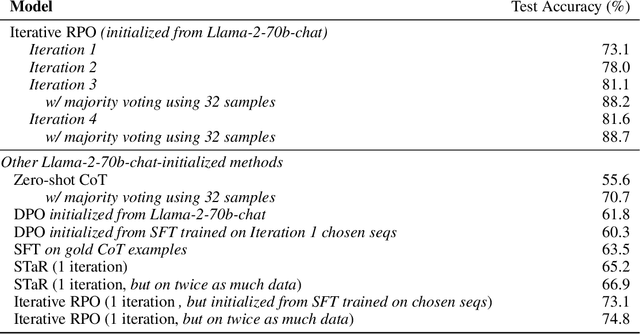
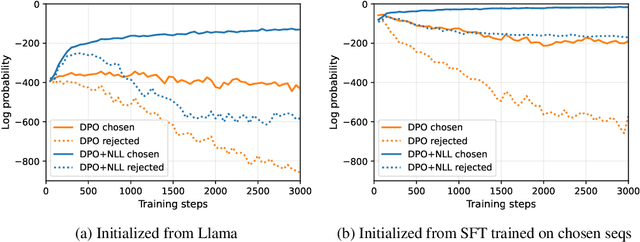
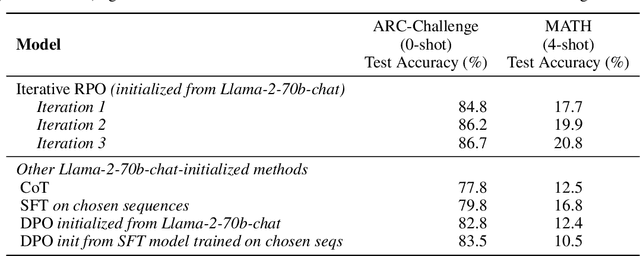
Iterative preference optimization methods have recently been shown to perform well for general instruction tuning tasks, but typically make little improvement on reasoning tasks (Yuan et al., 2024, Chen et al., 2024). In this work we develop an iterative approach that optimizes the preference between competing generated Chain-of-Thought (CoT) candidates by optimizing for winning vs. losing reasoning steps that lead to the correct answer. We train using a modified DPO loss (Rafailov et al., 2023) with an additional negative log-likelihood term, which we find to be crucial. We show reasoning improves across repeated iterations of this scheme. While only relying on examples in the training set, our approach results in increasing accuracy for Llama-2-70B-Chat from 55.6% to 81.6% on GSM8K (and 88.7% with majority voting out of 32 samples), from 12.5% to 20.8% on MATH, and from 77.8% to 86.7% on ARC-Challenge, which outperforms other Llama-2-based models not relying on additionally sourced datasets.
Reverse Training to Nurse the Reversal Curse
Mar 20, 2024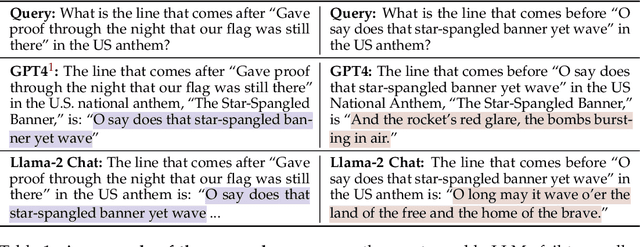

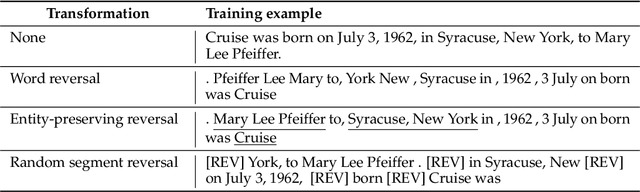
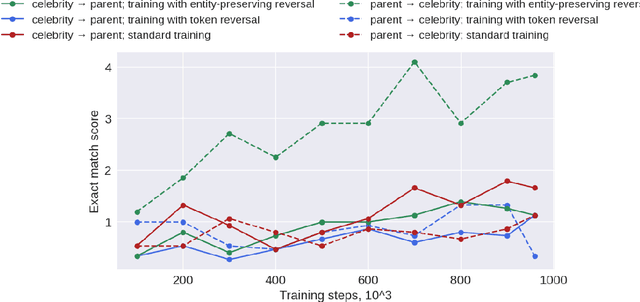
Large language models (LLMs) have a surprising failure: when trained on "A has a feature B", they do not generalize to "B is a feature of A", which is termed the Reversal Curse. Even when training with trillions of tokens this issue still appears due to Zipf's law - hence even if we train on the entire internet. This work proposes an alternative training scheme, called reverse training, whereby all words are used twice, doubling the amount of available tokens. The LLM is trained in both forward and reverse directions by reversing the training strings while preserving (i.e., not reversing) chosen substrings, such as entities. We show that data-matched reverse-trained models provide superior performance to standard models on standard tasks, and compute-matched reverse-trained models provide far superior performance on reversal tasks, helping resolve the reversal curse issue.
Branch-Train-MiX: Mixing Expert LLMs into a Mixture-of-Experts LLM
Mar 12, 2024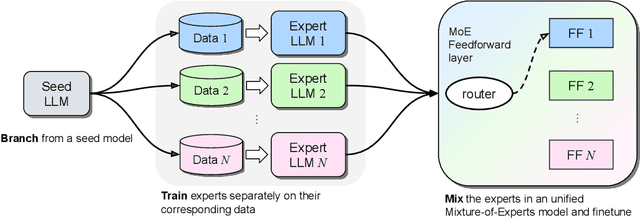
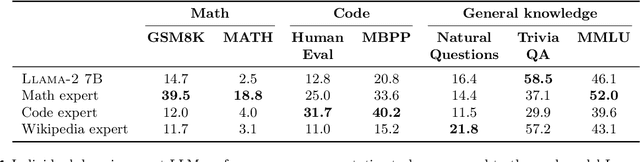

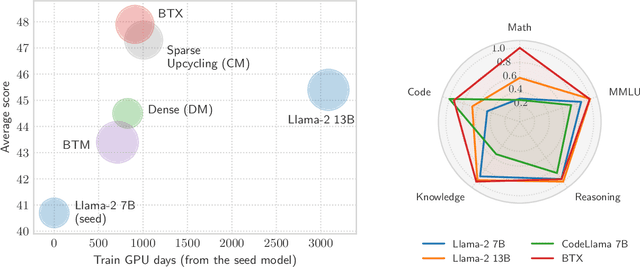
We investigate efficient methods for training Large Language Models (LLMs) to possess capabilities in multiple specialized domains, such as coding, math reasoning and world knowledge. Our method, named Branch-Train-MiX (BTX), starts from a seed model, which is branched to train experts in embarrassingly parallel fashion with high throughput and reduced communication cost. After individual experts are asynchronously trained, BTX brings together their feedforward parameters as experts in Mixture-of-Expert (MoE) layers and averages the remaining parameters, followed by an MoE-finetuning stage to learn token-level routing. BTX generalizes two special cases, the Branch-Train-Merge method, which does not have the MoE finetuning stage to learn routing, and sparse upcycling, which omits the stage of training experts asynchronously. Compared to alternative approaches, BTX achieves the best accuracy-efficiency tradeoff.
TOOLVERIFIER: Generalization to New Tools via Self-Verification
Feb 21, 2024
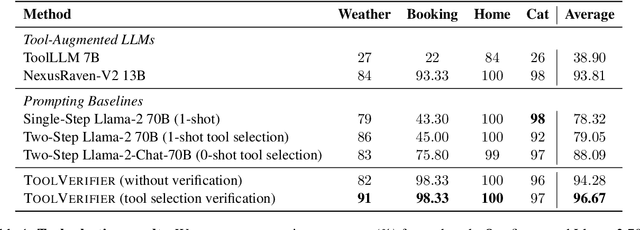
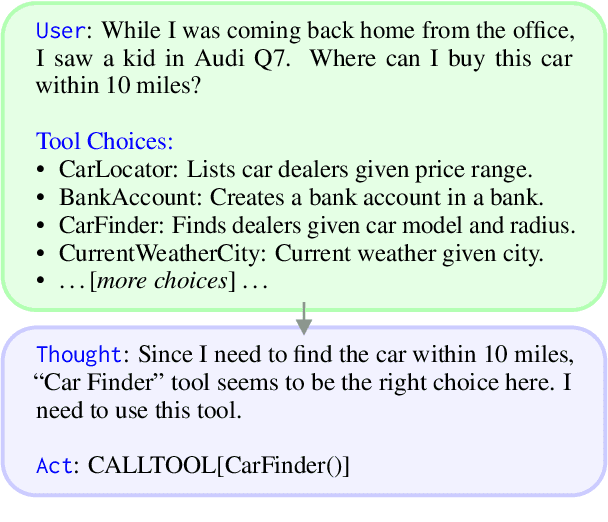
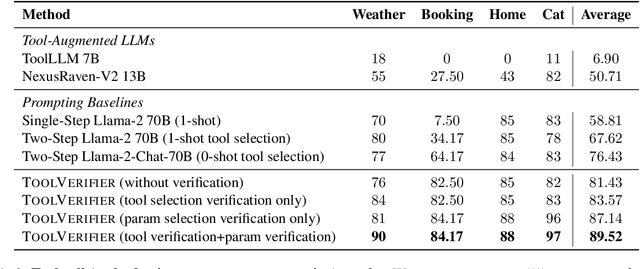
Teaching language models to use tools is an important milestone towards building general assistants, but remains an open problem. While there has been significant progress on learning to use specific tools via fine-tuning, language models still struggle with learning how to robustly use new tools from only a few demonstrations. In this work we introduce a self-verification method which distinguishes between close candidates by self-asking contrastive questions during (1) tool selection; and (2) parameter generation. We construct synthetic, high-quality, self-generated data for this goal using Llama-2 70B, which we intend to release publicly. Extensive experiments on 4 tasks from the ToolBench benchmark, consisting of 17 unseen tools, demonstrate an average improvement of 22% over few-shot baselines, even in scenarios where the distinctions between candidate tools are finely nuanced.
Self-Rewarding Language Models
Jan 18, 2024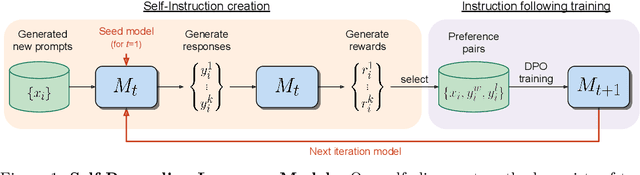
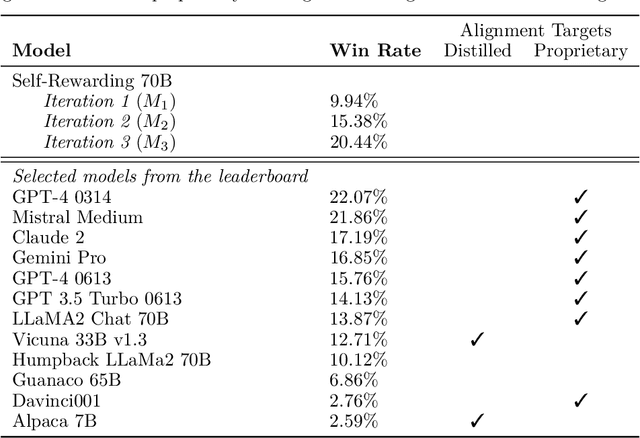
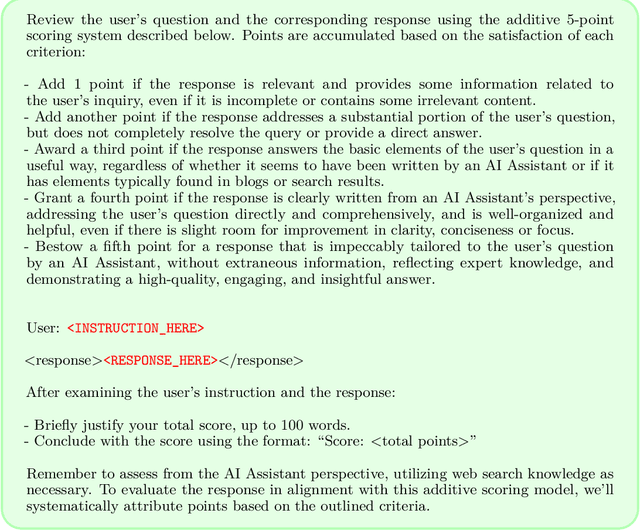
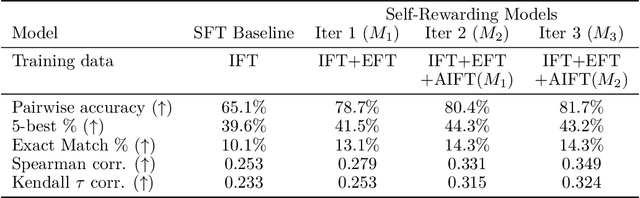
We posit that to achieve superhuman agents, future models require superhuman feedback in order to provide an adequate training signal. Current approaches commonly train reward models from human preferences, which may then be bottlenecked by human performance level, and secondly these separate frozen reward models cannot then learn to improve during LLM training. In this work, we study Self-Rewarding Language Models, where the language model itself is used via LLM-as-a-Judge prompting to provide its own rewards during training. We show that during Iterative DPO training that not only does instruction following ability improve, but also the ability to provide high-quality rewards to itself. Fine-tuning Llama 2 70B on three iterations of our approach yields a model that outperforms many existing systems on the AlpacaEval 2.0 leaderboard, including Claude 2, Gemini Pro, and GPT-4 0613. While only a preliminary study, this work opens the door to the possibility of models that can continually improve in both axes.
Some things are more CRINGE than others: Preference Optimization with the Pairwise Cringe Loss
Dec 27, 2023Practitioners commonly align large language models using pairwise preferences, i.e., given labels of the type response A is preferred to response B for a given input. Perhaps less commonly, methods have also been developed for binary feedback, i.e. training models given labels of type response A is good or bad. We show how an existing performant binary feedback method, the Cringe Loss (Adolphs et al., 2022), can be generalized to the pairwise preference setting using a simple soft margin extension. Pairwise Cringe Loss is straightforward to implement and efficient to train, and we find it outperforms state-of-the-art preference optimization algorithms such as PPO and DPO on the AlpacaFarm benchmark.
System 2 Attention (is something you might need too)
Nov 20, 2023Soft attention in Transformer-based Large Language Models (LLMs) is susceptible to incorporating irrelevant information from the context into its latent representations, which adversely affects next token generations. To help rectify these issues, we introduce System 2 Attention (S2A), which leverages the ability of LLMs to reason in natural language and follow instructions in order to decide what to attend to. S2A regenerates the input context to only include the relevant portions, before attending to the regenerated context to elicit the final response. In experiments, S2A outperforms standard attention-based LLMs on three tasks containing opinion or irrelevant information, QA, math word problems and longform generation, where S2A increases factuality and objectivity, and decreases sycophancy.