 Add to Chrome
 Add to Firefox
 Add to Edge
Creating Impactful Autonomous Driving Datasets: A Strategic Guide from Research Gap to Benchmark
Jul 01, 2026
Well-designed autonomous driving datasets have fundamentally shaped research progress, yet existing literature primarily describes what datasets contain rather than how to strategically design impactful ones. This is especially limiting for small and medium-sized labs and startups that cannot afford to misallocate scarce resources. We argue that impactful dataset creation begins with a diagnosis: whether a research question is blocked by a data problem or an evaluation problem, and proceeds by selecting the minimal data operator(s) that closes the resulting gap, recording new data only when no cheaper operator(s) suffices. We analyze the evolution of major autonomous driving (AD) datasets through this lens and distill a strategic framework spanning gap identification, operator choice, sensor suite design, and annotation strategy. We ground the framework in a running case study of our KITScenes dataset family. The datasets are available at: https://kitscenes.com/

The Road Ahead in Autonomous Driving: The KITScenes Multimodal Dataset
Jun 01, 2026Existing autonomous driving datasets have enabled major progress, but fall short in sensor fidelity, map completeness, or geographic diversity. We present KITScenes Multimodal, a European dataset built around high-fidelity sensors and maps. Our fully synchronized sensor suite combines high-resolution global-shutter cameras, long-range lidar beyond 400m, 4D imaging radar, and redundant GNSS/INS localization. Our HD maps are, to our knowledge, the most complete of any sensor dataset, validated through autonomous driving trials on open-source software. For the first time in a public dataset, all driving-relevant traffic elements, such as traffic lights, are mapped in 3D to a reprojection-accurate level with full topological connectivity. Recorded in cities with irregular street layouts and mixed traffic modes, our dataset complements existing datasets by broadening the available geographic diversity. We also introduce four benchmarks, each advancing spatial learning for embodied AI: online HD map construction, long-range depth estimation, novel view synthesis, and end-to-end driving. Project page: https://kitscenes.com/
Mosaic: An Extensible Framework for Composing Rule-Based and Learned Motion Planners
Apr 15, 2026Safe and explainable motion planning remains a central challenge in autonomous driving. While rule-based planners offer predictable and explainable behavior, they often fail to grasp the complexity and uncertainty of real-world traffic. Conversely, learned planners exhibit strong adaptability but suffer from reduced transparency and occasional safety violations. We introduce Mosaic, an extensible framework for structured decision-making that integrates both paradigms through arbitration graphs. By decoupling trajectory verification and scoring from the generation of trajectories by individual planners, every decision becomes transparent and traceable. Trajectory verification at a higher level introduces redundancy between the planners, limiting emergency braking to the rare case where all planners fail to produce a valid trajectory. Through unified scoring and optimal trajectory selection, rule-based and learned planners with complementary strengths and weaknesses can be combined to yield the best of both worlds. In experimental evaluation on nuPlan, Mosaic achieves 95.48 CLS-NR and 93.98 CLS-R on the Val14 closed-loop benchmark, setting a new state of the art, while reducing at-fault collisions by 30% compared to either planner in isolation. On the interPlan benchmark, focused on highly interactive and difficult scenarios, Mosaic scores 54.30 CLS-R, outperforming its best constituent planner by 23.3% - all without retraining or requiring additional data. The code is available at github.com/KIT-MRT/mosaic.
LongTail Driving Scenarios with Reasoning Traces: The KITScenes LongTail Dataset
Mar 24, 2026In real-world domains such as self-driving, generalization to rare scenarios remains a fundamental challenge. To address this, we introduce a new dataset designed for end-to-end driving that focuses on long-tail driving events. We provide multi-view video data, trajectories, high-level instructions, and detailed reasoning traces, facilitating in-context learning and few-shot generalization. The resulting benchmark for multimodal models, such as VLMs and VLAs, goes beyond safety and comfort metrics by evaluating instruction following and semantic coherence between model outputs. The multilingual reasoning traces in English, Spanish, and Chinese are from domain experts with diverse cultural backgrounds. Thus, our dataset is a unique resource for studying how different forms of reasoning affect driving competence. Our dataset is available at: https://hf.co/datasets/kit-mrt/kitscenes-longtail
MapGCLR: Geospatial Contrastive Learning of Representations for Online Vectorized HD Map Construction
Mar 11, 2026Autonomous vehicles rely on map information to understand the world around them. However, the creation and maintenance of offline high-definition (HD) maps remains costly. A more scalable alternative lies in online HD map construction, which only requires map annotations at training time. To further reduce the need for annotating vast training labels, self-supervised training provides an alternative. This work focuses on improving the latent birds-eye-view (BEV) feature grid representation within a vectorized online HD map construction model by enforcing geospatial consistency between overlapping BEV feature grids as part of a contrastive loss function. To ensure geospatial overlap for contrastive pairs, we introduce an approach to analyze the overlap between traversals within a given dataset and generate subsidiary dataset splits following adjustable multi-traversal requirements. We train the same model supervised using a reduced set of single-traversal labeled data and self-supervised on a broader unlabeled set of data following our multi-traversal requirements, effectively implementing a semi-supervised approach. Our approach outperforms the supervised baseline across the board, both quantitatively in terms of the downstream tasks vectorized map perception performance and qualitatively in terms of segmentation in the principal component analysis (PCA) visualization of the BEV feature space.
Impact of Localization Errors on Label Quality for Online HD Map Construction
Mar 03, 2026High-definition (HD) maps are crucial for autonomous vehicles, but their creation and maintenance is very costly. This motivates the idea of online HD map construction. To provide a continuous large-scale stream of training data, existing HD maps can be used as labels for onboard sensor data from consumer vehicle fleets. However, compared to current, well curated HD map perception datasets, this fleet data suffers from localization errors, resulting in distorted map labels. We introduce three kinds of localization errors, Ramp, Gaussian, and Perlin noise, to examine their influence on generated map labels. We train a variant of MapTRv2, a state-of-the-art online HD map construction model, on the Argoverse 2 dataset with various levels of localization errors and assess the degradation of model performance. Since localization errors affect distant labels more severely, but are also less significant to driving performance, we introduce a distance-based map construction metric. Our experiments reveal that localization noise affects the model performance significantly. We demonstrate that errors in heading angle exert a more substantial influence than position errors, as angle errors result in a greater distortion of labels as distance to the vehicle increases. Furthermore, we can demonstrate that the model benefits from non-distorted ground truth (GT) data and that the performance decreases more than linearly with the increase in noisy data. Our study additionally provides a qualitative evaluation of the extent to which localization errors influence the construction of HD maps.
XD-MAP: Cross-Modal Domain Adaptation using Semantic Parametric Mapping
Jan 20, 2026Until open-world foundation models match the performance of specialized approaches, the effectiveness of deep learning models remains heavily dependent on dataset availability. Training data must align not only with the target object categories but also with the sensor characteristics and modalities. To bridge the gap between available datasets and deployment domains, domain adaptation strategies are widely used. In this work, we propose a novel approach to transferring sensor-specific knowledge from an image dataset to LiDAR, an entirely different sensing domain. Our method XD-MAP leverages detections from a neural network on camera images to create a semantic parametric map. The map elements are modeled to produce pseudo labels in the target domain without any manual annotation effort. Unlike previous domain transfer approaches, our method does not require direct overlap between sensors and enables extending the angular perception range from a front-view camera to a full 360 view. On our large-scale road feature dataset, XD-MAP outperforms single shot baseline approaches by +19.5 mIoU for 2D semantic segmentation, +19.5 PQth for 2D panoptic segmentation, and +32.3 mIoU in 3D semantic segmentation. The results demonstrate the effectiveness of our approach achieving strong performance on LiDAR data without any manual labeling.
SDTagNet: Leveraging Text-Annotated Navigation Maps for Online HD Map Construction
Jun 10, 2025Autonomous vehicles rely on detailed and accurate environmental information to operate safely. High definition (HD) maps offer a promising solution, but their high maintenance cost poses a significant barrier to scalable deployment. This challenge is addressed by online HD map construction methods, which generate local HD maps from live sensor data. However, these methods are inherently limited by the short perception range of onboard sensors. To overcome this limitation and improve general performance, recent approaches have explored the use of standard definition (SD) maps as prior, which are significantly easier to maintain. We propose SDTagNet, the first online HD map construction method that fully utilizes the information of widely available SD maps, like OpenStreetMap, to enhance far range detection accuracy. Our approach introduces two key innovations. First, in contrast to previous work, we incorporate not only polyline SD map data with manually selected classes, but additional semantic information in the form of textual annotations. In this way, we enrich SD vector map tokens with NLP-derived features, eliminating the dependency on predefined specifications or exhaustive class taxonomies. Second, we introduce a point-level SD map encoder together with orthogonal element identifiers to uniformly integrate all types of map elements. Experiments on Argoverse 2 and nuScenes show that this boosts map perception performance by up to +5.9 mAP (+45%) w.r.t. map construction without priors and up to +3.2 mAP (+20%) w.r.t. previous approaches that already use SD map priors. Code is available at https://github.com/immel-f/SDTagNet
Human-Aided Trajectory Planning for Automated Vehicles through Teleoperation and Arbitration Graphs
Feb 04, 2025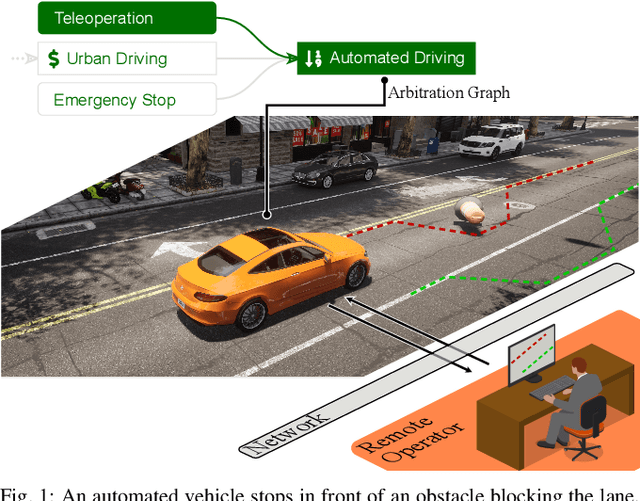

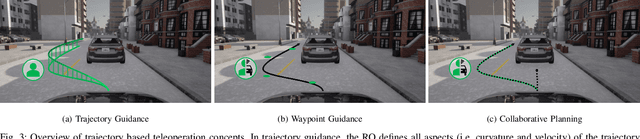
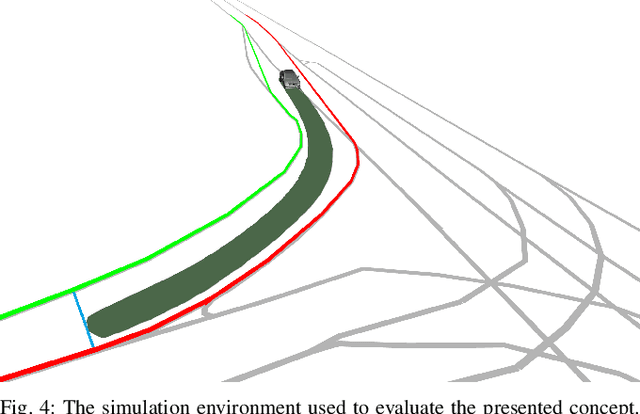
Teleoperation enables remote human support of automated vehicles in scenarios where the automation is not able to find an appropriate solution. Remote assistance concepts, where operators provide discrete inputs to aid specific automation modules like planning, is gaining interest due to its reduced workload on the human remote operator and improved safety. However, these concepts are challenging to implement and maintain due to their deep integration and interaction with the automated driving system. In this paper, we propose a solution to facilitate the implementation of remote assistance concepts that intervene on planning level and extend the operational design domain of the vehicle at runtime. Using arbitration graphs, a modular decision-making framework, we integrate remote assistance into an existing automated driving system without modifying the original software components. Our simulative implementation demonstrates this approach in two use cases, allowing operators to adjust planner constraints and enable trajectory generation beyond nominal operational design domains.
M3TR: Generalist HD Map Construction with Variable Map Priors
Nov 15, 2024Autonomous vehicles require road information for their operation, usually in form of HD maps. Since offline maps eventually become outdated or may only be partially available, online HD map construction methods have been proposed to infer map information from live sensor data. A key issue remains how to exploit such partial or outdated map information as a prior. We introduce M3TR (Multi-Masking Map Transformer), a generalist approach for HD map construction both with and without map priors. We address shortcomings in ground truth generation for Argoverse 2 and nuScenes and propose the first realistic scenarios with semantically diverse map priors. Examining various query designs, we use an improved method for integrating prior map elements into a HD map construction model, increasing performance by +4.3 mAP. Finally, we show that training across all prior scenarios yields a single Generalist model, whose performance is on par with previous Expert models that can handle only one specific type of map prior. M3TR thus is the first model capable of leveraging variable map priors, making it suitable for real-world deployment. Code is available at https://github.com/immel-f/m3tr