 Add to Chrome
 Add to Firefox
 Add to Edge
Generative AI for End-to-End Limit Order Book Modelling: A Token-Level Autoregressive Generative Model of Message Flow Using a Deep State Space Network
Aug 23, 2023
Developing a generative model of realistic order flow in financial markets is a challenging open problem, with numerous applications for market participants. Addressing this, we propose the first end-to-end autoregressive generative model that generates tokenized limit order book (LOB) messages. These messages are interpreted by a Jax-LOB simulator, which updates the LOB state. To handle long sequences efficiently, the model employs simplified structured state-space layers to process sequences of order book states and tokenized messages. Using LOBSTER data of NASDAQ equity LOBs, we develop a custom tokenizer for message data, converting groups of successive digits to tokens, similar to tokenization in large language models. Out-of-sample results show promising performance in approximating the data distribution, as evidenced by low model perplexity. Furthermore, the mid-price returns calculated from the generated order flow exhibit a significant correlation with the data, indicating impressive conditional forecast performance. Due to the granularity of generated data, and the accuracy of the model, it offers new application areas for future work beyond forecasting, e.g. acting as a world model in high-frequency financial reinforcement learning applications. Overall, our results invite the use and extension of the model in the direction of autoregressive large financial models for the generation of high-frequency financial data and we commit to open-sourcing our code to facilitate future research.

Unbiased Decisions Reduce Regret: Adversarial Domain Adaptation for the Bank Loan Problem
Aug 15, 2023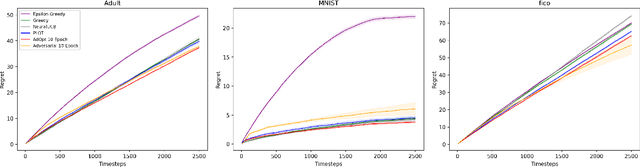

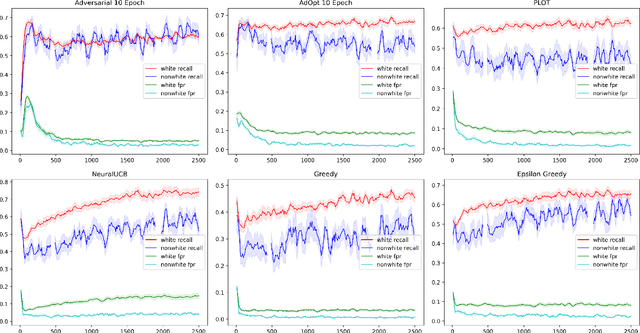
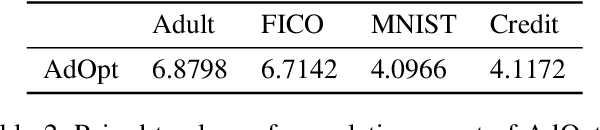
In many real world settings binary classification decisions are made based on limited data in near real-time, e.g. when assessing a loan application. We focus on a class of these problems that share a common feature: the true label is only observed when a data point is assigned a positive label by the principal, e.g. we only find out whether an applicant defaults if we accepted their loan application. As a consequence, the false rejections become self-reinforcing and cause the labelled training set, that is being continuously updated by the model decisions, to accumulate bias. Prior work mitigates this effect by injecting optimism into the model, however this comes at the cost of increased false acceptance rate. We introduce adversarial optimism (AdOpt) to directly address bias in the training set using adversarial domain adaptation. The goal of AdOpt is to learn an unbiased but informative representation of past data, by reducing the distributional shift between the set of accepted data points and all data points seen thus far. AdOpt significantly exceeds state-of-the-art performance on a set of challenging benchmark problems. Our experiments also provide initial evidence that the introduction of adversarial domain adaptation improves fairness in this setting.
Learning to Communicate using Contrastive Learning
Jul 03, 2023Communication is a powerful tool for coordination in multi-agent RL. But inducing an effective, common language is a difficult challenge, particularly in the decentralized setting. In this work, we introduce an alternative perspective where communicative messages sent between agents are considered as different incomplete views of the environment state. By examining the relationship between messages sent and received, we propose to learn to communicate using contrastive learning to maximize the mutual information between messages of a given trajectory. In communication-essential environments, our method outperforms previous work in both performance and learning speed. Using qualitative metrics and representation probing, we show that our method induces more symmetric communication and captures global state information from the environment. Overall, we show the power of contrastive learning and the importance of leveraging messages as encodings for effective communication.
A Model-Based Solution to the Offline Multi-Agent Reinforcement Learning Coordination Problem
May 26, 2023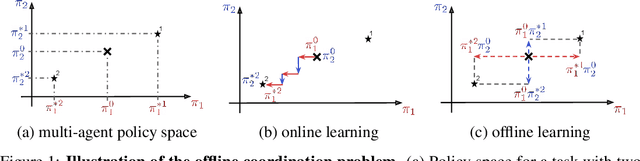

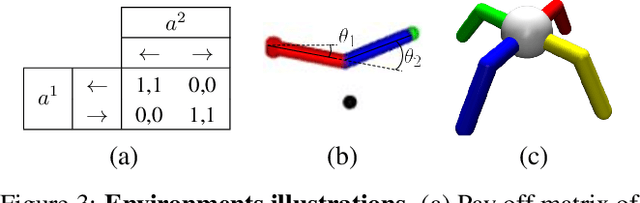
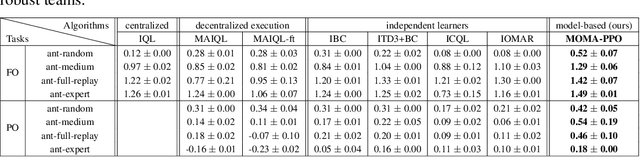
Training multiple agents to coordinate is an important problem with applications in robotics, game theory, economics, and social sciences. However, most existing Multi-Agent Reinforcement Learning (MARL) methods are online and thus impractical for real-world applications in which collecting new interactions is costly or dangerous. While these algorithms should leverage offline data when available, doing so gives rise to the offline coordination problem. Specifically, we identify and formalize the strategy agreement (SA) and the strategy fine-tuning (SFT) challenges, two coordination issues at which current offline MARL algorithms fail. To address this setback, we propose a simple model-based approach that generates synthetic interaction data and enables agents to converge on a strategy while fine-tuning their policies accordingly. Our resulting method, Model-based Offline Multi-Agent Proximal Policy Optimization (MOMA-PPO), outperforms the prevalent learning methods in challenging offline multi-agent MuJoCo tasks even under severe partial observability and with learned world models.
Arbitrary Order Meta-Learning with Simple Population-Based Evolution
Mar 16, 2023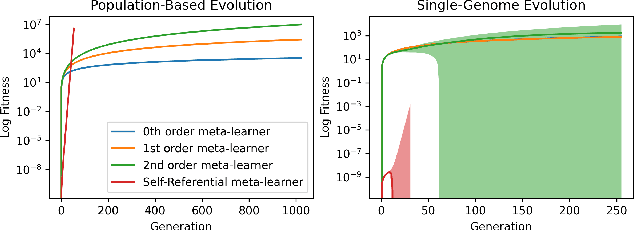
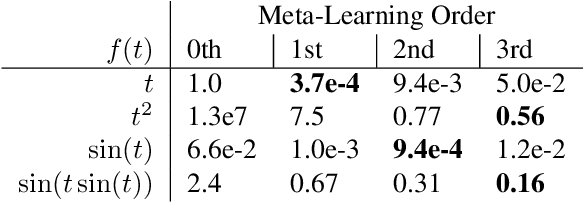
Meta-learning, the notion of learning to learn, enables learning systems to quickly and flexibly solve new tasks. This usually involves defining a set of outer-loop meta-parameters that are then used to update a set of inner-loop parameters. Most meta-learning approaches use complicated and computationally expensive bi-level optimisation schemes to update these meta-parameters. Ideally, systems should perform multiple orders of meta-learning, i.e. to learn to learn to learn and so on, to accelerate their own learning. Unfortunately, standard meta-learning techniques are often inappropriate for these higher-order meta-parameters because the meta-optimisation procedure becomes too complicated or unstable. Inspired by the higher-order meta-learning we observe in real-world evolution, we show that using simple population-based evolution implicitly optimises for arbitrarily-high order meta-parameters. First, we theoretically prove and empirically show that population-based evolution implicitly optimises meta-parameters of arbitrarily-high order in a simple setting. We then introduce a minimal self-referential parameterisation, which in principle enables arbitrary-order meta-learning. Finally, we show that higher-order meta-learning improves performance on time series forecasting tasks.
Structured State Space Models for In-Context Reinforcement Learning
Mar 09, 2023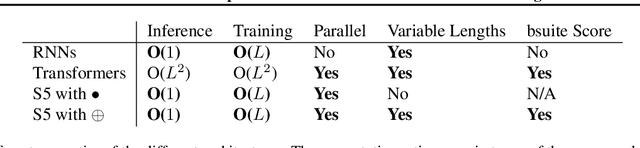
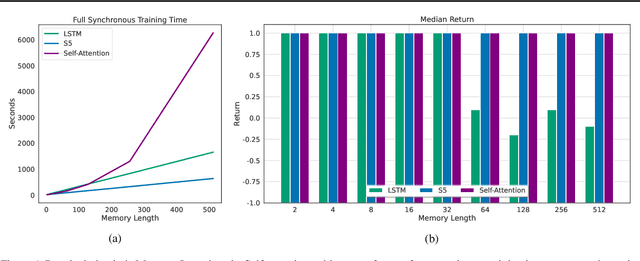
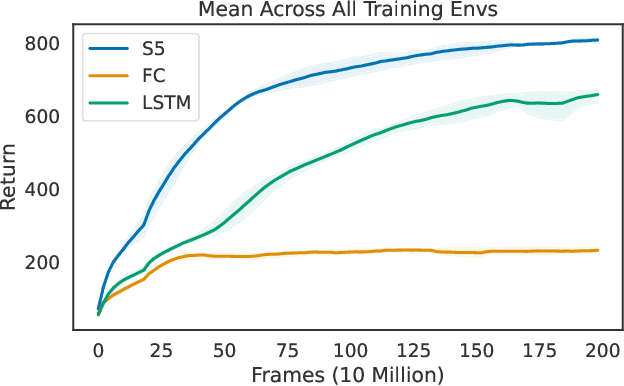
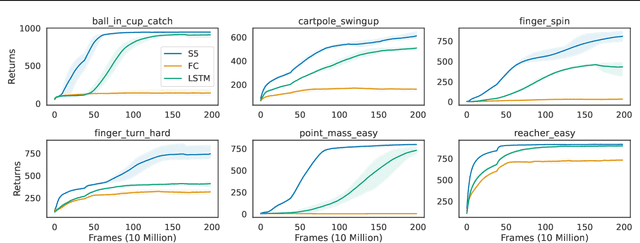
Structured state space sequence (S4) models have recently achieved state-of-the-art performance on long-range sequence modeling tasks. These models also have fast inference speeds and parallelisable training, making them potentially useful in many reinforcement learning settings. We propose a modification to a variant of S4 that enables us to initialise and reset the hidden state in parallel, allowing us to tackle reinforcement learning tasks. We show that our modified architecture runs asymptotically faster than Transformers and performs better than LSTM models on a simple memory-based task. Then, by leveraging the model's ability to handle long-range sequences, we achieve strong performance on a challenging meta-learning task in which the agent is given a randomly-sampled continuous control environment, combined with a randomly-sampled linear projection of the environment's observations and actions. Furthermore, we show the resulting model can adapt to out-of-distribution held-out tasks. Overall, the results presented in this paper suggest that the S4 models are a strong contender for the default architecture used for in-context reinforcement learning
MAESTRO: Open-Ended Environment Design for Multi-Agent Reinforcement Learning
Mar 06, 2023Open-ended learning methods that automatically generate a curriculum of increasingly challenging tasks serve as a promising avenue toward generally capable reinforcement learning agents. Existing methods adapt curricula independently over either environment parameters (in single-agent settings) or co-player policies (in multi-agent settings). However, the strengths and weaknesses of co-players can manifest themselves differently depending on environmental features. It is thus crucial to consider the dependency between the environment and co-player when shaping a curriculum in multi-agent domains. In this work, we use this insight and extend Unsupervised Environment Design (UED) to multi-agent environments. We then introduce Multi-Agent Environment Design Strategist for Open-Ended Learning (MAESTRO), the first multi-agent UED approach for two-player zero-sum settings. MAESTRO efficiently produces adversarial, joint curricula over both environments and co-players and attains minimax-regret guarantees at Nash equilibrium. Our experiments show that MAESTRO outperforms a number of strong baselines on competitive two-player games, spanning discrete and continuous control settings.
Similarity-based Cooperation
Nov 26, 2022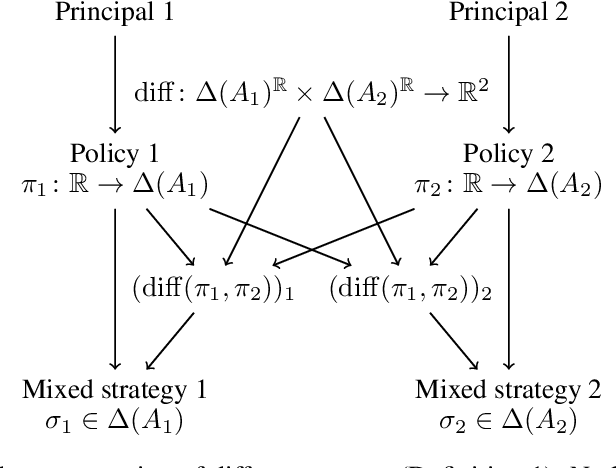
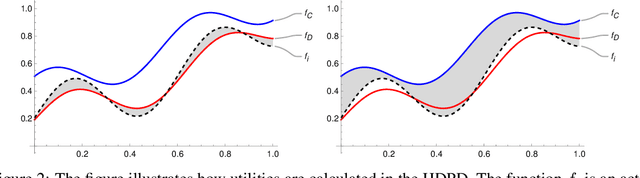
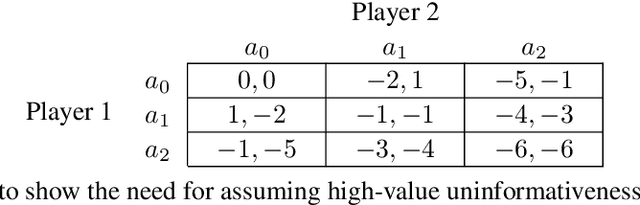
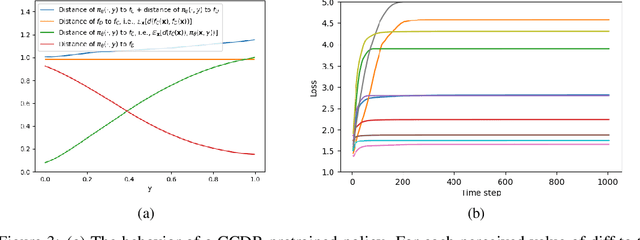
As machine learning agents act more autonomously in the world, they will increasingly interact with each other. Unfortunately, in many social dilemmas like the one-shot Prisoner's Dilemma, standard game theory predicts that ML agents will fail to cooperate with each other. Prior work has shown that one way to enable cooperative outcomes in the one-shot Prisoner's Dilemma is to make the agents mutually transparent to each other, i.e., to allow them to access one another's source code (Rubinstein 1998, Tennenholtz 2004) -- or weights in the case of ML agents. However, full transparency is often unrealistic, whereas partial transparency is commonplace. Moreover, it is challenging for agents to learn their way to cooperation in the full transparency setting. In this paper, we introduce a more realistic setting in which agents only observe a single number indicating how similar they are to each other. We prove that this allows for the same set of cooperative outcomes as the full transparency setting. We also demonstrate experimentally that cooperation can be learned using simple ML methods.
Adversarial Cheap Talk
Nov 20, 2022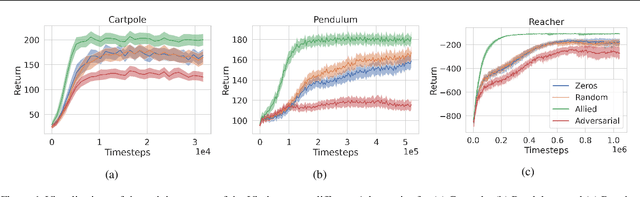
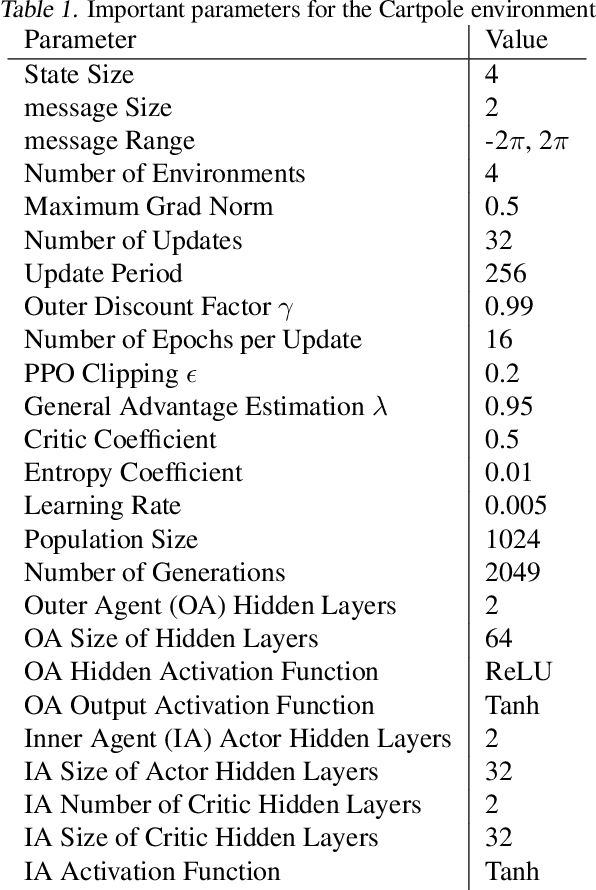
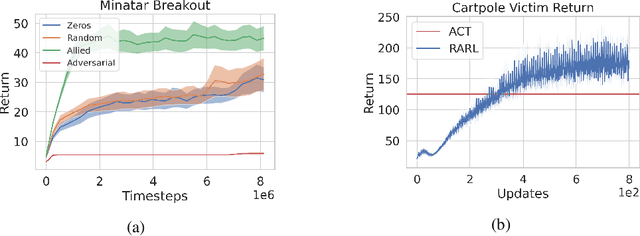
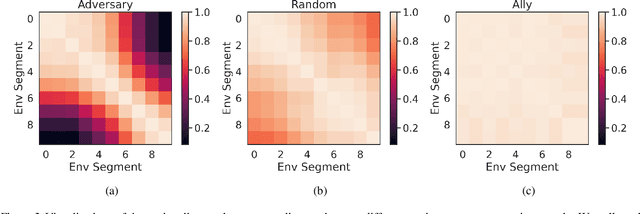
Adversarial attacks in reinforcement learning (RL) often assume highly-privileged access to the victim's parameters, environment, or data. Instead, this paper proposes a novel adversarial setting called a Cheap Talk MDP in which an Adversary can merely append deterministic messages to the Victim's observation, resulting in a minimal range of influence. The Adversary cannot occlude ground truth, influence underlying environment dynamics or reward signals, introduce non-stationarity, add stochasticity, see the Victim's actions, or access their parameters. Additionally, we present a simple meta-learning algorithm called Adversarial Cheap Talk (ACT) to train Adversaries in this setting. We demonstrate that an Adversary trained with ACT can still significantly influence the Victim's training and testing performance, despite the highly constrained setting. Affecting train-time performance reveals a new attack vector and provides insight into the success and failure modes of existing RL algorithms. More specifically, we show that an ACT Adversary is capable of harming performance by interfering with the learner's function approximation, or instead helping the Victim's performance by outputting useful features. Finally, we show that an ACT Adversary can manipulate messages during train-time to directly and arbitrarily control the Victim at test-time.
Perfectly Secure Steganography Using Minimum Entropy Coupling
Oct 24, 2022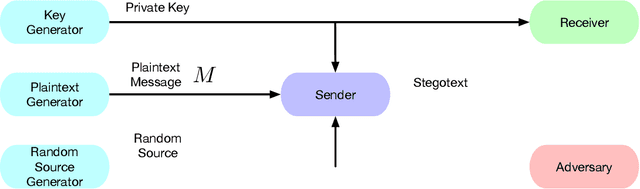
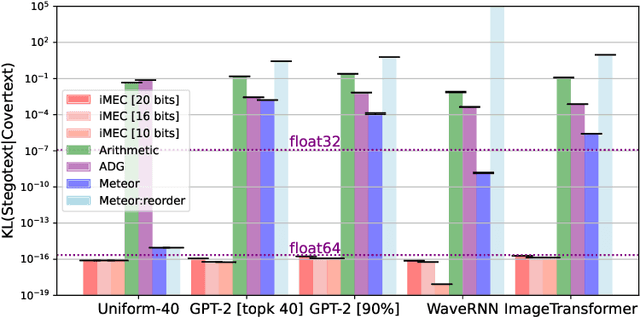
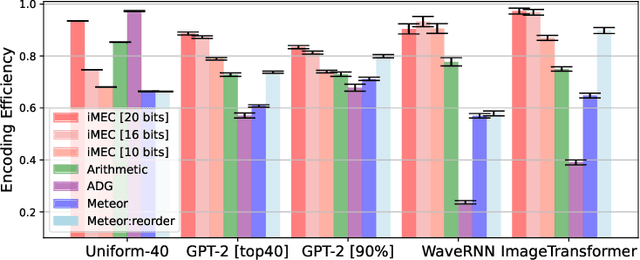
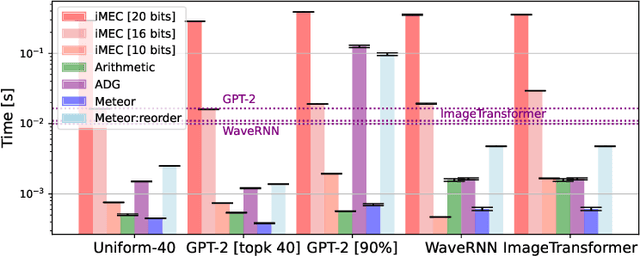
Steganography is the practice of encoding secret information into innocuous content in such a manner that an adversarial third party would not realize that there is hidden meaning. While this problem has classically been studied in security literature, recent advances in generative models have led to a shared interest among security and machine learning researchers in developing scalable steganography techniques. In this work, we show that a steganography procedure is perfectly secure under \citet{cachin_perfect}'s information theoretic-model of steganography if and only if it is induced by a coupling. Furthermore, we show that, among perfectly secure procedures, a procedure is maximally efficient if and only if it is induced by a minimum entropy coupling. These insights yield what are, to the best of our knowledge, the first steganography algorithms to achieve perfect security guarantees with non-trivial efficiency; additionally, these algorithms are highly scalable. To provide empirical validation, we compare a minimum entropy coupling-based approach to three modern baselines -- arithmetic coding, Meteor, and adaptive dynamic grouping -- using GPT-2 and WaveRNN as communication channels. We find that the minimum entropy coupling-based approach yields superior encoding efficiency, despite its stronger security constraints. In aggregate, these results suggest that it may be natural to view information-theoretic steganography through the lens of minimum entropy coupling.