 Add to Chrome
 Add to Firefox
 Add to Edge
Learning All-Terrain Locomotion for a Planetary Rover with Actively Articulated Suspension
Jun 05, 2026
This paper presents ERNEST, a four-wheeled planetary rover concept equipped with a two-degree-of-freedom Active Gimbal Suspension that combines yaw and roll actuation to enable wheel reconfiguration, steering, and active load redistribution. A single neural network controller, trained to track a desired path across challenging terrain, fully unlocks the capabilities of this actuated suspension system for autonomous obstacle negotiation. A reinforcement learning framework is developed using the high-fidelity DARTS simulation engine, which combines rigid-contact dynamics and Bekker-Wong terramechanics, enabling the emergence of locomotion strategies adapted to loose-soil conditions. To obtain a single unified controller across heterogeneous terrains, a policy consolidation strategy merges the experience of terrain-specialized agents into one neural network, eliminating the need for explicit terrain classification and controller switching. The resulting controller operates on a combination of proprioceptive and exteroceptive feedback, including sparse stereo-derived terrain elevation, chassis attitude, joint states, and force-torque measurements. Zero-shot transfer to the physical rover is achieved through domain randomization, sensor noise injection, and model-to-real system identification. Experimental results demonstrate autonomous traversal of rock fields, a bump trap, a wheel-high step, sand ripples, and sandy slopes. On a 20° sandy slope, the learned controller reduces the cost of transport by 37% on dry sand despite the additional actuation, and achieves superior performance on wet sand where the passive suspension becomes completely immobilized.

Simulation Distillation: Pretraining World Models in Simulation for Rapid Real-World Adaptation
Mar 16, 2026Simulation-to-real transfer remains a central challenge in robotics, as mismatches between simulated and real-world dynamics often lead to failures. While reinforcement learning offers a principled mechanism for adaptation, existing sim-to-real finetuning methods struggle with exploration and long-horizon credit assignment in the low-data regimes typical of real-world robotics. We introduce Simulation Distillation (SimDist), a sim-to-real framework that distills structural priors from a simulator into a latent world model and enables rapid real-world adaptation via online planning and supervised dynamics finetuning. By transferring reward and value models directly from simulation, SimDist provides dense planning signals from raw perception without requiring value learning during deployment. As a result, real-world adaptation reduces to short-horizon system identification, avoiding long-horizon credit assignment and enabling fast, stable improvement. Across precise manipulation and quadruped locomotion tasks, SimDist substantially outperforms prior methods in data efficiency, stability, and final performance. Project website and code: https://sim-dist.github.io/
Meta-Learning Online Dynamics Model Adaptation in Off-Road Autonomous Driving
Apr 23, 2025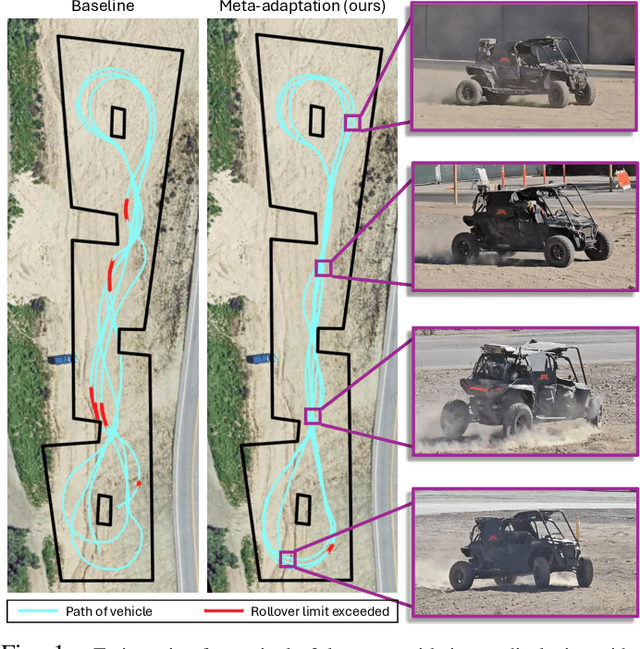
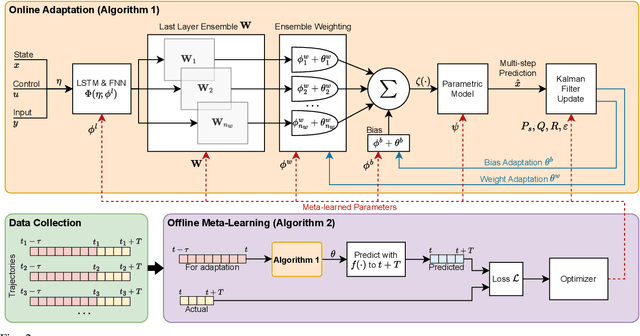
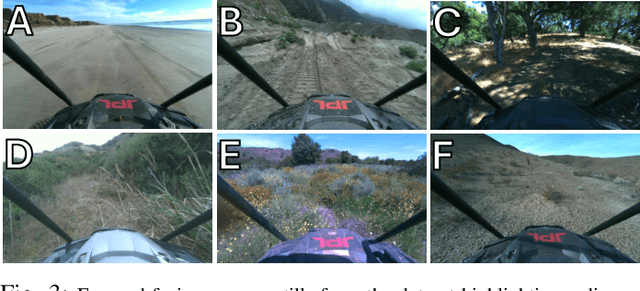
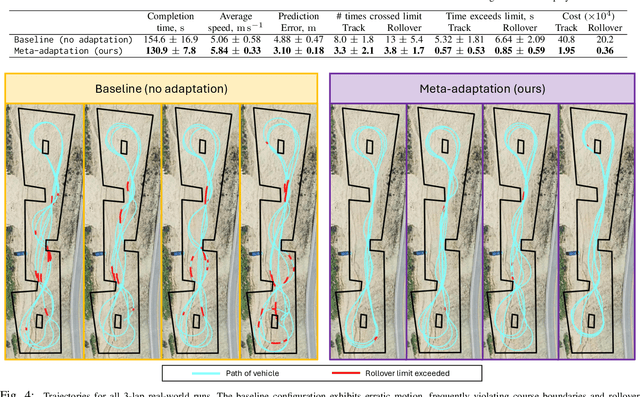
High-speed off-road autonomous driving presents unique challenges due to complex, evolving terrain characteristics and the difficulty of accurately modeling terrain-vehicle interactions. While dynamics models used in model-based control can be learned from real-world data, they often struggle to generalize to unseen terrain, making real-time adaptation essential. We propose a novel framework that combines a Kalman filter-based online adaptation scheme with meta-learned parameters to address these challenges. Offline meta-learning optimizes the basis functions along which adaptation occurs, as well as the adaptation parameters, while online adaptation dynamically adjusts the onboard dynamics model in real time for model-based control. We validate our approach through extensive experiments, including real-world testing on a full-scale autonomous off-road vehicle, demonstrating that our method outperforms baseline approaches in prediction accuracy, performance, and safety metrics, particularly in safety-critical scenarios. Our results underscore the effectiveness of meta-learned dynamics model adaptation, advancing the development of reliable autonomous systems capable of navigating diverse and unseen environments. Video is available at: https://youtu.be/cCKHHrDRQEA
Learning to Walk from Three Minutes of Real-World Data with Semi-structured Dynamics Models
Oct 11, 2024Traditionally, model-based reinforcement learning (MBRL) methods exploit neural networks as flexible function approximators to represent a priori unknown environment dynamics. However, training data are typically scarce in practice, and these black-box models often fail to generalize. Modeling architectures that leverage known physics can substantially reduce the complexity of system-identification, but break down in the face of complex phenomena such as contact. We introduce a novel framework for learning semi-structured dynamics models for contact-rich systems which seamlessly integrates structured first principles modeling techniques with black-box auto-regressive models. Specifically, we develop an ensemble of probabilistic models to estimate external forces, conditioned on historical observations and actions, and integrate these predictions using known Lagrangian dynamics. With this semi-structured approach, we can make accurate long-horizon predictions with substantially less data than prior methods. We leverage this capability and propose Semi-Structured Reinforcement Learning (SSRL) a simple model-based learning framework which pushes the sample complexity boundary for real-world learning. We validate our approach on a real-world Unitree Go1 quadruped robot, learning dynamic gaits -- from scratch -- on both hard and soft surfaces with just a few minutes of real-world data. Video and code are available at: https://sites.google.com/utexas.edu/ssrl
Active Inverse Learning in Stackelberg Trajectory Games
Aug 15, 2023Game-theoretic inverse learning is the problem of inferring the players' objectives from their actions. We formulate an inverse learning problem in a Stackelberg game between a leader and a follower, where each player's action is the trajectory of a dynamical system. We propose an active inverse learning method for the leader to infer which hypothesis among a finite set of candidates describes the follower's objective function. Instead of using passively observed trajectories like existing methods, the proposed method actively maximizes the differences in the follower's trajectories under different hypotheses to accelerate the leader's inference. We demonstrate the proposed method in a receding-horizon repeated trajectory game. Compared with uniformly random inputs, the leader inputs provided by the proposed method accelerate the convergence of the probability of different hypotheses conditioned on the follower's trajectory by orders of magnitude.
Feedback is All You Need: Real-World Reinforcement Learning with Approximate Physics-Based Models
Jul 16, 2023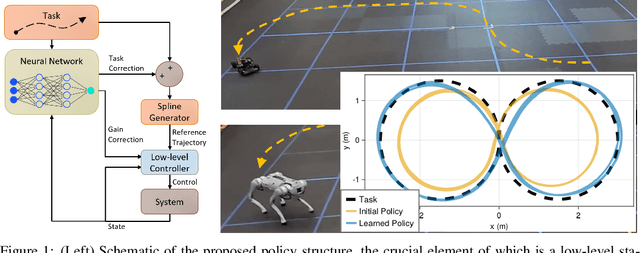
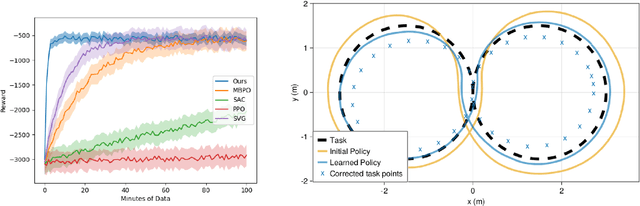
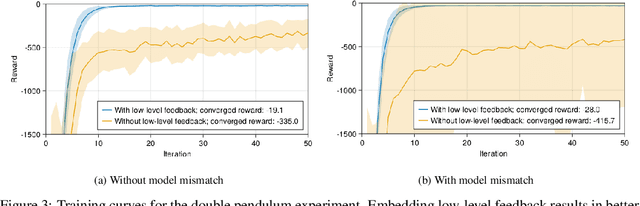
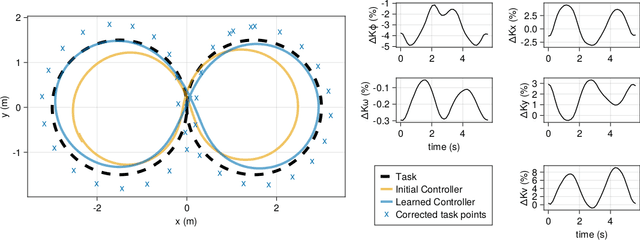
We focus on developing efficient and reliable policy optimization strategies for robot learning with real-world data. In recent years, policy gradient methods have emerged as a promising paradigm for training control policies in simulation. However, these approaches often remain too data inefficient or unreliable to train on real robotic hardware. In this paper we introduce a novel policy gradient-based policy optimization framework which systematically leverages a (possibly highly simplified) first-principles model and enables learning precise control policies with limited amounts of real-world data. Our approach $1)$ uses the derivatives of the model to produce sample-efficient estimates of the policy gradient and $2)$ uses the model to design a low-level tracking controller, which is embedded in the policy class. Theoretical analysis provides insight into how the presence of this feedback controller addresses overcomes key limitations of stand-alone policy gradient methods, while hardware experiments with a small car and quadruped demonstrate that our approach can learn precise control strategies reliably and with only minutes of real-world data.