 Add to Chrome
 Add to Firefox
 Add to Edge
Brevity is the Soul of Inference Efficiency: Inducing Concision in VLMs via Data Curation
Jun 24, 2026
Inference efficiency is typically pursued by shrinking the model: distillation, pruning, quantization, and sparse routing each lower per-token cost while treating token count as fixed. But output length has been inflating, and it is precisely the component the standard toolkit leaves untouched. Here, we argue that brevity is the missing inference-efficiency lever, and that pretraining data curation is a practical way to pull it: a model trained on concise, correct data learns to answer in fewer tokens; i.e. it has a lower Cost-of-Pass. We apply our VLM curation pipeline to the MAmmoTH-VL single-image subset, and compare models trained on our curated data, the standard MAmmoTH-VL data, and external open-weight frontier VLMs. On a controlled 20-evaluation set and 14 VLMs at 1B-4B activated parameters, we hold output length fixed with a per-model regression, separating brevity from quality, and price models in FLOPs per correct answer. Curation buys a 35x Cost-of-Pass advantage over the most verbose 4B comparator (Qwen3.5-4B) within $\sim$1 pp of accuracy (0.41 vs 14.58 TFLOPs per correct answer; 0.691 vs 0.704 mean accuracy). Curation also buys a +17.55-percentage-point matched-length accuracy gain over the uncurated baseline that grows with model scale (from +16.7 pp at 1B to +21.2 pp at 4B). This brevity improvement concedes no quality: generic verbosity buys no accuracy at any capability or scale, and the window where reasoning-structured verbosity still earns its tokens shrinks from 4 of 8 capability groups at 2B to 1 of 8 at 4B. Per example, the concise model even reaches correct answers the verbose reasoning model misses, marking reasoning as a distinct curation target rather than something brevity gives up. Inference efficiency in this regime is a tokens-per-correct problem, and brevity is the lever that targets it directly.

How Much is Brain Data Worth for Machine Learning?
May 10, 2026If a person can solve a task, can measuring their brain make it easier to train a model to solve that task too? Recent NeuroAI work suggests that supplementing task training with neural recordings can modestly improve model performance and robustness. However, it is unclear when there should be a benefit from using neural data and how much benefit to expect. We formulate this question mathematically, and begin to address it theoretically using a simple, analytically tractable linear gaussian model of task targets and neural recordings. For a multimodal estimator trained on both brain data and task labels, we derive scaling laws for how performance scales with the numbers of brain and task samples. From these laws we derive relative value and exchange rates between brain samples and task samples, quantifying how much extra task samples neural data is worth as a function of task-brain alignment, neural and task noise, latent dimension, and brain data sample size. We also analyze test distribution shift, to identify conditions where brain-regularized learning can produce substantial robustness gains through learned invariances. Finally, under a fixed collection budget, we characterize the regimes in which brain data is worth collecting. Our results provide a foundation for understanding how valuable brain data could be for improving machine learning.
The Finetuner's Fallacy: When to Pretrain with Your Finetuning Data
Mar 17, 2026Real-world model deployments demand strong performance on narrow domains where data is often scarce. Typically, practitioners finetune models to specialize them, but this risks overfitting to the domain and forgetting general knowledge. We study a simple strategy, specialized pretraining (SPT), where a small domain dataset, typically reserved for finetuning, is repeated starting from pretraining as a fraction of the total tokens. Across three specialized domains (ChemPile, MusicPile, and ProofPile), SPT improves domain performance and preserves general capabilities after finetuning compared to standard pretraining. In our experiments, SPT reduces the pretraining tokens needed to reach a given domain performance by up to 1.75x. These gains grow when the target domain is underrepresented in the pretraining corpus: on domains far from web text, a 1B SPT model outperforms a 3B standard pretrained model. Beyond these empirical gains, we derive overfitting scaling laws to guide practitioners in selecting the optimal domain-data repetition for a given pretraining compute budget. Our observations reveal the finetuner's fallacy: while finetuning may appear to be the cheapest path to domain adaptation, introducing specialized domain data during pretraining stretches its utility. SPT yields better specialized domain performance (via reduced overfitting across repeated exposures) and better general domain performance (via reduced forgetting during finetuning), ultimately achieving stronger results with fewer parameters and less total compute when amortized over inference. To get the most out of domain data, incorporate it as early in training as possible.
ÜberWeb: Insights from Multilingual Curation for a 20-Trillion-Token Dataset
Feb 16, 2026Multilinguality is a core capability for modern foundation models, yet training high-quality multilingual models remains challenging due to uneven data availability across languages. A further challenge is the performance interference that can arise from joint multilingual training, commonly referred to as the "curse of multilinguality". We study multilingual data curation across thirteen languages and find that many reported regressions are not inherent to multilingual scaling but instead stem from correctable deficiencies in data quality and composition rather than fundamental capacity limits. In controlled bilingual experiments, improving data quality for any single language benefits others: curating English improves non-English performance in 12 of 13 languages, while curating non-English yields reciprocal improvements in English. Bespoke per-language curation produces substantially larger within-language improvements. Extending these findings to large-scale general-purpose training mixtures, we show that curated multilingual allocations comprising under 8% of total tokens remain remarkably effective. We operationalize this approach within an effort that produced a 20T-token pretraining corpus derived entirely from public sources. Models with 3B and 8B parameters trained on a 1T-token random subset achieve competitive multilingual accuracy with 4-10x fewer training FLOPs than strong public baselines, establishing a new Pareto frontier in multilingual performance versus compute. Moreover, these benefits extend to frontier model scale: the 20T-token corpus served as part of the pretraining dataset for Trinity Large (400B/A13B), which exhibits strong multilingual performance relative to its training FLOPs. These results show that targeted, per-language data curation mitigates multilingual interference and enables compute-efficient multilingual scaling.
Soft Quantization: Model Compression Via Weight Coupling
Jan 29, 2026We show that introducing short-range attractive couplings between the weights of a neural network during training provides a novel avenue for model quantization. These couplings rapidly induce the discretization of a model's weight distribution, and they do so in a mixed-precision manner despite only relying on two additional hyperparameters. We demonstrate that, within an appropriate range of hyperparameters, our "soft quantization'' scheme outperforms histogram-equalized post-training quantization on ResNet-20/CIFAR-10. Soft quantization provides both a new pipeline for the flexible compression of machine learning models and a new tool for investigating the trade-off between compression and generalization in high-dimensional loss landscapes.
DatBench: Discriminative, Faithful, and Efficient VLM Evaluations
Jan 05, 2026Empirical evaluation serves as the primary compass guiding research progress in foundation models. Despite a large body of work focused on training frontier vision-language models (VLMs), approaches to their evaluation remain nascent. To guide their maturation, we propose three desiderata that evaluations should satisfy: (1) faithfulness to the modality and application, (2) discriminability between models of varying quality, and (3) efficiency in compute. Through this lens, we identify critical failure modes that violate faithfulness and discriminability, misrepresenting model capabilities: (i) multiple-choice formats reward guessing, poorly reflect downstream use cases, and saturate early as models improve; (ii) blindly solvable questions, which can be answered without images, constitute up to 70% of some evaluations; and (iii) mislabeled or ambiguous samples compromise up to 42% of examples in certain datasets. Regarding efficiency, the computational burden of evaluating frontier models has become prohibitive: by some accounts, nearly 20% of development compute is devoted to evaluation alone. Rather than discarding existing benchmarks, we curate them via transformation and filtering to maximize fidelity and discriminability. We find that converting multiple-choice questions to generative tasks reveals sharp capability drops of up to 35%. In addition, filtering blindly solvable and mislabeled samples improves discriminative power while simultaneously reducing computational cost. We release DatBench-Full, a cleaned evaluation suite of 33 datasets spanning nine VLM capabilities, and DatBench, a discriminative subset that achieves 13x average speedup (up to 50x) while closely matching the discriminative power of the original datasets. Our work outlines a path toward evaluation practices that are both rigorous and sustainable as VLMs continue to scale.
Luxical: High-Speed Lexical-Dense Text Embeddings
Dec 11, 2025Frontier language model quality increasingly hinges on our ability to organize web-scale text corpora for training. Today's dominant tools trade off speed and flexibility: lexical classifiers (e.g., FastText) are fast but limited to producing classification output scores, while the vector-valued outputs of transformer text embedding models flexibly support numerous workflows (e.g., clustering, classification, and retrieval) but are computationally expensive to produce. We introduce Luxical, a library for high-speed "lexical-dense" text embeddings that aims to recover the best properties of both approaches for web-scale text organization. Luxical combines sparse TF--IDF features, a small ReLU network, and a knowledge distillation training regimen to approximate large transformer embedding models at a fraction of their operational cost. In this technical report, we describe the Luxical architecture and training objective and evaluate a concrete Luxical model in two disparate applications: a targeted webcrawl document retrieval test and an end-to-end language model data curation task grounded in text classification. In these tasks we demonstrate speedups ranging from 3x to 100x over varying-sized neural baselines, and comparable to FastText model inference during the data curation task. On these evaluations, the tested Luxical model illustrates favorable compute/quality trade-offs for large-scale text organization, matching the quality of neural baselines. Luxical is available as open-source software at https://github.com/datologyai/luxical.
Learning to Share and Hide Intentions using Information Regularization
Aug 06, 2018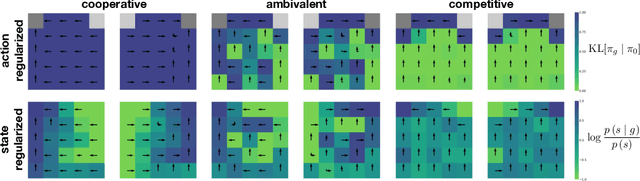
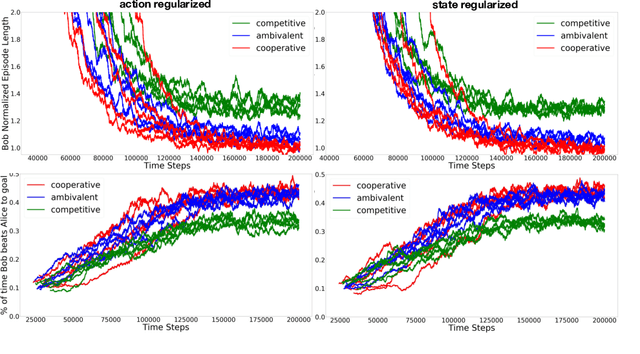
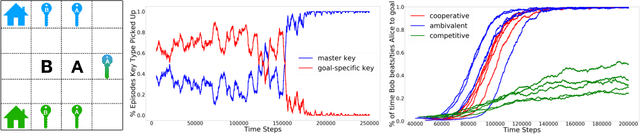
Learning to cooperate with friends and compete with foes is a key component of multi-agent reinforcement learning. Typically to do so, one requires access to either a model of or interaction with the other agent(s). Here we show how to learn effective strategies for cooperation and competition in an asymmetric information game with no such model or interaction. Our approach is to encourage an agent to reveal or hide their intentions using an information-theoretic regularizer. We consider both the mutual information between goal and action given state, as well as the mutual information between goal and state. We show how to stochastically optimize these regularizers in a way that is easy to integrate with policy gradient reinforcement learning. Finally, we demonstrate that cooperative (competitive) policies learned with our approach lead to more (less) reward for a second agent in two simple asymmetric information games.