 Add to Chrome
 Add to Firefox
 Add to Edge
BioAlchemy: Distilling Biological Literature into Reasoning-Ready Reinforcement Learning Training Data
Apr 03, 2026
Despite the large corpus of biology training text, the impact of reasoning models on biological research generally lags behind math and coding. In this work, we show that biology questions from current large-scale reasoning datasets do not align well with modern research topic distributions in biology, and that this topic imbalance may negatively affect performance. In addition, we find that methods for extracting challenging and verifiable research problems from biology research text are a critical yet underdeveloped ingredient in applying reinforcement learning for better performance on biology research tasks. We introduce BioAlchemy, a pipeline for sourcing a diverse set of verifiable question-and-answer pairs from a scientific corpus of biology research text. We curate BioAlchemy-345K, a training dataset containing over 345K scientific reasoning problems in biology. Then, we demonstrate how aligning our dataset to the topic distribution of modern scientific biology can be used with reinforcement learning to improve reasoning performance. Finally, we present BioAlchemist-8B, which improves over its base reasoning model by 9.12% on biology benchmarks. These results demonstrate the efficacy of our approach for developing stronger scientific reasoning capabilities in biology. The BioAlchemist-8B model is available at: https://huggingface.co/BioAlchemy.

Scalable Agentic Reasoning for Designing Biologics Targeting Intrinsically Disordered Proteins
Dec 17, 2025Intrinsically disordered proteins (IDPs) represent crucial therapeutic targets due to their significant role in disease -- approximately 80\% of cancer-related proteins contain long disordered regions -- but their lack of stable secondary/tertiary structures makes them "undruggable". While recent computational advances, such as diffusion models, can design high-affinity IDP binders, translating these to practical drug discovery requires autonomous systems capable of reasoning across complex conformational ensembles and orchestrating diverse computational tools at scale.To address this challenge, we designed and implemented StructBioReasoner, a scalable multi-agent system for designing biologics that can be used to target IDPs. StructBioReasoner employs a novel tournament-based reasoning framework where specialized agents compete to generate and refine therapeutic hypotheses, naturally distributing computational load for efficient exploration of the vast design space. Agents integrate domain knowledge with access to literature synthesis, AI-structure prediction, molecular simulations, and stability analysis, coordinating their execution on HPC infrastructure via an extensible federated agentic middleware, Academy. We benchmark StructBioReasoner across Der f 21 and NMNAT-2 and demonstrate that over 50\% of 787 designed and validated candidates for Der f 21 outperformed the human-designed reference binders from literature, in terms of improved binding free energy. For the more challenging NMNAT-2 protein, we identified three binding modes from 97,066 binders, including the well-studied NMNAT2:p53 interface. Thus, StructBioReasoner lays the groundwork for agentic reasoning systems for IDP therapeutic discovery on Exascale platforms.
Who Gets the Reward, Who Gets the Blame? Evaluation-Aligned Training Signals for Multi-LLM Agents
Nov 17, 2025Large Language Models (LLMs) in multi-agent systems (MAS) have shown promise for complex tasks, yet current training methods lack principled ways to connect system-level evaluation with agent-level and message-level learning. We propose a theoretical framework that unifies cooperative game-theoretic attribution with process reward modeling to transform system evaluation into agent credit and then into response-level signals. Unlike prior approaches that rely only on attribution (e.g., Shapley) or step-level labels (e.g., PRM), our method produces local, signed, and credit-conserving signals. In success cases, Shapley-based credit assignment fairly allocates outcomes across agents and is refined into per-message rewards that promote cooperation while discouraging redundancy or sabotage. In failure cases, first-error localization yields repair-aware preferences that penalize harmful steps while rewarding corrective attempts. The resulting signals are bounded, cooperative, and directly compatible with reinforcement-based or preference-based post-training, providing a unified and auditable pathway from global evaluation to local supervision in LLM multi-agent training. Our contribution is conceptual: we present a theoretical foundation and training signals, leaving empirical validation for future work.
Rapid detection of rare events from in situ X-ray diffraction data using machine learning
Dec 07, 2023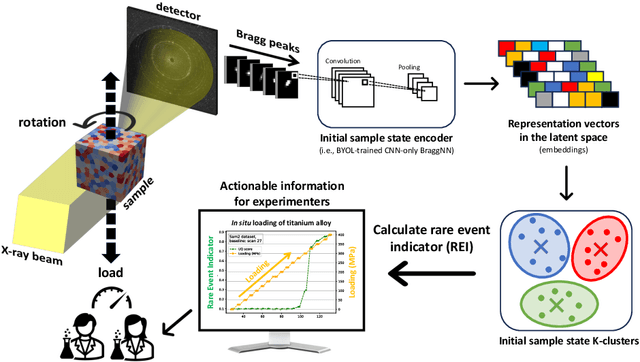
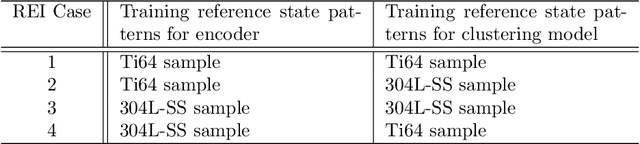
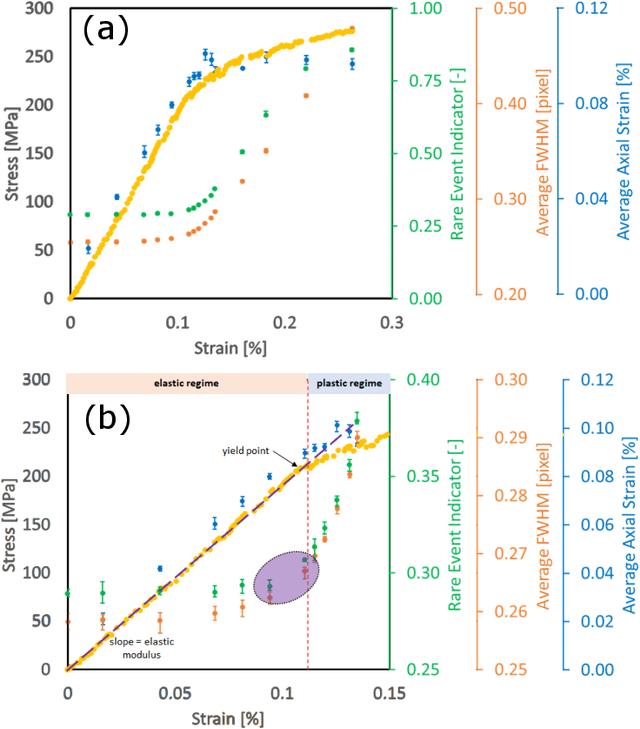
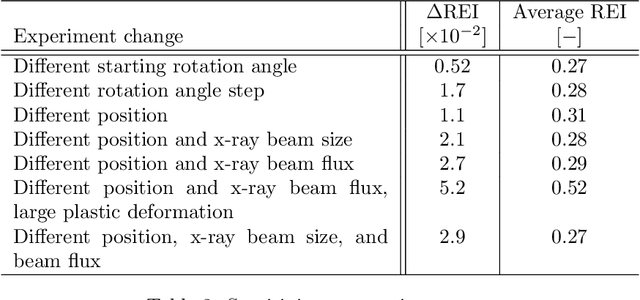
High-energy X-ray diffraction methods can non-destructively map the 3D microstructure and associated attributes of metallic polycrystalline engineering materials in their bulk form. These methods are often combined with external stimuli such as thermo-mechanical loading to take snapshots over time of the evolving microstructure and attributes. However, the extreme data volumes and the high costs of traditional data acquisition and reduction approaches pose a barrier to quickly extracting actionable insights and improving the temporal resolution of these snapshots. Here we present a fully automated technique capable of rapidly detecting the onset of plasticity in high-energy X-ray microscopy data. Our technique is computationally faster by at least 50 times than the traditional approaches and works for data sets that are up to 9 times sparser than a full data set. This new technique leverages self-supervised image representation learning and clustering to transform massive data into compact, semantic-rich representations of visually salient characteristics (e.g., peak shapes). These characteristics can be a rapid indicator of anomalous events such as changes in diffraction peak shapes. We anticipate that this technique will provide just-in-time actionable information to drive smarter experiments that effectively deploy multi-modal X-ray diffraction methods that span many decades of length scales.
Deep learning at the edge enables real-time streaming ptychographic imaging
Sep 20, 2022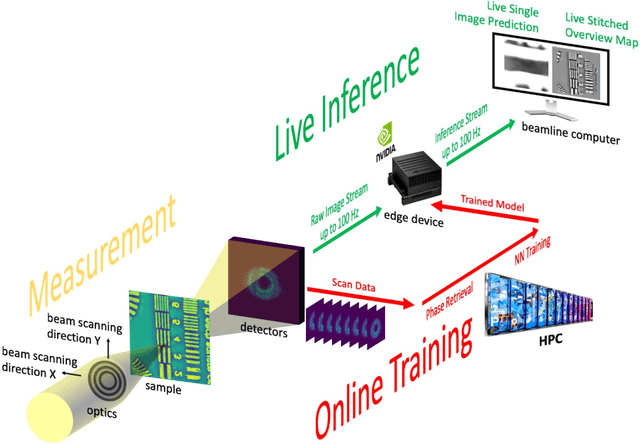
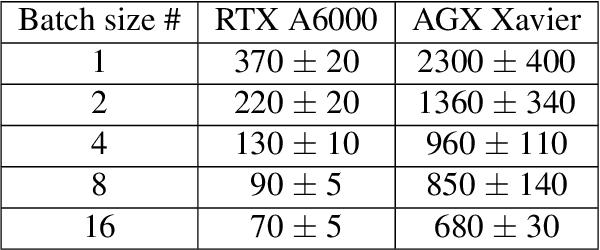
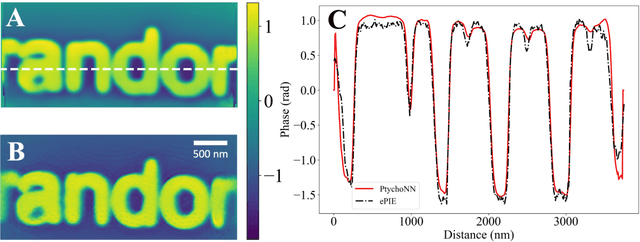
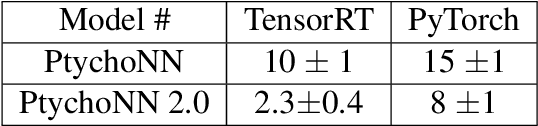
Coherent microscopy techniques provide an unparalleled multi-scale view of materials across scientific and technological fields, from structural materials to quantum devices, from integrated circuits to biological cells. Driven by the construction of brighter sources and high-rate detectors, coherent X-ray microscopy methods like ptychography are poised to revolutionize nanoscale materials characterization. However, associated significant increases in data and compute needs mean that conventional approaches no longer suffice for recovering sample images in real-time from high-speed coherent imaging experiments. Here, we demonstrate a workflow that leverages artificial intelligence at the edge and high-performance computing to enable real-time inversion on X-ray ptychography data streamed directly from a detector at up to 2 kHz. The proposed AI-enabled workflow eliminates the sampling constraints imposed by traditional ptychography, allowing low dose imaging using orders of magnitude less data than required by traditional methods.
Convolutional Neural Network Training with Distributed K-FAC
Jul 01, 2020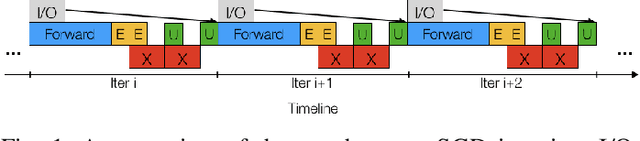
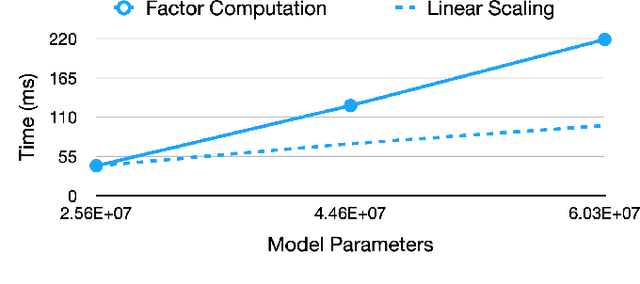
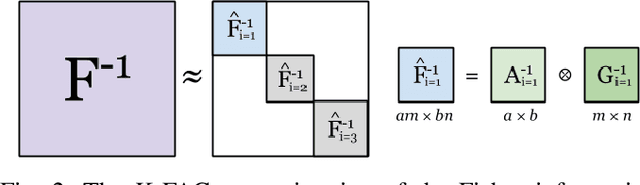
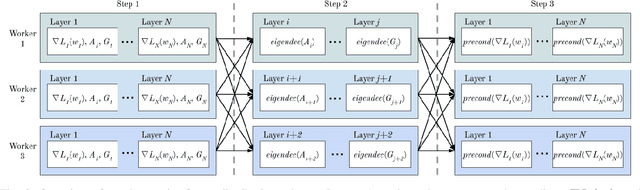
Training neural networks with many processors can reduce time-to-solution; however, it is challenging to maintain convergence and efficiency at large scales. The Kronecker-factored Approximate Curvature (K-FAC) was recently proposed as an approximation of the Fisher Information Matrix that can be used in natural gradient optimizers. We investigate here a scalable K-FAC design and its applicability in convolutional neural network (CNN) training at scale. We study optimization techniques such as layer-wise distribution strategies, inverse-free second-order gradient evaluation, and dynamic K-FAC update decoupling to reduce training time while preserving convergence. We use residual neural networks (ResNet) applied to the CIFAR-10 and ImageNet-1k datasets to evaluate the correctness and scalability of our K-FAC gradient preconditioner. With ResNet-50 on the ImageNet-1k dataset, our distributed K-FAC implementation converges to the 75.9% MLPerf baseline in 18-25% less time than does the classic stochastic gradient descent (SGD) optimizer across scales on a GPU cluster.